

Introduction
Your workforce is your most valuable asset, but is it being managed with precision?
If your answer is uncertain, you are not alone. While enterprises rigorously track revenue and profit margins with discipline, many lack the same visibility around how their workforce is managed. Without a consolidated view of how available talent is planned, allocated, or utilized, workforce decisions become reactive, and operational issues are identified too late.
This is where workforce management becomes essential. It provides a structured approach to align workforce planning, allocation, and monitoring with business demand. With clear insights into who is working on what, at what capacity, and against which priorities, managers can rebalance workloads, address skill gaps early, and prevent delivery disruptions before they escalate.
In this blog, we will explore workforce management and how it helps organizations operate with greater control, predictability, and discipline.
What is Workforce Management (WFM)?
Workforce management is the process of planning, scheduling, monitoring, and optimizing human resources to ensure the right talent is available at the right time to meet business and operational needs. It helps organizations align workforce capacity, skills, and availability with project demands, operational workloads, and strategic priorities.
An effective workforce management framework provides real-time visibility into resource utilization, capacity, and performance. This enables managers to make data-driven scheduling and staffing decisions, proactively address capacity and skill gaps, and prevent under-/overallocation. As a result, organizations can control labor costs and maintain consistent delivery outcomes.
Read our detailed guide on resource management and optimization.
Now that you understand what workforce management is, let us explore its benefits.
Why Workforce Management Matters at the Enterprise Level?
At the enterprise scale, workforce management directly influences operational stability, cost control, and delivery performance. The following are the benefits of effective workforce management:
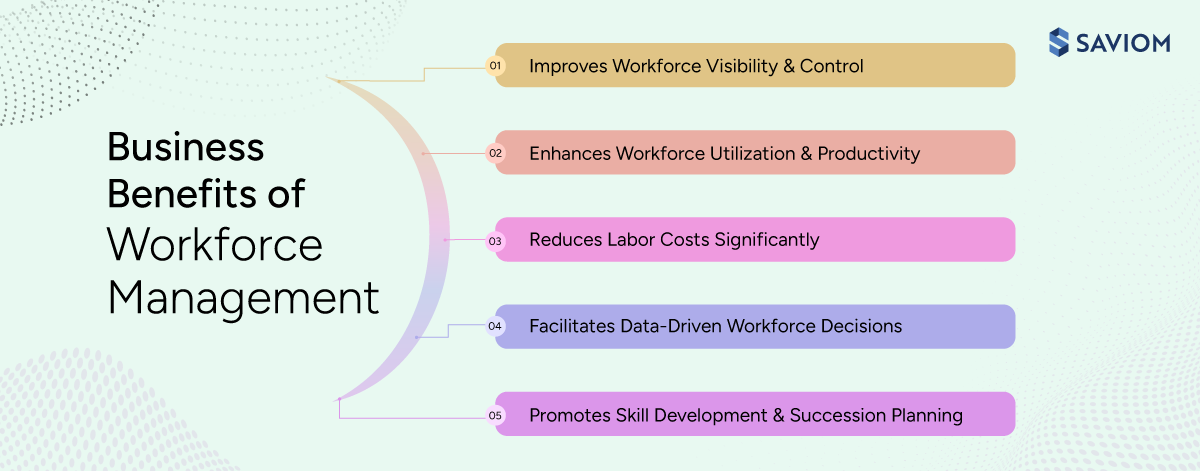
Improves Workforce Visibility & Control
Enterprise workforce management provides 360-degree visibility into resource allocation, workload distribution, and execution status across teams. This transparency enables faster identification of capacity constraints, skill gaps, and allocation conflicts before they impact delivery. As a result, managers gain stronger operational control and make workforce decisions with greater clarity and confidence.
Enhances Workforce Utilization & Productivity
According to a 2023 McKinsey survey, “More than 50% employees reported being relatively unproductive at work.”
A robust workforce management aligns employees’ skills, experience, and availability with the right tasks, preventing both overallocation and bench time. This helps organizations sustain consistent productivity levels without overburdening critical resources. Over time, this disciplined utilization approach enables enterprises to achieve more output from existing talent without increasing headcounts.
Explore what resource utilization is and how it helps maximize workforce productivity.
Reduces Labor Costs Significantly
Strategic workforce management replaces reactive staffing with disciplined allocation and workload planning. This prevents uneven work distribution, minimizes unnecessary overtime, avoids idle capacity, and reduces reliance on last-minute firefighting. As a result, organizations control labor cost leakages and protect margins while maintaining execution continuity.
Facilitates Data-Driven Workforce Decisions
Workforce management embeds measurable insights into everyday staffing and operational decisions. Instead of relying on subjective judgment, managers track metrics such as billable utilization, forecast accuracy, availability rate, etc. This enables more accurate resource forecasting, timely workforce adjustments, and informed trade-off decisions when priorities shift.
Promotes Skill Development & Succession Planning
With visibility into resource skills and future demand, workforce management helps organizations identify capability gaps early. This supports targeted upskilling and reskilling initiatives while enabling structured succession planning. As a result, firms can ensure readiness for critical roles and reduce dependency on a limited set of individuals.
Learn how structured skill development prepares your workforce for future business demands.
With a clear understanding of the benefits of workforce management, let us now learn about its core components.
Core Components of Workforce Management
Workforce management follows a structured set of stages that govern how demand is forecasted, capacity is evaluated, resources are allocated, and performance is monitored. Here are the core components of workforce management:
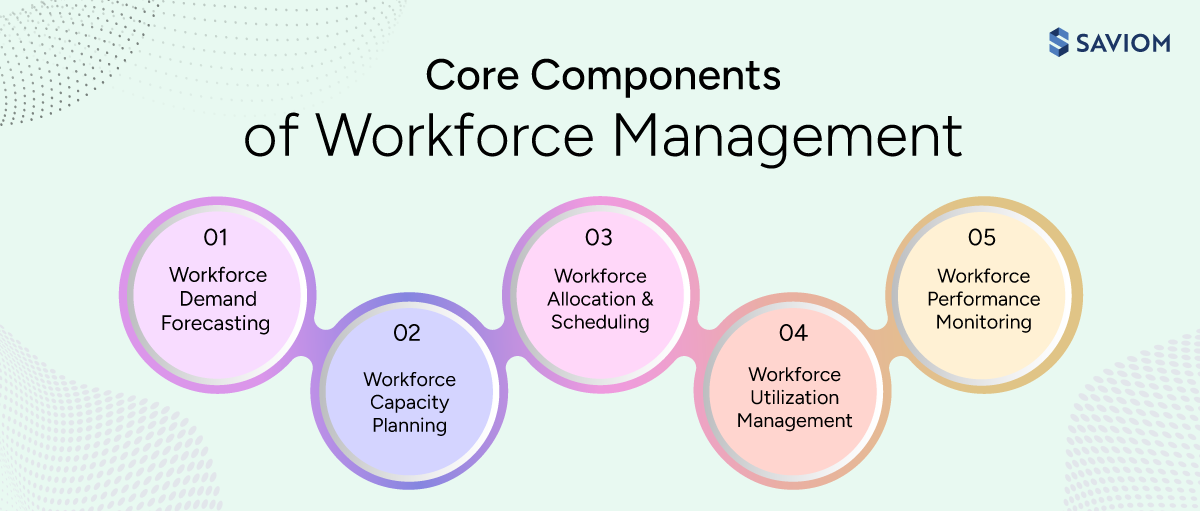
Workforce Demand Forecasting
Workforce demand forecasting involves estimating future workload requirements based on business objectives, service-level commitments, project pipelines, etc. Accurate forecasting establishes a reliable baseline for workforce planning, reduces last-minute resourcing decisions, and limits reactive adjustments during project execution.
Workforce Capacity Planning
Workforce capacity planning involves evaluating an organization’s available human capacity and capabilities against forecasted demand. It includes considering factors such as working hours, leaves, and existing assignments to provide an accurate supply-demand view. This helps identify capacity shortages or surpluses early, enabling proactive corrective actions.
Read our detailed guide on resource capacity planning and learn how it improves project outcomes.
Workforce Allocation & Scheduling
Workforce allocation and scheduling involve assigning employees to projects and operational tasks based on confirmed demand, available capacity, and required competencies. This structured approach ensures that the right skills are deployed where they are needed most while maintaining balanced workloads across teams.
Workforce Utilization Management
Workforce utilization management focuses on continuously monitoring how effectively employees’ time is being used across projects and operational activities. It helps identify and address workload imbalances such as overutilization, which can lead to burnout and quality issues, or underutilization, which results in idle time and productivity loss.
Learn what billable utilization is and how it helps maximize business revenue.
Workforce Performance Monitoring
Workforce performance monitoring involves continuous tracking of employee productivity, schedule adherence, planned vs. actual time, and utilization during active operations. This visibility enables managers to detect performance gaps early and take timely corrective action to maintain execution stability.
To learn how effective resource management improves workforce planning and utilization, read our comprehensive eBook.
Moving on, let us now understand how workforce management differs from other closely related concepts.
Workforce Management vs. Workforce Planning vs. Human Capital Management
While workforce management, workforce planning, and human capital management (HCM) are closely related, they address different layers of decision-making. The following table clarifies how they differ in scope, focus, and operational responsibility:
| Parameter | Workforce Management | Workforce Planning | Human Capital Management (HCM) |
|---|---|---|---|
| Primary Objective | Optimize workforce performance and execution | Ensure the right workforce capacity and skills are available for future needs | Manage the employee lifecycle and HR processes |
| Time Horizon | Short to mid-term (ongoing operations) | Medium- to long-term (future readiness) | Continuous across employee lifecycle stages |
| Key Processes Involved | Forecasting, allocation, scheduling, performance monitoring, optimization | Demand forecasting, headcount planning, skills gap analysis, scenario planning | Recruitment, onboarding, payroll, benefits, appraisals, learning & development |
| Ownership | Operations, PMO, resource management, leadership | Strategic planning, HR, and finance leadership | HR department |
| Decision-Making Level | Tactical and operational | Strategic and predictive | Administrative and strategic HR decisions |
| Performance Metrics Used | Utilization rate, productivity, schedule adherence, cost efficiency | Capacity coverage, staffing gaps, and forecast accuracy | Attrition rate, engagement score, compensation ratios |
| Technology Enablement | Workforce management software and operational dashboards | Workforce planning tools and analytics models | HCM systems and HR software suites |
| Business Impact | Improves productivity, cost control, and delivery predictability | Prevents future skill shortages and capacity risks | Enhances workforce stability, compliance, and talent retention |
Learn in detail about workforce planning and the benefits it offers.
Next, let us understand who owns and executes workforce management within an enterprise.
Who is Responsible for Workforce Management in Enterprises?
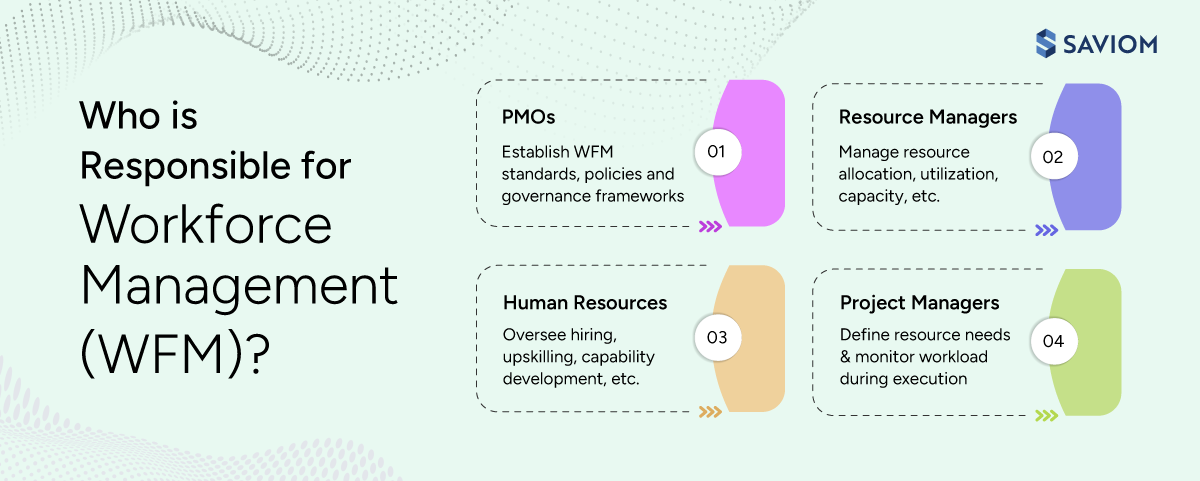
Workforce management is not owned by a single function but executed through coordinated roles across the enterprise. Let us understand how each role contributes to effective workforce management:
Project Management Offices (PMOs)
Project Management Offices establish enterprise-wide workforce management standards, policies, and governance frameworks. They align workforce allocation with portfolio priorities and strategic initiatives while monitoring resource utilization and capacity across projects. This ensures consistent workforce decision-making, clear visibility into workload, and disciplined project execution.
Read this blog to learn about PMO resource management.
Resource Managers
Resource managers maintain continuous visibility into workforce skills, availability, and utilization across teams. They allocate resources based on skill fit, priority, and workload balance, while identifying capacity gaps and redeployment opportunities. This helps mitigate capacity risks early and ensures the right resources are assigned to the right work.
Human Resources
Human resources support workforce management by managing hiring, onboarding, and capability building. HR also maintains accurate workforce data on roles, competencies, and career paths, and works with operational teams to plan targeted upskilling and reskilling initiatives. This strengthens workforce readiness, minimizes skill gaps, and supports sustainable workforce growth.
Project Managers
Project managers define project-specific resource requirements based on scope, timelines, and budget. They collaborate with resource managers to secure the required skills and oversee team workload during execution. This helps maintain delivery timelines, reduce execution risk, and ensure project outcomes remain aligned with commitments.
Check out our blog on project resource management.
With clear ownership and accountability established, the next step is defining how organizations can build a scalable workforce management strategy.
How to Build a Scalable Workforce Management Strategy?
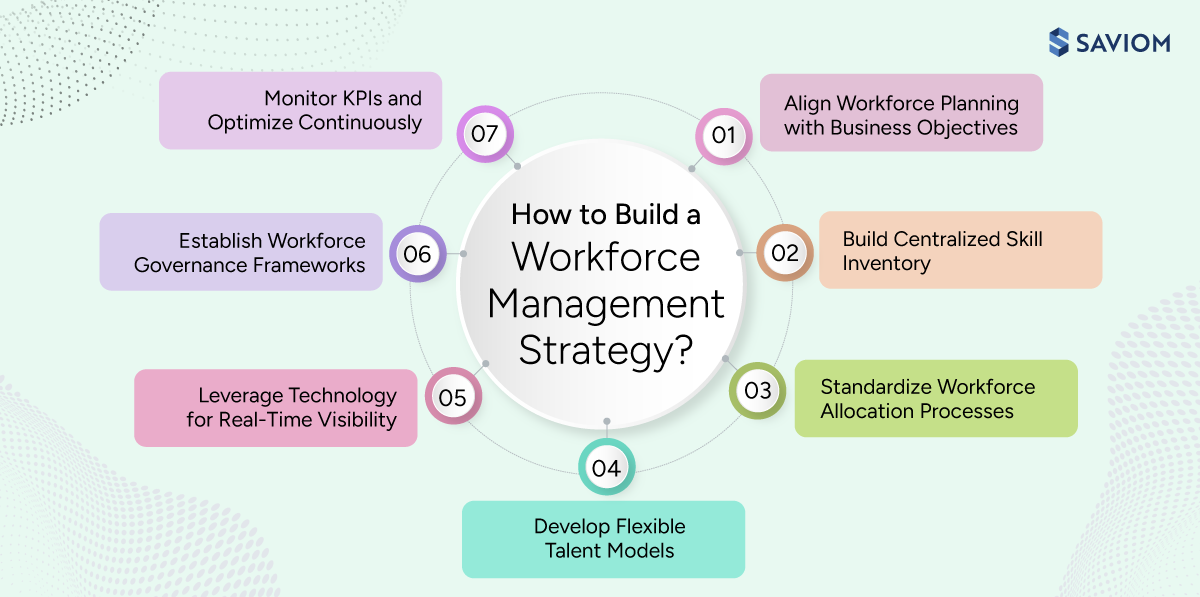
A scalable workforce management strategy provides a structured approach to align workforce decisions with business growth and changing demand. The following framework outlines how to build it:
Align Workforce Planning with Business Objectives
Start by aligning workforce planning decisions with organizational strategy and the upcoming project pipeline. This ensures workforce capacity and skills are planned to support business priorities. To maintain this alignment, upskilling, hiring, and workforce allocation decisions should be guided by long-term business goals. As a result, organizations improve execution stability and planning accuracy.
Build Centralized Skill Inventory
Create a centralized repository of workforce skills, certifications, and experience across teams and locations. A skill inventory provides decision-makers with clear visibility into available capabilities and makes capability data accessible for workforce planning and allocation. With this foundation in place, organizations can enable skill-based allocation, identify gaps early, and deploy the right expertise where it is needed.
Read in detail about the skill matrix and its importance.
Standardize Workforce Allocation Processes
Establish standardized workforce allocation processes across teams and projects to ensure consistent resource assignment. Additionally, allocation decisions should consider workforce skills, availability, priorities, and workload. In addition, managers can set clear utilization thresholds, such as an 85% maximum utilization level, to prevent employee burnout and sustainable delivery performance.
Develop Flexible Talent Models
Develop flexible talent models by combining full-time, part-time employees, and contingent workers to manage demand fluctuations. Use contractors or freelancers for short-term or specialized requirements and rely on permanent hiring for long-term needs. This approach allows organizations to respond to demand changes while avoiding costly hiring and firing cycles.
Leverage Technology for Real-Time Visibility
Use workforce management software to track capacity, utilization, and workload across projects and departments in real-time. This visibility enables managers to make timely, data-driven workforce planning and allocation decisions. As a result, resourcing decisions become faster, more consistent, and less dependent on manual tracking or fragmented inputs.
Establish Workforce Governance Frameworks
Define clear workforce governance frameworks that specify roles, responsibilities, and decision ownership across the organization. In addition, standardize hiring approvals, timesheet policies, performance tracking metrics, and succession planning practices to bring structure to workforce decisions. Strong governance ensures growth does not weaken operational discipline or execution control.
Monitor KPIs and Optimize Continuously
Track workforce KPIs such as utilization, capacity variance, productivity, and cost performance on an ongoing basis. Use these insights to refine resource planning and allocation decisions as business conditions change. Continuous monitoring and optimization help maintain workforce efficiency, improve decision quality, and strengthen long-term resilience.
Read our blog on workforce efficiency and explore actionable strategies to improve it.
Once a scalable workforce management strategy is in place, the next step is measuring how effectively it is working. This requires tracking the right workforce KPIs and metrics.
Key Workforce Management KPIs and Metrics
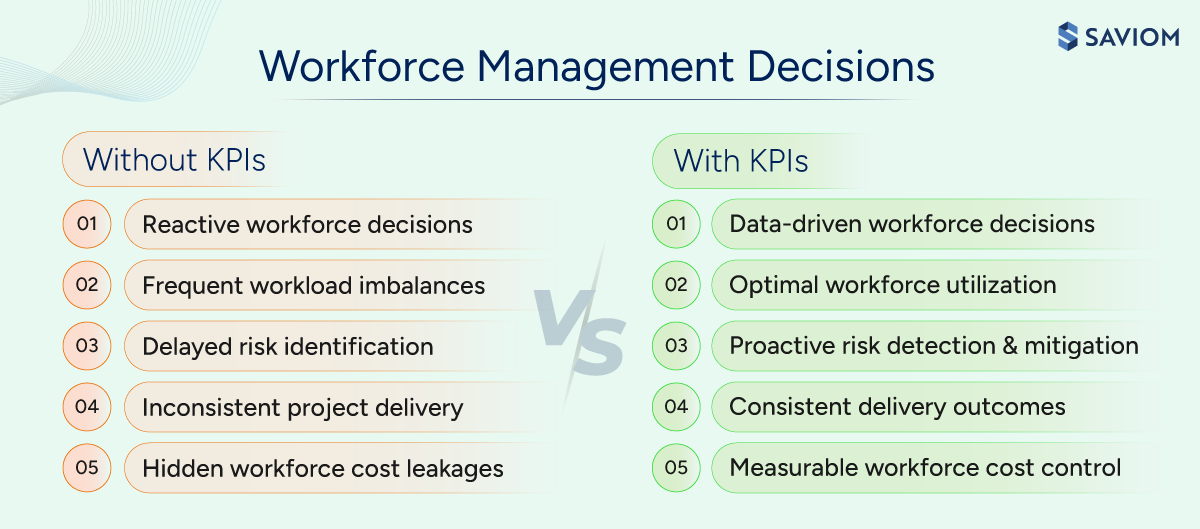
Tracking the right metrics helps firms measure the effectiveness of their workforce management strategy and identify areas for improvement. Here are the important workforce management KPIs that organizations must track:
Workforce Utilization Rate
Workforce utilization rate measures the percentage of available workforce capacity that is actively deployed on productive work within a defined period. Tracking this metric helps balance workloads, prevent resource overutilization or bench time, and maintain sustainable workforce productivity levels.
The formula to calculate the workforce utilization rate is:
X 100
Workforce Forecast Accuracy
Workforce forecast accuracy measures how closely projected workforce demand aligns with actual labor requirements over a specific timeframe. Monitoring this KPI improves workforce planning discipline, reduces reactive staffing decisions, and improves operational stability.
The formula to calculate workforce forecast accuracy is:
Workforce Availability Rate
Workforce availability rate measures the proportion of total workforce capacity that is available for productive assignment after accounting for leave and existing commitments. Tracking this metric helps improve resource scheduling decisions and reduces the risk of unexpected capacity shortages.
The formula to calculate the workforce availability rate is:
Explore our blog on resource availability and how organizations can track it.
Employee Productivity Rate
Employee productivity rate measures the output generated by employees relative to the time and effort invested during a defined period. Monitoring this metric helps assess performance consistency, identify productivity gaps, and improve overall workforce efficiency.
The formula to calculate employee productivity rate is:
Total Number of Employees Working
Workforce Allocation Effectiveness
Workforce allocation effectiveness measures how accurately workforce capacity is assigned to the right roles or tasks based on skill requirements and workload priorities. Strong allocation effectiveness improves execution reliability, reduces misalignment across projects, and enhances workforce performance outcomes.
The formula to calculate workforce allocation effectiveness is:
Allocated Hours) X 100
Revenue per Employee
Revenue per employee measures the amount of revenue generated per human resource within a given period, clearly defining the individual contribution to the firm’s financial performance. Tracking this metric helps organizations assess utilization efficiency and determine whether labor costs are aligned with revenue outcomes.
The formula to calculate revenue per employee is:
Skill Gap Index
Skill gap index measures the difference between the skills required to meet operational demand and the skills currently available within the workforce. Tracking this metric helps organizations plan skill development activities proactively, reduce execution risk, and strengthen workforce capability over time.
The formula to calculate the skill gap index is:
Number of Skills Required] X 100
Discover 15 critical resource management metrics in this blog.
In the next section, we shall explore the common workforce management challenges and ways to solve them effectively.
Workforce Management Challenges and How to Overcome Them
Despite structured workforce planning efforts, many organizations face recurring challenges that disrupt project execution. The table below outlines common roadblocks, their organizational impact, and practical corrective measures.
| Challenge | Impact on the Organization | Recommended Solution |
|---|---|---|
| Misalignment Between Workforce Strategy and Business Goals | Workforce capacity and skills are planned independently of strategic priorities, causing shortages in critical initiatives and surplus capacity in low-value areas | Integrate workforce planning with business strategy and project pipeline to ensure capacity aligns with strategic demand |
| Workforce Cost Escalation Without Productivity Gains | Labor costs increase due to inefficient allocation, overtime, and excess capacity, while overall output remains stagnant | Track labor costs alongside utilization metrics to identify inefficiencies and optimize allocation decisions |
| Pertinent Skill Gaps and Shortages | Critical skills are unavailable when needed, causing project delays and overdependence on key individuals | Maintain a centralized skills inventory, track competencies, and initiate learning & development activities |
| Inability to Address Immediate and Seasonal Demands | Sudden workload surges create short-term capacity gaps, missed deadlines, and rushed staffing decisions | Adopt flexible workforce models, cross-train employees, and build capacity buffers to manage demand fluctuations |
| Imbalanced Workforce Utilization and Productivity Loss | Some employees are consistently overloaded, while others remain underutilized, reducing overall productivity | Continuously monitor utilization levels and rebalance workloads based on utilization thresholds |
| Surge in Employee Burnout, Unplanned Absenteeism, and Attrition | Sustained overutilization leads to fatigue, unplanned leaves, disengagement, and higher turnover rates | Plan capacity proactively and enforce utilization limits to maintain sustainable workloads |
Check out our blog on resource management challenges and how to overcome them.
Having understood the workforce management challenges and their solutions, let us now learn how it addresses industry-specific demands.
Role of Workforce Management Across Industries
The following examples illustrate how different industries apply workforce management to improve planning, execution, and delivery reliability.
AEC Industry
AEC firms operate in dynamic, project-based environments across multiple sites, where workforce demand shifts throughout the project lifecycle. Resource requirements remain relatively low during initiation, planning, and closure phases but rise sharply during execution. Without structured planning, these fluctuations often result in reactive hiring and layoffs, increased bench size, and escalating project costs.
Workforce management introduces control by providing clear visibility into skill availability, site assignments, and workload distribution. This enables proactive ramp-up and ramp-down planning, efficient redeployment between phases, and stronger workforce alignment during execution peaks. Ultimately, it reduces reactive hiring/firing and improves coordination across concurrent projects.
Audit, Accounting, and Legal Firms
Audit, accounting, and legal firms operate under strict deadlines and regulatory pressures. Their workload follows predictable seasonal spikes such as tax filing periods and financial year-end audits, followed by relative troughs with lower demand. Poor staffing coordination during peaks leads to excessive overtime and delays, while slower periods create resource underutilization.
Workforce management enables structured forecasting and workload balancing across client portfolios. By anticipating peaks and troughs, firms can plan workforce capacity proactively, redistribute work efficiently, reduce overtime during busy seasons, and minimize bench time during slower periods. Ultimately, this helps AEC firms maintain service quality and workforce stability year-round.
Read our blog on capacity planning challenges in audit and accounting firms.
Professional Services Industry
Professional services firms rely heavily on specialized expertise, with revenue directly tied to billable utilization. Multiple client projects often compete for the same niche skills. Moreover, since pricing depends on expertise and value delivered, poor allocation can reduce margins and affect client satisfaction. Without precise workforce planning, firms risk overutilizing key experts or under deploying critical talent.
Workforce management enhances allocation precision by aligning specialized skills with project requirements and providing clear visibility into billable vs. non-billable effort. This structured oversight helps firms maximize billable utilization, safeguard margins, and ensure high-value talent is consistently deployed to initiatives that generate the strongest returns.
IT Industry
IT organizations operate in rapidly evolving technology environments where continuous innovation and changing client demands frequently widen skill gaps. Accelerated release cycles often trigger last-minute staffing decisions, while poor visibility into workload and bench strength leads to uneven utilization. In addition, limited growth opportunities contribute to unplanned attrition, disrupting project execution.
Workforce management brings structure to IT workforce deployment by providing real-time visibility into skills, capacity, and bench strength. It enables proactive skill-gap identification, optimized talent utilization, and planned ramp-ups aligned with release cycles. Moreover, internal mobility and mentorship initiatives minimize crisis staffing, reduce attrition, and ensure stable, high-quality project delivery.
Explore our blog on IT project risks and ways to mitigate them.
Moving on, let us explore the trends that are transforming the future of workforce management.
Modern Trends Shaping the Future of Workforce Management
Workforce management is evolving in response to changing business models, workforce expectations, and advances in technology. Here are the trends organizations are adapting to remain effective and scalable:
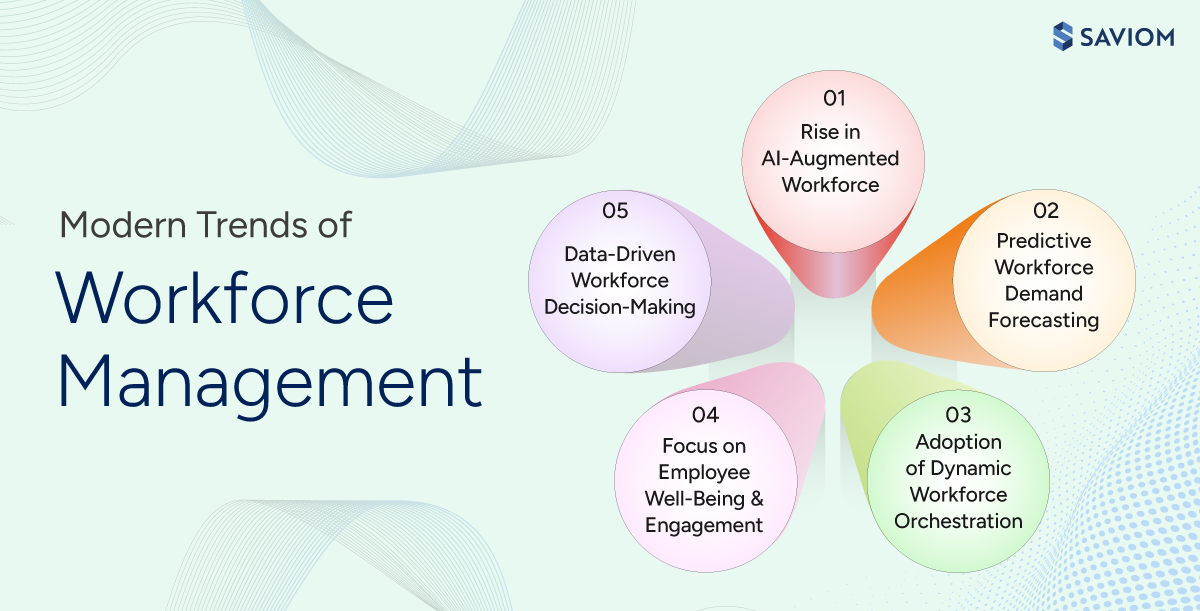
Rise in AI-Augmented Workforce
According to a McKinsey report, “Up to 30% of current work hours can be automated with AI by 2030.”
An AI-augmented workforce refers to a work environment where AI tools and humans operate together. AI handles routine and data-intensive tasks while humans focus on complex thinking, judgment, and creativity. It helps firms:
- Improve workforce planning and forecasting accuracy
- Reduce manual effort in workforce planning and scheduling, tracking, and reporting
- Take faster and more consistent workforce decisions
- Focus on higher-value, judgment-based work
Predictive & Prescriptive Workforce Demand Forecasting
The predictive method uses historical data and trends to estimate future requirements. The prescriptive approach builds on these predictions through scenario planning to recommend actions to address upcoming demand. It helps organizations:
- Identify future workforce and skill requirements early
- Evaluate and select the best action plans, such as reallocation, reskilling, or hiring
- Take informed actions before capacity gaps occur
- Reduce reactive and last-minute workforce decisions
Check out our blog on demand management and its benefits.
Adoption of Dynamic Workforce Orchestration
Dynamic workforce orchestration refers to continuously adjusting workforce allocations as priorities, workloads, and timelines change, instead of relying on fixed planning cycles. It enables businesses to:
- Respond quickly to changing business needs
- Identify bench time and emerging backlogs early
- Shift resources instantly to address workload changes
- Maintain productivity and delivery continuity
Focus on Employee Well-being, Engagement, and DEI
Businesses are increasingly focusing on balanced utilization and inclusive workforce practices to improve employee engagement and retention. It’s not only about maximizing efficiency anymore but also about creating fair work environments. It helps firms to:
- Maintain balanced workloads and reduce employee burnout
- Improve engagement through fair and transparent work distribution
- Promote inclusion by ensuring equitable access to opportunities
- Strengthen retention through flexible and inclusive work models
Discover employee retention KPIs that every business should track.
Data-Driven Workforce Decision-Making
Workforce management decisions are moving beyond assumptions toward data-driven intelligence that guides planning, allocation, and utilization decisions. This shift enables continuous workforce optimization. With these insights, firms can:
- Gain clear visibility into workforce capacity, utilization, and workload
- Make more consistent and objective workforce decisions
- Strengthen governance through centralized workforce data
- Prevent workforce-related risks, project delays, and cost overruns
After exploring modern workforce management trends, it is important to assess how these practices translate into financial efficiency and cost control.
How Workforce Management Improves Cost Efficiency?
According to a Gartner survey, “56% of CFOs rank cost optimization as a top priority for 2026.”
Workforce costs represent a significant portion of enterprise operating expenses. By implementing structured workforce management best practices, organizations can:
Establish Workforce Cost Visibility Across the Organization
Organizations must consolidate workforce cost rates, billable vs. non-billable work, and role-based costs into a unified financial view. This helps firms gain enterprise-wide clarity into where workforce budgets are consumed and eliminate cost blind spots. As a result, they can strengthen financial oversight and take data-driven staffing decisions.
Check out our blog on resource cost reduction strategies.
Optimize Workforce Utilization to Reduce Operational Costs
Workforce management provides visibility into how resources are utilized across projects. This helps firms improve allocation precision, rebalance workloads, reduce bench time, avoid unnecessary hiring, and maximize billable utilization. Thus, by reducing over- or underutilization, firms lower project delivery costs and strengthen profit margins.
Track Workforce Management KPIs and Financial Metrics
Strategic workforce management enables managers to track KPIs, such as utilization rate, cost per employee, resource cost variance, and billable utilization, to assess financial efficiency. By linking these metrics to financial outcomes, firms can identify inefficiencies early and refine workforce decisions. Continuous measurement helps minimize cost overruns and improve long-term ROI.
Transform how you plan, allocate, and monitor your workforce with SAVIOM’s resource management software. Book a demo today.
Effective workforce management requires more than strategy and KPIs; it depends on having the right systems in place to execute consistently. The following section outlines how SAVIOM supports enterprise workforce management at scale.
How SAVIOM Supports Enterprise Workforce Management?
SAVIOM’s advanced resource management software translates workforce management strategy into measurable outcomes through the following capabilities:
- All-in-one resource planner centralizes workforce data to provide 360-degree visibility into allocations, utilization, capacity, availability, and leave for unified workforce oversight.
- The embedded capacity planner compares workforce capacity against demand to identify shortages and excesses, supporting proactive capacity planning and workforce stability.
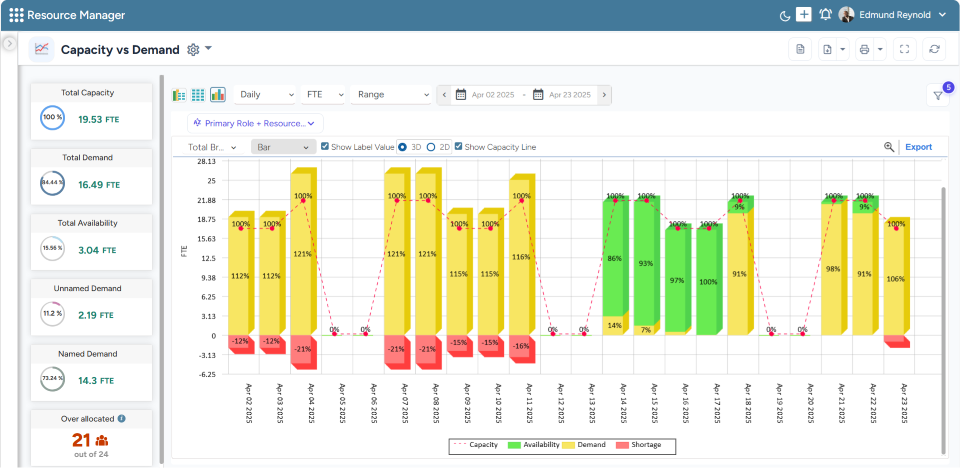 SAVIOM’s Capacity vs. Demand graph compares workforce capacity against forecasted demand to highlight shortages and excess capacity in real time.
- KPI forecaster tracks critical workforce metrics, such as availability, utilization, forecast variance, and bench strength, to support informed decision-making.
- Embedded heat mapping provides color-coded visibility into overutilized and underutilized resources, enabling faster workload rebalancing and corrective action.
Read our blog on resource heatmap and learn how to analyze it.
- The early warning system instantly flags scheduling conflicts like double bookings or overutilization, enabling managers to take corrective action before they impact delivery.
- The competency matrix consolidates workforce skills, experience, and certifications into a single view to enable skill-based allocation and identify competency gaps.
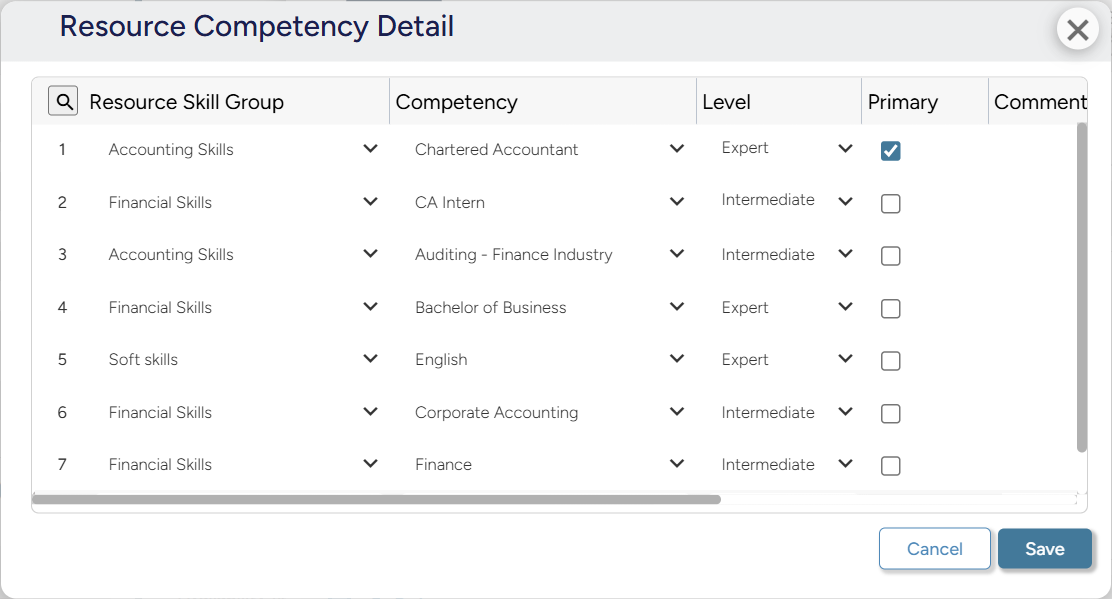 SAVIOM’s Competency Matrix enables managers to view and manage workforce skills and proficiency levels in a single, structured interface.
- Integrated timesheets capture workforce effort data and compare forecast vs. actual time to improve execution control and planning accuracy.
- Real-time BI reports deliver comprehensive dashboards covering capacity, availability, bench strength, and workforce performance metrics for enterprise-level oversight.
- What-if analysis simulates alternative workforce scenarios to assess potential impacts on cost, timelines, and capacity before arriving at the most feasible and cost-effective workforce plan.
Conclusion
Effective workforce management brings structure to how organizations plan, allocate, and monitor their human resources. With clear visibility into capacity, utilization, skills, and costs, managers can make informed decisions that improve execution consistency and financial performance. Organizations that adopt disciplined workforce management best practices are better positioned to reduce inefficiencies, respond to change, and sustain long-term operational stability.
Frequently Asked Questions (FAQs)
Workforce management is the structured process of forecasting, planning, allocating, and optimizing human resources to meet business demand efficiently. It ensures that the right skills are available at the right time based on workload requirements and operational priorities. By aligning workforce capacity with demand, organizations improve productivity, control labor costs, and maintain delivery consistency.
The core components of workforce management are:
1. Workforce demand forecasting
2. Workforce capacity planning
3. Workforce allocation and scheduling
4. Workforce utilization management
5. Workforce performance monitoring
Workforce planning focuses primarily on evaluating how many resources are required, what skills are needed, and when those resources will be needed based on business projections.
Workforce management is broader and extends beyond planning into execution. It includes allocation, scheduling, utilization monitoring, performance tracking, and cost control throughout the delivery lifecycle.
The industries that benefit most from workforce management are:
1. AEC Industry
2. Audit, Accounting, and Legal Firms
3. Professional Services Industry
4. IT Industry
1. Workforce utilization rate
2. Workforce forecast accuracy
3. Workforce availability rate
4. Employee productivity rate
5. Workforce allocation effectiveness
6. Revenue per employee
7. Skill gap index
Workforce management is typically anchored within operations because it governs workforce deployment, execution oversight, and performance control. HR plays a supporting role by providing talent data, managing skills information, and aligning hiring and development policies. Therefore, effective workforce management requires cross-functional collaboration with clear operational accountability.