

Introduction
“Expect the best, plan for the worst, and prepare to be surprised.” — Denis Waitley
That being said, this mindset is rarely reflected in how enterprises plan resources. Most capacity plans are based on assumptions of stable demand, consistent priorities, and readily available skills. When demand fluctuates, priorities shift, and critical skills become unavailable, organizations struggle with delivery delays, inflated costs, and last-minute firefighting.
Resource capacity requirement planning addresses this by introducing a structured, forward-looking approach to align current and future project demand with available resource capacity. By identifying potential resource risks, such as shortages, skill gaps, increased bench size, etc., early, organizations can validate delivery commitments, prepare contingency actions, and respond confidently to change.
This blog explores what resource capacity requirement planning is and how it supports better alignment between resources and business needs, reducing delivery risks, and improving planning confidence.
What is Resource Capacity Requirement Planning?
Resource capacity requirement planning is the process of evaluating whether an organization has sufficient resources, such as personnel, equipment, finances, etc., to meet current and future project demands.
It involves forecasting resource demand based on approved and pipeline work, assessing available capacity after accounting for leaves and non-project work, and identifying surpluses or shortages in advance. This enables organizations to make informed decisions around hiring, upskilling, resource reallocation, prioritization, or timeline adjustments before capacity constraints impact delivery.
Having understood the definition of resource capacity requirement planning, let us move on to its benefits.
Read our guide on resource capacity planning.
Why is Resource Capacity Requirement Planning Important?
Resource capacity requirement planning provides early visibility into demand shifts and capacity risks, enabling organizations to ensure resource availability, protect delivery timelines, and control costs. Here are some of its benefits:
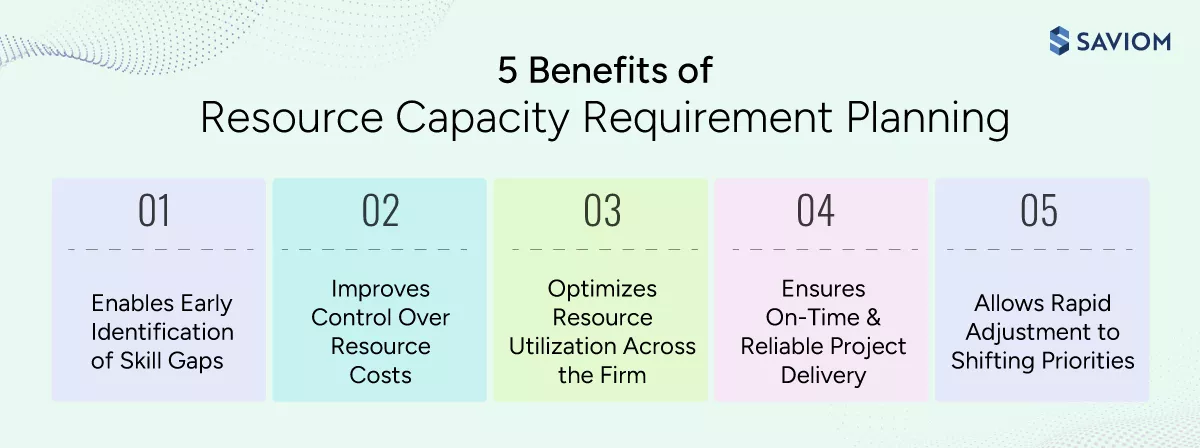
Enables Early Identification of Skill Gaps
By comparing forecasted demand with available capabilities, organizations can proactively identify future skill shortages and excesses. This early visibility allows managers to redeploy resources, plan reskilling, or onboard new hires. Thus, it helps reduce last-minute firefighting, minimize delivery risks, and prevent cost overruns.
Improves Control Over Resource-Related Costs
Resource capacity requirement planning helps organizations to minimize bench time and reduce reliance on reactive hiring or unplanned resourcing adjustments. As a result, they can maintain tighter control over resource-related costs across different project phases and protect project margins.
Read our blog to explore resource cost reduction strategies.
Optimizes Resource Utilization Across the Enterprise
As per a Gallup workplace survey, “Only 23% of employees are engaged at work, while a significant portion remain disengaged due to unbalanced workloads and lack of planning clarity.”
With early visibility into future capacity, managers can ensure that sufficient resources are planned against project requirements and proactively correct imbalances. Consequently, this reduces the risk of over- and underutilization, improves employee productivity, and fosters a more engaged workforce.
Ensures On-Time and Reliable Project Delivery
Resource capacity requirement planning enables managers to ensure that the right skills and capacity are available at the right time. This prevents unrealistic schedule commitments and execution bottlenecks. As a result, teams deliver work within planned timelines, strengthening delivery reliability and stakeholder trust.
Discover how resource capacity forecasting helps organizations plan a future-ready workforce.
Allows Rapid Adjustment to Shifting Business Priorities
Effective resource capacity requirement planning enables firms to respond quickly to changing priorities. When new initiatives emerge or existing plans shift, managers can reassess capacity, reallocate resources, and reprioritize work without disrupting ongoing delivery. This agility further helps in maintaining operational stability.
After exploring the benefits, it is essential to learn the types of capacity requirement planning for modern businesses.
Types of Resource Capacity Requirement Planning
Organizations apply different types of capacity requirement planning based on the resources they manage and the time horizon over which decisions must be made. Let us explore these types in detail.
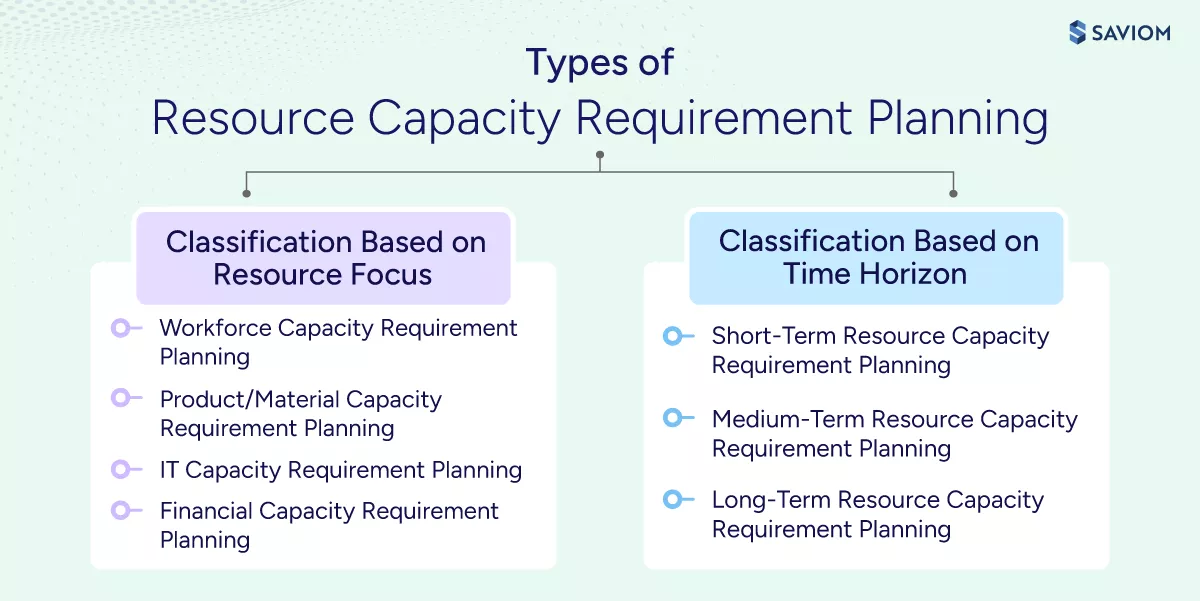
Classification Based on Resource Focus
Here are the types of capacity requirement planning based on the resources organizations need to manage:
Workforce Capacity Requirement Planning
Workforce capacity requirement planning is the process of evaluating whether the existing talent pool can meet short- and long-term project requirements. By assessing capacity based on skills, experience, availability, and utilization, and comparing it with upcoming demand, managers can ensure timely and cost-effective project delivery.
Read our blog to learn more about workforce planning.
Product/Material Capacity Requirement Planning
Product/material capacity requirement planning assesses the production capacity a business needs to meet changing product demand. It involves forecasting production volume and balancing available resources (such as labor, machinery, and raw materials) with customer demand. This ensures that products are manufactured efficiently without over- or under-production.
IT Capacity Requirement Planning
IT capacity requirement planning ensures that systems, applications, and supporting infrastructure have sufficient capacity to meet current and future project needs. It enables organizations to anticipate requirements, prevent technology bottlenecks, and scale infrastructure in line with workload growth. This results in uninterrupted operations and reliable system performance
Learn about resource capacity planning challenges and their solutions.
Financial Capacity Requirement Planning
Financial capacity requirement planning assesses whether the organizations have sufficient budget to support project needs. It involves estimating the cost of internal resources, hiring, training, equipment and tools required to meet forecasted demand. By aligning resource capacity decisions with financial constraints, organizations can avoid unplanned spending and control resource-related costs.
Classification Based on Time Horizon
Given below are the types of capacity requirement planning based on the time horizon over which capacity decisions are made:
Short-Term Resource Capacity Requirement Planning
Short-term capacity planning is a day-to-day or weekly process that evaluates whether current capacity is sufficient to meet immediate and near-term demand. This helps managers address shortages or excesses through tactical adjustments such as reallocations or temporary staffing and avoid bottlenecks.
Understand demand planning and how it helps businesses.
Medium-Term Resource Capacity Requirement Planning
Medium-term capacity requirement planning focuses on aligning available resources with upcoming demand, typically spanning 1-3 years. It supports quarterly or annual planning cycles by helping managers address skill gaps through planned reskilling or hiring strategy, ensuring workforce decisions remain aligned with business priorities.
Long-Term Resource Capacity Requirement Planning
Long-term resource capacity requirement planning is a high-level process that uses forward-looking demand forecasts to align organizational capacity with future business goals and transformation initiatives. It enables proactive investments in skill development, technology, infrastructure, and capacity expansion, ensuring the organization is prepared to meet future demand sustainably.
For a better understanding of how organizations can assess future demand, identify skill gaps, and make informed decisions, read our eBook on resource capacity planning.
So far, we have explored the definition, types, and importance of resource capacity requirement planning for firms. Let us now understand its role across industries.
Role of Resource Capacity Requirement Planning Across Industries
The role of resource capacity requirement planning varies across industries based on demand patterns, skill requirements, and delivery timelines. It supports capacity decisions across key sectors in the following ways:
Audit, Accounting & Legal Firms
Resource planning in audit and accounting firms are often challenging due to seasonal workload fluctuations. During tax seasons or year-end audits, demand for specialized expertise rises sharply against fixed regulatory deadlines across audit, accounting, and legal firms.
AEC Industry
The AEC industry often experiences frequent ramp-up and ramp-down phases as projects move across design, construction, and completion stages, requiring different skills and equipment at different points in time.
Resource capacity requirement planning helps firms assess upcoming project phases in advance and align workforce and equipment capacity accordingly. This enables smoother transitions between ramp-up and ramp-down periods without creating capacity gaps or delivery disruptions.
Let us understand this with an example:
A construction firm plans to execute three infrastructure projects in the upcoming quarter with the following demand:
- Project A: 1,500 crane hours and 2,000 skilled labor hours
- Project B: 1,200 excavator hours and 1,800 general labor hours
- Project C: 1,800 bulldozer hours and 2,200 specialized labor hours
Total demand:
- Equipment: 4,500 hours (1,500 + 1,200 + 1,800)
- Labor: 6,000 hours (2,000 + 1,800 + 2,200)
Upon reviewing current capacity, the firm finds that it has 3,800 equipment hours and 5,400 labor hours available.
The capacity shortfall is calculated as follows: Expected Demand – Available Capacity
- Equipment shortage: 700 hours (4,500 – 3,800)
- Labor shortage: 600 hours (6,000 – 5,400)
Based on these gaps, the firm can plan targeted actions such as renting additional equipment, engaging temporary labor, or reallocating resources from other projects.
Therefore, we see how targeted capacity requirement planning enables the construction firm to stay prepared and minimize delays, ensuring seamless project delivery.
Learn how to implement resource capacity planning effectively in the AEC industry.
Professional Services Industry
Professional services firms often manage multiple concurrent client engagements that compete for the same specialized skills, making it challenging to balance workloads as project priorities shift and timelines overlap.
With resource capacity requirement planning, firms can identify where specific resources may become overloaded and where resource conflicts are likely to occur. This allows managers to plan resource allocations proactively, reducing delivery delays, protecting client commitments, and maintaining service quality and satisfaction.
For a better understanding of how organizations can assess future demand, identify skill gaps, and make informed decisions, read our eBook on resource capacity planning.
IT Industry
The IT industry frequently faces rapid changes in technology requirements alongside overlapping project timelines, which often creates sudden demand for niche or emerging skills across multiple initiatives.
With resource capacity requirement planning, IT teams can forecast niche skill demands in advance and assess whether the required capability is available internally. This enables managers to plan retraining/upskilling, hiring, or redeployment early, reducing delays and minimizing disruptions caused by skill shortages.
Read our blog to learn ways to optimize resources in the IT industry.
Manufacturing Industry
In the manufacturing industry, customer orders often fluctuate due to changing sales trends and market conditions. This variation in demand directly affects production schedules.
Resource capacity requirement planning helps managers assess whether sufficient labor and machine capacity are available to meet production needs. Consequently, they can make timely capacity adjustments and prevent disruptions across manufacturing operations.
Now that we’ve seen how resource capacity requirement planning applies across industries, let’s walk through the key steps.
How to Do Capacity Requirement Planning? (Step-by-Step)
Executing capacity requirement planning effectively requires a structured approach rather than ad-hoc adjustments. The following steps outline a practical capacity requirement planning process:
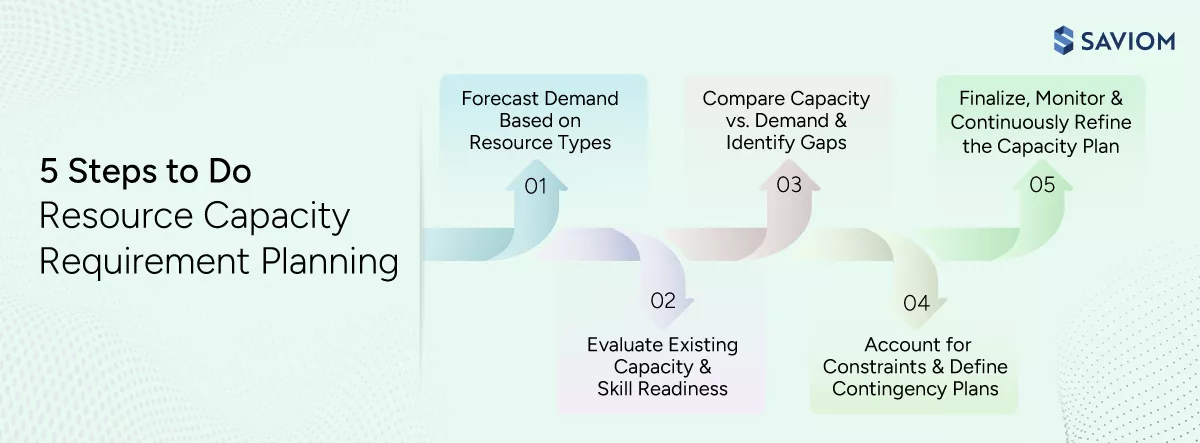
Step 1: Forecast Demand Based on Resource Types
The first step in capacity requirement planning is accurately forecasting future demand across personnel, equipment, and technology. This helps organizations anticipate peak periods, identify upcoming workload requirements, and assess the capacity needed across skills, roles, systems, and assets in advance.
Learn about demand management and how it helps balance supply with demand.
Step 2: Evaluate Existing Capacity and Skill Readiness
The next step is to assess existing capacity across personnel, technology, and infrastructure. In the case of human resources, managers can evaluate workforce availability and skill readiness after accounting for planned leave and ongoing assignments. This helps them determine whether existing capacity is sufficient or if resource constraints require corrective action.
Step 3: Compare Capacity vs. Demand and Identify Gaps
According to a McKinsey report, “90% of leaders consider capacity planning a pressing to-do that needs addressing now or soon.”
Once demand forecasts and available capacity are established, managers can identify resource shortages or excesses. Shortages can be addressed through upskilling, redeployment, out-rotation, and backfilling or hiring. In cases of excess capacity, organizations can expedite project timelines or sell excess capacity at discounted rates.
Explore our blog on how to measure resource capacity and demand effectively.
Step 4: Account for Constraints and Define Contingency Plans
The next step is to account for potential constraints, such as attrition risk, unplanned absences, skill scarcity, changes in project scope, or budget limits. Identifying these risks early helps managers prepare contingency plans such as cross-training employees, building backup skill pools, or onboarding contingent workers.
Step 5: Finalize, Monitor, and Continuously Refine the Capacity Plan
The final step is to finalize the capacity plan based on updated forecasts and defined resourcing actions. Once in place, the plan should be monitored regularly to reflect project changes, demand shifts, or execution-level variations. Continuous refinement ensures the capacity plan remains relevant and aligned as business priorities evolve.
Improve demand visibility and plan resource capacity with greater accuracy using SAVIOM’s futuristic resource management software. Book a demo today to see it in action.

With a clear understanding of the resource capacity requirement planning process, let us now see how SAVIOM helps organizations apply these steps in practice.
How Does SAVIOM Support Resource Capacity Requirement Planning?
SAVIOM’s resource capacity planning software enables organizations to support capacity planning by bringing together demand forecasts, capacity data, skills, and timelines to drive consistent, informed capacity decisions. Here’s how:
- The all-in-one resource planner provides a consolidated view of resource data across teams and timelines, helping organizations assess the required capacity.
- The embedded capacity planner supports demand planning and forecasting by enabling managers to compare required capacity with available capacity and identify shortages or excesses.
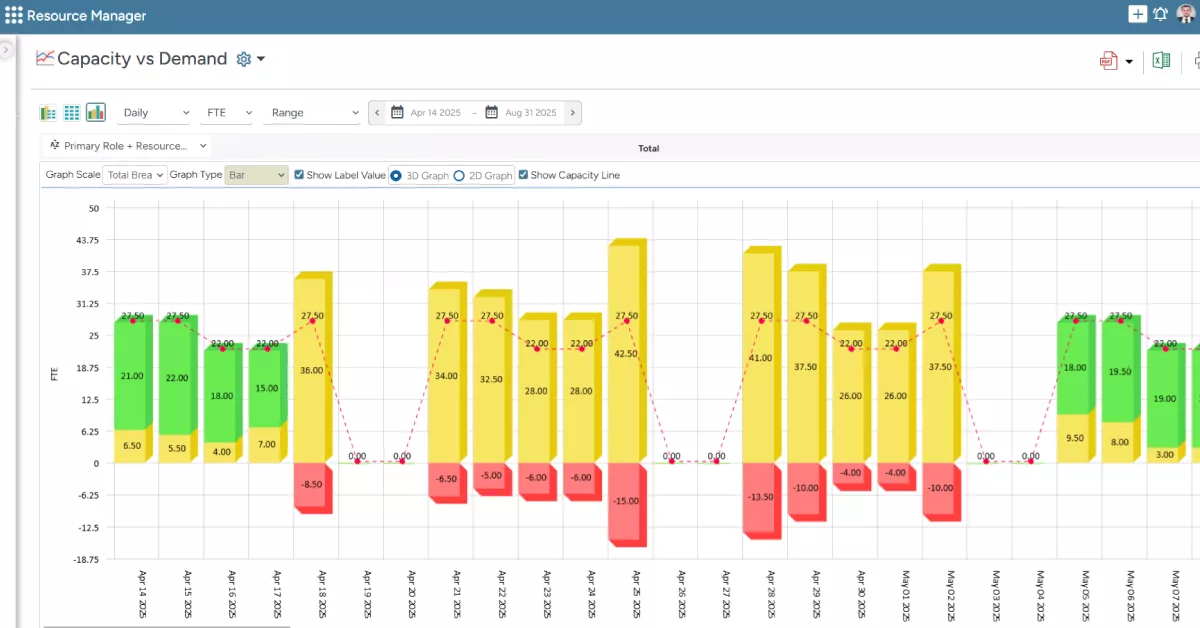 SAVIOM’s Capacity vs. Demand Graph enables managers to compare forecasted demand against available capacity and identify potential shortages or excesses in advance.
- The KPI forecaster provides visibility into capacity, utilization, and availability, helping teams track resource-demand forecasting trends and adjust capacity plans as demand evolves.
- Embedded heatmaps visually highlight over- and underutilized resources, enabling managers to balance workloads and address capacity constraints early.
- The early warning system flags overallocations and booking conflicts, allowing teams to address resource requirement planning issues before they impact delivery.
- The competency matrix centralizes skills and certifications, enabling managers to assess skill readiness and identify gaps aligned with future demand.
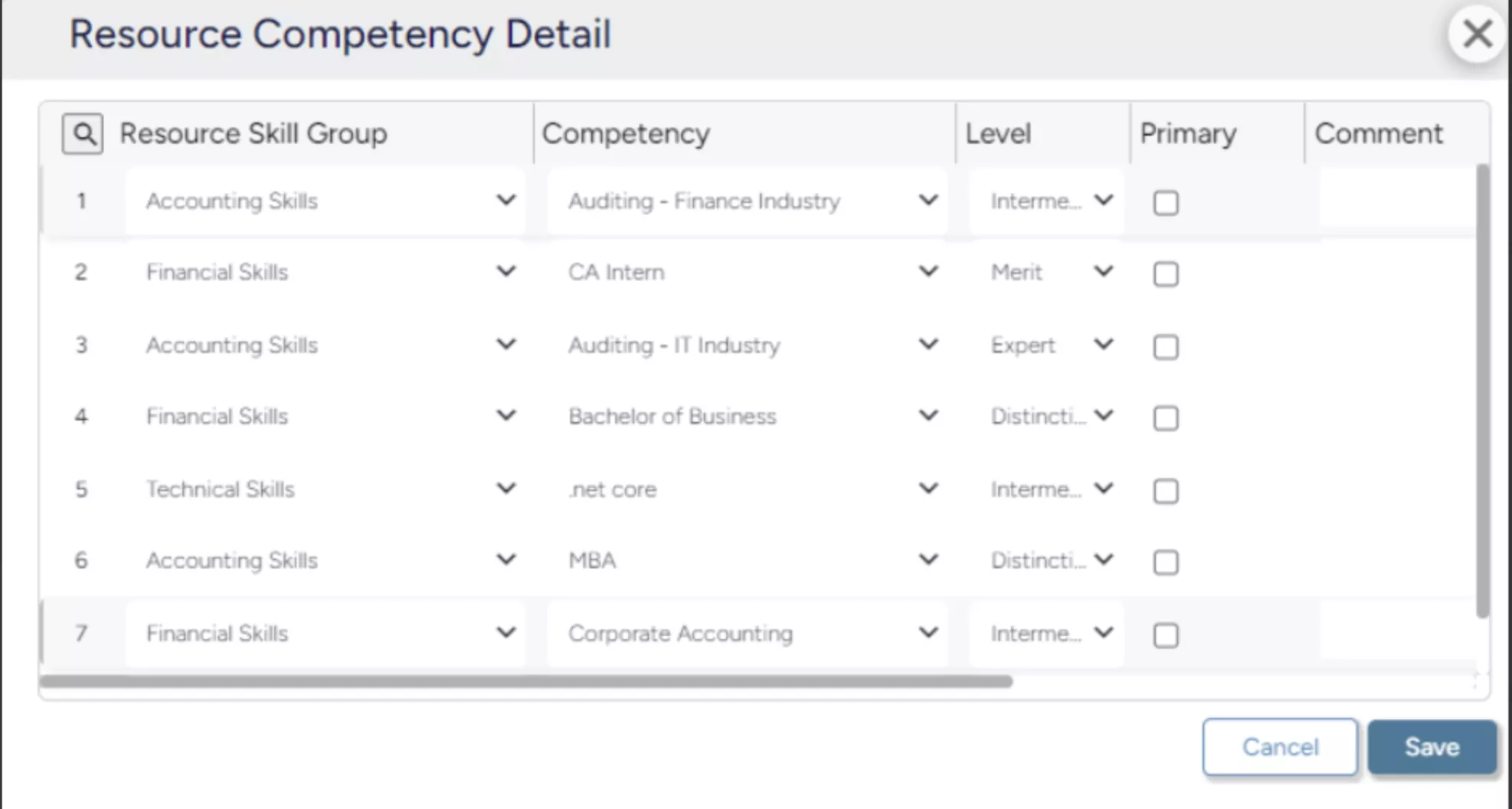
SAVIOM’s Competency Matrix enables managers to track skills, certifications, and proficiency levels, helping identify skill gaps and plan targeted reskilling initiatives.
- Real-time BI reports provide insights into utilization, people on the bench, and project vacancies, supporting data-driven capacity planning.
- Scenario modeling allows teams to compare capacity vs. demand scenarios and test different responses before committing to capacity decisions.
Read our blog to learn more about scenario planning.
Conclusion
Resource capacity requirement planning has evolved from a tactical exercise into a strategic leadership capability. When applied consistently, it enables data-driven workforce decisions, strengthens delivery predictability, and supports sustainable growth. Organizations that embed this discipline are better equipped to navigate uncertainty and align capacity with long-term objectives.
Frequently Asked Questions (FAQs)
Resource capacity requirement planning is the process of evaluating whether an organization has sufficient capacity to meet future demand by comparing forecasted workloads with available resources. It helps identify shortages or excesses early, enabling timely resourcing decisions before delivery is impacted.
Here is why resource capacity requirement planning is important for organizations:
1. Enables early identification of skill gaps
2. Improves control over resource-related costs
3. Optimizes resource utilization across the enterprise
4. Ensures on-time and reliable project delivery
5. Allows rapid adjustment to shifting business priorities
The types of resource capacity requirement planning are:
Classification Based on Resource Focus
1. Workforce capacity requirement planning
2. Product/material capacity requirement planning
3. IT capacity requirement planning
4. Financial capacity requirement planning
Classification Based on Time Horizon
1. Short-term resource capacity requirement planning
2. Medium-term resource capacity requirement planning
3. Long-term resource capacity requirement planning
The steps to do resource capacity requirement planning are:
1. Forecast demand based on resource types
2. Evaluate existing capacity and skill readiness
3. Compare capacity vs. demand and identify gaps
4. Account for constraints and define contingency plans
5. Finalize, monitor, and continuously refine the capacity plan