

Introduction
In today’s multi-project environment, organizations are under constant pressure to maximize resource utilization and enhance business productivity. However, achieving this remains challenging as many firms rely on fragmented reports and siloed metrics that fail to highlight utilization inefficiencies across projects and teams.
A capacity utilization rate provides a structured way to measure how efficiently available organizational capacity is being used. By offering insights into workload imbalances and productivity gaps, it enables managers to make data-driven decisions that help optimize resource efficiency, improve delivery performance, and boost business profitability.
This blog explores what the capacity utilization rate is, why it matters, and how to calculate and optimize it effectively.
What is the Capacity Utilization Rate?
The capacity utilization rate measures the percentage of an organization’s available capacity actively used for productive work over a given period. It evaluates how efficiently resources, including people, equipment, and budget, are deployed relative to their total available capacity.
By comparing actual utilization with available capacity, organizations can identify instances of resource under- and overutilization. This visibility helps managers optimize resource allocation, balance overall workloads, and make informed decisions to improve operational efficiency and delivery performance.
Now that we know what the capacity utilization rate is, let’s explore its benefits.
Read our blog to understand how capacity planning helps maximize business efficiency.
Why is it Important to Calculate the Capacity Utilization Rate?
Understanding capacity utilization provides clear visibility into how efficiently resources are used, enabling more predictable delivery and better cost control. Let’s explore the key benefits:
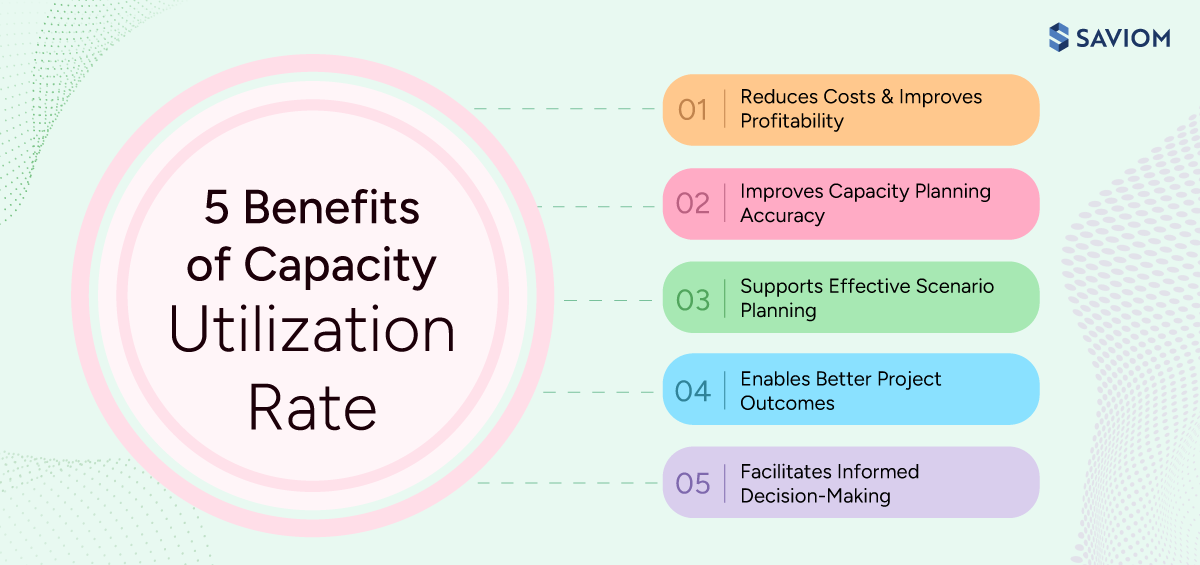
Reduces Costs and Improves Profitability
Underutilized workforce capacity increases operational costs by maintaining salaries, infrastructure, and tools that are not generating proportional revenue. By tracking capacity utilization rate, managers can better plan staffing and allocation, helping control resource costs and improve profit margins.
Improves Capacity Planning Accuracy
Capacity utilization data provides visibility into how much available capacity is currently being used and how much remains. With clearer insight into capacity levels, firms can determine whether existing teams can support upcoming demand. If not, it allows them sufficient time to take suitable resourcing measures to ensure seamless project initiation and delivery.
Supports Effective Scenario Planning
Capacity utilization rates provide a clear baseline of current resource usage, enabling organizations to evaluate different “what-if” scenarios based on actual capacity constraints. This allows organizations to evaluate trade-offs in advance and choose the most feasible approach to meet demand and execute projects with greater confidence.
Read our blog to learn how scenario planning helps you prepare for uncertainty.
Enables Better Project Outcomes
According to PMI’s 2024 research, “Only about 48% of projects are successful globally, highlighting widespread execution and resource challenges.”
While multiple factors influence project outcomes, inefficient resource utilization can increase the risk of missed deadlines, poor project quality, and rework. By monitoring capacity utilization, managers can detect and mitigate workload imbalances early, optimizing employee productivity and maintaining consistent delivery standards.
Facilitates Informed Decision-Making
A unified view of the capacity utilization rate provides clear visibility into over- and underutilized resources. With this insight, managers can take targeted actions, such as deploying resources from non-billable to billable work or redistributing existing workloads, to ensure optimal capacity utilization and drive higher ROI.
Read this comprehensive eBook to learn how to implement effective capacity planning strategies and deliver projects with confidence.
Having understood the benefits, let’s understand the process of calculating the capacity utilization rate.
How to Calculate Capacity Utilization Rate: A Step-by-Step Framework
To accurately measure capacity utilization, focus on actual productive output rather than logged hours alone. Here’s a simple step-by-step approach:
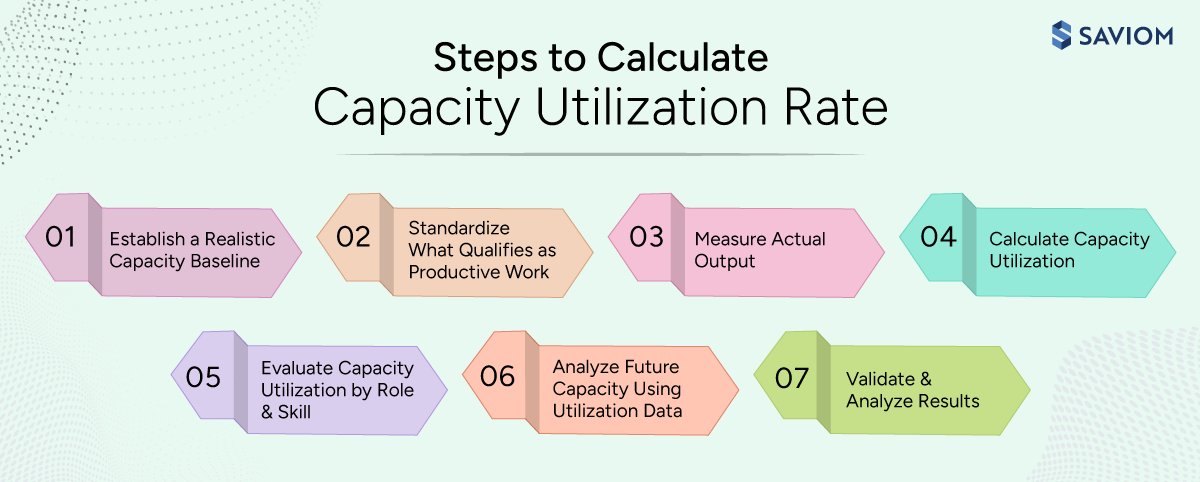
Step 1: Establish a Realistic Capacity Baseline
Start by defining capacity as the amount of work that resources can reliably deliver within a specific period, taking into account availability, skills, and contractual hours. Adjust theoretical capacity by accounting for holidays, planned leave, meetings, and training time to determine practical, usable capacity.
For example, in an IT consulting firm, a consultant may be contracted for 40 hours per week. However, 6–8 hours are often spent on internal meetings, documentation, and skill development. This reduces the consultant’s available capacity to roughly 32–34 hours per week.
Discover how a resource capacity model helps you match workload with available resources.
Step 2: Standardize What Qualifies as Productive Work
Only count activities that directly contribute to project delivery, revenue generation, or measurable outcomes. Exclude purely administrative or internal coordination tasks that don’t advance external value creation. This helps standardize what qualifies as productive work across teams.
For example, in an AEC firm, drafting design plans, conducting site inspections, and producing client-approved drawings qualify as productive work. However, internal compliance meetings or general coordination calls should not be included when calculating productive work.
Step 3: Measure Actual Output
Track relevant output metrics, such as billable hours, completed tasks, deliverables, or milestones, depending on how your organization generates value. Additionally, record these outputs consistently across teams and over defined time periods to ensure accurate and comparable performance data.
For example, in an accounting firm, billable client hours and completed tax filings can serve as measurable output indicators. Recording these metrics weekly or monthly creates a reliable record of work performed, which can later be used for capacity utilization calculations.
Learn how optimizing billable hours can boost utilization and improve project profitability.
Step 4: Calculate Capacity Utilization
Divide actual output by available capacity for the given reporting period, such as weekly, monthly, or quarterly, and express the result as a percentage to determine the capacity utilization rate. Compare this percentage against benchmarks or historical data to assess whether capacity is under-utilized, overstretched, or optimized.
The formula for the capacity utilization rate is:
For example, in a consulting firm, if a consultant has 160 practical capacity hours in a month and records 128 billable hours, the capacity utilization rate is (128/160) × 100 = 80%. This indicates that the consultant used 80% of the available billable capacity during that period.
Step 5: Evaluate Capacity Utilization by Role and Skill
Average capacity utilization can create a false sense of balance by masking role-specific constraints. To prevent that, break down metrics by critical roles or skills to uncover under- or overutilized capacity and hidden bottlenecks for targeted resource optimization.
For example, in a law firm, overall capacity utilization may appear healthy at 82%. However, senior litigators could be operating at 95% utilization while junior associates remain at 65%. This reveals a skill imbalance that risks burnout at the top and capacity wastage below.
Find out what causes resource underutilization and how to address it to improve productivity.
Step 6: Analyze Future Capacity Using Utilization Data
Use current utilization trends to estimate available capacity, then compare it against projected project demand to identify future gaps. This forward-looking analysis shows whether teams can absorb additional work. If capacity gaps arise, managers can take corrective actions such as hiring, upskilling, or reallocating resources to meet projected demand.
For example, in an IT services firm, current developer utilization may already be at 88%. If two large client projects are scheduled to start next quarter, demand projections may push required capacity beyond 100%, signaling the need to onboard contract developers or reschedule low-priority work.
Step 7: Validate and Analyze Results
Compare current utilization rates with historical trends to identify deviations. In addition, account for seasonality, demand fluctuations, and planned downtime when interpreting the data. This helps ensure capacity decisions are based on long-term, consistent patterns rather than short-term fluctuations.
For example, in an accounting firm, utilization may spike to 95% during tax season but drop to 70% afterward. Without historical context, managers might misinterpret the spike as chronic overload rather than a predictable seasonal cycle.
Now that we understand the calculation process, the next step is to learn how to improve capacity utilization.
How to Optimize Capacity Utilization?
Optimizing capacity utilization is critical for improving delivery predictability, increasing agility, and protecting employee well-being. Here’s how high-performing organizations actively optimize their capacity utilization rate:
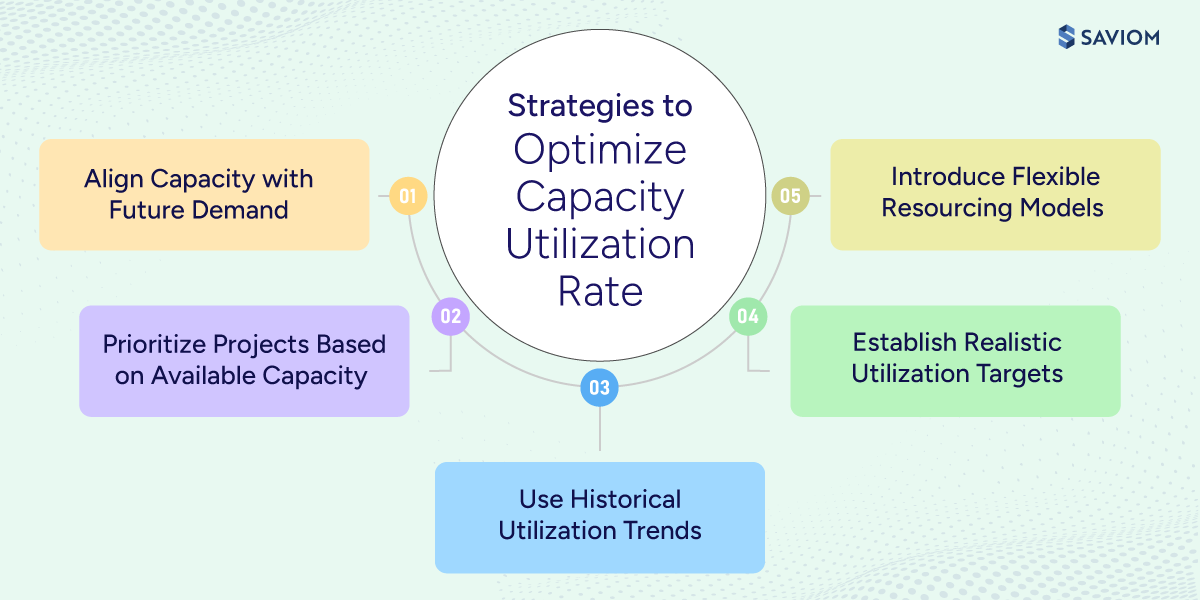
Align Capacity with Future Demand
Organizations must proactively compare available resource capacity with upcoming project requirements to identify capacity shortages or surpluses early. In case of any deviations, managers can take remedial measures such as training/upskilling, adjusting timelines, rebalancing workloads, or hiring to meet delivery commitments.
Understand how balancing capacity and demand helps improve planning accuracy.
Prioritize Projects Based on Available Capacity
When resources are limited, prioritize projects based on available capacity to ensure critical initiatives receive adequate support. Additionally, reprioritize, postpone, or phase low-priority projects until sufficient capacity becomes available. This approach prevents chronic overutilization and reduces delivery risk without increasing unnecessary headcounts.
Use Historical Utilization Trends
Analyze utilization data over multiple quarters to identify patterns rather than reacting to short-term fluctuations. These historical trends highlight recurring overloads or underutilized capacity, enabling managers to optimize workload distribution and maintain consistent project delivery.
Learn how tracking resource utilization can improve productivity.
Establish Realistic Utilization Targets
Define utilization targets based on industry benchmarks, role types, and organizational priorities rather than relying on fixed percentages. Setting realistic ranges helps identify both underutilization and overutilization early. Accordingly, managers can take suitable actions to ensure balanced workload distribution and boost resource performance.
Introduce Flexible Resourcing Models
Leverage third-party vendors or on-demand resources to manage demand spikes without adding costly permanent headcounts. This helps organizations to reduce overtime costs, protect team well-being, lower attrition risk, and ensure consistent delivery performance.
Gain real-time visibility into capacity utilization and upcoming project demand with SAVIOM’s advanced resource management solution. Book a demo to see it in action.

After going through the optimization methods, let’s see how capacity planning software helps achieve the maximum capacity utilization rate.
How Can SAVIOM Help Improve the Capacity Utilization Rate?
SAVIOM’s advanced capacity planning software helps organizations improve capacity utilization rate by connecting future demand, resource availability, and utilization trends through data-driven insights. Let us see how:
- An all-in-one resource planner offers enterprise-wide visibility into critical resource metrics such as utilization, capacity, and availability, enabling managers to identify resource-centric bottlenecks proactively.
- An embedded capacity planner helps reduce unexpected capacity shortages or excesses by enhancing demand visibility and forecast accuracy.
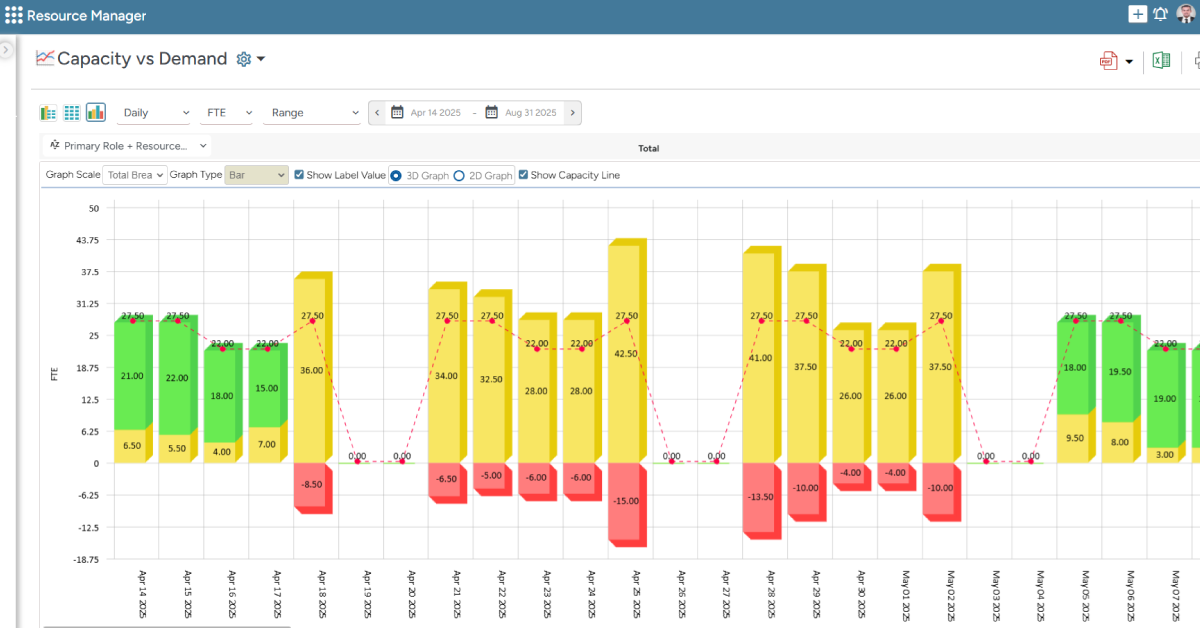 SAVIOM’s Capacity vs. Demand Graph enables managers to spot resource shortages and excesses, and take timely action to balance supply and demand.
- Intelligent matchmaking helps assign work based on skills, availability, and cost to ensure optimum resource utilization.
- Embedded heatmaps help managers identify resource overutilization and underutilization patterns early and take proactive measures accordingly.
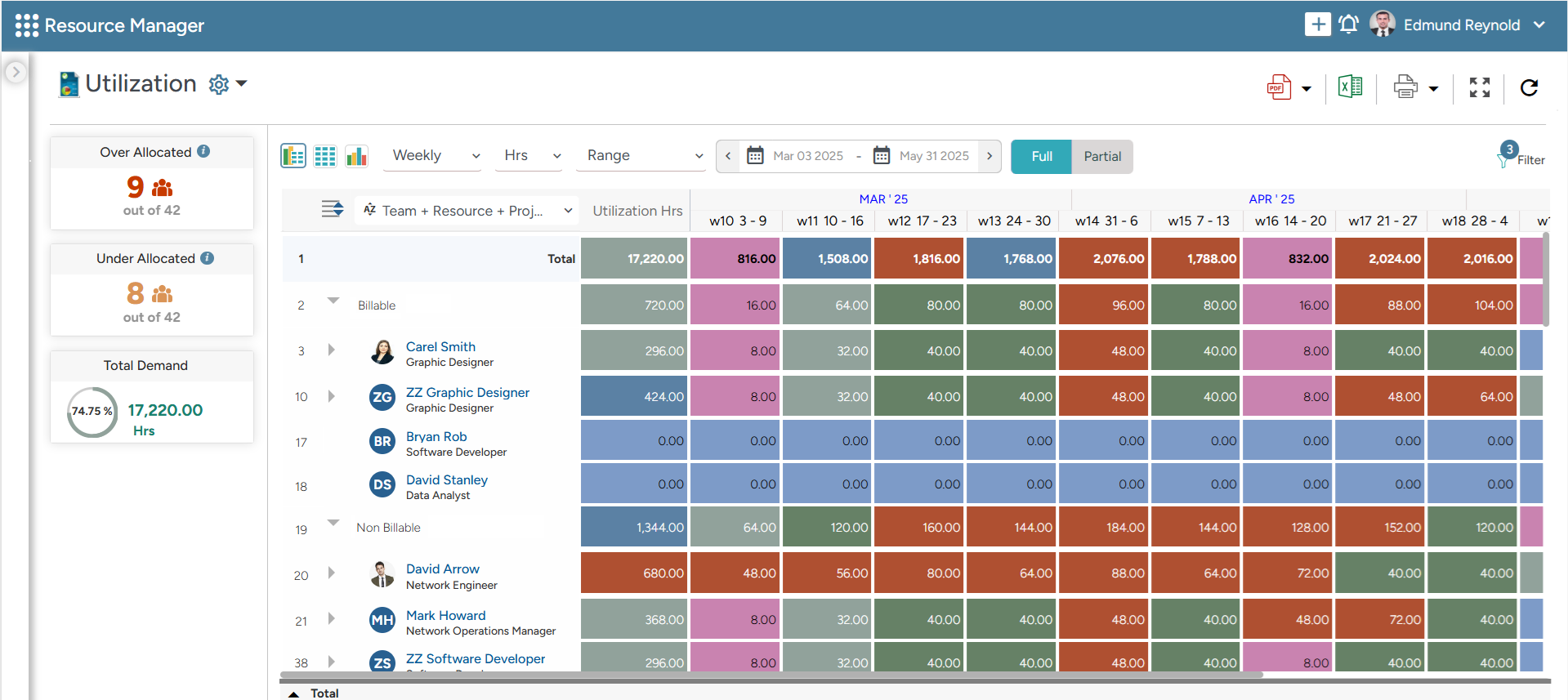 SAVIOM’s Color-Coded Heatmap highlights the real-time resource utilization levels, helping managers identify imbalances and optimize productive utilization.
- KPI forecaster monitors utilization, availability, and capacity over time to ensure data-driven decision-making.
- Scenario modeling enables managers to simulate various scenarios in a sandbox environment and arrive at an optimized capacity plan.
- A competency matrix highlights skill gaps that restrict effective utilization, helping organizations plan targeted upskilling or hiring initiatives accordingly.
- Real-time BI reports offer visibility into capacity, availability, and utilization trends, supporting data-driven capacity utilization decisions.
Conclusion
Capacity utilization rate is an ongoing strategic metric that reveals how effectively organizational capacity converts into productive output. It guides smarter staffing, better planning, and balanced workloads. Moreover, regular review of the capacity utilization report enables informed decision-making that improves profitability, delivery reliability, and workforce sustainability.
Frequently Asked Questions (FAQs)
The capacity utilization rate measures the percentage of an organization’s available capacity actively used for productive work over a given period.
It is important to measure the capacity utilization rate because it:
1. Reduces costs and improves profitability
2. Improves capacity planning accuracy
3. Supports effective scenario planning
4. Enables better project outcomes
5. Facilitates informed decision-making
The steps to calculate the capacity utilization rate are:
Step 1: Establish a realistic capacity baseline
Step 2: Standardize what qualifies as productive work
Step 3: Measure actual output
Step 4: Calculate capacity utilization
Step 5: Evaluate capacity utilization by role and skill
Step 6: Analyze future capacity using utilization data
Step 7: Validate and analyze results
A good capacity utilization rate typically falls between 80% and 85%, as this range balances productivity with sustainable workloads and helps prevent burnout.
To optimize capacity utilization:
1. Align capacity with future demand
2. Prioritize projects based on available capacity
3. Use historical utilization trends
4. Establish realistic utilization targets
5. Introduce flexible resourcing models