

Introduction
In many organizations, work is distributed informally due to limited visibility into project priorities, available capacity, and resource capabilities. It is usually assigned based on urgency, familiarity, or who appears to be available at the moment.
Consequently, it leads to unbalanced resource utilization, leaving some employees overloaded while others remain underutilized. This is where workload balancing becomes critical. It helps optimize resource utilization, improve team productivity, and enable on-time project delivery.
This blog explains what workload balancing means, why it matters, and the frameworks, metrics, and models organizations use to distribute work evenly across teams.
What is Workload Balancing?
Workload balancing is the strategic and continuous process of distributing tasks, responsibilities, and resources across teams, employees, or systems to optimize productivity, enhance utilization, and ensure timely project delivery.
This process ensures that no individual or system is overburdened or underutilized, helping organizations improve performance, meet deadlines, and reduce employee burnout. Moreover, by balancing workload with capacity, organizations can optimize resource health indices and maintain a steady project workflow.
Now that we understand what workload balancing is, let’s explore how it benefits enterprise performance.
How Workload Balancing Benefits Enterprises?
Workload balancing enables organizations to distribute work effectively across teams based on capacity and skills. Ensuring resources are neither overutilized nor underutilized helps improve productivity, maintain employee well-being, and support consistent project delivery. Let’s explore the key benefits:
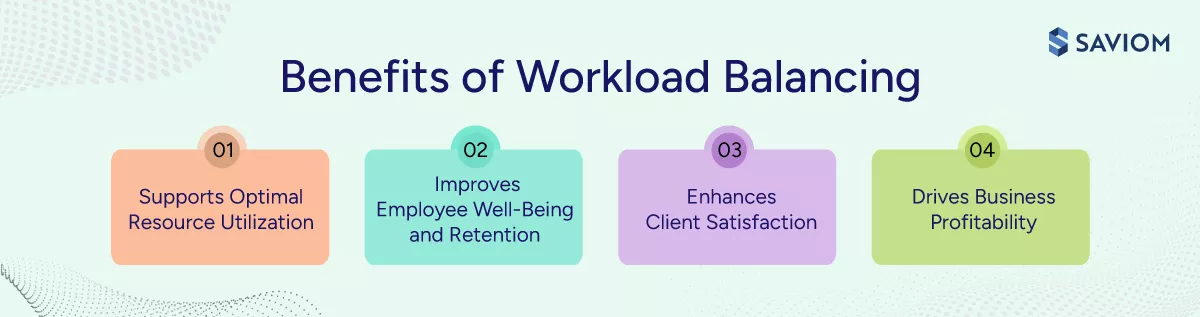
Supports Optimal Resource Utilization
Workload balancing ensures tasks are assigned based on employee capacity and skill sets, enabling individuals to handle work more effectively. This prevents instances of resource overutilization or underutilization, maintains the resource health index, and boosts employee productivity.
Read our detailed blog on resource utilization.
Improves Employee Well-Being and Retention
According to a McKinsey survey, “Approximately 25% of employees report experiencing symptoms of burnout in the workplace.”
Proactive workload balancing addresses this by aligning tasks with employee skills, experience, and capacity. It prevents senior talent from handling repetitive tasks and generic resources from taking on work beyond their capabilities or expertise. This alignment reduces burnout or disengagement, improves job satisfaction, and enhances employee retention.
Enhances Client Satisfaction
When employees are not overwhelmed with competing priorities, they can focus on delivering higher-quality outputs and adhere to stipulated timelines. Thus, balanced workload distribution helps teams to produce consistent results, which ultimately strengthens client trust and improves professional relationships.
Drives Business Profitability
When tasks and responsibilities are aligned with employees’ capacity and skills, they can work more efficiently and deliver better outcomes. This reduces expensive rework and maximizes productivity, resulting in better profit margins.
Learn more about billable utilization and how it drives revenue and profitability.
Having explored the benefits of workload balancing, it is important to clarify related terms that are often confused with it.
Capacity Planning vs. Resource Allocation vs. Workload Balancing
Understanding the distinctions between capacity planning, resource allocation, and workload balancing helps clarify their roles within the resource management ecosystem. This prevents conceptual overlap and ensures organizations apply the right practice at the right stage of project planning and execution.
| Aspect | Capacity Planning | Resource Allocation | Workload Balancing |
|---|---|---|---|
| Primary Purpose | Aligns available workforce capacity with forecasted demand to ensure the organization can deliver planned work without resource shortages or excesses | Assigns competent resources or roles to projects based on planned timelines, budgets, and skill requirements | Actively redistributes and adjusts workload across teams and projects to prevent over- or underutilization as conditions change |
| Planning Horizon | Forward-looking and strategic, typically aligned with quarterly, annual, or project planning cycles | Tactical and project-focused, occurring during project initiation and staffing decisions | Continuous and operational, responding to real-time workload fluctuations and execution dynamics |
| Core Activity | Identifies potential resource shortages or excesses before commitments are made and helps take corrective actions | Matches resources to projects based on role fit, availability, and utilization level | Reviews and redistributes workload based on emerging constraints such as shifting priorities, unexpected demand, and capacity changes |
| Key Inputs | Workforce availability, historical utilization trends, leave calendars, and demand forecasts | Project plans, budget allocations, timelines, and skill requirements | Real-time utilization data, project timeline, and schedule changes |
| Outcome | Offers realistic delivery predictability and informs hiring, outsourcing, or reallocation decisions | Creates an initial staffing structure for projects | Streamlines project execution by smoothing workload distribution and addressing emerging imbalances |
| How They Work Together | Defines how much work the organization can realistically deliver | Uses estimated capacity to assign resources to initiatives | Continuously adjusts work distribution as priorities evolve, keeping delivery capacity aligned with actual demand |
Understanding these distinctions helps clarify how workload balancing operates within the broader resource management process. Let’s now examine the common causes of workload imbalance.
Discover resource allocation models and strategies for optimizing workforce utilization.
Common Causes of Workload Imbalance
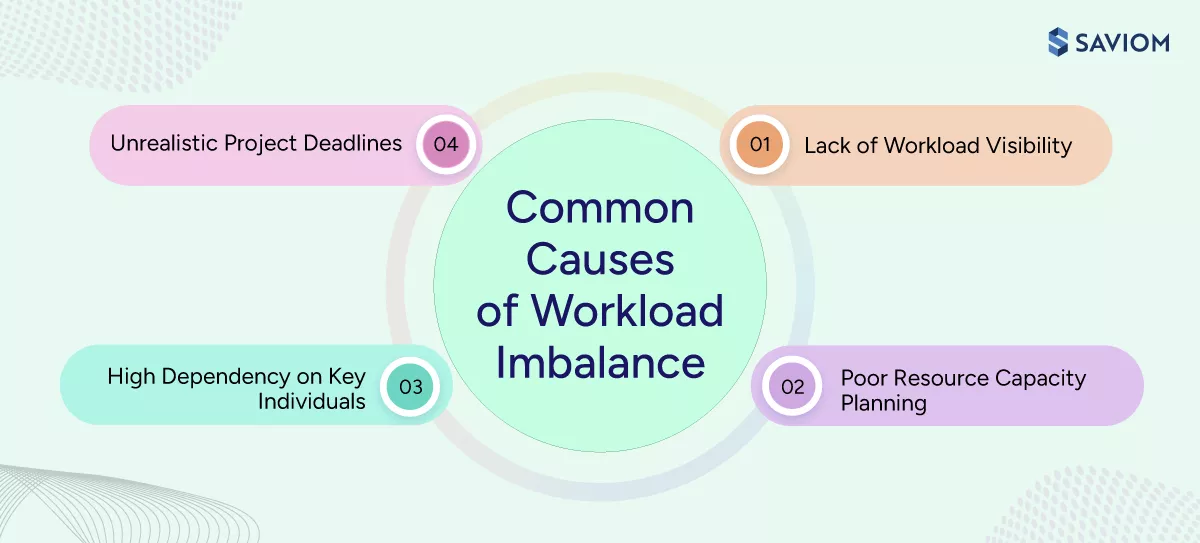
Workload imbalance arises from ineffective workforce planning, limited visibility, and poor resource management practices. When organizations lack clear insights into capacity, demand, and task distribution, work is not assigned evenly across teams. This leads to resource over- and underutilization. Let’s explore the common causes:
Lack of Workload Visibility
Without centralized visibility into factors, such as resource capacity, availability, current and future allocations, etc., managers rely on guesswork or assumptions to distribute tasks. Naturally, this results in an imbalance wherein some employees are overloaded while others remain underutilized. Oftentimes, these imbalances go unnoticed until they affect deadlines or performance.
Poor Resource Capacity Planning
According to a McKinsey & Company study, “Nearly 87% of organizations either face a skills gap today or expect one in the near future.”
When organizations lack structured resource capacity planning processes, managers cannot accurately forecast or forward plan for future work and secure competent resources with the right skills ahead of time. Therefore, work is assigned reactively, leading to last-minute firefighting. This results in uneven workload distribution, leaving some resources overburdened and others with insufficient work.
Explore resource capacity planning and how it supports successful project delivery.
Dependency on a Few Key Individuals
Many organizations unintentionally rely on the same group of high performers to handle complex work or urgent requests. Over time, this overreliance can lead to burnout and mental fatigue among these employees, affecting their engagement and work performance. Additionally, if these key individuals become unavailable or leave the organization, it can create significant knowledge gaps and pose delivery risks.
Unrealistic Project Deadlines
Unrealistic project deadlines compress work into shorter timelines without considering actual resource availability and individual bandwidth. It forces certain employees to take on excessive workloads to meet commitments. Unfortunately, this leads to compromised quality, errors, and costly rework, ultimately affecting project outcomes and client satisfaction.
Having examined the common causes of workload imbalance, let’s explore the framework organizations can use to address and prevent them.
Enterprise Workload Balancing Framework
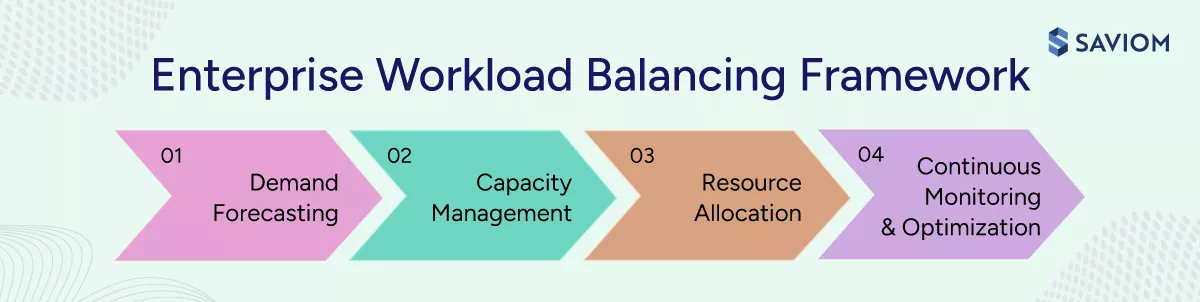
An enterprise workload balancing framework enables organizations to manage and distribute work systematically across teams. It provides a structured approach to align available resources with demand and maintain balanced workloads. Let’s explore the key components:
Demand Forecasting
Demand forecasting helps organizations analyze historical workload data, project pipelines, and operational trends to anticipate future demand. This foresight allows organizations to plan upcoming work more effectively and prepare for expected resource requirements in advance.
Explore how to measure and balance resource capacity and demand.
Capacity Management
Capacity management helps organizations determine true available resource capacity after accounting for leaves, administrative work, and meetings. By performing a gap analysis, firms can analyze and bridge gaps, set a realistic capacity baseline for future work, and maintain a balanced workload.
Resource Allocation
Resource allocation ensures work is assigned to individuals based on skills, availability, expertise, and business priorities. It helps distribute work evenly among qualified resources, instead of assigning it to the same few individuals. This balanced distribution minimizes errors caused by skill misalignment and improves overall delivery quality.
Continuous Monitoring and Optimization
Utilization monitoring helps track how effectively workforce capacity is being used across projects by measuring resource utilization and workload distribution trends. This visibility helps managers identify instances of resource over- or underutilization early, enabling timely corrective actions to optimize utilization levels and improve employee productivity.
Understand how to track resource utilization effectively.
Read this eBook to learn how 5th gen resource management improves resource visibility and helps organizations balance workloads effectively.

With the key elements of the workload-balancing framework established, it is important to understand the metrics used to assess its effectiveness.
Essential Metrics: Measuring Utilization, Throughput, and Lead Time
Maintaining workload balance requires tracking key metrics that provide visibility into how effectively resources are utilized and how work progresses across teams. These metrics help organizations identify imbalances, improve planning accuracy, and optimize workload distribution. Let’s look at the key metrics:
Resource Utilization Rate
Resource utilization rate measures the percentage of available time allocated to productive work, providing clear visibility into how workforce capacity is being used. By tracking utilization trends over time, organizations can identify instances of resource under- or over-utilization and redistribute work to maintain balanced workloads.
The formula to calculate the resource utilization rate is:
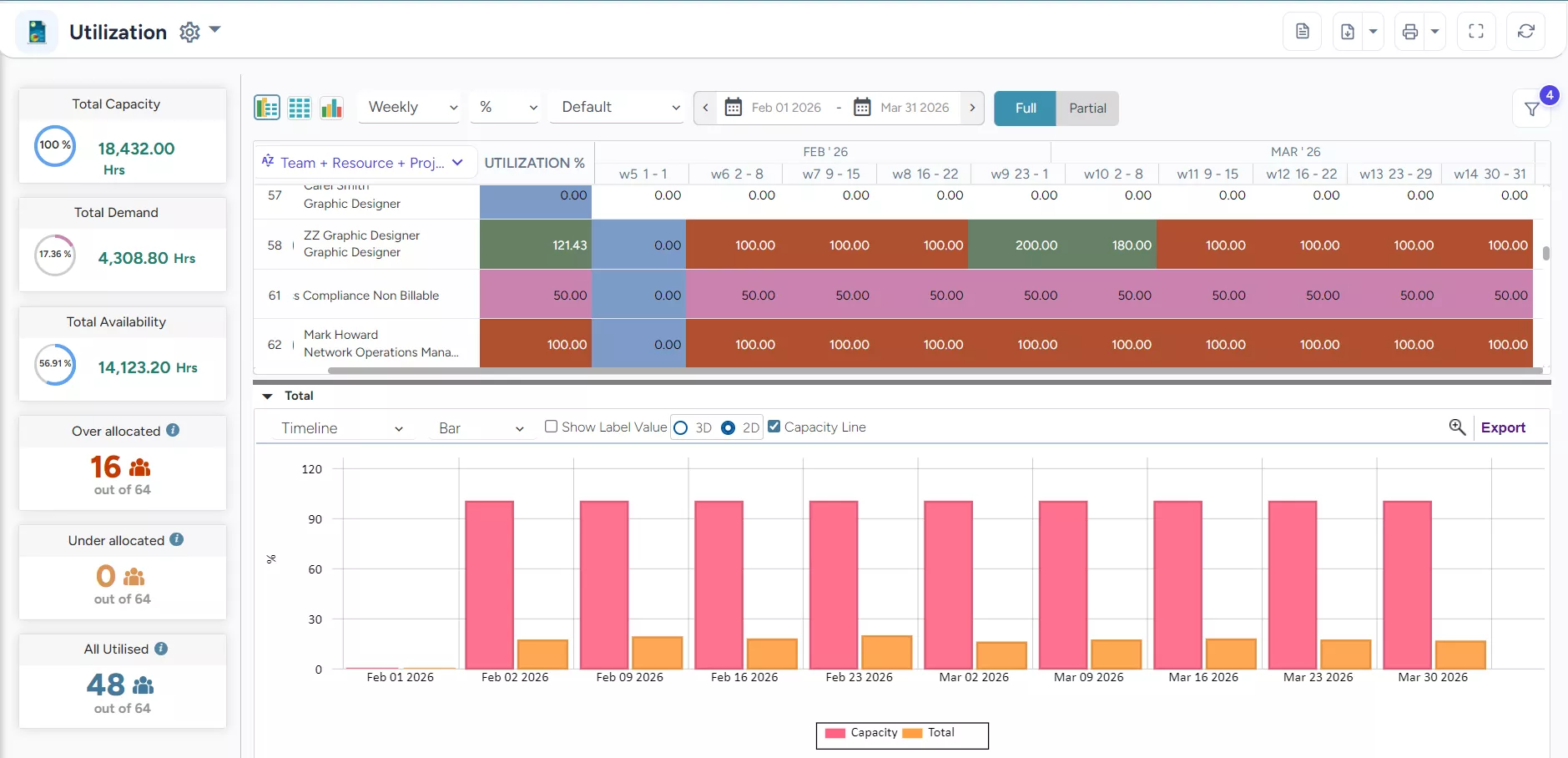
SAVIOM’s Utilization Report visualizes resource over- or underutilization using color-coded indicators, supporting data-driven decision-making.
Billable Utilization
Billable utilization measures the percentage of total available hours spent on revenue-generating work. Monitoring this metric helps organizations detect workload imbalance patterns. Identifying these trends allows leaders to take proactive measures, redistribute tasks, and maintain optimal workload levels.
The formula to calculate billable utilization is:
Resource Capacity Utilization
Resource capacity utilization indicates how much of an employee’s available capacity is actually used. It helps managers quickly identify underutilized resources or individuals operating beyond sustainable limits, which enables better workload adjustments.
The formula to calculate capacity utilization is:
Productive Utilization
Productive utilization measures how effectively resources are allocated to high-value work, such as billable tasks, strategic initiatives, and other revenue-generating projects. By tracking it, organizations can ensure teams spend more time on high-impact activities that improve both financial returns and operational outcomes.
The formula to calculate productive utilization is:
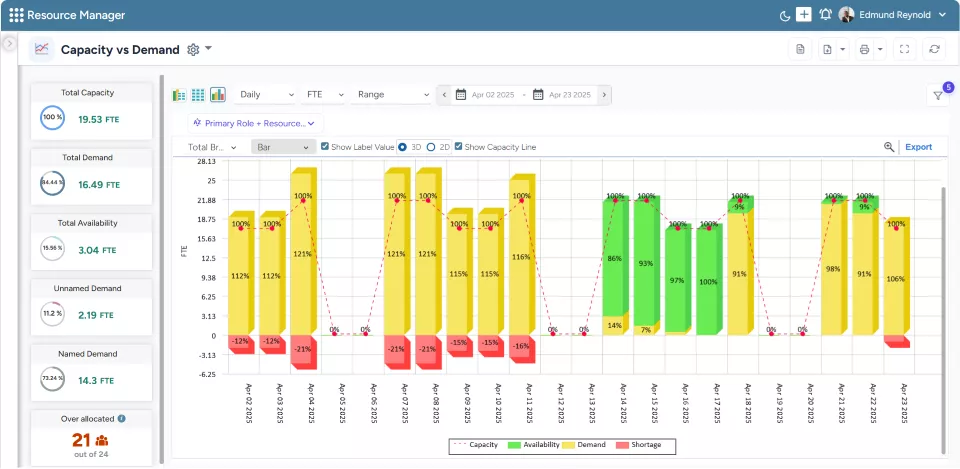
SAVIOM’s Capacity vs. Demand Graph enables managers to spot resource shortages and excesses, and take timely action to balance supply and demand.
Forecast vs. Actual Time
Forecast vs. actual time measures the difference between the estimated task duration and the time actually spent completing the work. Tracking this gap helps teams identify planning inaccuracies that affect workload distribution. Moreover, these insights improve future estimates and support more balanced workload planning.
The formula to calculate forecast vs. actual time is:
Discover the key benefits and strategies for effective workload distribution.
Resource Effort Variance
Resource effort variance measures the difference between the planned effort and the actual effort required to complete a task. Tracking this variance helps managers detect underestimation, scope creep, or unexpected efficiencies. These insights improve future planning accuracy and help keep project timelines and costs under control.
The formula to calculate resource effort variance is:
Employee Productivity Rate
Employee productivity rate measures the output produced by a workforce over a specific period, relative to the workforce responsible for delivering it. This metric enables managers to spot underperformance or outstanding results and make data-driven decisions on workload distribution and overall performance management.
The formula to calculate employee productivity rate is:
Now that we understand the key metrics, let’s explore the models organizations use to balance workloads across cross-functional teams.
Types of Workload Balancing in Cross-Functional Teams
Managing workloads across cross-functional teams requires accounting for varying skills, dependencies, and capacity. The following types of workload balancing help organizations distribute work effectively across functions while preventing the overburdening of critical resources. Let’s explore the key types:
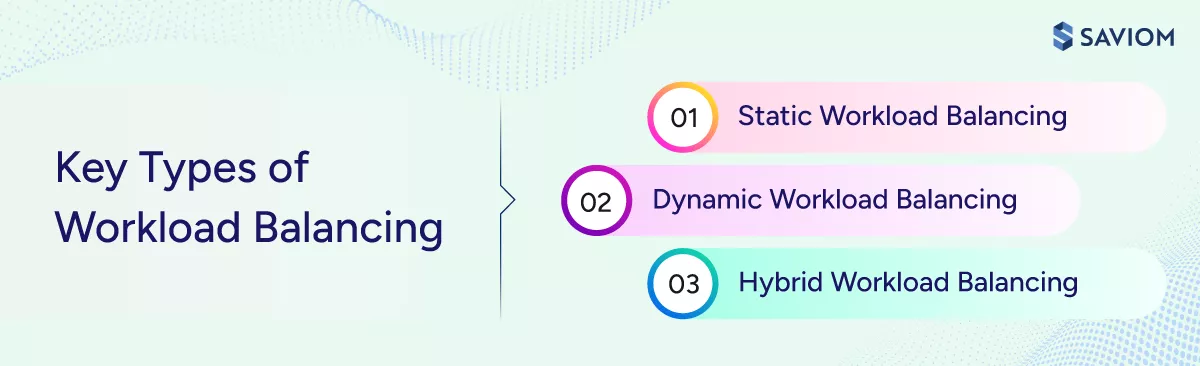
Static Workload Balancing
Static workload balancing involves assigning work in advance based on expected demand, predefined roles, and known resource capacity. In this approach, tasks remain fixed during execution, making it suitable for stable and predictable environments. However, it offers limited flexibility to handle sudden changes in demand or resource availability.
Dynamic Workload Balancing
Dynamic workload balancing involves adjusting work distribution based on real-time demand and resource availability. In this approach, tasks are reassigned as conditions evolve, making it well-suited to fast-paced, unpredictable environments. It enables organizations to respond quickly to demand fluctuations while maintaining balanced workloads.
Hybrid Workload Balancing
Hybrid workload balancing combines elements of both static and dynamic approaches. It allows organizations to plan work in advance while making adjustments based on changing demand and resource availability. This approach improves adaptability, reduces workload imbalances, and ensures more consistent project execution.
With the key types of workload balancing defined, let’s explore a step-by-step process that an organization can follow to implement them effectively.
A Step-by-Step Workload Balancing Process
A structured process enables organizations to balance workloads consistently by aligning available capacity with incoming demand. It provides a systematic approach to assess capacity, allocate resources, and maintain balanced workloads throughout the project lifecycle. Let’s go through the key steps:
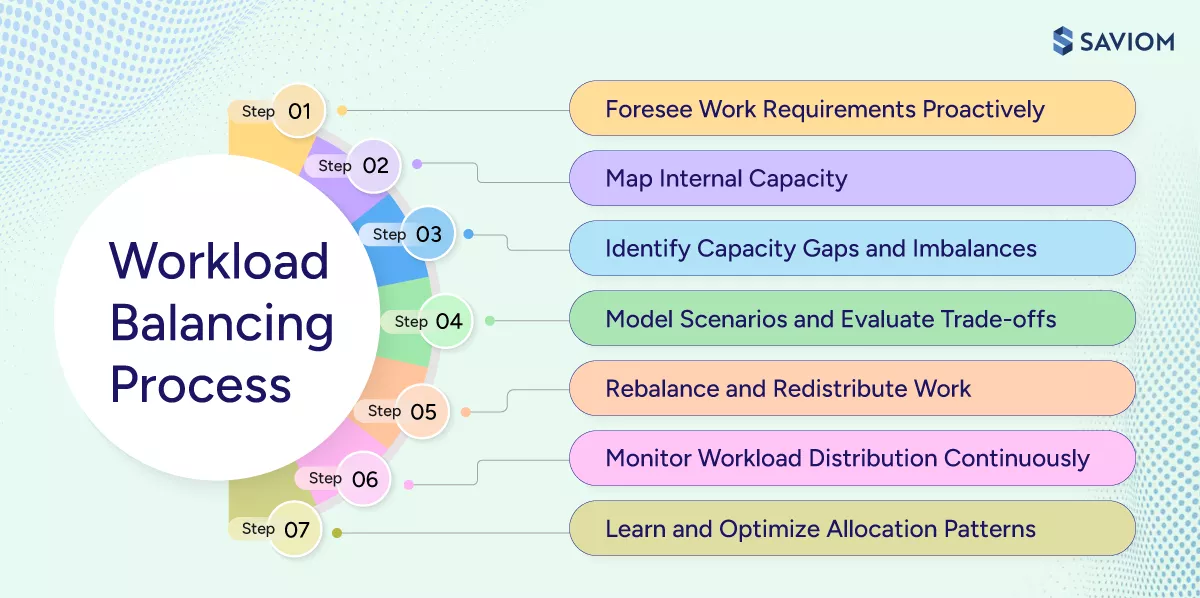
Step 1: Foresee Work Requirements Proactively
Workload balancing begins with a clear understanding of incoming work. Organizations must consolidate demand across projects, tasks, and timelines to create a unified view of what needs to be delivered. Without this visibility, balancing efforts become reactive and fragmented.
Step 2: Map Internal Capacity
Next, assess the actual capacity available across resources by factoring in availability, non-project work, and other constraints. This step establishes a realistic baseline of what can be delivered within a given timeframe and highlights any immediate limitations.
Step 3: Identify Capacity Gaps and Imbalances
With demand and capacity in view, organizations must actively compare the two to identify capacity gaps, i.e., resource excesses or shortages. It includes detecting overloaded resources, underutilized capacity, or critical skill gaps. Early identification of these imbalances is key to preventing delivery risks and inefficiencies.
Step 4: Model Scenarios and Evaluate Trade-offs
Before taking action, organizations should evaluate different ways to resolve imbalances using scenario planning. This includes simulating options such as redistributing work, shifting timelines, adding resources, or reprioritizing tasks. By comparing trade-offs across these scenarios, teams can make more informed, data-driven decisions rather than relying on ad hoc adjustments.
Step 5: Rebalance and Redistribute Work
Based on the selected scenario, managers should actively redistribute work across available resources. This may involve shifting tasks, reallocating responsibilities, or adjusting ownership to ensure a more even workload distribution. This is the core execution step where workload balancing decisions are implemented.
Step 6: Monitor Workload Distribution Continuously
Workload balancing requires continuous monitoring, not periodic reviews. Managers should track workload distribution, utilization, and emerging bottlenecks in real time to ensure that balance is maintained as conditions change.
Step 7: Learn and Optimize Allocation Patterns
Finally, organizations should analyze patterns in workload distribution to improve future decisions. This includes identifying recurring bottlenecks, refining allocation strategies, and improving how work is structured and assigned over time.
Use SAVIOM’s resource management software to gain real-time visibility into workloads, balance resource allocation, and optimize utilization. Book a Demo Today.

Now that we understand the step-by-step process of workload balancing, let’s explore the tools and system capabilities that enable it at scale.
Tools and System Capabilities That Enable Workload Balancing at Scale
Workload imbalances usually stem from fragmented visibility, delayed signals, and disconnected systems. Teams often operate with partial information, making it difficult to spot overallocation early or redistribute work effectively. Addressing this requires systems that can provide critical insights, guide real-time decision-making, and adapt dynamically. The capabilities outlined below highlight the core functionalities modern workload management tools must provide to enable consistent workload balancing.
Multi-Dimensional Resource Visibility
Modern workload balancing tools must provide multi-dimensional visibility into resources across roles, skills, projects, locations, and time horizons. A single-layer view of availability is insufficient at scale; systems should enable teams to slice and analyze capacity across multiple dimensions simultaneously. This level of visibility allows firms to uncover hidden bottlenecks and make more nuanced allocation decisions.
Robust Resource Capacity Planning
Effective tools should offer robust capacity planning capabilities that account for both current commitments and future demand. This includes forecasting and planning at individual, team, and organizational levels while incorporating factors such as non-project work, time off, and mentoring responsibilities. Strong planning capabilities enable realistic commitments, better prioritization, and improved delivery predictability.
Intelligent Skill-Matching
Another critical functionality is intelligent skill-matching mechanisms that go beyond basic role-based assignments. Systems should leverage detailed skill taxonomies, proficiency levels, and historical performance data to recommend the best-fit resources for each task. This ensures higher-quality outcomes, reduces rework, and distributes work more equitably across teams.
Resource Optimization
The system should actively support resource optimization. This includes identifying under-allocation and overallocation of resources, suggesting reassignments, and enabling efficient redistribution of work. Optimization capabilities should help organizations maximize productivity while maintaining sustainable workloads, ensuring that capacity is neither wasted nor overstretched.
Predictive KPI Forecasting
Modern systems should provide predictive KPI forecasting facilities that help organizations track metrics such as utilization, availability, and capacity trends over time. Such foresight enables business leaders to anticipate performance outcomes rather than react to them. This forward-looking approach supports better planning, risk mitigation, and more informed decision-making.
Discover essential resource management metrics for better project outcomes.
Early Warning and Risk Detection
Workload balancing tools must include early warning mechanisms to detect risks such as overallocation, missed deadlines, or capacity shortfalls. These systems should proactively flag issues through alerts, thresholds, or anomaly detection, allowing teams to take corrective action before problems escalate. Early visibility into risks is critical for maintaining delivery reliability at scale.
Real-Time BI Analytics and Reporting
To support continuous improvement, the tool should offer real-time business intelligence (BI) analytics and reporting capabilities. This includes customizable dashboards, drill-down insights, and cross-functional reporting on workload, capacity, and performance metrics. Real-time analytics ensure that decisions are based on the latest data, enabling organizations to continuously refine resource planning, task prioritization, and utilization optimization.
Alongside system capabilities, organizations must also address hidden workload demands that affect delivery timelines. Let’s examine these factors.
Balancing Hidden Workload Demands: Admin, Meetings, and Mentorship
Hidden activities often reduce available resource capacity but are overlooked in workload planning. However, accounting for these demands is essential to maintain balanced workloads and accurate capacity estimates. Let’s examine the common hidden workload demands:
Account for Administrative Responsibilities and Operational Tasks
Administrative and operational work takes up a portion of employee capacity but is often overlooked or unaccounted for in project or operational plans. However, organizations can address this hidden demand by:
- Estimating administrative tasks when assessing available team capacity realistically.
- Streamlining reporting and approval processes to reduce operational inefficiencies and save time.
- Automating repetitive tasks to free capacity for strategic or billable work.
Make Space for Time Spent in Internal Meetings and Coordination
Meetings and coordination activities are essential but can often consume productive time if not managed effectively. Firms can balance these demands by:
- Limiting unnecessary status meetings and consolidating review discussions.
- Protecting uninterrupted work hours to support focused, high-value project execution.
Explore effective strategies to increase employee productivity in the workplace.
Factor in Mentorship, Training, and Knowledge Transfer
Mentorship and training are critical for long-term workforce development but require dedicated time from employees. To balance these demands, firms can begin by:
- Allocating dedicated time for onboarding, training, and knowledge transfer activities.
- Planning internal training sessions ahead of time to minimize disruption to project timelines.
The Next Steps: Predictive Workload Balancing
Traditional workload management tends to be reactive, where managers address imbalances only after they surface. This often results in operational inefficiencies, employee burnout, and increased delivery risk. In contrast, predictive workload balancing enables organizations to anticipate demand, identify capacity gaps early, and make informed, proactive resourcing and allocation decisions.
By adopting this approach, organizations can maintain consistent workload distribution, improve delivery reliability, and sustain a healthy resource health index. Over time, this enhances workforce productivity and supports employee well-being, enabling teams to operate at a sustainable pace while delivering high-quality outcomes.
Frequently Asked Questions (FAQs)
Workload balancing is the strategic and continuous process of distributing tasks, responsibilities, and resources across teams, employees, or systems to optimize productivity, enhance resource utilization, and ensure timely project delivery.
The benefits of workload balancing include:
1. Supports optimal resource utilization
2. Improves employee well-being and retention
3. Enhances client satisfaction
4. Drives business profitability
The factors that commonly lead to workload imbalance include:
1. Lack of workload visibility
2. Poor resource capacity planning
3. High dependency on key individuals
4. Unrealistic project deadlines
The key components of an enterprise workload balancing framework are:
1. Demand forecasting
2. Capacity management
3. Resource allocation
4. Continuous monitoring and optimization
The metrics to assess workload imbalance include:
1. Resource utilization rate
2. Billable utilization
3. Resource capacity utilization
4. Productive utilization
5. Forecast vs. actual time
6. Resource effort variance
7. Employee productivity rate
The types of workload balancing in cross-functional teams are:
1. Static workload balancing
2. Dynamic workload balancing
3. Hybrid workload balancing
The steps to balance workload are:
1. Forecast workforce demand
2. Assess workforce capacity
3. Analyze capacity vs. demand gaps
4. Optimize resource allocation
5. Adjust workloads and delivery timelines
6. Monitor workforce utilization levels
7. Review outcomes and continuously improve