

Introduction
Enterprises often struggle to translate day-to-day business demand into effective staffing decisions. Teams may be overextended during peak periods and underutilized at others, not due to a lack of talent, but a lack of structured planning.
Operational workforce planning addresses this by aligning short-term staffing needs with day-to-day business operations. It enables organizations to anticipate demand, allocate resources efficiently, and ensure the right skills are available when and where they are needed.
This guide explains what operational workforce planning is, including its process, components, KPIs, challenges, solutions, and more.
What is Operational Workforce Planning?
Operational workforce planning is the process that ensures an organization has the right people and skills to meet immediate and near-term business requirements, typically over a 6- to 18-month horizon. The primary goal is to maintain day-to-day efficiency while remaining flexible enough to handle unexpected changes like demand spikes or sudden staff departures.
In practice, it evaluates project requirements, compares them against current talent supply, identifies shortages or surpluses, and triggers actions such as redeployment, upskilling, hiring, or reprioritization. When done well, operational workforce planning strengthens talent deployment, improves employee productivity, and ensures the project is delivered on time.
How Operational Workforce Planning is the Missing Link Between Strategy and Execution?
Organizations invest heavily in crafting ambitious strategies, yet many struggle to translate those plans into consistent, on-the-ground execution. This is where operational workforce planning plays a critical role, bridging strategy with execution by aligning immediate workforce needs with business demand. Let’s see how it acts as a missing link between strategy and execution:
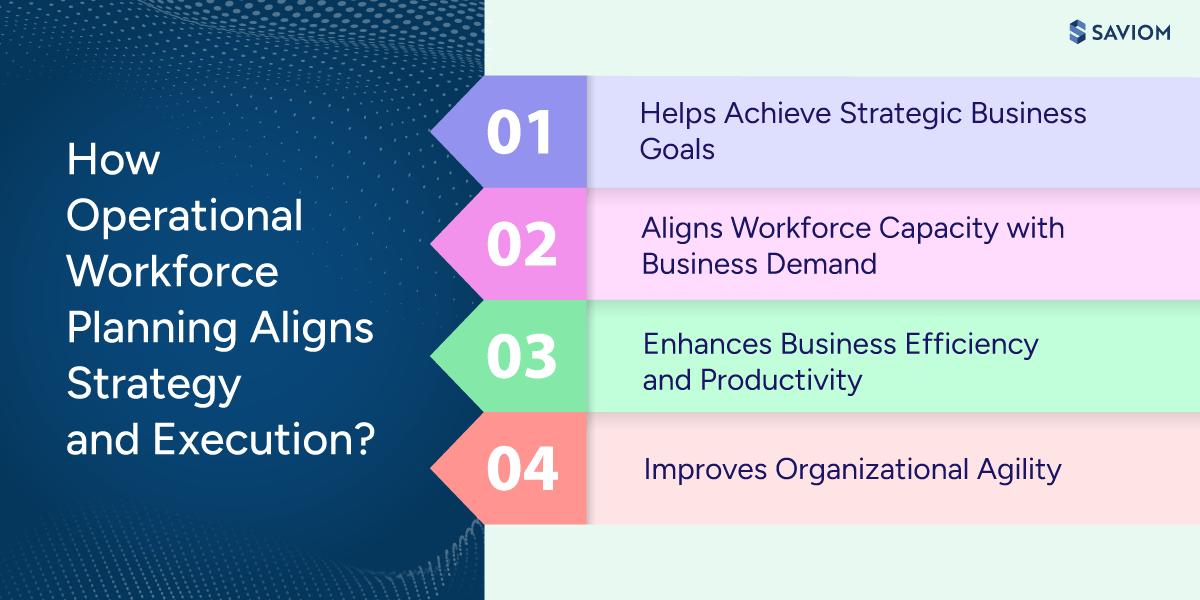
Provides a Roadmap to Achieve Strategic Business Goals
Operational workforce planning focuses on the short- to medium-term workforce needs required to execute strategic goals. It answers practical questions such as:
- How many employees are needed next month or quarter?
- What skills are required to support new initiatives?
- How should staff be allocated?
- Where are the workforce shortages or surpluses?
By addressing these questions, it ensures that strategic priorities are backed by the right workforce at the right time.
Aligns Workforce Capacity with Business Demand
A well-defined operational workforce planning process helps align workforce capacity with actual business demand. It ensures that staffing decisions directly support organizational priorities. The following examples illustrate how strategic priorities translate into specific workforce planning actions:
| Strategy | Operational Workforce Planning Action |
|---|---|
| Expand customer service operations | Hire and train additional service agents |
| Launch a new product | Allocate technical, marketing, and support staff |
| Improve delivery speed | Optimize staffing levels and shifts |
| Implement digital tools | Train employees in new technology |
This alignment ensures optimal resource utilization, enhances efficiency, and helps firms meet business goals without overstaffing or understaffing.
Deep dive into workforce capacity planning.
Enhances Business Efficiency and Productivity
Operational workforce planning improves execution by ensuring optimal deployment of resources. It helps organizations:
- Optimize staffing levels
- Reduce unnecessary overtime
- Prevent skill shortages
- Allocate talent to high-value work
As a result, workforce capacity is utilized more effectively, leading to improved productivity and enhanced operational efficiency.
Improves Organizational Agility
According to a report by the World Economic Forum, “As skill gaps continue to rank among the leading barriers to transformation, agility increasingly depends on workforce visibility rather than intuition.”
Operational workforce planning strengthens an organization’s ability to respond to changing business conditions by improving visibility into workforce capacity and demand. It enables organizations to:
- Adjust staffing levels quickly
- Reallocate employees across functions
- Respond to fluctuations in demand
- Manage resource-related risks
This agility ensures that strategic plans remain realistic, responsive, and executable even in rapidly evolving environments.
Now, let’s understand the difference between operational, tactical, and strategic workforce planning.
Operational vs. Tactical vs. Strategic Workforce Planning
Workforce planning operates at multiple levels, strategic, tactical, and operational, each serving a distinct purpose in aligning people with business objectives. While these types are closely connected, they differ in scope, time horizon, and level of execution. Understanding these differences is essential for aligning long-term goals with day-to-day workforce decisions.
| Dimension | Operational Workforce Planning | Tactical Workforce Planning | Strategic Workforce Planning |
|---|---|---|---|
| Primary Purpose | Ensure day-to-day and near-term work is fully staffed and executable | Translate strategy into medium-term capacity and hiring plans | Define future workforce capabilities aligned with business strategy |
| Time Horizon | Short term (weeks to months) | Medium term (6–18 months) | Long term (2–5+ years) |
| Decision Level | Delivery and operations | Portfolio and department leadership | Executive and business leadership |
| Key Questions Answered | Who does what, when, and with which skills? | How do we align capacity with upcoming initiatives and programs? | What capabilities and workforce will we need in the future? |
| Demand Input | Active projects and operational workload | Approved initiatives and portfolio roadmap | Business strategy, market trends, growth plans |
| Typical Outputs | Staffing plans, schedules, redeployment or hiring actions | Capacity plans, hiring plans, sourcing strategies | Workforce strategy, hiring roadmaps, reskilling roadmap |
| Update Frequency | Weekly or monthly | Quarterly or rolling cycles | Annual or multi-year cycles |
| Business Value | Improves delivery reliability, utilization, and cost control | Ensures readiness for upcoming initiatives | Builds long-term capability readiness and competitiveness |
Next, let us understand the key components of a modern operational staffing plan.
Critical Components of a Modern Operational Staffing Plan
An effective operational staffing plan is built on a set of interconnected components that ensure workforce decisions are aligned with business demand. These components provide the foundation for forecasting needs, allocating resources, and maintaining execution readiness. Let’s take a closer look at the core components:
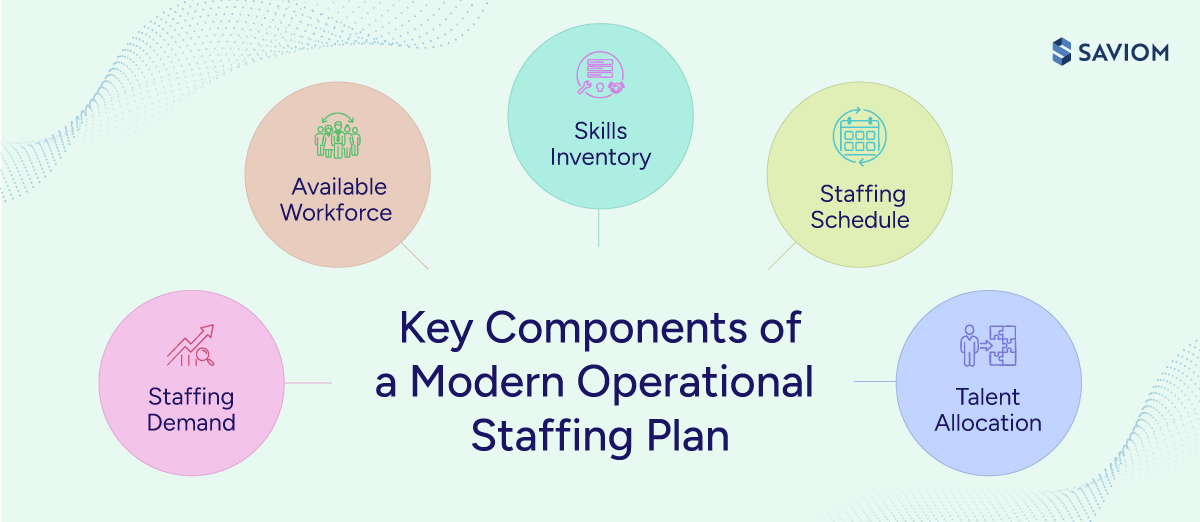
Staffing Demand
Staffing demand refers to the quantity and type of workforce required to deliver projects and ongoing operations. It translates business activities into role- and skill-based requirements over specific time periods such as weeks or months. Consequently, it enables organizations to anticipate demand peaks and potential capacity constraints in advance, allowing for proactive resource planning.
Available Workforce
The available workforce represents the actual capacity of the organization across roles, skills, and time periods. It helps managers compare forecasted demand with existing workforce availability to identify skill gaps or excess capacity. As a result, managers can take timely actions such as hiring, retraining/upskilling, redeploying, or reprioritizing work.
Read our detailed blog on resource availability.
Skills Inventory
A skills inventory is a structured record of roles, skills, experience, and certifications of an organization’s employees. It ensures that both demand and capacity are described using consistent definitions. This prevents ambiguity caused by unclear job titles or inconsistent naming conventions. As a result, skill inventory or skill matrix enables accurate alignment between work requirements and available talent.
Staffing Schedule
The staffing schedule translates operational demand and workforce capacity into a time-phased plan for resource deployment. It outlines when resources should be onboarded, redeployed, or released, and how staffing aligns with project timelines and operational cycles. This provides forward visibility into staffing changes, enabling more disciplined sequencing of work, a smoother onboarding process, and handoffs.
Understand what resource scheduling is and how it helps in project success.
Talent Allocation
Talent allocation assigns specific individuals or teams to planned work activities. It converts staffing plans into clear ownership and accountability at the execution level. When each work package is backed by well-matched resources, organizations can balance workloads more effectively, minimize scheduling conflicts, and prevent both overuse and underutilization of resources.
After components, let us take a look at the types of operational workforce planning.
Operational Workforce Planning by Workforce Type
Planning by workforce type matters because a single staffing logic does not fit every labor model. The planning cadence, constraints, and levers change significantly depending on the workforce type. Understanding these distinctions helps organizations apply the right planning approach for each workforce segment.
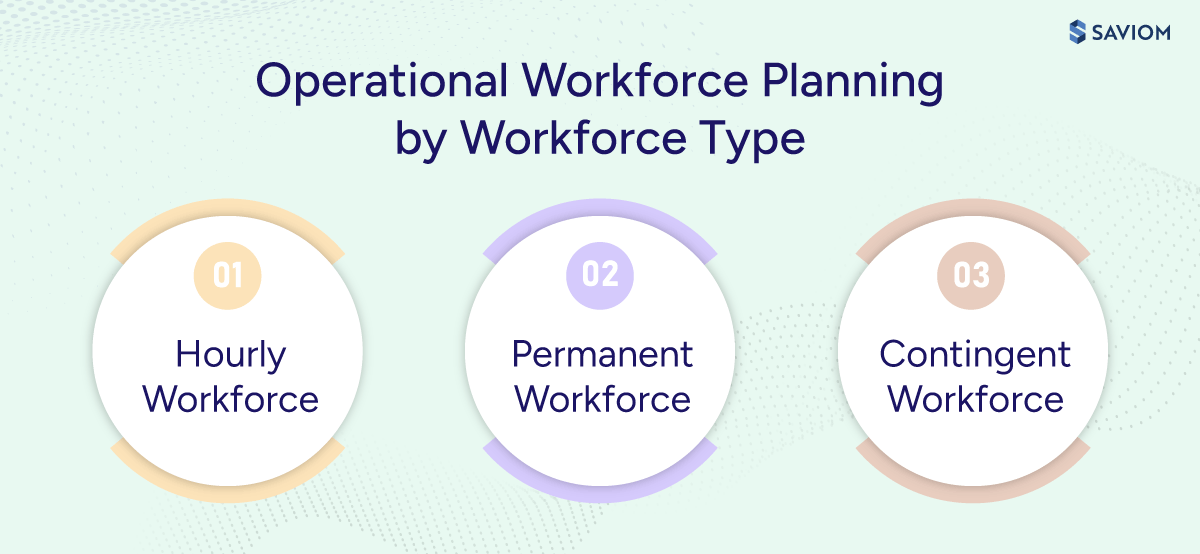
Hourly Workforce
The hourly workforce is a group of employees who are compensated based on the number of hours they work. They are important for businesses to ensure adequate coverage during peak and off-peak periods. Workforce planning for hourly employees focuses on shift planning, workload-based staffing, and optimizing labor hours to meet short-term operational needs.
Permanent Workforce
A permanent workforce includes full-time or part-time employees who are hired on an ongoing basis and receive a fixed salary along with benefits. These employees form the core of the organization and are typically aligned with long-term business goals. Workforce planning for permanent staff focuses on capacity utilization, skill development, and role stability.
Contingent Workforce
A contingent workforce consists of non-permanent workers such as contractors, freelancers, consultants, or temporary staff engaged for specific projects or time periods. Organizations use contingent workers to manage demand variability or access specialized skills. Workforce planning here focuses on flexible staffing, rapid onboarding, and scaling capacity without increasing permanent headcount.
Learn more about contingent workers.
Next, let us take a look at the operational workforce planning process.
The 5-Step Operational Workforce Planning Process
Behind every well-executed operation is a planning process that connects operational demand with workforce capacity and execution. Without this structure, staffing decisions often become reactive and short-term. Here is a step-by-step approach that helps organizations bring consistency and discipline to workforce planning:
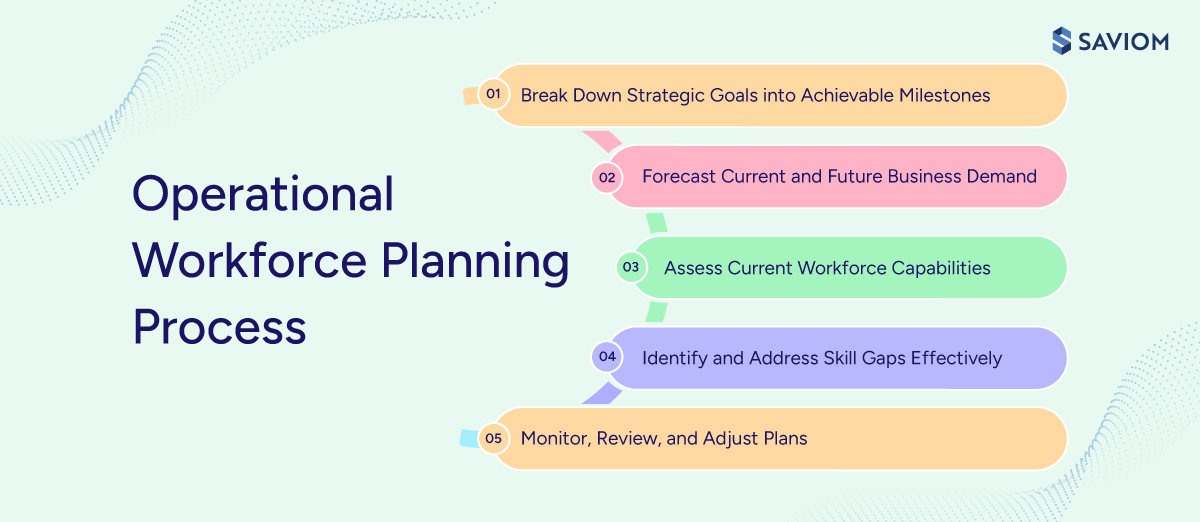
Break Down Strategic Goals into Achievable Milestones
Operational workforce planning begins with translating high-level business objectives into actionable milestones. Long-term goals are broken down into monthly or quarterly targets, along with the key initiatives and operational activities required to achieve them. This step establishes clear timelines and priorities, ensuring that operational workforce planning is grounded in realistic execution needs rather than abstract strategy.
Forecast Current and Future Business Demand
Once milestones are defined, the next step is to forecast workforce demand. This involves breaking down each initiative and operational activity into specific roles and skills. Demand is then translated into time-phased requirements, such as hours or full-time equivalents (FTEs) per week or month, providing clarity on when and where specific skills will be needed.
Deep dive into the resource forecasting blog to uncover its benefits.
Assess Current Workforce Capabilities
The third step involves evaluating the current workforce in terms of skills, competencies, availability, and resource utilization. It also accounts for real-world factors such as vacations, attrition, and operational buffers to build an accurate view of effective capacity. Both internal employees and external resources, including contingent workers and approved hires, are considered to ensure a comprehensive capacity assessment.
Identify and Address Skill Gaps Effectively
With demand and capacity clearly defined, organizations can identify gaps between required and available talent. This includes both shortages that may delay execution and surpluses that may lead to underutilization. They can then take targeted actions such as hiring, redeployment, upskilling, contracting, or reprioritizing work, ensuring workforce decisions remain proactive and aligned with business priorities.
Explore how to measure resource capacity and demand effectively.
Monitor, Review, and Adjust Plans
Lastly, organizations must regularly track workforce demand and utilization against the plan. As business conditions change, due to delays, new initiatives, or shifts in project scope, workforce requirements should be reforecasted. This enables timely adjustment to staffing decisions and ensures that workforce plans remain aligned with both operational realities and strategic objectives.
Read this eBook to learn how 5th gen resource management improves workforce visibility and helps organizations gain a competitive edge.
After the process, let us learn about demand and capacity planning at the operational level.
Demand and Capacity Planning at the Operational Level
The success of day-to-day operations depends on how effectively organizations align demand with available workforce capacity. Even small misalignments can lead to inefficiencies, delays, and increased costs, making demand and capacity planning a critical component of operational workforce planning. The following sections explore its key functions in detail.
Operational Demand
Operational demand is the total effort required to deliver planned projects, tasks, and operational activities within a defined period. Managers can estimate it using project pipeline analysis, work breakdown structures, historical effort benchmarks, task-level effort estimates, and skill-based demand mapping.
Formula for Calculating Operational Demand
Or more explicitly:
Workforce Capacity
Workforce capacity is the total productive time the workforce is available to undertake different initiatives. It should be assessed through resource availability analysis, utilization assumptions, leave and absence patterns, skill inventory mapping, and capacity calendars.
Formula for Calculating Workforce Capacity
time + non-operational time)
Where non-working time may include leave, holidays, sickness, and absence, and non-operational time may include training, internal meetings, admin work, and compliance activities.
Read our blog on resource capacity planning.
Workforce Gap Analysis
Workforce gap analysis compares operational demand and resource capacity to determine whether the organization can realistically execute the work ahead. It reveals shortages, surpluses, feasibility risks, and the likely need for hiring, outsourcing, redeployment, or reprioritization. Additionally, it prevents managers from committing to work that the current workforce cannot deliver.
Formula for Workforce Gap Analysis
If:
- Ratio > 1 → Surplus capacity with room for additional work or redeployment
- Ratio = 1 → Balanced workload with limited flexibility
- Ratio < 1 → Capacity shortage requiring intervention before execution suffers
Building an Operational Workforce Plan
By combining demand estimation, capacity analysis, and gap assessment, organizations can build an operational workforce plan. It helps managers identify future capacity or capability shortages early and supports hiring and training decisions. Managers can also determine what work can realistically be accepted and improve delivery reliability.
Learn how to create an effective resource management plan.
Now, let us take a look at what operational workforce KPIs organizations need to track.
Measuring Success: Operational Workforce Planning KPIs to Track
To evaluate the effectiveness of operational workforce planning, organizations need a well-defined set of KPIs that measure alignment between demand and capacity, workforce utilization, and delivery performance. Here are the critical operational workforce planning metrics businesses should track:
Workforce Forecast Accuracy
Workforce forecast accuracy measures how closely forecasted talent demand matches actual demand. Higher accuracy reduces last-minute hiring, rescheduling, and staffing chaos while improving project budget discipline and execution readiness.
Formula:
Actual Demand) X 100
Workforce Availability Rate
Workforce availability rate tracks the percentage of time resources are available to support operational and project work. Low availability often signals overbooking, hidden non-billable work, or poor planning assumptions.
Formula:
Workforce Utilization Rate
The workforce utilization rate is a critical metric that measures how effectively the workforce is utilized against its total available capacity. It helps firms identify instances of under- and overutilization and take corrective action to prevent burnout and boost workforce efficiency.
Formula:
X 100
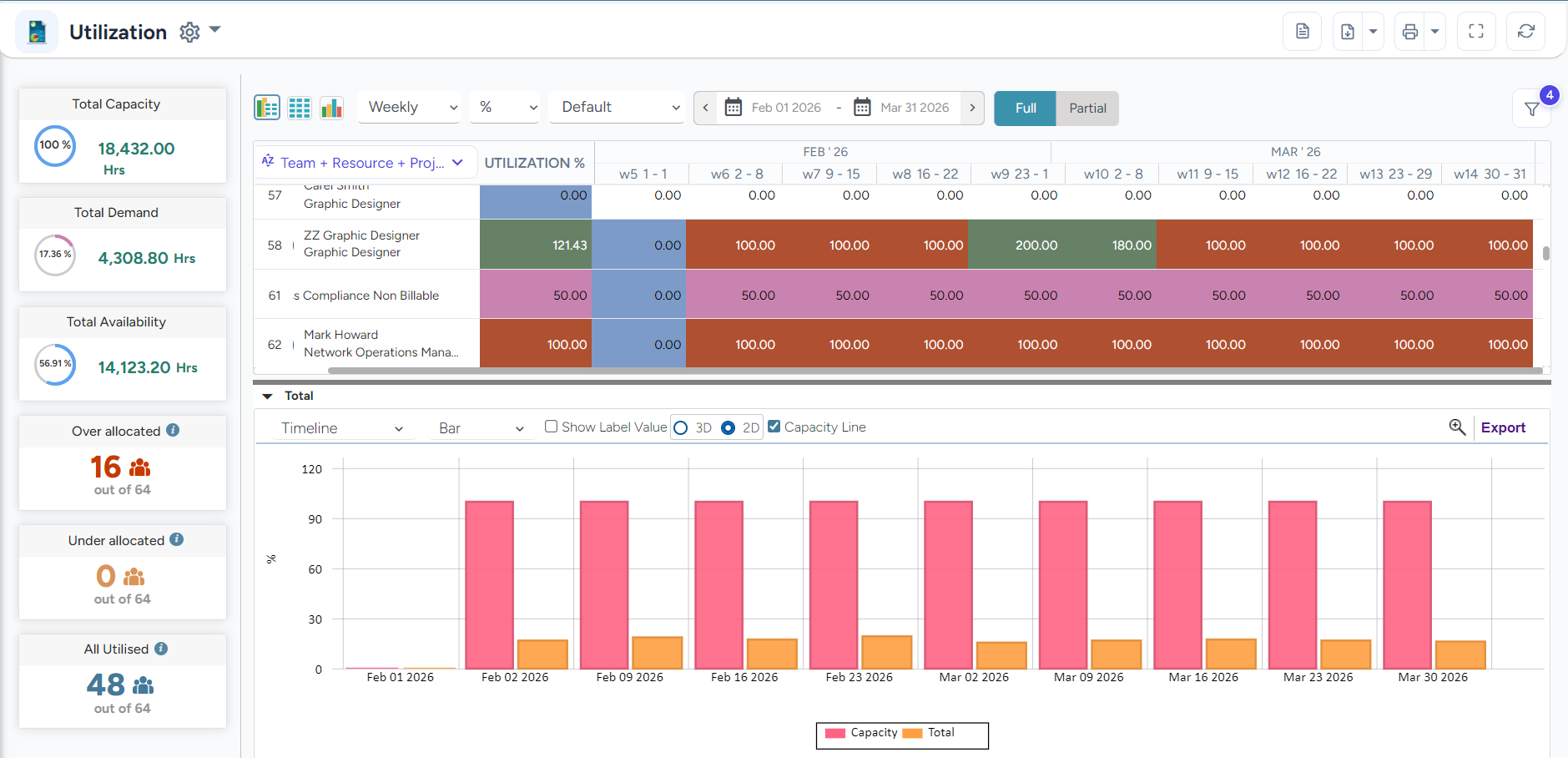 SAVIOM’s Utilization Report visualizes resource over- or underutilization using color-coded indicators, supporting data-driven decision-making.
Workforce Allocation Effectiveness
Workforce allocation effectiveness measures how efficiently and accurately resources are assigned to the projects based on their skills, availability, and business priorities. It evaluates whether the workforce is being utilized in a way that maximizes productivity while minimizing conflicts, underutilization, or overloading.
Formula:
Allocated Hours) X 100
Forecast vs. Actual Workforce Utilization
Forecast vs. actual workforce utilization measures the variance between planned and actual utilization. Significant gaps indicate misalignment due to inaccurate forecasts, shifting priorities, or weak allocation practices. This metric helps identify resource planning gaps and should trigger a review of demand assumptions and resource allocation to improve future accuracy and utilization.
Formula:
Utilization) / Forecasted Utilization] X 100
Skill Gap Index
The skill gap index measures the difference between the skills the organization needs and the ones it currently has available. It is useful for highlighting roles that require targeted hiring, reskilling, or cross-training.
Formula:
Number of Skills Required
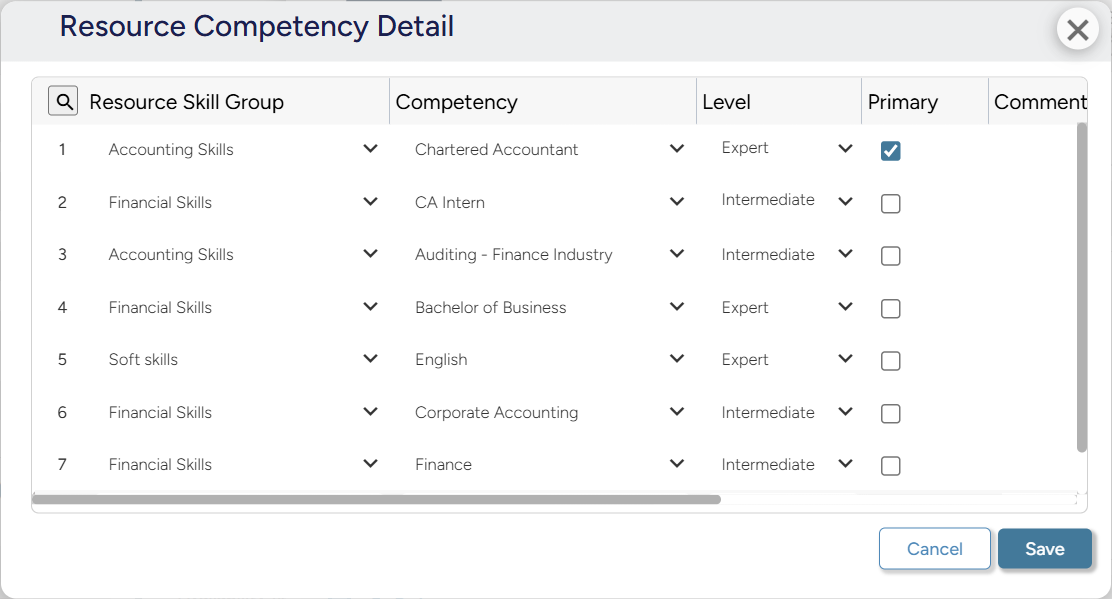 SAVIOM’s Competency Matrix enables managers to track skills, certifications, and proficiency levels, helping identify skill gaps and plan targeted reskilling initiatives.
Employee Turnover Rate
Employee turnover rate measures the percentage of employees who leave the organization over a given period. It reflects workforce stability and helps identify trends related to retention, engagement, and workforce planning. A high turnover rate may indicate issues such as poor workload balance or skill mismatches, while a stable rate reflects a healthier and more sustainable work environment.
Formula:
Average Number of Employees During the Period) X 100
Workforce Capacity Utilization
Workforce capacity utilization measures the extent to which available workforce capacity is being used for productive work over a given period. It compares actual work performed against total available capacity to assess how efficiently resources are utilized.
Formula:
100
After KPIs, let us take a look at the common operational workforce planning challenges and how they can be solved.
Common Operational Workforce Planning Challenges and Their Solutions
Organizations today face increasing complexity in aligning workforce capacity with dynamic business demands. By understanding these roadblocks and implementing targeted solutions, organizations can build a more agile, responsive, and optimized workforce that supports both short-term operations and long-term strategic goals. Here are common operational workforce planning challenges and solutions:
| Challenge | Impact | Solution |
|---|---|---|
| Poor Demand Visibility | Late identification of skill needs leads to reactive staffing, delivery delays, and missed opportunities | Build forward-looking demand forecasts using pipeline data, project milestones, and role-level effort estimates |
| Unrealistic Workforce Capacity | Overstated availability results in overcommitment, employee burnout, and frequent deadline slippages | Implement effective capacity planning that accounts for leave, administrative time, meetings, training, and other non-billable activities |
| Persistent Skill Mismatches | Work is assigned to underqualified or unavailable talent, impacting quality and slowing execution | Establish enterprise-wide skills visibility with standardized skill inventory that captures capabilities, proficiency, certifications, etc. |
| Overreliance on Contractors | Rising costs and erosion of institutional knowledge over time | Use contingent labor selectively while prioritizing internal redeployment, cross-skilling, and reskilling |
| Outdated Workforce Plans | Static plans quickly become misaligned with evolving demand, creating avoidable staffing gaps | Adopt continuous reforecasting through rolling planning cycles and scenario-based adjustments |
Explore common workforce planning challenges and their solution.
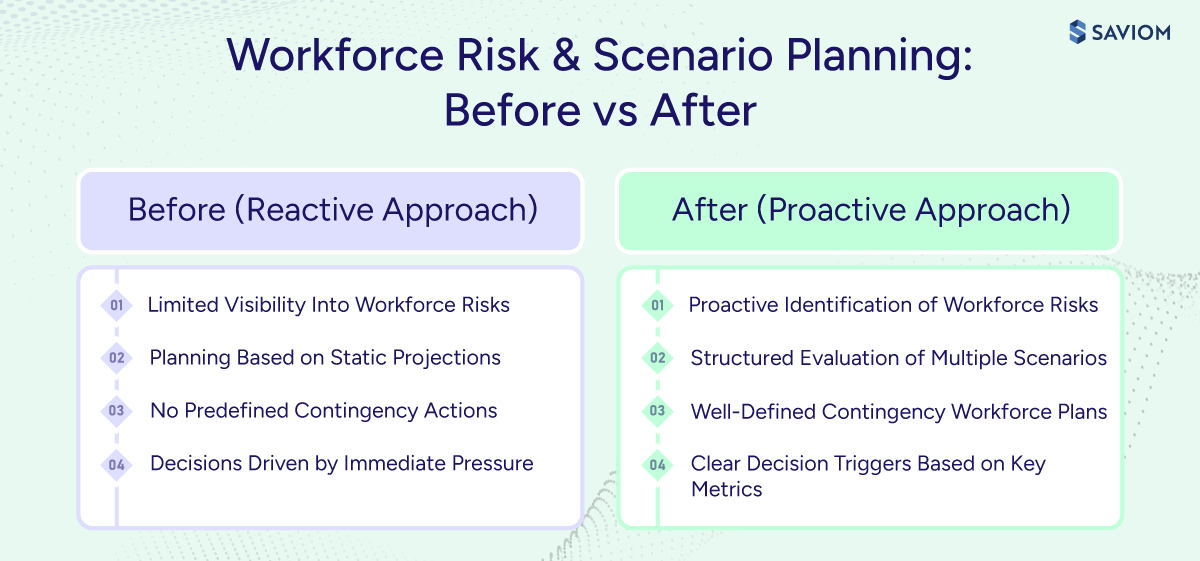
After understanding the key challenges, it is equally important to explore how organizations can proactively manage uncertainty through risk assessment, scenario planning, and what-if analysis.
Risk, Scenario & What-If Planning for Operational Workforce Resilience
Risk and what-if planning enable organizations to anticipate potential disruptions, evaluate alternative strategies, and make informed decisions under changing conditions. Let’s understand how contingency planning ensures organizations are better prepared to respond effectively while maintaining continuity and operational performance.
Identify Potential Workforce Risks and Opportunities
To strengthen workforce resilience, organizations should take a forward-looking view of both risks and opportunities. This includes:
- Assessing potential disruptions such as market shifts, automation, and changing demand patterns
- Identifying critical skill gaps that could impact future workforce capacity
- Monitoring external labor market constraints affecting hiring speed, cost, or talent availability
- Analyzing how technology changes may reshape roles and required capabilities
- Identifying opportunities such as internal mobility and digital enablement to improve agility and productivity
Implement Scenario Planning
Instead of planning for a single outcome, organizations should prepare for multiple possible futures. They can develop structured scenarios to assess how different conditions may impact workforce demand and capacity. Common scenarios include:
- Demand surge: A sudden increase in workload requiring additional capacity
- Demand slowdown: Reduced demand requiring workforce reallocation
- Talent shortage: Limited availability of niche-skilled resources
- Absence of key resources: Unexpected unavailability of individuals due to resignation, illness, leave, or other disruptions
- Scope changes: Expansion, reduction, or modification of project requirements that changes workforce needs
- Accelerated project deadlines: Project timelines bought forward, requiring faster execution often with the same resources
Scenario planning helps managers anticipate workforce gaps or surpluses and evaluate trade-offs before making decisions. Consequently, they can prepare alternative staffing strategies in advance and avoid last-minute interventions.
Deep dive into our scenario planning blog to understand the concept better.
Develop Contingency Operational Workforce Plans
Effective operational workforce planning includes clearly defined actions when conditions shift. Organizations should build contingency workforce plans that enable rapid and structured responses to demand fluctuations while minimizing disruption. Key response levers include:
- Upskilling and reskilling: Preparing employees for evolving roles and emerging skill needs
- Redeploying internal talent: Moving employees across projects to improve utilization
- Reprioritizing project staffing: Aligning resources to the most critical initiatives based on business priorities
- Leveraging contingent workforce selectively: Using external talent strategically to address short-term gaps without long-term cost burdens
- Adjusting hiring strategies: Accelerating hiring for critical roles or fast-tracking resource fulfillment to support compressed delivery timelines
By proactively defining these actions, organizations can respond with speed and confidence, ensuring continuity while maintaining operational efficiency.
Next, let’s explore how organizations can enhance operational workforce planning by integrating AI, advanced analytics, and modern planning tools to drive more informed, agile, and data-driven decisions.
Integrating AI, Analytics & Workforce Planning Tools
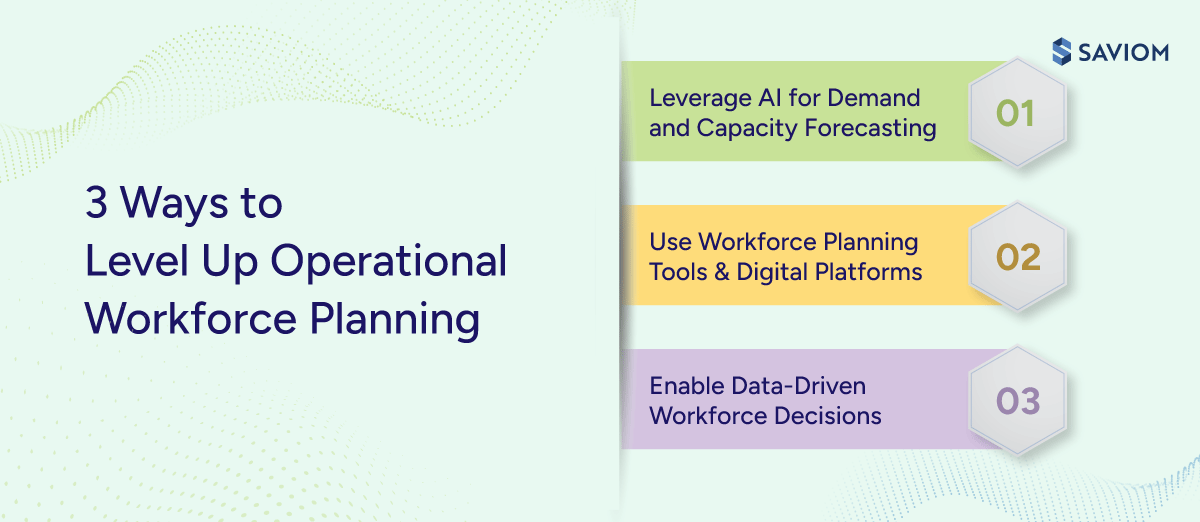
As operational workforce planning becomes more complex and data-intensive, organizations are increasingly leveraging AI, advanced analytics, and integrated planning tools to enhance accuracy, speed, and agility. Let’s explore how these technologies provide real-time visibility into workforce supply and demand, uncover actionable insights, and enable more predictive, data-driven decision-making.
AI for Demand and Capacity Forecasting
AI improves workforce forecasting by identifying patterns in historical workload, delivery cycles, staffing behavior, and capacity utilization that may not be visible through traditional analysis. It enables organizations to predict future demand, identify emerging skill gaps early, and recommend optimal staffing levels. Additionally, AI continuously refines forecasts and supports dynamic scenario simulation.
Workforce Planning Tools and Digital Platforms
Workforce planning tools and digital platforms help organizations streamline and centralize planning processes. They provide capabilities such as resource allocation, skills inventory management, capacity-demand modeling, and scenario planning. In addition, these tools provide real-time dashboards and reporting, enabling firms to plan more accurately and respond quickly to changing workforce needs.
Data-Driven Workforce Decisions
Integrating AI, analytics, and planning tools enables faster and more accurate workforce decisions. Organizations can evaluate multiple scenarios, understand constraints, and align staffing with business priorities. These technologies improve forecast accuracy while reducing manual effort in planning processes. They also enhance transparency, making workforce decisions more consistent and evidence-based.
Next, let us take a look at some industry-specific examples of operational workforce planning.
Industry Examples: Operational Workforce Planning in Different Sectors
Operational workforce planning looks different across industries because demand patterns, constraints, and workforce models vary widely. Understanding these differences helps organizations apply the right planning approaches instead of using a one-size-fits-all model. Moreover, real-world examples highlight how leading organizations adapt workforce planning to their specific operational realities.
IT Services Firms
Scenario: Accelerated AI Migration Timeline and MLOps Talent Gap in a BFSI Project
A Tier-1 IT services firm was executing a cloud and AI migration for a banking client. Midway through the program, the client accelerated timelines due to regulatory pressure. The firm faced a critical shortage of MLOps engineers, while several Java developers remain underutilized on the bench.
How operational workforce planning helped:
- The team mapped adjacent skill clusters and identified Java engineers with prior exposure to Python and DevOps.
- A 2-week rapid reskilling sprint was launched to transition these engineers into MLOps support roles.
- Non-critical internal projects were deprioritized, and three experienced MLOps specialists were reallocated to the project.
- Subcontractors were used only for low-risk modules, preserving margin on core deliverables.
Outcome: The firm avoided delays, improved billable utilization (bench reduced by ~18%), and built a reusable internal AI deployment talent pool for future projects.
Professional Services Firms
Scenario: Margin Erosion Due to Skill Mismatch in Consulting Firm
A consulting firm noticed declining margins across key engagements despite steady demand. Analysis revealed that senior consultants were overutilized for tasks that could be handled by mid-level staff, while junior consultants lacked structured deployment opportunities.
How operational workforce planning helped:
- Shifted routine work to mid- and junior-level consultants.
- Rebalanced team structures to optimize the Partner–Manager–Consultant mix.
- Reserved senior consultants for high-impact activities and client interactions.
- Introduced structured allocation to improve utilization across levels.
Outcome: The firm improved margin realization by 15%, increased billable utilization by 12% across roles, and delivered projects more efficiently without compromising quality.
Architecture, Engineering, and Construction (AEC) Firms
Scenario: Metro Rail Project Facing Permit Delays
An AEC firm working on an urban metro project experienced unexpected delays in environmental permits, halting civil construction activities for six weeks.
How operational workforce planning helped:
- The firm implemented a phase-shift staffing model, reallocating engineers to design validation and simulation work for upcoming project phases.
- Selected site supervisors were temporarily reassigned to another project with similar structural requirements.
- A rolling staffing schedule was introduced, aligned with permit approval probabilities rather than fixed timelines.
Outcome: Bench time reduced by 40%, downstream project phases were completed faster due to pre-work, and costs did not spiral out of control.
Audit, Accounting, and Legal Firms
Scenario: Tax Season Overload in a Mid-Sized Accounting Firm
During peak tax season, a mid-sized accounting firm experienced uneven workload distribution, with complex filings concentrated among a few senior accountants, while mid-level staff were primarily assigned simpler tasks.
How operational workforce planning helped:
- Reassigned moderately complex filings to mid-level staff to reduce dependency on senior accountants.
- Upskilled selected mid-level accountants to handle higher-complexity work, expanding available capacity.
- Restructured senior accountants’ roles to focus on review and quality assurance rather than end-to-end execution.
Outcome: Turnaround time improved by 20%, error rates dropped, and senior staff’s workload became more sustainable.
Healthcare Organizations
Scenario: Surge in Emergency Cases in a Multi-Specialty Hospital
A multi-specialty hospital experienced recurring weekend spikes in emergency cases, particularly trauma and cardiac incidents. While staffing levels remained uniform throughout the week, leading to increased patient wait times and staff strain.
How operational workforce planning helped:
- Introduced demand-based shift redesign, aligning staffing with historical patient inflow patterns.
- Created a flexible pool of cross-trained nurses who could be deployed across the ER and ICU based on demand.
- Introduced short-duration “micro-shifts” during peak hours to provide targeted capacity without overstaffing.
Outcome: Patient wait times reduced by ~25%, staff burnout decreased, and overall service quality improved without increasing headcount.
Plan, manage, and optimize your workforce in real-time using SAVIOM’s advanced workforce management software. Get your free demo now.
Linking Operational Plans to Strategic Workforce Planning
Operational workforce planning focuses on meeting immediate and near-term talent needs, while strategic workforce planning defines long-term capability requirements aligned with business goals. Linking the two ensures that short-term staffing decisions support broader organizational priorities rather than solving problems in isolation.
When operational plans are aligned with strategic workforce planning, day-to-day hiring, allocation, and redeployment decisions contribute to future skill readiness. This connection helps organizations build critical capabilities, close long-term skill gaps, and avoid reactive workforce adjustments.
By continuously feeding operational insights, such as workload trends, utilization patterns, and recurring skill shortages, into strategic planning, organizations improve workforce forecasting and investment decisions. This creates a cohesive workforce strategy that balances immediate execution needs with long-term growth objectives.
Explore what workforce management is and how it helps improve business efficiency.
Conclusion
Operational workforce planning is the execution backbone of modern enterprise delivery. It connects strategy to staffing, demand to capacity, and workforce cost to business performance. When organizations plan with real skills, real timing, and real deployable capacity, they reduce delivery risk, improve utilization quality, and make growth more scalable.
Beyond efficiency, it also enables organizations to become more resilient and adaptive in the face of uncertainty. By continuously aligning workforce decisions with evolving business priorities, companies can respond faster to market changes, optimize talent investments, and create a more agile operating model.
FAQs
Operational workforce planning is the process of aligning an organization’s short-term staffing needs with its day-to-day business operations. It ensures that the right number of employees, with the right skills, are available at the right time to meet demand, maintain productivity, and control costs.
Operational workforce planning is important for organizations because it:
1. Provides a roadmap to achieve strategic business goals
2. Aligns workforce capacity with business demand
3. Enhances business efficiency and productivity
4. Improves organizational agility
Operational workforce planning focuses on the short term, ensuring day-to-day work is staffed by aligning current demand with available capacity. Strategic workforce planning focuses on the long term, defining future workforce needs, skills, and capabilities to support business goals. In simple terms, strategy sets direction, while operations ensures execution.
The key steps in operational workforce planning are:
1. Break down strategic goals into achievable milestones
2. Forecast current and future business demand
3. Assess current workforce capabilities
4. Identify and address skill gaps effectively
5. Monitor, review, and adjust plans
The common challenges in operational workforce planning include:
1. Poor demand visibility
2. Unrealistic workforce capacity
3. Constant skill mismatches
4. Overreliance on contractors
5. Outdated workforce plans
Operational workforce planning supports cost control by aligning staffing levels with actual demand, preventing overstaffing, and reducing unnecessary labor costs. It optimizes resource allocation, minimizes overtime, and ensures work is assigned to the right skill level, improving efficiency while maintaining productivity.
There are three main workforce types:
1. Hourly workforce
2. Permanent workforce
3. Contingent workforce