

Introduction
As organizations grow and business demands evolve, ensuring the right resources are in place becomes increasingly critical. In many cases, companies struggle to keep their resources aligned with changing needs, leading to skill shortages, a lack of specialized expertise, and inadequate infrastructure that can hinder business performance and growth.
This is where robust resource capacity building becomes essential. It enables organizations to strengthen both human and non-human resources, equipping teams with the skills, knowledge, and tools they need to stay agile, tackle resource constraints effectively, and seize new opportunities.
In this article, we’ll explore what resource capacity building is, its benefits, and practical strategies to enhance organizational performance and drive future success.
What is Resource Capacity Building?
Resource capacity building is the systematic process of developing skills, knowledge, and capabilities while strengthening organizational infrastructure to meet long-term and short-term business demands sustainably.
It involves initiatives, such as targeted retraining/upskilling, process improvements, and technology enablement, to tackle persistent resource challenges and ensure timely project delivery. Unlike short-term fixes, it focuses on long-term capability creation, helping firms enhance their people, processes, and tools to drive sustainable business growth.
Having laid down the groundwork, it is important to understand the business value of resource capacity building and the tangible outcomes it delivers.
Read our guide on resource capacity planning to learn how to stay future-ready.
Why is Resource Capacity Building Important?
Resource capacity building improves both organizational efficiency and business growth by strengthening tangible and intangible assets to meet demands effectively. Key benefits include:
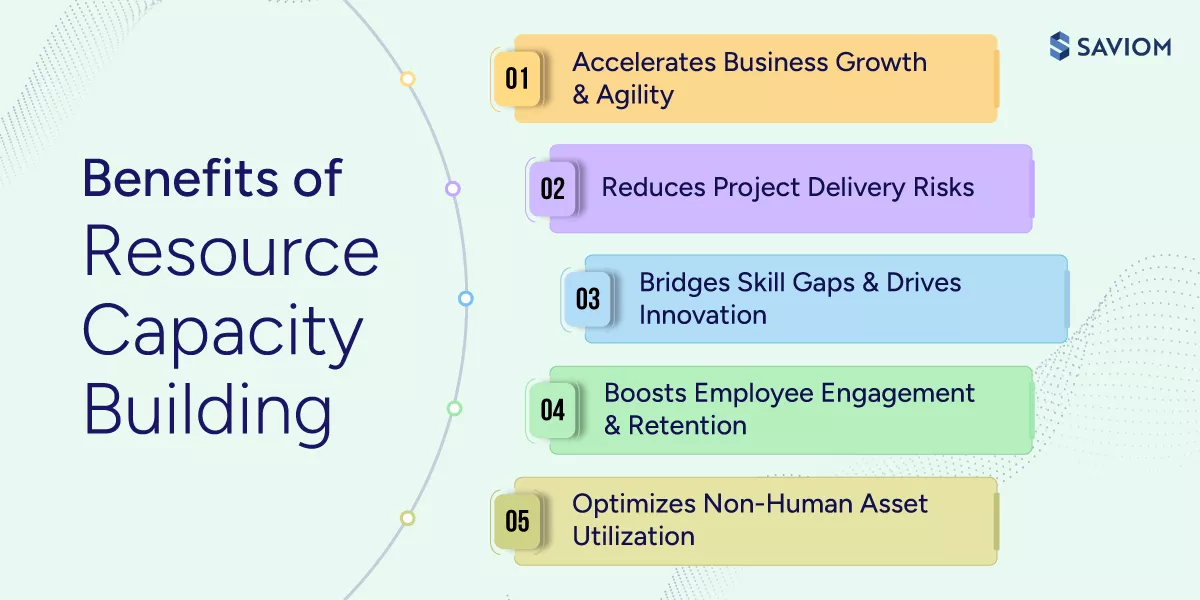
Accelerates Business Growth and Agility
Resource capacity building ensures organizations have the right people, tools, and systems available when needed. This enables firms to respond faster to market and customer demand, allocate resources efficiently, and reduce reliance on expensive, last-minute hiring or external contractors.
Reduces Project Delivery Risks
By proactively identifying potential risks, such as skill shortages, outdated technology, or operational capacity bottlenecks, organizations can develop targeted skills, processes, and systems to mitigate them. These resource capacity building strategies help ensure projects are delivered on time, within budget, and meet expected quality standards.
Read our blog to explore how to mitigate resource risks in project management.
Bridges Skill Gaps and Drives Innovation
By first identifying future skill gaps, organizations can upskill, cross-train, or hire employees to meet evolving demand. These initiatives equip teams with critical skills and enable the adoption of new technologies, tools, and delivery models, which naturally drive innovation and improve project outcomes.
Boosts Employee Engagement and Retention
By investing in continuous learning, mentorship, and career development through a resource capacity-building plan, organizations demonstrate that employees are valued and supported. This strengthens the sense of appreciation, increases job satisfaction, boosts productivity, and reduces employee turnover over time.
Explore different strategies to enhance employee engagement.
Optimizes Non-Human Asset Utilization
A resource capacity-building framework ensures that equipment, tools, systems, and infrastructure are well-maintained, upgraded, and efficiently allocated to projects. This enhances asset readiness, maximizes resource utilization, and ensures projects are delivered reliably, efficiently, and within budget.
Now that we understand the benefits, let’s explore the distinction between resource capacity building and resource capacity planning.
Resource Capacity Building vs. Resource Capacity Planning
While both resource capacity building and resource capacity planning focus on optimizing resources, they differ in purpose, focus, and timeframe. The following section clarifies these differences.
| Aspect | Resource Capacity Building | Resource Capacity Planning |
|---|---|---|
| Definition | It is the process of strengthening and enhancing employees’ skills and the organization’s infrastructure to achieve long-term goals. | It is the process of forecasting and bridging capacity gaps to efficiently meet upcoming project requirements. |
| Goal | To build sustainable capability to handle complexity, change, and growth | To ensure the right resources are available at the right time |
| Timeframe | Long-term, aiming for scalability and organizational maturity | Short to medium-term, driven by present and future capacity demand |
| Outcome | Stronger skills coverage, enhanced performance, adaptability, and resilience | Improved efficiency, addressing skill shortages and excesses seamlessly |
Explore this blog to learn about resource capacity planning challenges and how to overcome them.
The following section will explore the strategies for effective resource capacity building.
9 Proven Strategies for Resource Capacity Building
Below are the resource capacity building strategies that organizations can implement to strengthen business performance over time:
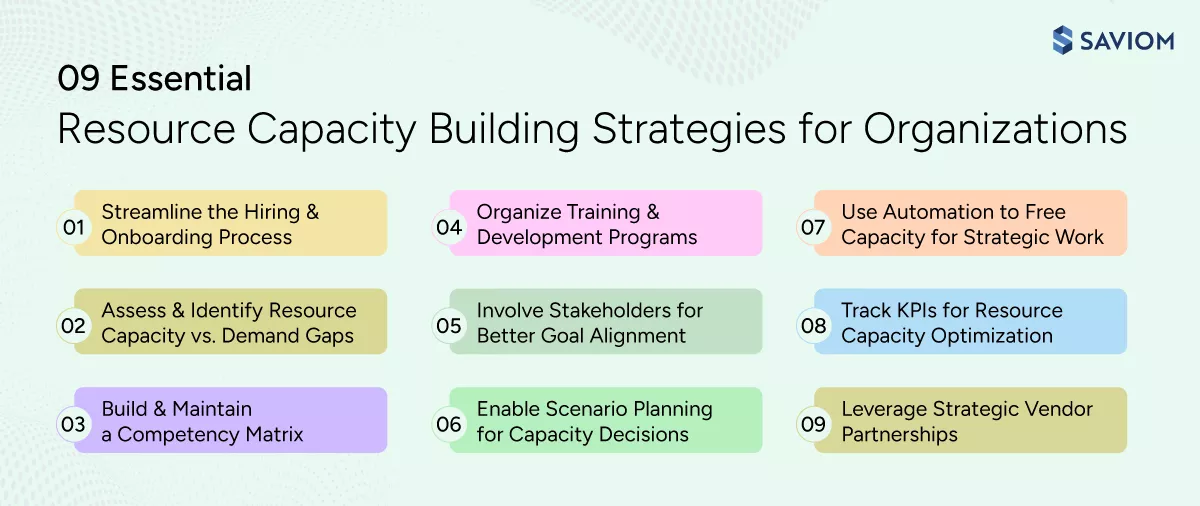
Streamline the Hiring and Onboarding Process
Implement role-based hiring and a structured onboarding process to ensure new employees have the right skills and understand business priorities from day one. This accelerates time-to-productivity, closes early skill gaps, and strengthens operational capacity, enabling teams to support organizational growth.
Assess and Identify Resource Capacity vs. Demand Gaps
According to a McKinsey Global Survey, “87% of executives say their organizations already face or expect skill gaps within the next few years.”
To avoid this risk, organizations must actively forecast future resource capacity requirements to identify excess or shortage before they impact business performance. With proactive resource capacity building, firms can invest in upskilling, training, or implementing a phased hiring strategy.
For example, an IT services organization anticipating multiple cloud migration projects identifies a shortfall of certified cloud architects. By initiating phased hiring and upskilling existing engineers early, the firm avoids costly contractors and ensures on-time project delivery.
Read our blog to understand how to measure resource capacity and demand.
To learn how organizations can build skills, improve execution capability, and plan for future demand, read our eBook on resource capacity planning.
Build and Maintain a Competency Matrix
To build capacity effectively, organizations should maintain an up-to-date skills matrix that tracks employees’ skills, qualifications, and progress. This helps managers identify skill gaps and implement targeted training, upskilling, and mentorship programs, enabling the firms to develop a versatile, future-ready workforce.
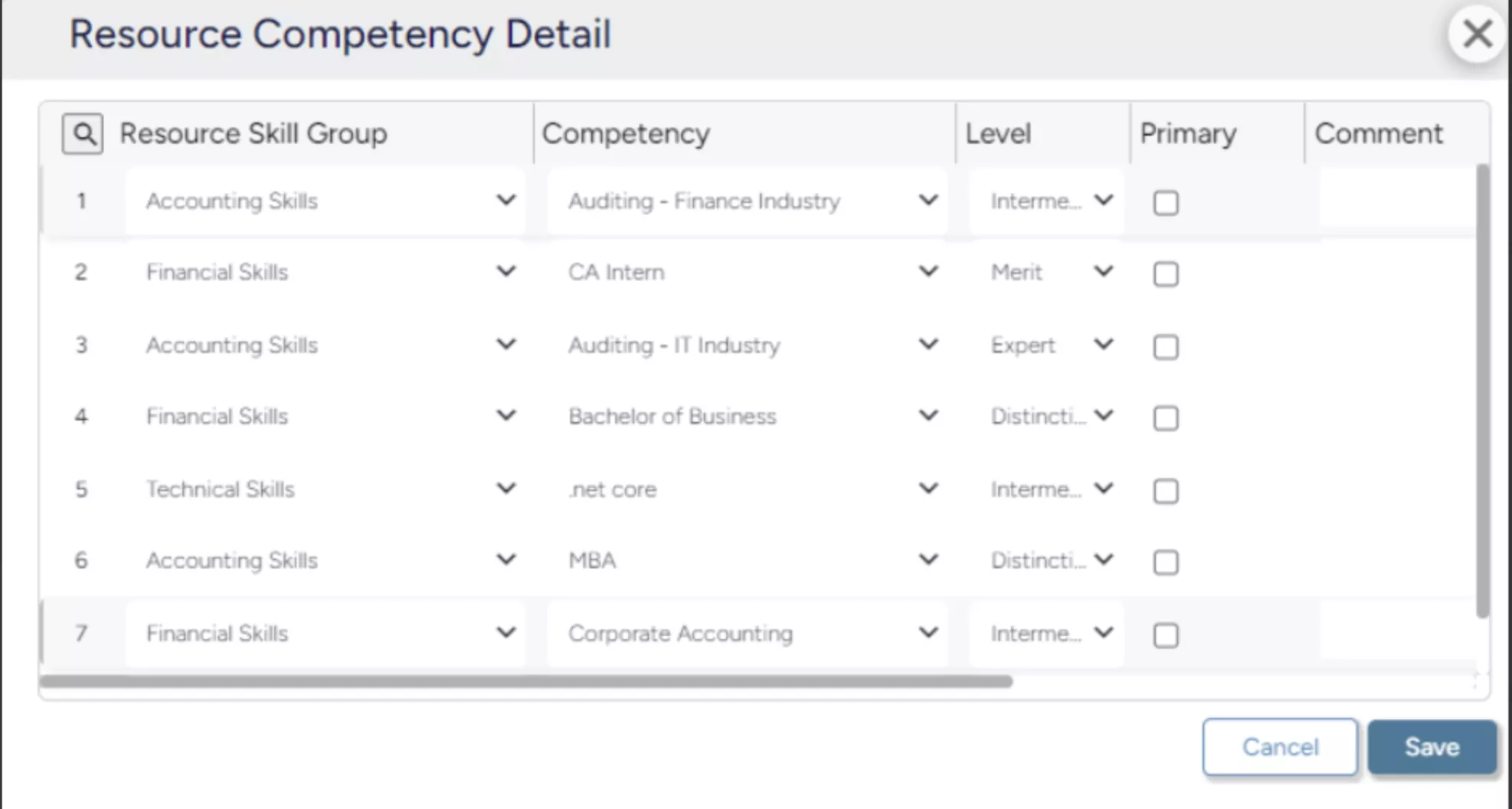 SAVIOM’s Competency Matrix enables managers to track skills, certifications, and proficiency levels, helping identify skill gaps and plan targeted reskilling initiatives.
Organize Training and Development Programs
According to McKinsey research, “Nearly 70% organizations with reskilling programs say the business impact met or exceeded the investment.”
To build an optimized workforce and engage employees, implement tailored training programs that combine organizational skill needs with Individual Development Plans (IDPs). Equipping employees with new skills enhances task execution, boosts productivity, and directly contributes to organizational success.
Read our blog on skill development.
Involve Stakeholders for Better Goal Alignment
As part of resource capacity building, actively engage project stakeholders, the finance team, and HR in demand forecasting and resource planning discussions. This ensures that training, hiring, and infrastructure investments align with business goals, making capacity-building efforts practical, cost-effective, and strategically relevant.
For example, before approving a hiring plan, a consulting firm may involve the finance team to validate budgets, the HR team to assess timelines, and other stakeholders to confirm skill requirements. This collaboration prevents over-hiring, avoids budget overruns, and ensures hiring decisions directly support successful project delivery.
Drive Resource Capacity Decisions Using Scenario Planning
Organizations can model multiple scenarios in a sandbox environment, considering constraints such as resource shortages, tight project timelines, and financial limits, to assess whether existing resources can meet upcoming needs. This analysis helps managers evaluate risks, make informed decisions, and develop a robust resource capacity plan.
For example, an accounting firm planning to expand into advisory services may assess if existing staff can handle the additional workload, identify required skills, and determine if hiring is needed. This helps leadership understand resource capacity risks before committing to the new service line.
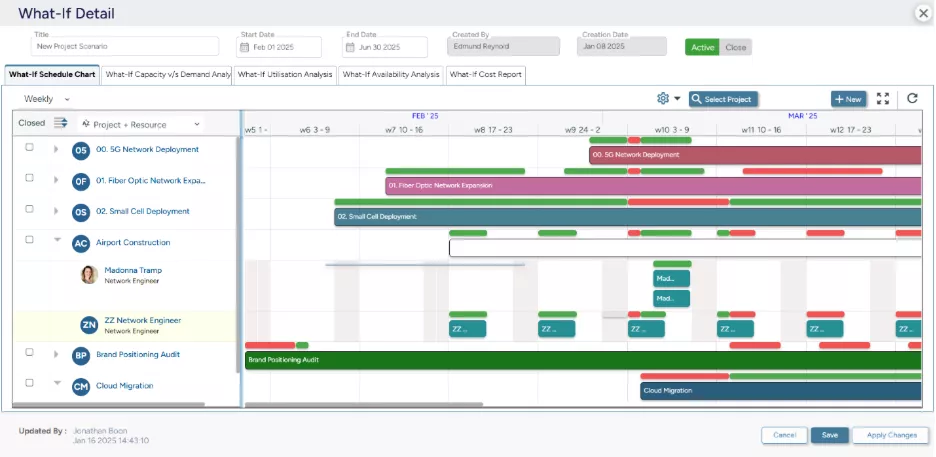 SAVIOM’s What-If Analysis empowers managers to compare various workforce scenarios and select the most favorable and profitable outcome.
Use Automation to Free Resource Capacity for Strategic Work
As per a McKinsey Survey, “72% of organizations that met their automation goals considered automation a strategic priority for better operational outcomes.”
By automating repetitive, low-value tasks, firms can streamline processes, reduce errors, and free up employees to focus on high-value, strategic, and billable work. This helps employees develop their skills and capabilities by engaging in work that is more aligned with their expertise and business priorities. Consequently, it improves resource utilization and drives higher revenue.
Track KPIs for Resource Capacity Optimization
Organizations should establish KPIs, such as resource utilization, skills gap index, system uptime, or task completion rates, to measure how effectively human and non-human resources are used. Regularly monitoring these metrics allows managers to spot deviations, take corrective action, and align resources with business demand to improve productivity.
For example, a law firm evaluating a legal research training program might track reduced case preparation time, higher billable hours per attorney, and fewer rework errors. These insights enable leadership to optimize allocation, close skill gaps, and refine future resource capacity-building initiatives.
Explore key resource management metrics to improve project performance.
Leverage Strategic Vendor Partnerships
Organizations should leverage strategic partnerships by carefully selecting vendors and clearly defining business objectives. In addition, they can use formal agreements to outline responsibilities and expected outcomes. This helps ensure the availability of niche skills and specialized tools required to meet demand without adding long-term overhead.
For example, an engineering firm working on a renewable energy project may partner with a specialized environmental analysis vendor for impact assessments. With defined SLAs, performance metrics, and regular coordination, the firm meets project requirements without maintaining a permanent in-house capability.
Strengthen delivery readiness and close capacity gaps with SAVIOM’s advanced resource management software. Book a demo to explore how it supports smarter resource capacity building.
Now that we have discussed the resource capacity building strategies, let’s see how a resource capacity planning tool can help with that.
How Can a Robust Resource Capacity Planning Software Help?
Organizations can rely on SAVIOM’s robust resource capacity planning software to drive business success and ensure sustainable growth. Here’s how:
- All-in-one resource planner offers enterprise-wide visibility into the resource pool, allowing managers to view current and future resource schedules.
- Embedded capacity planner helps managers anticipate future needs, identify resource gaps, and address them proactively.
- The KPI forecaster provides real-time insights into critical metrics such as resource availability, utilization, burnout, and skill gaps.
- A competency matrix helps track and record each employee’s current skills, competencies, certifications, etc., and helps mitigate skill gaps.
- What-if analysis feature helps simulate various scenarios in a sandbox environment and arrive at an optimized capacity plan.
- Real-time BI reports and dashboards provide insights into forecast vs. actual, project vacancy, and people-on-the-bench for informed decision-making.
Thus, the advanced functionalities of a capacity planner enable businesses to align workforce capabilities with strategic goals, thereby driving sustainable growth.
Conclusion
Resource capacity building is a continuous, enterprise-level capability rather than a one-time initiative. By deliberately investing in skills, infrastructure, and technology, organizations can scale delivery while maintaining predictability and supporting their workforce. Consequently, treating organizational capacity building as a strategic priority positions businesses for sustained growth and a future-ready workforce.
Frequently Asked Questions (FAQs)
Resource capacity building is the process of developing workforce skills, capabilities, organizational tools, and infrastructure to meet business demand sustainably, with a long-term focus on delivery capability rather than short-term staffing.
Resource capacity building is important for growing teams because it:
1. Accelerates business growth and agility
2. Reduces project delivery risks
3. Bridges skill gaps and drives innovation
4. Boosts employee engagement and retention
5. Optimizes non-human asset utilization
Resource capacity planning identifies future gaps, while resource capacity building focuses on closing those gaps by developing the skills, systems, and structures needed to turn plans into execution capability.
Key resource capacity building strategies include:
1. Streamline the hiring and onboarding process
2. Assess and identify resource capacity vs. demand gaps
3. Build and maintain a competency matrix
4. Organize training and development programs
5. Involve stakeholders for better goal alignment
6. Enable scenario planning for capacity decisions
7. Use automation to free capacity for strategic work
8. Track KPIs for resource capacity optimization
9. Leverage strategic vendor partnerships
KPIs such as resource capacity utilization rate, task completion rate, skills gap index, demand–supply variance, resource forecast accuracy, etc., indicate whether resource capacity-building efforts are effective.