

Introduction
Are your resource management practices helping your business grow, or quietly limiting its potential?
Growth is not only about winning new projects or increasing revenue. It also depends on how effectively an organization manages resources, matches skills to work, and delivers as business needs evolve. That is why resource management needs to evolve from a reactive function into a strategic capability.
The resource management maturity model helps assess current practices, identify gaps, and improve how resources are planned and allocated. As organizations move to higher levels of maturity, they gain the ability to measure resource demand and capacity more accurately, redeploy talent more effectively, and make better trade-offs between short-term delivery needs and long-term business priorities.
This guide explains the resource management maturity model, its different levels, how to assess your current state, and the key steps to reach a higher level.
What is a Resource Management Maturity Model?
A resource management maturity model is a structured framework that helps organizations assess, improve, and standardize how they plan, allocate, and utilize resources. It defines different stages of maturity, showing how resource management evolves from reactive and inconsistent practices to more strategic, data-driven, and proactive approaches.
The model helps organizations evaluate existing resource planning capabilities, identify improvement areas, and build a roadmap toward higher maturity. By strengthening processes, tools, governance, and decision-making models, it enables businesses to use resources more effectively, improve delivery performance, and better align talent with business goals.
Now that the definition is clear, let us understand why firms need a maturity model.
Why Do Organizations Need a Resource Management Maturity Model?
As organizations grow, resource management becomes more complex than simply assigning people to projects. Without a clear framework, resource decisions often stay reactive, leading to inefficiencies and delivery risks. A resource management maturity model helps organizations understand where they are today and how to build a more strategic, scalable approach. Here is why it matters:
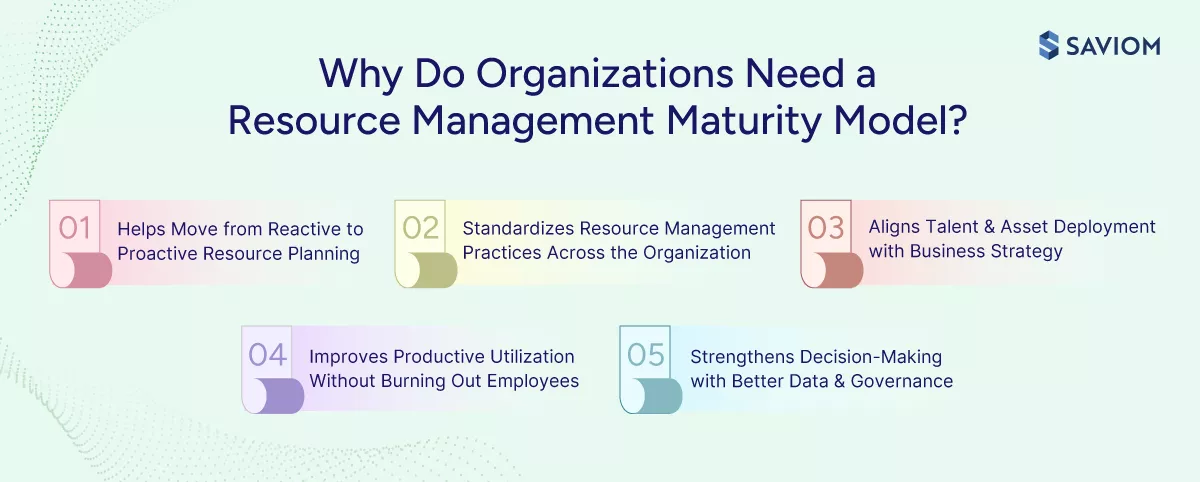
Helps Move from Reactive to Proactive Resource Planning
A resource management maturity model helps organizations build a forward-looking planning capability. As maturity increases, leaders can anticipate demand earlier, align capacity in advance, and make more confident resourcing decisions before delivery pressure builds. This creates a stronger planning culture, improves preparedness, and enables the business to respond with greater agility and control.
Standardizes Resource Management Practices Across the Organization
A resource management maturity model provides a common foundation for how resource management is understood and executed across the business. It helps organizations establish consistent processes, shared definitions, and aligned ways of working across teams and functions. This standardization improves coordination, strengthens collaboration, and makes enterprise-wide planning more effective and scalable.
Aligns Talent and Asset Deployment with Business Strategy
Organizations need a resource management maturity model because it helps ensure talent is deployed where it can create the greatest impact. A more mature approach connects resource decisions to business priorities, strategic initiatives, and growth objectives. This allows leaders to direct critical skills toward the work that matters most, improving execution while reinforcing the organization’s broader strategic goals.
Read our resource scheduling blog.
Improves Productive Utilization Without Burning Out Employees
A maturity model enables organizations to pursue smarter, healthier utilization. As resource management practices become more advanced, businesses can improve productivity while also creating more balanced workloads, better allocation decisions, and more sustainable use of talent. This supports both organizational performance and employee well-being, helping teams remain engaged, effective, and resilient over the long term.
Strengthens Decision-Making with Better Data and Governance
As per Deloitte’s survey, “58% of organizations lack a strategic governance structure for workforce management, and more than 50% are not effectively using workforce system data or analytics.”
A maturity model helps organizations improve the quality and consistency of resource-related decisions. By advancing data practices, governance structures, and accountability, it enables leaders to make decisions with greater clarity and confidence. This results in stronger prioritization, better trade-off management, and a more disciplined approach to allocating talent in line with business needs.
After benefits, let us learn about the various resource management maturity levels.
What are the Different Resource Management Maturity Levels?
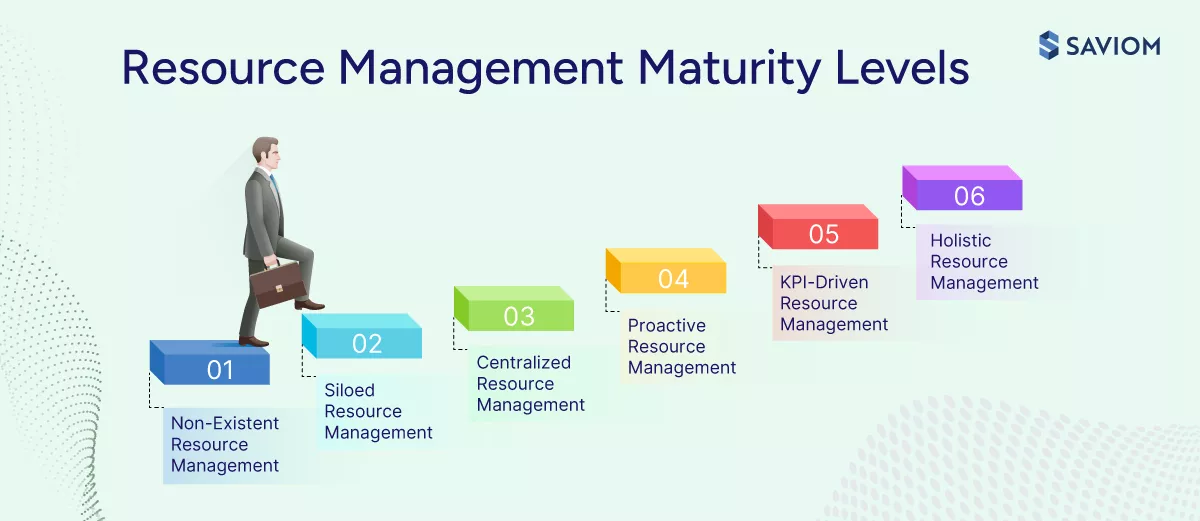
The effectiveness of resource management depends on how mature the underlying processes are. Organizations at lower maturity levels often struggle with limited visibility and reactive decisions, while those at higher levels are better equipped to forecast demand, manage capacity, and support business strategy. Read about these levels in detail to understand where improvements are needed:
Non-Existent Resource Management
At this level, there is no formal resource management structure, and line managers handle acquisition and allocation reactively once new work is confirmed. This leads to last-minute firefighting, high recruitment costs, and poor matching of skills to work. Without a centralized view into resource availability, skills, and utilization, firms often face both under- and over-utilization, resulting in lower productivity and inefficient project delivery.
Siloed Resource Management
At this level, resource planning and allocation are handled separately at the department or team level, typically by line or resource managers. These teams often rely on spreadsheets or outdated tools, leading to duplicated effort, conflicting priorities, and suboptimal resource utilization. Skills data is usually recorded only at the time of hiring and rarely updated, while misalignment between sales and delivery further weakens planning effectiveness.
Centralized Resource Management
At maturity level three, resources are treated as part of a shared organizational pool that can be allocated across projects based on business needs. Processes and governance are standardized and centrally coordinated to create greater consistency across departments. At the same time, resource managers may operate within individual business units in a federated model, ensuring alignment with the enterprise’s overall goals.
Proactive Resource Management
At this level, organizations shift from reacting to immediate needs toward anticipating future resource requirements. With better visibility into resource capacity and skills across the enterprise, managers can identify shortages or excesses early and take data-driven decisions. This reduces last-minute resourcing issues, improves delivery outcomes, and strengthens alignment between sales and delivery teams to meet client needs more effectively.
KPI-Driven Resource Management
At the KPI-driven level, resource managers are accountable for tracking and improving key performance indicators such as resource forecasting accuracy, utilization rate, allocation efficiency, and bench time. These metrics enable stronger performance evaluation, support data-driven decision-making, and drive continuous improvement in resource allocation across teams and departments. As a result, organizations can optimize resource performance and improve project success rates.
Holistic Resource Management
At the highest maturity level, resource management is embedded in strategic planning across the organization. It enables businesses to support both project and operational demands while aligning resources with near-term and long-term objectives. This stage marks a move from responding to immediate requirements to proactively adjusting resources in line with changing business priorities.
Take a quick glance at the comparison between various maturity levels and their capabilities.
| Maturity Level | Process State | Tools & Data | Skills Visibility | KPIs Used | Typical Outcomes |
|---|---|---|---|---|---|
| Non-Existent | Ad hoc, manager-led, undocumented | Spreadsheets, email, tribal knowledge | None or minimal | Little to none | Firefighting, missed staffing windows, unpredictable delivery |
| Siloed | Departmental planning with limited coordination | Disconnected point tools and local trackers | Partial, team-specific | Basic utilization snapshots | Resource conflicts, duplicate effort, low cross-team agility |
| Centralized | Standardized planning and shared workflows | Single source of truth with better reporting | Growing inventory of roles and capabilities | Utilization, allocation, staffing demand | Better coordination, fewer conflicts, improved control |
| Proactive | Forward planning and scenario-based decisions | Integrated systems with forecasting views | Skills mapped for redeployment and planning | Forecast accuracy, fulfillment rate, bench time | Earlier risk detection, stronger portfolio trade-offs |
| KPI-Driven | Continuous optimization tied to business goals | Dashboards, analytics, simulation, executive reporting | Dynamic skills intelligence and internal mobility | Full operational and strategic KPI set | Higher predictability, better utilization quality, stronger margins |
| Holistic | Strategic, enterprise-wide, fully integrated with business planning | Connected enterprise platforms with real-time data, scenario planning, and strategic forecasting | End-to-end visibility across project and non-project work, including current and future capability needs | Operational, financial, capacity, and strategic workforce KPIs | Agile resource decisions, stronger business alignment, optimized workforce capacity, and improved long-term competitiveness |
Understand what resource management is and how it is beneficial for organizations.
Next, let us understand how to assess resource management maturity.
How to Assess Your Organization’s Resource Management Maturity?
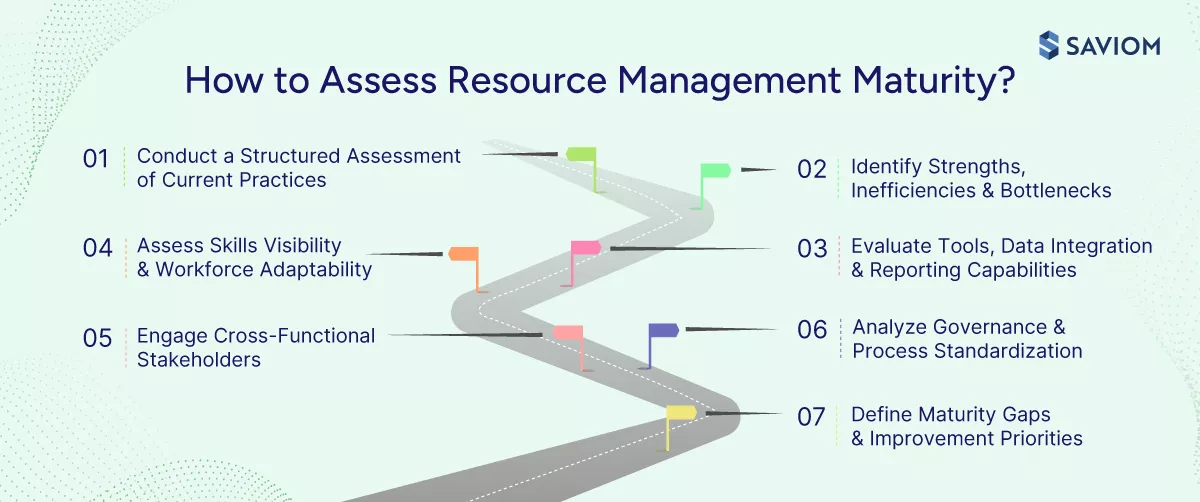
Assessing maturity helps organizations understand how effectively their current resource management practices support project delivery and business growth. It reveals gaps in processes, tools, skills visibility, forecasting capability, and governance that may limit performance. Here is how managers can assess maturity in a structured way and prioritize improvements based on business impact.
Conduct a Structured Assessment of Current Practices
Managers should begin by reviewing how resource planning, forecasting, allocation, and utilization are currently managed across the enterprise. Mapping these processes helps determine whether they are standardized, repeatable, and aligned with business objectives, or whether they remain fragmented, inconsistent, and reactive. This creates a clear baseline for evaluating current maturity.
Identify Strengths, Inefficiencies & Bottlenecks
The next step is to identify the strengths and gaps in existing practices. Simultaneously, it is essential to identify gaps in processes that slow down decision-making and reduce employee productivity. This helps firms identify priority areas, ensuring that improvements yield the highest business value.
Explore common resource management challenges and ways to tackle them.
Evaluate Tools, Data Integration & Reporting Capabilities
Next, managers should evaluate whether the current tools and technological infrastructure adequately support resource management activities or if they fall short due to limitations in functionality. Additionally, they should review the effectiveness of dashboards and reports to ensure they provide timely and accurate insights. Beyond this, they must also assess the level of data integration between their resource management solutions and other enterprise platforms.
Assess Skills Visibility & Workforce Adaptability
As per CIPD’s data, “Many employers are still uneven in collecting workforce planning data such as current skills gaps, future skill requirements, and hiring demand signals.”
The next step is to assess whether the organization has a structured, up-to-date skills inventory and competency mapping framework that clearly aligns workforce capabilities with role and project requirements. Managers should also evaluate how easily they can identify available expertise, spot capability gaps, and match the right talent to the right work using reliable skills data.
Learn what a skill matrix is and how to create one.
Engage Cross-Functional Stakeholders
Managers should identify all relevant stakeholders from different groups, like delivery, HR, finance, etc., and clarify their roles and expectations. To gather their perspectives, managers can conduct workshops, interviews, or surveys. This helps capture detailed insights into current practices, resource management challenges, and strengths from different functional perspectives, ensuring no viewpoint is overlooked.
Analyze Governance & Process Standardization
In this step, managers should review whether governance frameworks, roles, and responsibilities for resource planning and ownership are clearly defined and enforced. It is equally important to ensure that process improvements and governance updates are reviewed, measured, and embedded within the firm to continue supporting business goals. Furthermore, they should identify gaps where processes are overly ad-hoc or rely on individual discretion and take actions to maintain control.
Define Maturity Gaps & Improvement Priorities
Once current scores are mapped against target-state expectations, managers should identify the gaps that have the greatest impact on delivery predictability, resource efficiency, and financial performance. For most organizations, the right roadmap starts with visibility, governance, and core resource management workflows before moving to advanced capabilities such as analytics, scenario planning, and optimization.
To gain a better understanding of resource management fundamentals that can help your organization achieve a higher maturity level, read our comprehensive eBook.
Now that we understand how to assess resource management maturity level, let us look at the steps for implementing a resource maturity model framework.
Steps to Implement a Resource Management Maturity Model
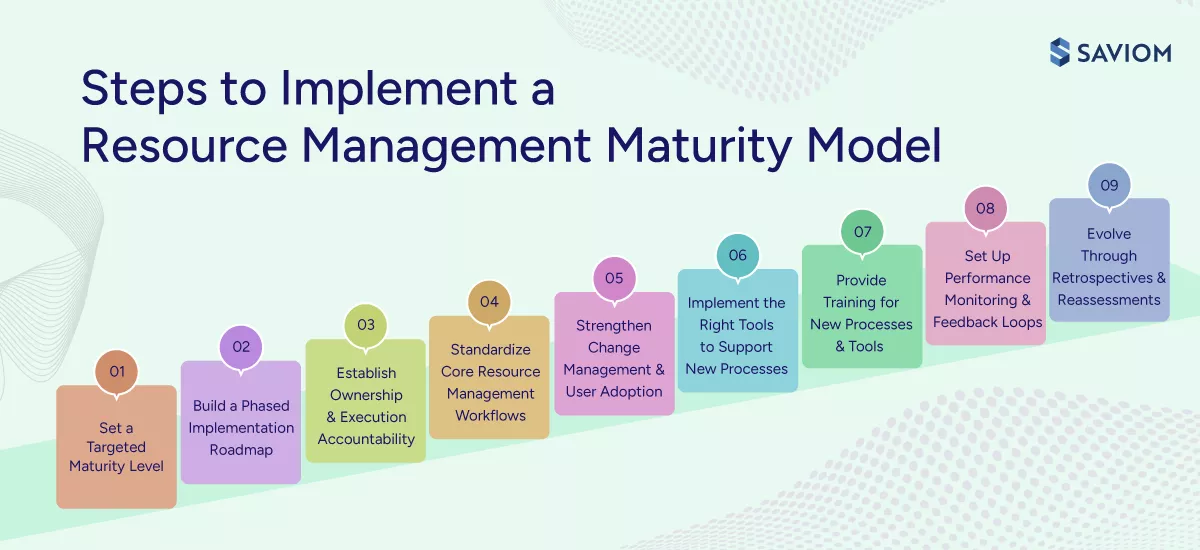
Implementing a resource maturity model requires more than identifying problems; it requires a practical path forward. A structured implementation approach ensures organizations build resource management maturity steadily and deliver measurable results. Let us understand the steps in detail:
Clearly Set a Targeted Maturity Level
To begin with, organizations must set a clear maturity target that fits the organization’s size, delivery complexity, workforce needs, and growth plans. They should make sure the target is practical and easy to measure. Additionally, they should align it with the broader business strategy, so improvement efforts stay focused and relevant.
Build a Phased Implementation Roadmap
Secondly, firms should break the maturity journey into short-term, mid-term, and long-term initiatives that can be delivered in a structured manner. Subsequently, organizations can prioritize foundational improvements such as visibility, governance, and planning workflows first, then move to more advanced capabilities like forecasting, KPIs, and optimization.
Establish Ownership & Execution Accountability
In this step, organizations should assign clear ownership for each part of the implementation, so responsibilities remain visible, and progress does not stall. Additionally, they should define who leads execution, monitors progress, and resolves issues as they arise. Strong accountability keeps teams aligned on milestones, speeds up decision-making, and helps ensure the implementation delivers the intended outcomes.
Standardize Core Resource Management Workflows
Next, managers should create standard workflows for requesting, approving, assigning, and rebalancing resources across teams. Consistent processes reduce confusion and improve the speed and fairness of decisions. Moreover, standardization makes the model easier to scale as workload complexity and team size increase.
Strengthen Change Management & User Adoption
After standardizing workflows, managers should support the transition with clear communication, practical training, and visible leadership support. They must help teams understand why the change matters and how it improves their work. In addition, they should address resistance early and reinforce the new ways of working, so adoption becomes consistent and lasting.
Implement the Right Tools to Support New Processes
This step involves implementing the right tools to support and scale new resource management processes. The ideal solution should provide 360-degree visibility into key resource attributes, along with real-time BI reports and configurable dashboards that support better decision-making. It should also integrate seamlessly with other enterprise systems to create a connected ecosystem.
Provide Training for New Processes and Tools
At this stage, organizations should deliver practical training to help teams and managers use new processes and tools with confidence. This should include role-specific sessions, supported by internal champions who encourage adoption across departments. To reinforce learning, organizations can also provide manuals, FAQs, video walkthroughs, blended learning formats, and refresher sessions.
Set Up Performance Monitoring and Feedback Loops
Businesses must define clear KPIs, such as utilization rate, resource forecast accuracy, availability rate, etc., to evaluate performance against consistent benchmarks. Once these indicators are in place, managers can establish baseline data to track performance at multiple levels over time and measure the impact of newly implemented processes.
Evolve Through Retrospectives & Reassessments
Lastly, organizations must place strong emphasis on continuously evolving their resource management practices by learning from past experiences and reassessing their maturity level at regular intervals. After completing major projects, it’s critical to conduct retrospectives to evaluate improvements, challenges, and compare outcomes against expectations.
Let us explore the various metrics to measure the success of resource management maturity.
Metrics to Measure Resource Management Maturity Success
The success of resource management maturity should be measured through clear and practical performance indicators. The right metrics show whether resource planning is becoming more accurate, efficient, and strategically aligned. Here are the key metrics to evaluate resource management maturity success and improve decision-making:
Resource Utilization Rate
The resource utilization rate measures the percentage of a resource’s available time spent on productive, value-adding tasks. A healthy utilization rate usually reflects stronger maturity, where organizations can align capacity with demand, allocate work effectively, and maintain a productive workforce.
Learn how to track resource utilization accurately.
Capacity vs. Demand Forecast Accuracy
Capacity vs. demand forecast accuracy tracks how closely projected demand aligns with available capacity over a planning horizon. It is one of the clearest signs of resource management maturity because strong forecast accuracy reduces last-minute staffing, lowers revenue leakage risk, and allows managers to make hiring or redeployment decisions earlier.
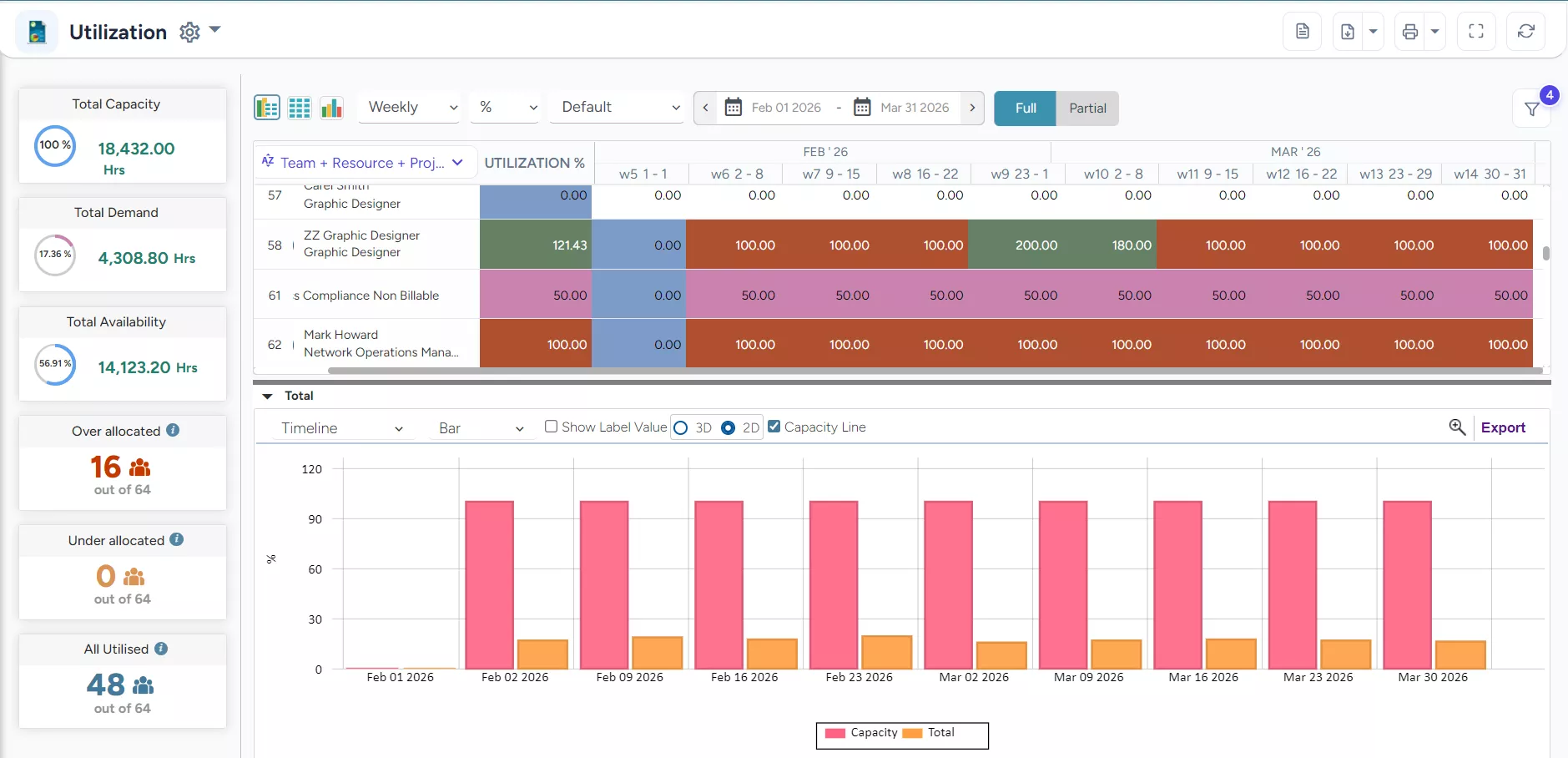
SAVIOM’s Utilization Report visualizes resource over- or underutilization using color-coded indicators, supporting data-driven decision-making.
Time to Staff Roles or Projects
Time to staff measures the average time required to assign an appropriate resource after a request is approved. Lower numbers usually indicate better visibility, optimized workflows, and stronger readiness of the resource pool, especially when staffing quality remains high.
Bench Time or Idle Capacity
Bench time or idle capacity refers to the time employees remain available but are not assigned to billable work, productive tasks, or strategic initiatives. High or prolonged bench time indicates reactive planning and weak demand forecasting, while controlled and intentional bench time can reflect higher maturity, where organizations maintain a small buffer to support flexibility, internal mobility, or upcoming project demand.
Resource Request Fulfillment Rate
The resource request fulfillment rate measures the percentage of resource requests that are successfully filled within the required time and with the desired skills. A high fulfillment rate usually reflects stronger skills visibility and a more effective balance between demand and supply. A low fulfillment rate may indicate limited capacity visibility, weak forecasting, skill mismatches, or delays in allocation decisions.
Understand how to create an efficient resource request workflow.
Resource Allocation Efficiency
Resource allocation efficiency tracks whether resources are consistently matched to work that fits their skills, availability, cost, and business priorities. High allocation efficiency reflects stronger maturity, where organizations have better visibility into skills and capacity, while low allocation efficiency often points to gaps in planning and limited skills visibility.
Decision-Making Cycle Time
Decision-making cycle time measures the time it takes to make and finalize resource-related decisions, from the moment a request or issue is raised to the point when an action is approved and communicated. A shorter cycle time usually reflects higher maturity, where governance is clear, roles and approvals are well defined. A longer cycle time often points to unclear ownership, fragmented processes, and poor visibility.
Skill Gap Index
The skill gap index measures the difference between the skills an organization needs to deliver existing and future projects and the current capabilities of its workforce. A higher index indicates lower maturity, often due to weak skills visibility or poor workforce planning, while a lower index suggests a more mature approach supported by proactive retraining/upskilling, and redeployment.
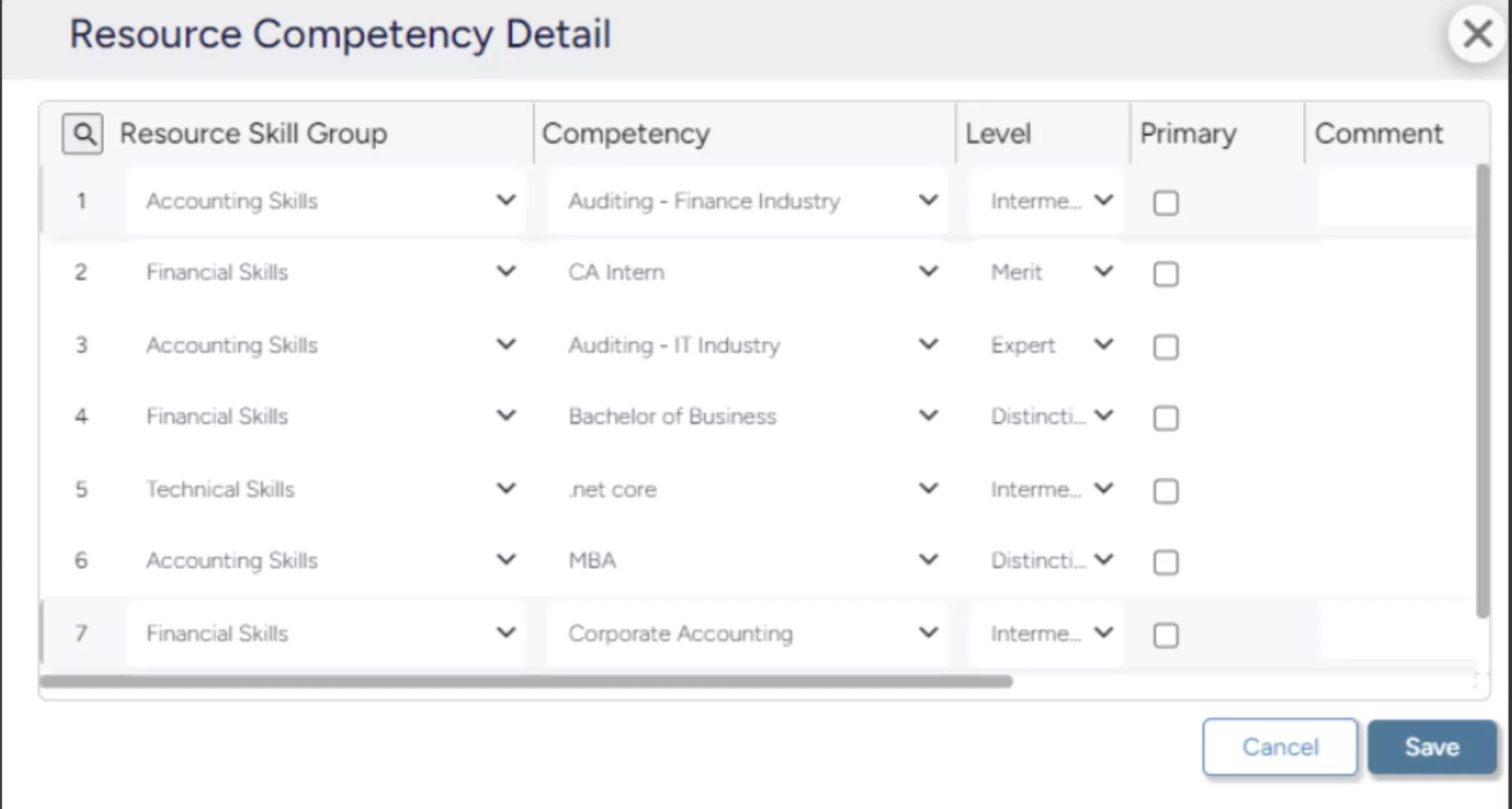
SAVIOM’s Competency Matrix enables managers to track skills, certifications, and proficiency levels, helping identify skill gaps and plan targeted reskilling initiatives.
Redeployment Rate of Internal Talent
The redeployment rate shows how often existing talent is reassigned to emerging priorities instead of leaving skills underused or relying on external hiring. A higher rate indicates stronger maturity, supported by better skills visibility, workforce agility, and internal mobility. A lower rate often points to gaps in planning, rigid role structures, or limited ability to match talent to evolving demand.
Next, let us look at some common challenges that firms face while advancing resource management maturity.
Common Challenges in Advancing Resource Management Maturity
Improving resource management maturity is rarely straightforward, even when the need for change is widely recognized. Many organizations encounter barriers such as siloed data, limited adoption, weak forecasting, and technology constraints that slow progress and reduce impact. Recognizing these challenges is the first step toward addressing them effectively and building lasting improvements.
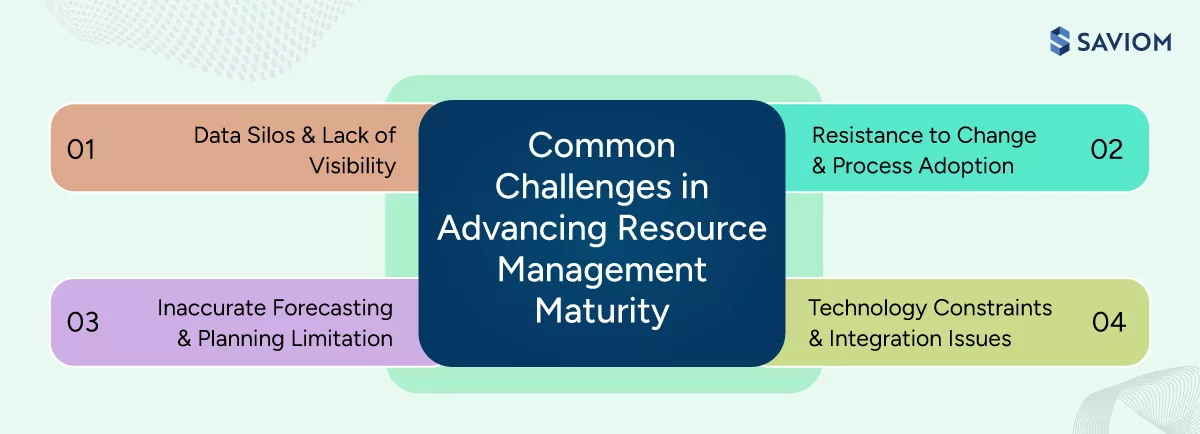
Data Silos & Lack of Visibility
One of the most common barriers to resource maturity is fragmented data across disconnected systems. Resource information often sits separately in HR, project management, finance, and delivery tools, making it difficult to build a unified view of resource capacity, skills and, demand. Without timely and reliable data, managers struggle to make informed decisions and respond to shifting priorities.
Understand why you should not use spreadsheets.
Resistance to Change & Process Adoption
Even when organizations introduce better processes and tools, resistance to change can slow adoption. Cultural barriers, limited stakeholder buy-in, and concerns over losing control often reduce the impact of new resource management practices. Training and communication gaps can make it harder for teams to understand the value of change or apply new processes consistently.
Inaccurate Forecasting & Planning Limitations
Many organizations still rely on outdated assumptions, incomplete data, or inconsistent inputs when they forecast resource capacity and demand. These gaps weaken planning accuracy, create avoidable staffing conflicts, and force managers to react late to changing priorities.
Deep dive into our resource forecasting blog.
Technology Constraints & Integration Issues
As per Deloitte’s research, “44% plan to implement new technology, underlining how often the technology layer still limits progress.”
Technology limitations can slow maturity progress, especially when organizations rely on legacy systems or outdated tools that do not support modern resource management needs. Poor integration between platforms can lead to duplicate data entry, inconsistent reporting, and weaker decision-making. Without the right technology foundation, it becomes difficult to standardize processes and sustain improvement.
Use SAVIOM’s resource planner to identify, allocate, and optimize resources in real-time and elevate your organization’s resource management maturity level. Book a Demo Today.

Now, let us understand the role of technology in advancing resource management maturity.
The Role of Technology in Accelerating Resource Management Maturity
Technology plays a critical role in helping organizations scale and strengthen resource management practices. It improves visibility, standardization, forecasting, and decision-making across teams and functions. When supported by the right processes, technology becomes a major accelerator of maturity.
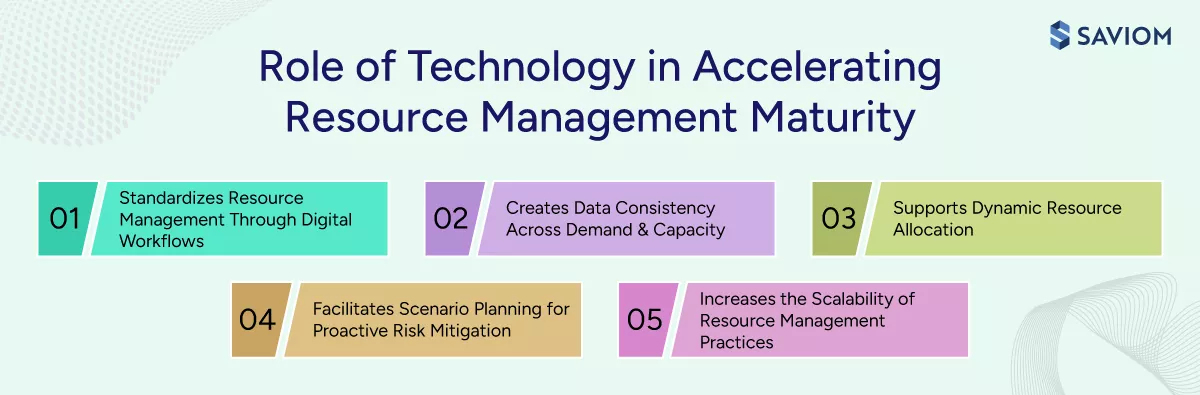
Standardizing Resource Management Through Digital Workflows
Digital workflows help standardize the resource management framework by reducing manual errors, closing process gaps, and ensuring teams follow consistent processes for resource planning, requisition, approval, and allocation. Instead of relying on informal methods or spreadsheets, organizations can use structured systems to create greater consistency across projects and business units.
Creating Data Consistency Across People, Demand & Capacity
Technology brings together data on workforce skills, project demand, and available capacity into a more centralized and reliable view. This improves visibility across the organization and ensures managers work from consistent inputs when making resource decisions. As a result, resource forecasting, planning, and reporting become more accurate and aligned.
Supporting Dynamic Resource Allocation
Modern resource management software provides real-time data on resource availability and utilization that helps organizations reassign people faster when priorities, delivery timelines, or customer needs shift. This makes it easier to respond to shifting priorities, project changes, or unexpected constraints without losing control over delivery.
Scenario Planning & Simulation for Proactive Risk Mitigation
Scenario planning and simulation capabilities allow teams to test alternative resource plans before they commit to one. They help managers evaluate trade-offs, anticipate resource constraints, and prepare for changes in demand, timelines, or priorities. As a result, organizations make more proactive decisions and reduce the likelihood of disruptions.
Increasing the Scalability of Resource Management Practices
As per a Gartner survey, “Organizations are moving from exploring AI to implementation, suggesting that resource management systems will increasingly become more predictive and adaptive.”
Technology makes resource management more scalable by standardizing workflows, centralizing resource data, and improving visibility across teams, projects, and geographies. It replaces manual processes with connected systems that support faster decisions, consistent planning, and better control as the organization grows.
Conclusion
A resource management maturity model is not just a diagnostic framework; it is a business growth framework. It helps organizations move from fragmented visibility and reactive staffing toward consistent planning, stronger skills deployment, optimized resource utilization, and more confident strategic execution.
Organizations that invest in maturing resource management create a stronger foundation for scale, resilience, and long-term performance. They align people more effectively to business priorities, respond faster to change, and build the operational discipline needed to support sustainable growth.
FAQ Section
A resource management maturity model is a framework that helps organizations assess and improve how they plan, allocate, and utilize resources. It defines different stages of maturity, showing how resource management evolves from reactive and inconsistent practices to more strategic, data-driven, and proactive approaches.
A resource maturity model is important for organizations because it:
1. Helps move from reactive to proactive resource planning
2. Standardizes resource management practices across the organization
3. Aligns talent and asset deployment with business strategy
4. Improves productive utilization without burning out employees
5. Strengthens decision-making with better data and governance
The stages of resource management maturity are:
1. Non-existent resource management
2. Siloed resource management
3. Centralized resource management
4. Proactive resource management
5. KPI-driven resource management
6. Holistic resource management
To assess resource management maturity, organizations should:
1. Conduct a structured assessment of current practices
2. Identify strengths, inefficiencies, and bottlenecks
3. Evaluate tools, data integration, and reporting capabilities
4. Assess skills visibility and workforce adaptability
5. Engage cross-functional stakeholders
6. Analyze governance and process standardization
7. Define maturity gaps and improvement priorities
Following are the steps to implement a resource management maturity model framework:
1. Set a targeted maturity level
2. Build a phased implementation roadmap
3. Establish ownership & execution accountability
4. Standardize core resource management workflows
5. Strengthen change management & user adoption
6. Implement the right tools to support new processes
7. Provide training for new processes & tools
8. Set up performance monitoring & feedback loops
9. Evolve through retrospectives & reassessments
The most useful metrics include
1. Capacity vs. Demand Forecast Accuracy
2. Time to Staff Roles or Projects
3. Bench Time or Idle Capacity
4. Resource Request Fulfillment Rate
5. Resource Allocation Efficiency
6. Decision-Making Cycle Time
7. Skill Gap Index
8. Redeployment Rate of Internal Talent
The most common challenges in advancing resource management maturity involve:
1. Data silos and lack of visibility
2. Resistance to change and process adoption
3. Inaccurate forecasting and planning limitations
4. Technology constraints and integration issues