

Introduction
“By failing to prepare, you are preparing to fail.” ~ Benjamin Franklin
Rightly said! In project-driven organizations, resource management begins with understanding what demand lies ahead. Without having clear visibility into future project requirements, organizations often resort to reactive hiring, incur higher resourcing costs, and experience delays in project execution.
That’s where resource capacity forecasting comes into the picture. It enables businesses to anticipate future resource demands, build solid talent pipelines, and stay ahead of the curve. By replacing guesswork with structured foresight, organizations can improve resource utilization, avoid resource risks, and ensure consistent project delivery.
In this blog, we will explore the nitty-gritty of resource capacity forecasting, including definition, types, steps, challenges, and best practices.
What is Resource Capacity Forecasting?
Resource capacity forecasting is the process of anticipating the type, quantity, and quality of resources required to effectively meet current and upcoming project demand. It helps businesses ensure the right resources are available at the right time by analyzing project pipelines, historical data, skill demand, and upcoming commitments.
Additionally, by performing demand forecasting and capacity planning in advance, organizations can proactively address emerging skill shortages or surpluses and take corrective measures, such as hiring, upskilling, or retraining, to bridge the gap. As a result, this prevents last-minute firefighting, ensures competent resource allocation, and drives successful project delivery.
Read our resource forecasting eBook to learn how to predict resource requirements, bridge capacity gaps early, and build a future-ready workforce.
Now that we have clarified the resource capacity forecasting definition, let us dive into its types.
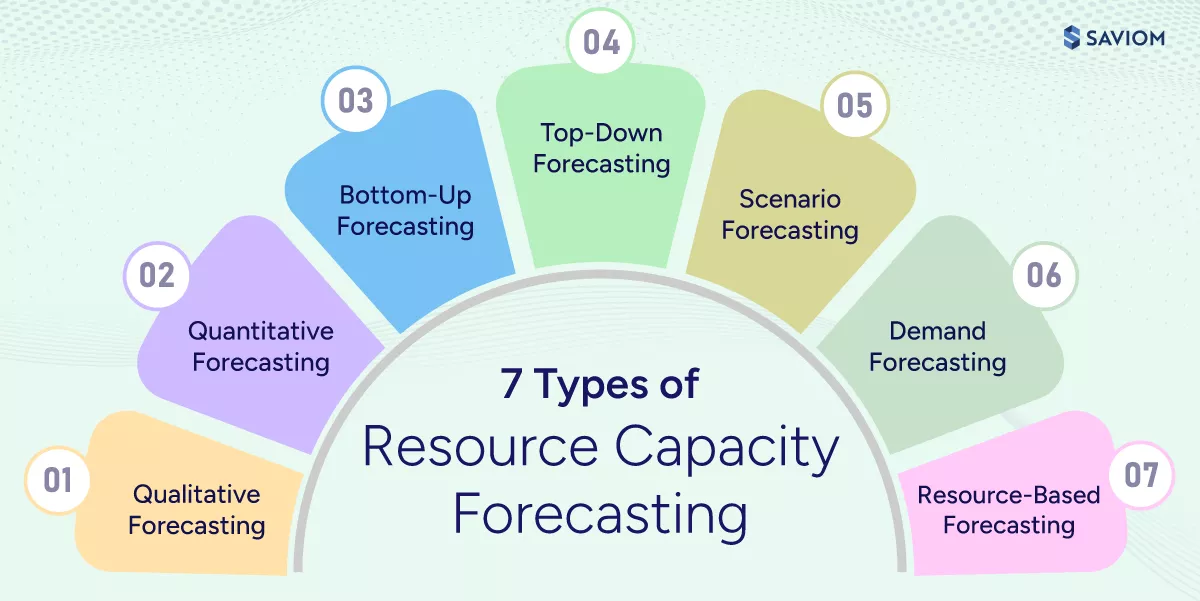
7 Types of Resource Capacity Forecasting
Based on the business requirements, resource capacity forecasting can be classified into different types. Given below are a few:
Qualitative Forecasting
Qualitative forecasting is a resource capacity forecasting method that relies on expert judgment, market insights, and stakeholder input instead of historical data. It is particularly used when historical data is limited or unavailable. Common techniques include surveys, focus groups, and the Delphi method.
Quantitative Forecasting
Quantitative forecasting is a data-driven method that uses historical trends, statistical models, and mathematical techniques to predict future capacity needs. It relies on measurable data, such as resource utilization metrics or past workload patterns, to ensure forecast accuracy. This approach works best when reliable historical data is available, and business conditions are relatively stable.
Bottom-Up Forecasting
Bottom-up forecasting involves estimating future resource capacity needs by analyzing data at a granular level and then aggregating the results to form an overall forecast. Key techniques include sales pipeline analysis, workload-based or employee-based forecasting, etc.
Top-Down Forecasting
Top-down forecasting is a method that estimates future capacity needs by analyzing high-level business trends, overall market conditions, and organizational goals before breaking them down into specific resource requirements. It commonly relies on inputs like market growth analysis, economic indicators, benchmarking, etc.
Scenario Forecasting
Scenario forecasting is a technique used to predict and prepare for possible future outcomes by considering various “what-if” situations. Instead of just relying on one likely outcome, it explores multiple different workforce scenarios based on changes in trends or external factors to better anticipate potential challenges or opportunities.
Explore how to perform scenario planning effectively and make smarter workforce decisions.
Demand Forecasting
Demand forecasting involves predicting future business demand for products or services to determine the upcoming workload. This insight enables organizations to estimate the types, quantity, and quality of resources required, ensuring their timely availability to meet business objectives efficiently.
Resource-Based Forecasting
Resource-based forecasting is the process of anticipating future resource requirements, such as personnel, equipment, and finance for pipeline projects, beforehand. This foresight provides firms with sufficient lead time to build internal capacity, mitigating potential resource risks, and ensuring they meet upcoming demands.
Read more on why accurate resource forecasting matters for project delivery.
Having understood its types, let us now examine the importance of resource capacity forecasting.
Why is Resource Capacity Forecasting Important?
Resource capacity forecasting empowers businesses to meet project demands confidently, ensuring the right quantity, quality, and type of resources are available to kick off and deliver projects on time. By identifying resource gaps early, businesses can take proactive measures to address talent or skill shortages, eliminating the need for last-minute, expensive recruitment.
Additionally, resource capacity forecasting helps organizations identify the best-fit employee for each project based on factors, such as skills, experience, qualifications, and location. This ensures businesses optimize resource allocation, putting the right people in the right roles to deliver optimal results.
Finally, resource capacity forecasting provides insight into an individual’s billable and non-billable activities to determine utilization levels. Since non-billable work does not generate revenue, managers can reallocate resources to billable tasks, thereby improving employee productivity and revenue generation while ensuring timely project completion.
Gain early foresight into upcoming project demands to plan capacity more accurately with SAVIOM’s 5th Gen resource management software. Book a demo to see it in action.
Gain more insights on how effective resource capacity planning can future-proof your workforce.
Given its importance, let’s now focus on a comprehensive step-by-step breakdown of how to perform resource capacity forecasting and planning effectively.
How to Perform Resource Capacity Forecasting: A Step-by-Step Process
Here are the essential steps firms should take to ensure they have the proper inventory to meet anticipated demand:
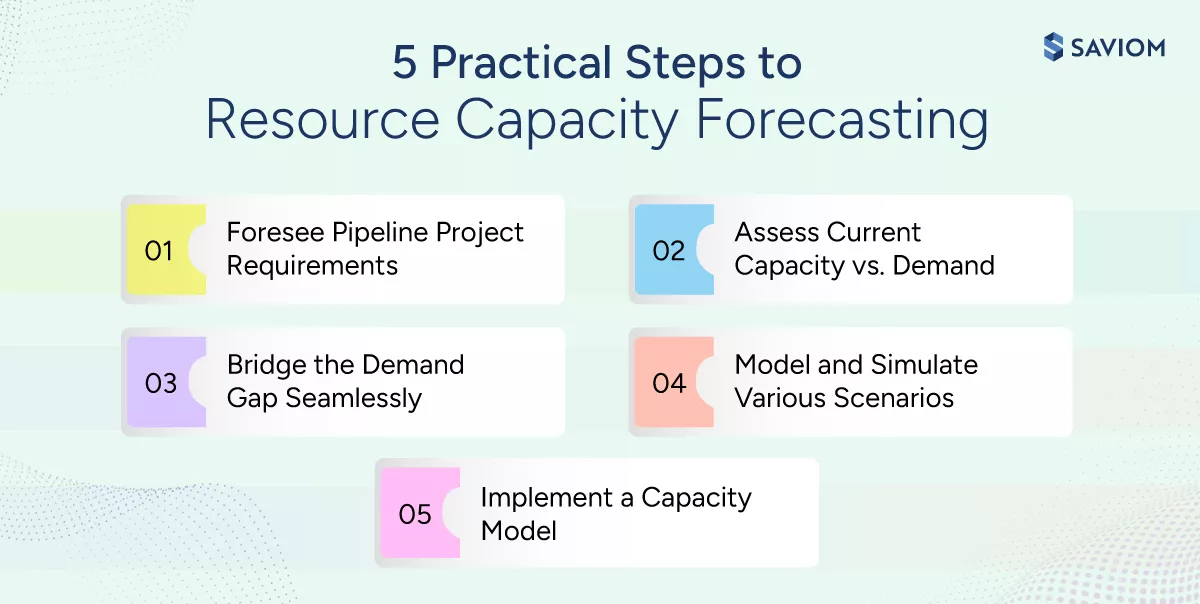
Foresee Pipeline Project Requirements
The first step in resource capacity forecasting is tracking potential pipeline projects to anticipate demand in advance. This allows managers to gain a clear picture of the project scope, objectives, timeline, etc., enabling them to determine the resources required to meet upcoming requirements accurately.
Assess Current Capacity Vs. Demand
Next, managers must evaluate whether the current capacity aligns with projected demand. By conducting a capacity and demand gap analysis, they can identify potential resource shortages or surpluses and take corrective actions for timely project initiation.
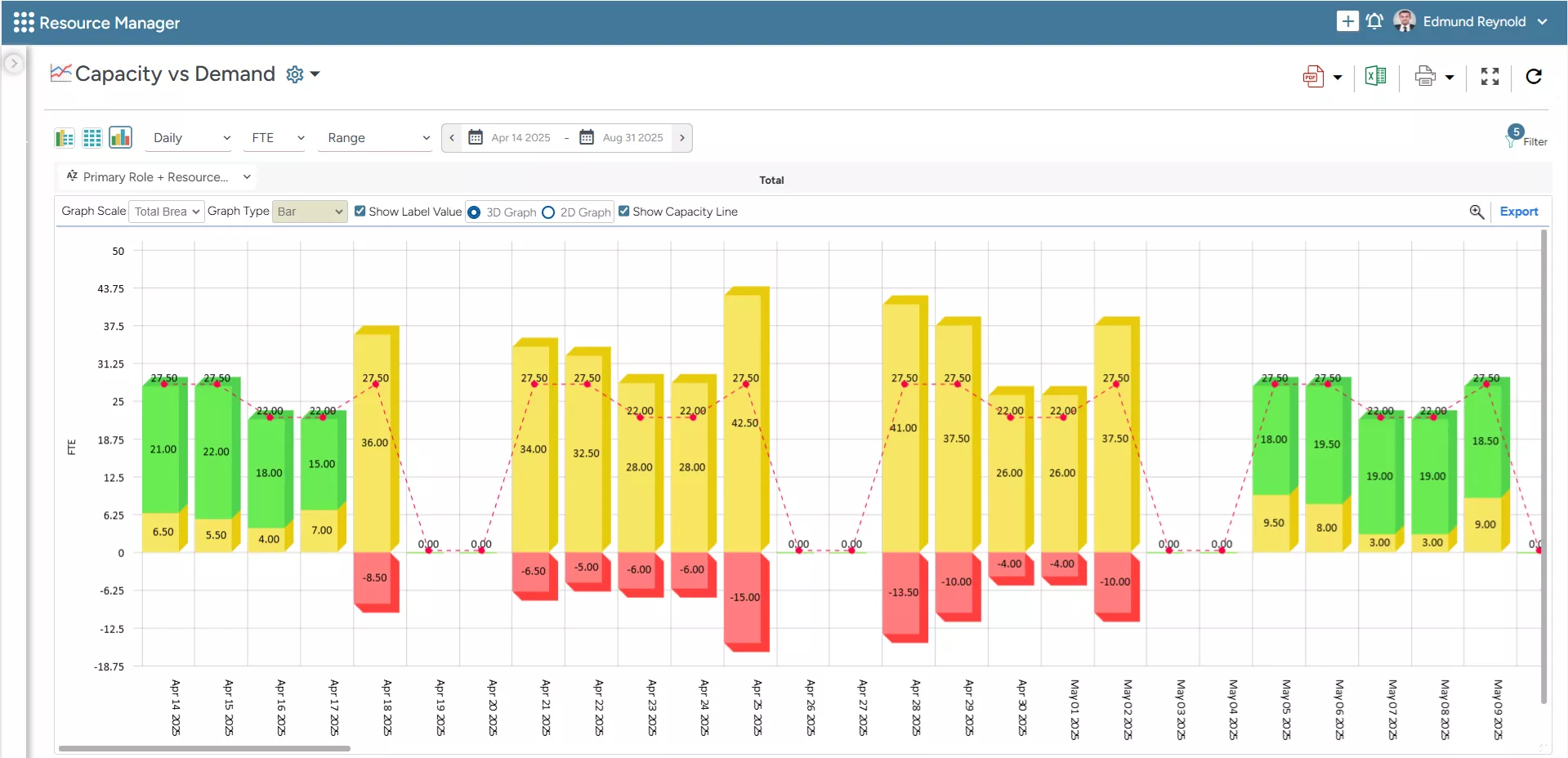 SAVIOM’s Capacity vs. Demand Graph enables managers to quickly spot resource shortages or excesses, and take timely action to balance supply and demand.
Continue reading on the effective steps to measure resource capacity and demand.
Bridge the Demand Gaps Seamlessly
After assessing existing skill gaps, managers can implement suitable resourcing measures, such as cross-training/upskilling, out-rotation/backfill plans, or initiate targeted hiring in the case of resource shortages. For resource surpluses, firms can expedite project timelines or offer their expertise at discounted rates.
Model and Simulate Various Scenarios
According to GoodFirms’ survey, “34.2% of companies rely on scenario planning for more accurate forecasting.”
Create and simulate various capacity plans by adjusting demand projections, resource allocations, project timelines, and other factors. This enables firms to evaluate how these elements affect overall capacity and, in turn, project outcomes. Consequently, they can identify and mitigate potential resource risks to better prepare for future challenges.
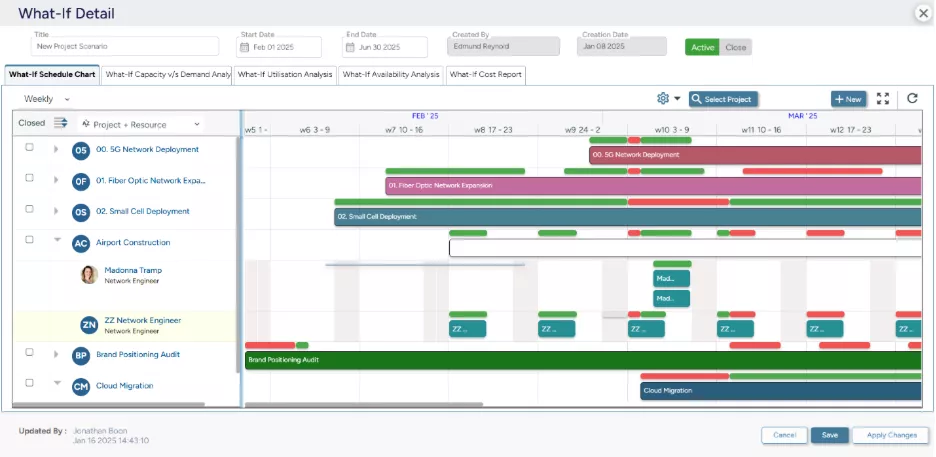 SAVIOM’s What-if Analysis empowers managers to compare various workforce scenarios and select the most favorable & profitable outcome.
Implement a Resource Capacity Model
Finally, leverage a well-designed capacity model to forecast resource requirements and identify potential capacity gaps. This enables managers to take proactive measures to address gaps, ensuring effective capacity management and helping organizations stay agile and prepared for future demands.
Take a deep dive into best practices for building a robust capacity model.
The following section outlines common challenges in resource capacity forecasting that firms often encounter.
Common Resource Capacity Forecasting Challenges
While resource capacity forecasting provides valuable benefits, businesses frequently face several challenges in its implementation. The following section outlines some of the most common obstacles firms must navigate. Read on:
Fluctuating Market Conditions
Fluctuating market conditions, such as economic changes, supply chain disruptions, or regulatory changes, create uncertainty around future workload. This makes it challenging to forecast resource needs accurately, often resulting in excess capacity or shortages, last-minute scrambling, and delayed project delivery.
Discover how to beat market volatility with efficient resource capacity planning.
Unexpected Scope Creep
Unexpected scope creep can alter original project requirements and timelines as new tasks or features are added without adequate lead time. This makes it challenging to secure the right resources upfront, leading to increased resourcing costs, overburdened teams, and missed project deadlines.
Lack of an Up-to-Date Skills Matrix
According to a McKinsey survey, “Only 5% of respondents say their organizations already have the capabilities they need.”
Without a clear and updated record of employee skills, certifications, and experience, organizations struggle to align internal resource capabilities with projected demand. This can lead to misallocation of resources, project budget overruns, delayed project execution, and compromised deliverables.
Explore further on the importance of the skill matrix for business success.
Cross-Departmental Silos
When departments operate in isolation and fail to share critical information on resource availability, project timelines, or upcoming demand, assessing actual capacity becomes difficult. This lack of visibility and coordination can lead to double-booking, underutilization, or overallocation, thereby impacting overall project performance.
Over-Reliance on Legacy Tools
Legacy tools often lack the flexibility, scalability, and integration required to handle modern business complexities. As a result, firms struggle with incomplete or outdated information, limiting real-time visibility into resource availability and demand, ultimately reducing forecasting accuracy and delaying decision-making.
Discover 7 reasons why you shouldn’t use Excel for resource planning.
Let us now move to some of the best practices for effective resource capacity forecasting.
Resource Capacity Forecasting Best Practices
Firms can follow the following best practices to implement resource capacity forecasting accurately and drive successful project delivery:
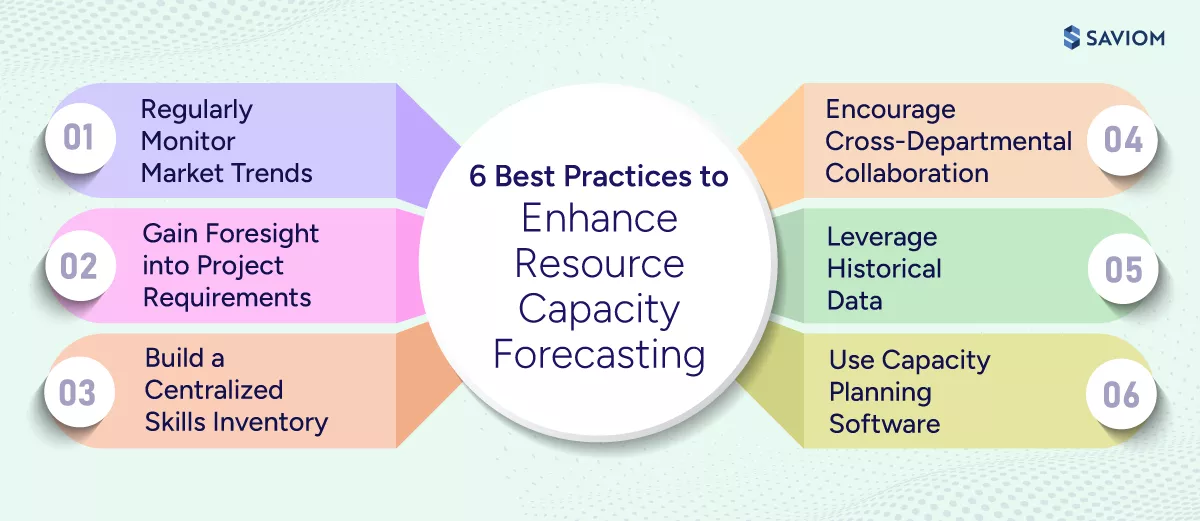
Monitor Market Trends Regularly
Staying informed about industry trends, competitor strategies, economic shifts, and technological advancements helps businesses foresee changes in workforce demand. By analyzing these factors, they can proactively identify emerging opportunities, potential risks, and shifts in customer behavior that may affect project requirements and adjust their capacity plans accordingly.
Gain Foresight into Project Requirements
Accurate resource capacity forecasting requires a deep understanding of upcoming project requirements. Thus, by collaborating with project managers, clients, and other stakeholders, companies can assess workforce demand based on project scope, timelines, and complexity. This proactive approach helps secure the right resources in advance, ensuring a seamless project initiation and completion.
Build a Centralized Skills Inventory
A centralized skill inventory provides a comprehensive, real-time view of employees’ skills, expertise, and certifications, enabling managers to quickly identify the best-suited resources for upcoming projects. It also helps highlight skill gaps early, allowing firms to take corrective actions, such as targeted hiring or training, and avoid last-minute talent shortages.
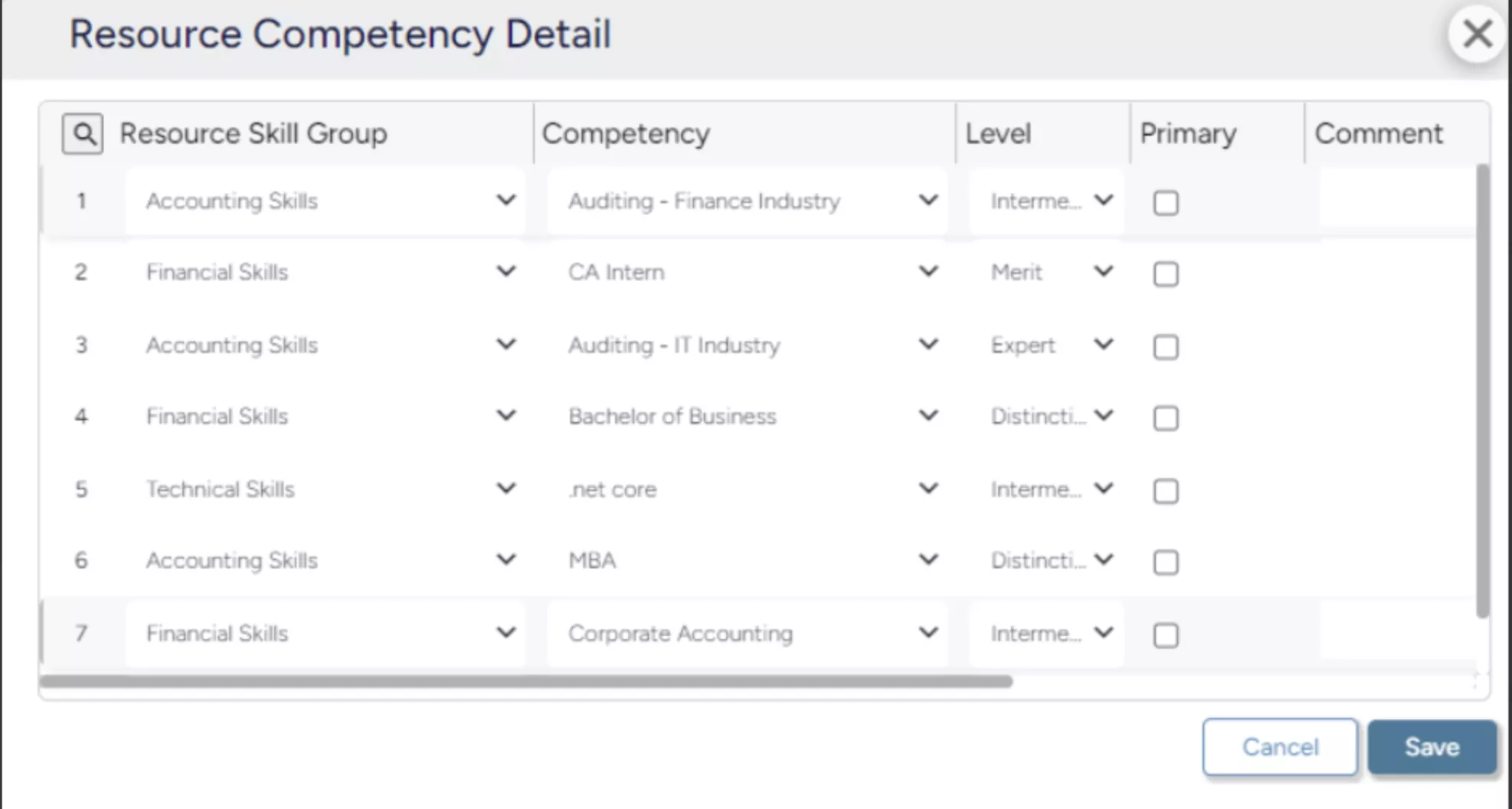 SAVIOM’s Competency Matrix provides visibility into existing skills across the organization, allowing managers to identify skill gaps and take corrective hiring or upskilling decisions.
Encourage Cross-Departmental Collaboration
When teams across different functions collaborate, they bring diverse insights that improve forecasting accuracy and resource planning. This integrated approach helps identify resource gaps, overlapping demands, and inefficiencies early. As a result, organizations can optimize utilization, make informed decisions, and drive better outcomes through proactive resource capacity planning.
Explore 10 ways to improve cross-departmental collaboration.
Leverage Historical Data
Historical data analysis helps firms identify patterns in utilization, demand fluctuations, and project timelines to forecast future resource needs accurately. As a result, this minimizes guesswork and facilitates informed decisions. For instance, law firms prepare for peak periods, such as tax season, by analyzing past case volumes and billable hours to ensure adequate staffing and uninterrupted operations.
Use Resource Capacity Planning Software
Modern resource capacity planning software provides real-time visibility into resource availability and future project requirements, enabling businesses to address capacity constraints proactively. Besides, by flagging potential resource shortages, surpluses, and risks with advanced analytics, these tools support informed decision-making, optimal allocation, and consistent project delivery.
Next, we shall see how powerful resource capacity planning software benefits an organization.
How Does a Modern Resource Capacity Planning Tool Help Organizations Do Accurate Forecasts?
An advanced resource capacity planning tool can significantly enhance the ability of employees to accurately forecast, plan, and build a robust talent pool. Here’s how :
- The all-in-one resource planner provides 360-degree visibility into future pipeline projects, ongoing commitments, and the availability and skills of resources, enabling managers to make data-driven decisions.
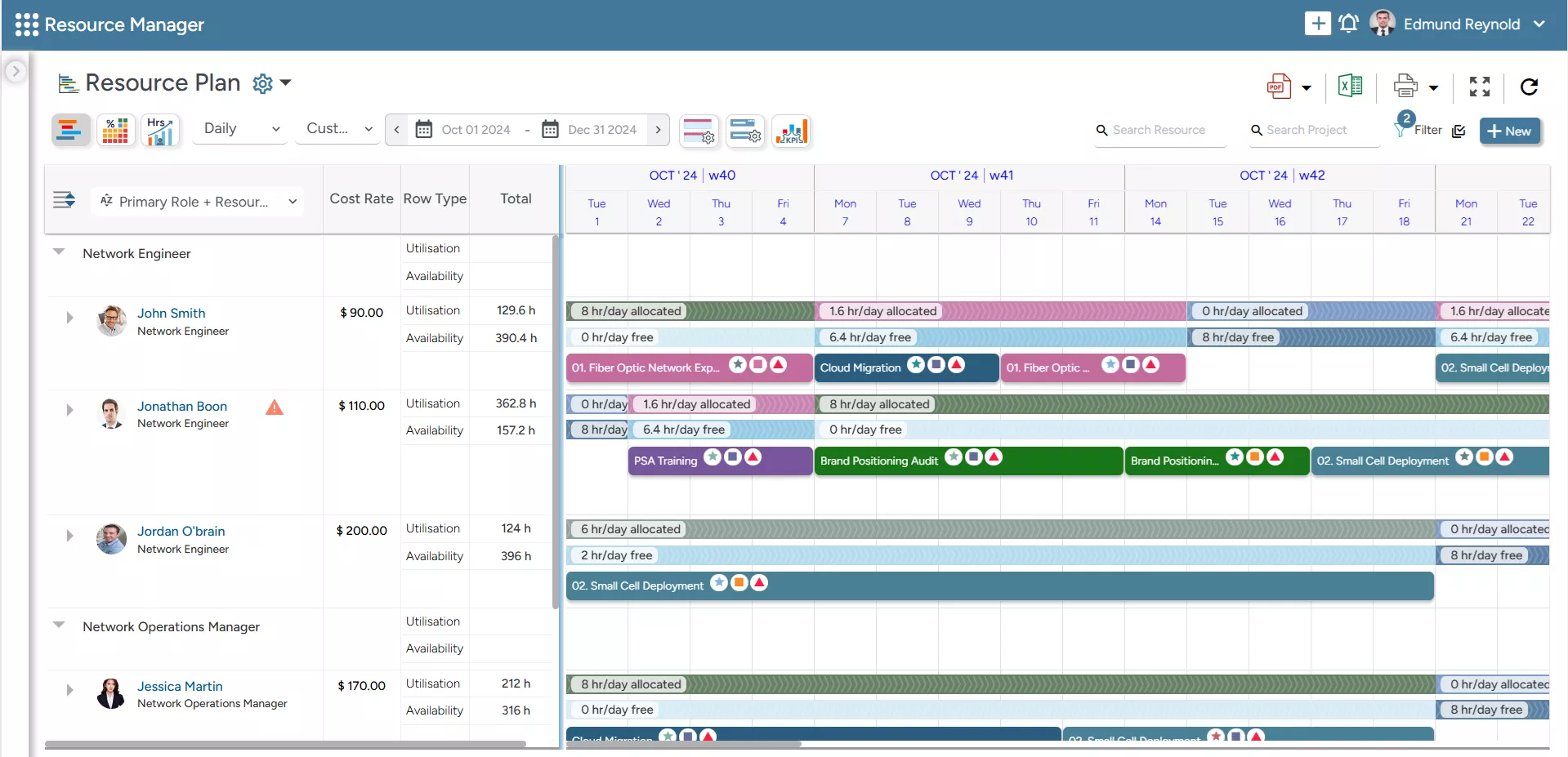 SAVIOM’s All-in-One Resource Planner provides organizations with a holistic view of the resource’s availability, utilization, and capacity, enabling informed decision-making.
- An embedded capacity planner allows managers to forecast project demand, identify resource shortages/excesses, and implement corrective measures to bridge the gap.
- KPI forecaster offers real-time insights into resources’ capacity, utilization, and availability, enabling managers to ensure fair workload distribution and boost team productivity.
- A competency matrix lets managers track and record each employee’s current skills, experience, competencies, certifications, etc., helping them identify and deploy best-fit resources to the projects.
- Embedded resource heatmaps instantly highlight overutilized, underutilized, and constrained resources, enabling smarter and more precise resource planning and reallocation decisions.
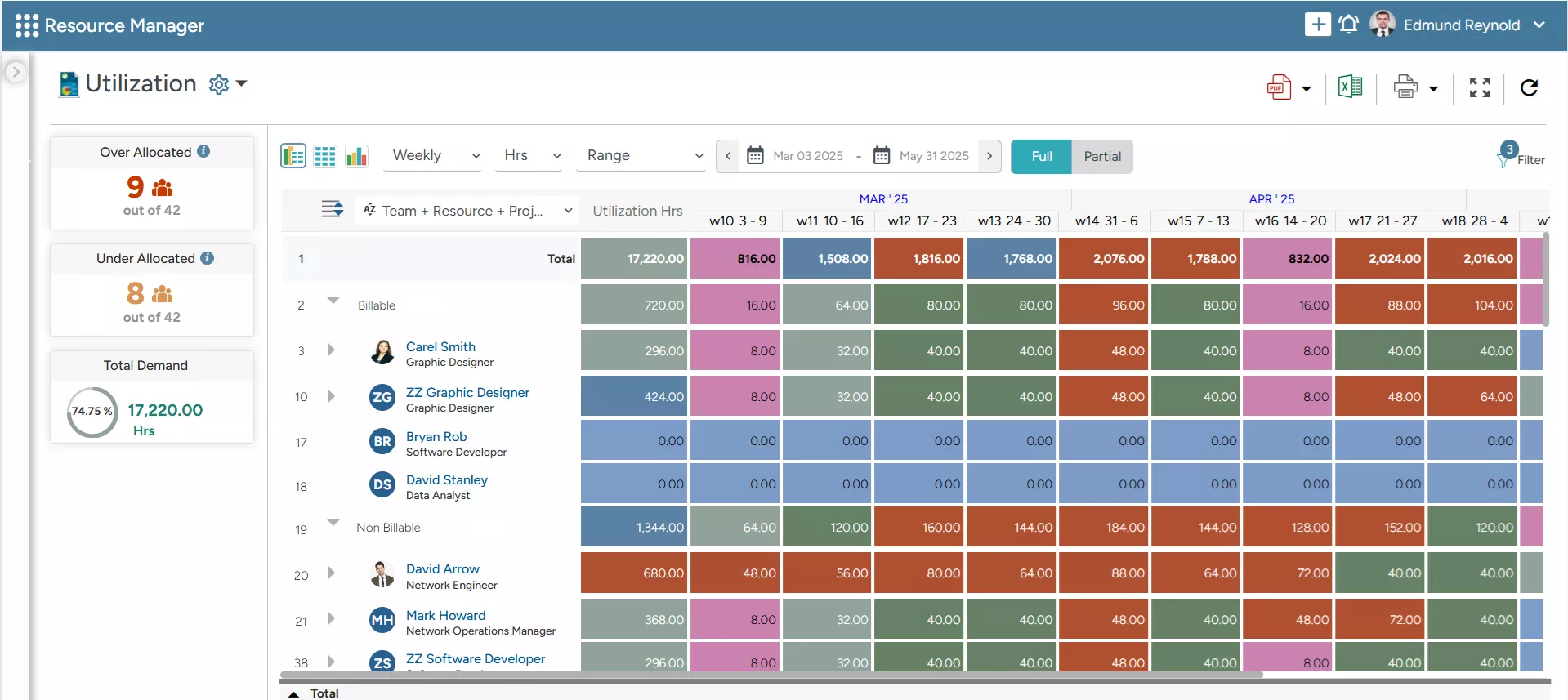 SAVIOM’s Embedded Resource Heatmap helps managers identify over- or underutilized resources and take proactive measures to balance workloads.
- An early warning system proactively identifies capacity constraints, skill misalignment, and workload imbalances, helping managers take corrective measures before they impact delivery.
- The tool’s real-time BI reports, like utilization, project vacancy, people-on-the-bench, etc., offer detailed information about resource metrics like availability, capacity, and utilization, facilitating smooth capacity planning.
- Finally, scenario modeling helps create and simulate various resource capacity forecasting scenarios by adjusting various key metrics to understand their impact and choose the most profitable outcome.
Discover how to make data-driven decisions with resource management software.
Conclusion
Without accurate resource forecasting, businesses struggle to understand future capacity requirements and address potential bottlenecks on time. However, by proactively measuring capacity and anticipating future needs, firms can streamline workflows, enhance organizational productivity, and drive long-term success seamlessly.
Frequently Asked Questions (FAQs)
Resource capacity forecasting is the process of predicting the future availability of resources required to meet anticipated project demand. It helps organizations understand whether their current and planned capacity can support upcoming workloads.
Resource capacity forecasting plays a critical role in boosting business performance as it:
1. Reduces Unnecessary Project Costs
2. Bridges the Resource Capacity vs. Demand Gap
3. Facilitates Competent Resource Allocation
4. Prevents Under- and Overutilization
5. Enables Data-Driven Resourcing Decisions
Common capacity forecasting methods encompass the following:
1. Qualitative Forecasting
2. Quantitative Forecasting
3. Bottom-Up Forecasting
4. Top-Down Forecasting
5. Scenario Forecasting
6. Demand Forecasting
7. Resource-Based Forecasting
The resource capacity forecasting process typically involves:
1. Foresee Pipeline Project Requirements
2. Assess Current Capacity vs. Demand
3. Bridge the Demand Gap Seamlessly
4. Model and Simulate Various Scenarios
5. Implement a Resource Capacity Model
Resource capacity forecasting focuses on predicting future resource demand and availability based on historical data and market trends. Contrarily, resource capacity planning involves forecasting, identifying, and bridging capacity vs. demand gaps by taking corrective actions, such as targeted hiring/upskilling or reallocating resources, to ensure successful project delivery.