

Introduction
A critical project is nearing its deadline, but halfway through execution, key team members are suddenly unavailable. Despite having a well-defined plan, the lack of real-time visibility into resource availability forces managers to reshuffle priorities, delay deliverables, and stretch already overloaded teams. What looked feasible on paper quickly unravels in execution.
This scenario is more common than most organizations admit. Without accurate insights into availability, resource planning becomes reactive rather than strategic. In multi-project environments, even small availability gaps can cascade into larger inefficiencies, making it essential for businesses to measure, forecast, and optimize resource availability with precision.
In this guide, we will dive deep into the nitty-gritties of resource availability, including benefits, calculation, steps to track, KPIs to assess, and more.
Let’s begin!
What is Resource Availability?
Resource availability refers to the actual time and capacity of people, equipment, and materials that are accessible to complete a project or take up a new task. In project management, it helps determine who is available, when they are available, and how much work they can handle, thereby ensuring realistic resource planning and timely delivery.
This process involves continuously tracking resource schedules, accounting for workloads and time-off, and updating availability in real time. By doing so, firms can make informed resource allocation decisions and reduce bench time. This results in higher productivity and drives efficient project execution.
Check out our resource management guide to manage capacity, availability, and utilization more effectively.
Now that we have the understood resource availability meaning, let us explore why it is important for firms to track.
Why Resource Availability Matters in Project Management?
Resource availability directly shapes how reliably plans translate into outcomes, influencing everything from allocation effectiveness, utilization efficiency, delivery timelines, and cost control. Let us understand key resource availability benefits:
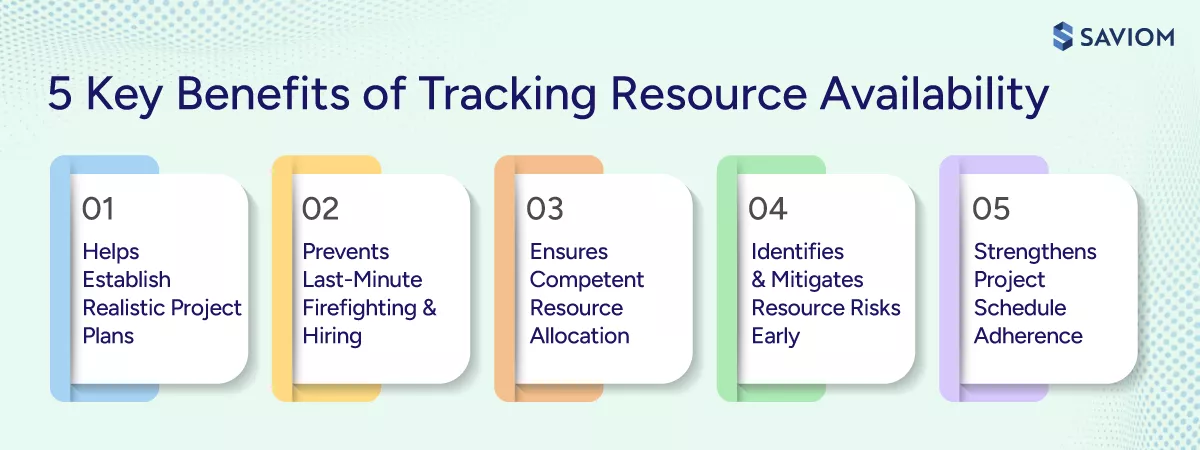
Helps Establish Realistic Project Plans
Monitoring resource availability provides real-time visibility into who is available, at what time, and what capacity. This helps managers make informed decisions about project prioritization and initiation. As a result, they can eliminate guesswork and create project plans based on ground reality and commit to what is achievable.
Prevents Last-Minute Firefighting and Costly Hiring
According to the SHRM Benchmarking Report, “The average cost per hire is nearly $4700.”
By tracking resource availability, managers can align capacity with demand effectively, ensuring that the right resources are available at the right time and cost. This helps them avoid last-minute firefighting, rushed allocations, and costly hiring. As a result, managers can reduce operational costs and protect project profitability.
Learn what a cost overrun is and key tips to prevent it effectively.
Ensures Competent Resource Allocation
Accurate resource availability data helps managers enable skill-based allocation, ensuring work is allocated efficiently and executed without unnecessary rework or delays. This also helps improve productivity, balance workload, and avoid overutilization of resources and bench time effectively.
Identifies and Mitigates Resource Risks Early
Tracking workforce availability provides early visibility into resource risks like shortages, skill gaps, or scheduling conflicts that allow managers to anticipate potential disruptions. This enables them to plan contingencies, such as reallocating work, adjusting timelines, or securing backup resources, and ensure delivery timelines stay intact and within budget.
Learn what enterprise risk management is and how it helps businesses.
Strengthens Project Schedule Adherence
Ensuring clear visibility into resource availability allows teams to align the right resources with the right phases of execution, preventing delays caused by last-minute shortages or misaligned allocations. This reduces schedule delays, improves coordination across tasks, and enables projects to stay on track.
Now that we have learned the importance of resource availability, let us focus on understanding the difference between two similar concepts.
Resource Availability vs. Resource Capacity: What’s the Difference?
While often used interchangeably, resource availability and resource capacity planning represent different realities. One reflects actual usable bandwidth, while the other defines total potential supply. Let us examine the differences in detail:
| Basis | Resource Availability | Resource Capacity |
|---|---|---|
| Definition | The actual time and bandwidth resources have to take on new or additional work | The total working time or maximum output resources can provide |
| Nature | Dynamic and continuously changing based on real-time conditions | Stable and predefined over a given time period |
| Focus | What is actually available for allocation right now or in the near future | What could be available under ideal conditions |
| Impact on Projects | Directly affects timelines, delivery, and resource allocation efficiency | Helps estimate whether sufficient resources exist for future demand |
| Update Frequency | Updated frequently (real-time or daily) to reflect changes | Updated periodically based on planning cycles |
| Role in Decision-Making | Guides operational decisions like task assignment and workload balancing | Guides strategic decisions like upskilling and hiring |
| Unit of Measurement | Measured as remaining hours, days, or available bandwidth | Measured as total hours, FTEs, or maximum output |
Having understood the critical distinction between the two concepts, we shall now explore the key factors that impact resource availability.
Core Factors that Affect Resource Availability in Firms
Resource availability is influenced by a range of dynamic conditions that continuously shape how resources can be deployed. These factors collectively impact planning accuracy, allocation decisions, and overall execution readiness. Let us take a closer look:
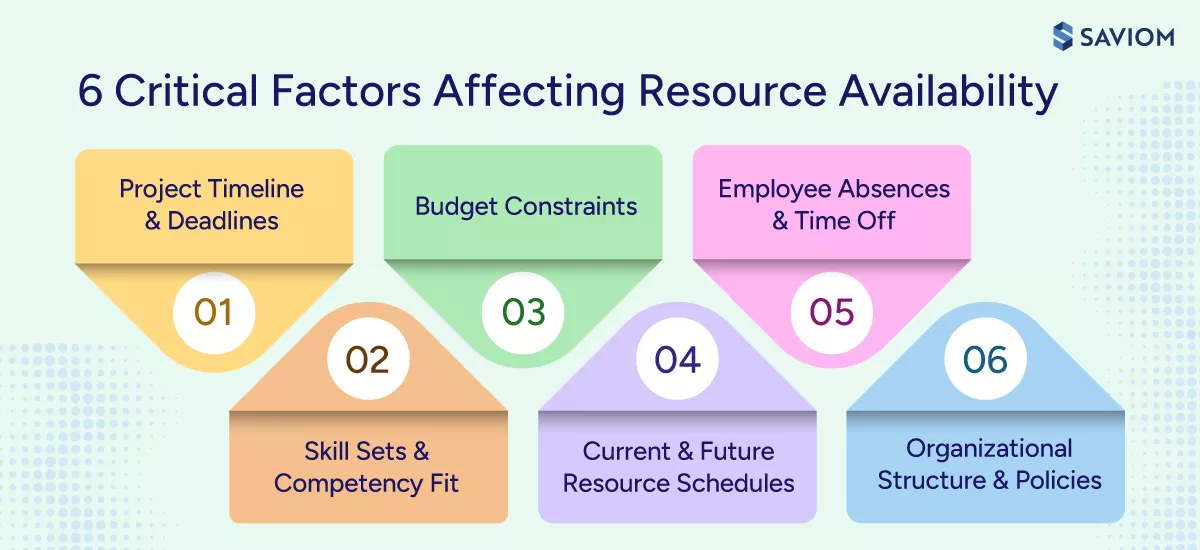
Project Timeline and Deadlines
When multiple project timelines overlap, the same resources are often stretched across competing priorities, reducing their effective availability. Additionally, frequent deadline changes and tight timelines disrupt planned project schedules, making it difficult to maintain stability in execution.
Skill Sets and Competency Fit
In many organizations, resources may have open bandwidth, but if their expertise does not align with project requirements, that capacity remains effectively unusable. This creates resource constraints, delays project initiation, and increases dependency on a limited pool of specialized talent.
Discover how a skill matrix helps firms optimize team deployment.
Budget Constraints
Budget constraints limit the ability to expand resource capacity through hiring or subcontracting, thereby reducing the pool of resources available to meet project demand. This forces teams to operate under lean staffing models, which consequently increases workloads, sub-optimal utilization, and project delays.
Current and Future Resource Schedules
Existing allocations reduce immediate bandwidth, while pipeline project bookings constrain future flexibility, often limiting an organization’s ability to accommodate new or shifting priorities. Moreover, a lack of centralized visibility into these leads to double-bookings and scheduling conflicts, making workforce availability fragmented.
Read our resource scheduling guide to understand the basics.
Employee Absences and Time-off
As per AbsenceSoft Report, “57% of employers reported a 21% increase in employee leave requests.”
While planned leaves such as vacations and holidays can be anticipated and incorporated into schedules, unplanned absences can reduce the effective working hours available for project execution, thereby limiting overall workforce availability. Also, poor visibility into resource calendars leads to overcommitment and reactive allocations.
Organizational Structure and Policies
In rigid or siloed structures, limited cross-functional movement, along with approval hierarchies, role boundaries, and allocation rules, delays access to available resources. Also, work policies like shift patterns, remote work norms, and utilization targets further define when and how resources can be engaged, directly impacting their effective availability.
Understand what a matrix organization is and how to manage it.
Having identified the core factors, let us dive into the calculation of resource availability.
How to Calculate Resource Availability? (Formula + Example)
To calculate resource availability in project management, firms can use the following formula:
Hours) × 100
where,
- Available working hours denotes the number of hours that a resource is accessible or free for work
- Capacity hours denote the number of hours that a resource is available in total (weekly, monthly, yearly)
Let us understand this in detail using a resource availability example:
Imagine a senior cloud engineer has a total monthly capacity of 200 hours. Out of this, 60 hours are already allocated to an ongoing project, and 30 hours are blocked for planned leaves and internal meetings. Then,
Available Working Hours = 200 – (60+30) = 200 – 90 = 110 hours
Now applying the formula,
Resource Availability = (110 / 200) x 100 = 55%
This indicates that the senior cloud engineer has more than half of their capacity free. In practical terms, the resource has relatively low current allocation and sufficient bandwidth for new tasks or projects.
Learn how effective project management helps firms gain a competitive edge.
So far, we have established the advantages, core factors, and formula for resource availability. Now we shall understand key steps involved in tracking workforce availability effectively.
Step-by-Step Process to Track Resource Availability
Effective tracking of resource availability depends on a well-defined process that integrates planning, scheduling, and real-time monitoring to reflect actual working conditions. This structured approach ensures that availability data remains current, enabling more reliable planning. Let us examine the steps involved:
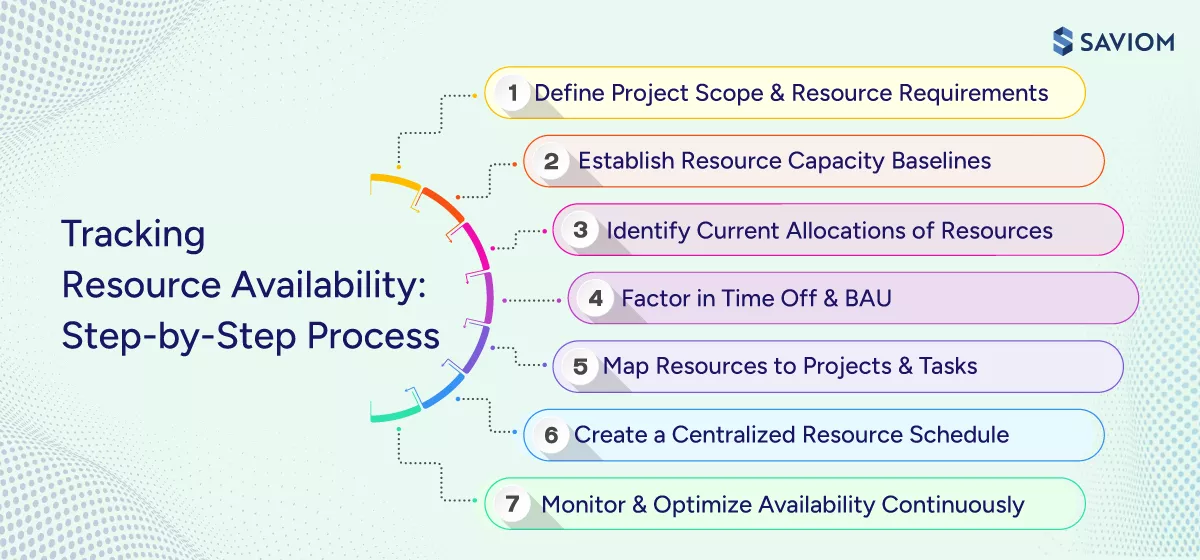
Define Project Scope and Resource Requirements
First is to clearly define the project scope, including deliverables, dependencies, milestones, etc., to accurately determine the required resources from the outset. Translating this scope into granular tasks enables a more precise assessment of the type and quantity of resources required at each stage. Also, leveraging historical data and expert judgment further strengthens the resource estimation accuracy.
Establish Resource Capacity Baselines
Next, managers must determine total working hours based on contractual terms, schedules, and standard organizational calendars to ensure consistency. Standardizing this capacity across teams creates a uniform benchmark, enabling accurate comparison of available resources against demand. This baseline then serves as a reliable foundation for calculating resource availability.
Learn how to measure resource capacity and demand effectively.
Identify Current Allocations of Resources
In this third step, managers should gain a clear view of how resources are engaged across ongoing projects, capturing both full and partial commitments to accurately assess remaining bandwidth. Centralizing this information in a single system ensures complete visibility, eliminating fragmented tracking and enabling more reliable resource allocation strategies.
Factor in Time Off and BAU
Now, managers must account for time-off and business-as-usual activities to reflect true working capacity, as planned leaves, holidays, training, and administrative tasks consistently reduce available hours. By doing so, they can ensure that availability calculations are grounded in realistic working conditions. Ignoring these recurring commitments leads to inflated assumptions of availability and misaligned planning.
Explore our blog on leave management and its importance.
Map Resources to Projects and Tasks
This step involves assigning the workforce to projects based on both their availability and skill suitability to ensure efficient execution. By aligning resource capacity with specific task requirements, managers can improve resource utilization while preventing over- or underutilization. Moreover, managers must avoid using fragmented tools like spreadsheets to reduce conflicts and allocation confusion.
Create a Centralized Resource Schedule
Next, managers must create a consolidated view of how resources are allocated across projects over time, enabling better coordination and planning. By leveraging dashboards, managers can clearly visualize workloads, identify capacity gaps, and detect potential conflicts early. Aligning this schedule with project interdependencies ensures that resources are available when needed, supporting smoother execution.
Discover key resource scheduling benefits every business should know.
Monitor, Update, and Optimize Availability Continuously
Finally, managers should continuously track resource utilization and availability to ensure that any changes in workloads, priorities, or capacity are immediately reflected in planning. This allows them to proactively reallocate resources as project demands evolve to maintain alignment and prevent disruptions. This ongoing optimization helps eliminate resource bottlenecks and sustain efficient allocation across projects.
Explore this eBook to understand how 5th gen resource management helps track workforce availability, improve allocations, and boost utilizations.

In the next section, we will explore the critical KPIs that help analyze resource availability in firms.
KPIs & Metrics that Help Assess Resource Availability in Firms
To accurately evaluate resource availability, organizations must rely on a structured set of metrics that capture both capacity and actual usage. These given KPIs help translate raw data into actionable insights for better planning and allocation decisions. Let us look into them in detail:
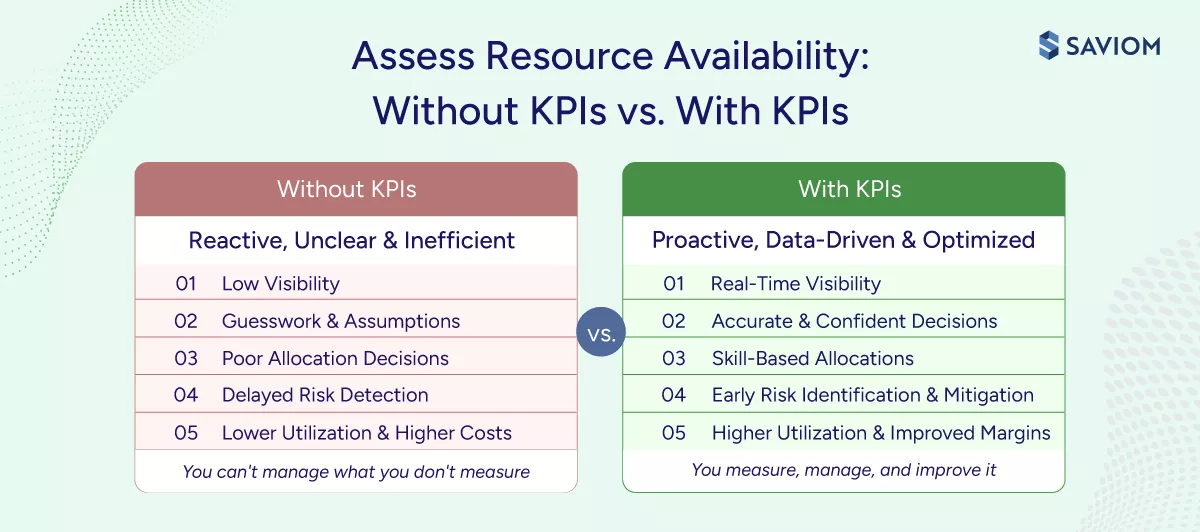
Resource Availability Rate
This metric measures the proportion of total capacity that remains free after accounting for existing commitments and non-working time, providing a clear view of usable bandwidth. It helps assess how much capacity is truly available for new or additional work and helps identify underutilized resources.
Resource Capacity
Resource capacity represents the total working hours or effort a resource can deliver within a defined period, providing a clear view of overall supply. By comparing this capacity against current and projected demand, it helps assess resource availability by revealing potential shortages or excesses, supporting balanced planning.
Read our workforce capacity planning guide for effective resourcing decisions.
Net Available Capacity
Net available capacity represents the actual volume of resource bandwidth that remains usable after accounting for existing commitments and routine constraints, expressed in concrete units such as Full-Time Equivalent (FTE), hours, or days. It shows exactly how much work can be assigned, thereby avoiding overcommitment. The formula is:
Working Time)
Resource Allocation Rate
This metric measures the proportion of a resource’s time that is currently assigned to project or operational work, reflecting how fully they are engaged. It ensures that resources are meaningfully allocated rather than being on the bench. This also helps highlight over-/or under-allocation, enabling managers to balance workload.
Discover ways to prevent overallocation of resources in projects.
Resource Utilization Rate
Resource utilization rate measures how effectively resources are utilized against their total available capacity. Higher utilization typically signals constrained availability, while lower utilization highlights excess capacity, enabling managers to make informed decisions on workload distribution.
Hours) × 100
Skill Availability Index
This metric evaluates the extent to which required competencies are accessible within the available resource pool. It helps assess workforce availability by determining whether the right skills are deployable when needed, thereby enabling managers to identify skill shortages and take corrective measures.
Explore key proven strategies to implement skill development in firms.
Time-to-Allocate
This measures the duration between identifying a resource requirement and successfully assigning a suitable workforce, serving as an indicator of allocation efficiency. It helps assess workforce availability by revealing how quickly the organization can access and deploy the right talent in practice, enabling more responsive project execution.
Bench Strength
It measures the proportion of resources who are not currently engaged in billable tasks, providing visibility into immediately deployable capacity. It helps assess workforce availability by identifying how many resources are readily accessible. A higher bench strength indicates underutilization or planning inefficiencies.
Learn essential strategies to minimize bench time and improve billability in firms.
Given the KPIs, let’s understand the recurring resource availability challenges that firms often face.
Common Challenges Firms Face in Tracking Resource Availability
Accurately tracking workforce availability remains a persistent challenge for many firms because it depends on several changing factors, including workload, skills, capacity, and project priorities. Below are the common issues firms face while tracking resource availability:
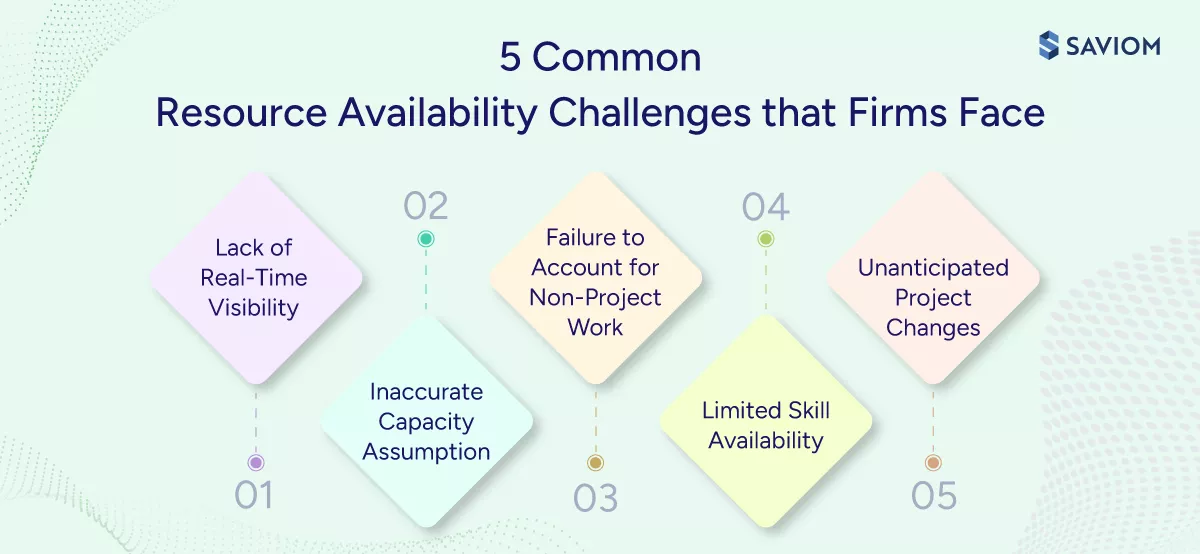
Lack of Real-Time Visibility
Firms often struggle to track workforce availability because their data does not reflect real-time changes. As a result, managers make decisions based on outdated information, which increases the risk of assigning resources who might be unavailable. This further leads to reactive planning and makes it harder to maintain accurate visibility across ongoing and upcoming work.
Explore why it is not ideal to use Excel for resource planning.
Inaccurate Capacity Assumption
Organizations frequently depend on static or short-term capacity assumptions when estimating resource availability. However, these assumptions fail to capture changing workloads, shifting priorities, and future demand patterns. Consequently, firms may face sudden shortages or excess capacity because they cannot accurately anticipate how availability will change over time.
Failure to Account for Non-Project Work
Firms often overestimate availability when they do not consistently track leaves, holidays, administrative duties, training, or other non-project activities. Although a resource may appear fully available on paper, its actual working time may be significantly lower. This gap creates unrealistic planning assumptions and increases the chances of overloading resources.
Learn the key difference between billable and non-billable work.
Limited Skill Availability
According to the Future of Jobs Report 2025, “Skill gaps are identified as the most significant barrier to successful business transformation.”
In many organizations, resources appear available in terms of time, but do not have the specific skills needed for the assigned work. This becomes more difficult when skill sets, certifications, experience levels, and project-specific expertise are not clearly visible across the organization. As a result, managers may struggle to identify competent resources, creating a gap between general availability and actual usable availability.
Unanticipated Project Changes
Businesses often struggle with sudden changes in project requirements during execution. Moreover, scope expansions, shifting priorities, or urgent client requests can increase resource demand without giving teams enough time to adjust existing allocations. This creates unexpected demand spikes and forces teams into reactive reallocation across current and upcoming work.
Discover critical strategies to avoid scope creep during project execution.
After challenges, let us move on to the key strategies that firms should adopt for optimizing resource availability.
Key Strategies for Optimizing Resource Availability in Multi-Project Environments
Optimizing workforce availability in multi-project environments requires firms to balance demand, capacity, skills, and timelines across several active projects. Since resource needs can shift quickly, the following strategies can help firms improve visibility, reduce allocation conflicts, and support better planning:
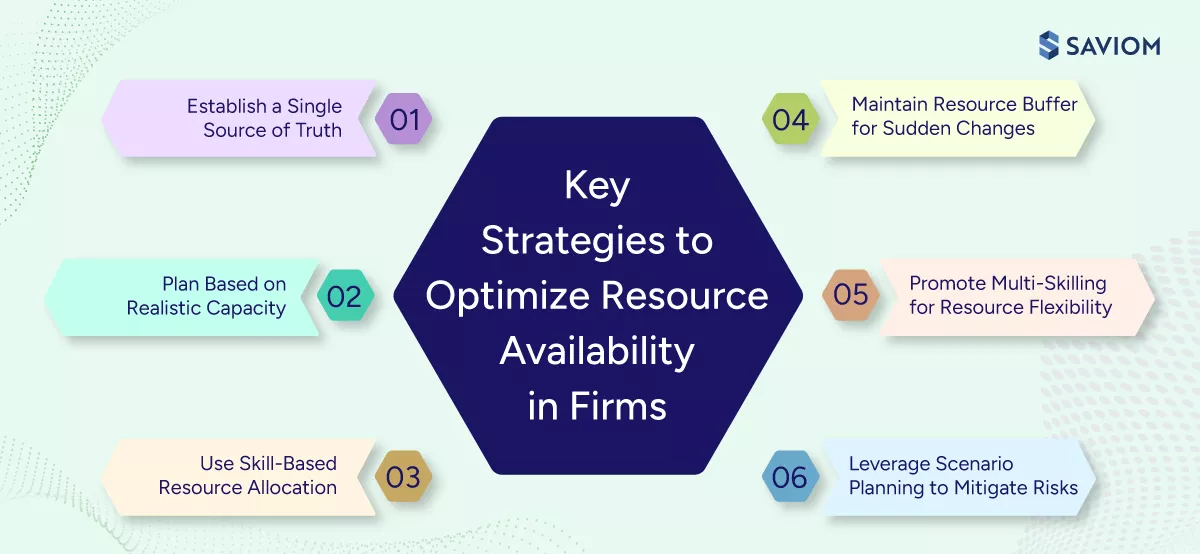
Establish a Single Source of Truth
Firms should centralize resource data in one platform to eliminate silos, outdated records, and fragmented visibility. This allows managers to track allocations, workload changes, and availability across multiple projects in real-time. As a result, they can make faster and more informed decisions based on accurate resource status.
Plan Based on Realistic Capacity, Not Assumptions
Organizations should plan resource availability using realistic capacity data instead of relying on fixed or broad assumptions. By considering historical trends, current workload, and future project demand, managers can better anticipate shortages or excess capacity. This approach helps firms create more reliable resource plans and adjust proactively as business needs change.
Read our resource forecasting guide to plan resources realistically.
Use Skill-Based Resource Allocation
Managers should allocate resources based on verified skills, proficiency levels, and relevant experience rather than availability alone. This ensures that the right people are assigned to the right tasks and helps maintain quality across project execution. In addition, a centralized skills inventory allows managers to identify suitable resources faster and reduce delays caused by skill mismatches.
Maintain Resource Buffer for Unanticipated Changes
Organizations should reserve a portion of resource capacity to manage unexpected work, scope changes, or urgent project requirements. Instead of fully allocating every resource, managers can maintain flexibility to absorb demand spikes without disrupting existing commitments. This strategy helps teams respond to changes more smoothly while protecting planned project timelines.
Promote Multi-Skilling to Enhance Resource Flexibility
Firms should develop cross-functional capabilities through training/upskilling, so resources can support different types of tasks when specific expertise is unavailable. By expanding skill coverage across teams, managers gain more flexibility in assigning work and using available capacity effectively. This also reduces dependency on a limited talent pool and helps projects continue smoothly during workload shifts.
Enable Scenario-Based Planning to Mitigate Unavailability Risks
Organizations should use scenario-based planning to prepare for changes in project demand, workforce availability, and business priorities. By evaluating best-case, worst-case, and likely scenarios, managers can understand potential risks before they affect delivery. This strategy helps firms reduce reactive decisions and build more flexible resource plans across multiple projects.
Learn the benefits, steps, and best practices of scenario planning.
Explore how advanced resource management software helps implement these strategies and transform the way firms manage workforce availability. Book your demo now!

The next section will focus on the importance of implementing robust resource management software in firms.
How Does a Next-Gen Resource Management Tool Help Track Resource Availability?
A 5th gen resource management software like SAVIOM offers a comprehensive suite of features that help monitor and optimize resource availability in real-time. Here are the core features that help in the same:
- All-in-One Resource Planner: Provides a comprehensive view of current and future pipeline project schedules along with resource data, enabling managers to make informed, data-driven decisions.
- Embedded Capacity Planner: Compares resource capacity with demand to identify shortages or excesses and take timely corrective actions.
- KPI Forecaster: Delivers up-to-date insights into resource availability and utilization, enabling managers to adjust plans proactively.
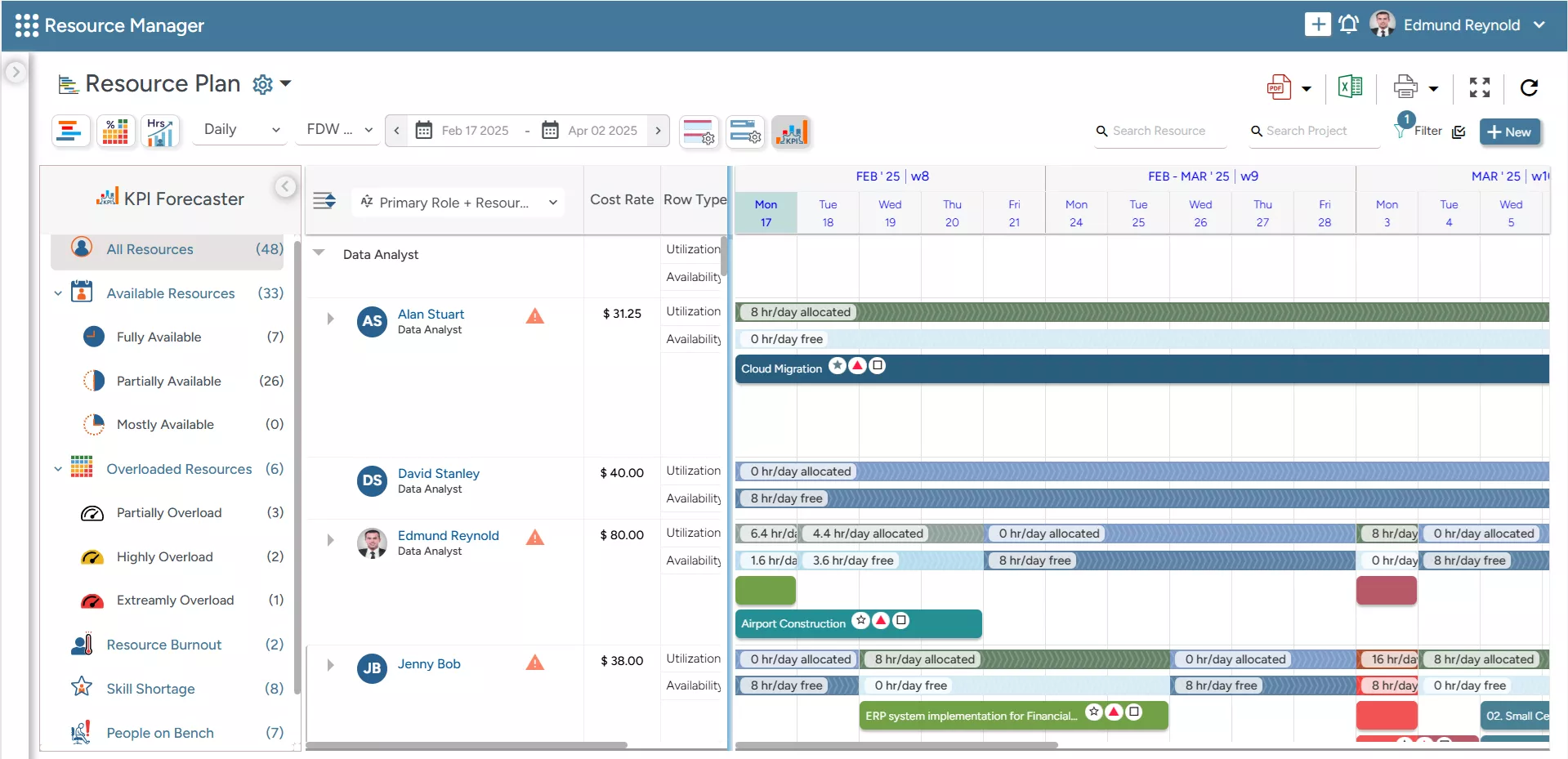 SAVIOM’s KPI Forecaster dashboard help managers gain real-time insights into key metrices like availability, shortages, burnouts, etc., enabling timely actions.
- Embedded Resource Heatmaps: Highlights over- and underutilization through color-coded visuals, helping managers maintain balanced workloads.
- Intelligent Matchmaking: Assigns resources to tasks by evaluating skills, availability, and other key factors, ensuring precise and effective allocation.
- Early Warning Signals: Detects issues such as resource overallocation and scheduling conflicts early, helping teams protect timelines and avoid disruptions.
- Competency Matrix: Tracks employee skills, competencies, and experience, enabling managers to identify gaps and plan targeted upskilling or hiring.
- Real-Time Business Intelligence: Provides real-time reports and analytics on utilization, project vacancies, bench strength, and more, supporting capacity planning.
- Scenario Modeling: Simulates and compares multiple planning scenarios under varying constraints, such as budget, availability, and scope changes, to identify the most feasible and cost-efficient plan.
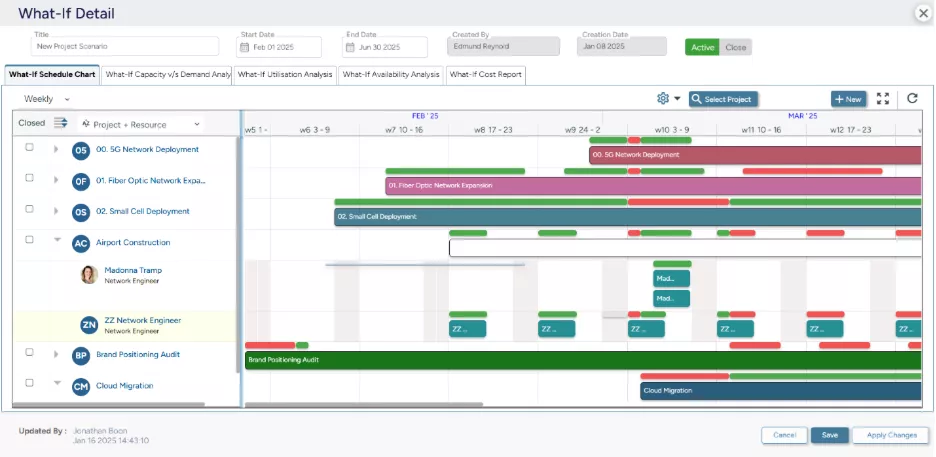 SAVIOM’s Scenario Modeling functionality allows managers to simulate and test multiple workforce scenarios in a sandbox environment.
Conclusion
Resource availability plays a critical role in helping firms plan projects realistically, allocate competent resources, and maintain delivery timelines. When managers have accurate visibility into capacity, workload, skills, and time-off, they can reduce allocation conflicts, avoid overcommitment, and make more informed resource planning decisions.
Moreover, as multi-project environments become more dynamic, firms must move beyond static planning and continuously monitor resource availability in real-time. By using structured processes, relevant KPIs, and advanced resource management tools, organizations can optimize workforce availability, improve utilization, and strengthen overall project execution.
Resource Availability FAQs
Resource availability in project management refers to the actual time and capacity of resources—such as people, equipment, or materials—that are free to work on a project. It helps determine who is available, when they are available, and how much work they can handle, ensuring realistic planning, balanced workloads, and timely project delivery.
Firms must track resource availability because it:
1. Establishes realistic project plans
2. Prevents last-minute firefighting and costly hiring
3. Ensures competent resource allocation
4. Identifies and mitigates resource risks early
5. Strengthens project schedule adherence
Resource availability is calculated by subtracting allocated work hours and non-working time (like leave or meetings) from total capacity hours. The result shows how much time is actually available for new tasks. It can also be expressed as a percentage using the formula: (Available Hours ÷ Total Capacity Hours) x 100.
The common factors that affect workforce availability are:
1. Project timeline and deadlines
2. Skill sets and competency fit
3. Budget constraints
4. Current and future resource schedules
5. Employee absences and time off
6. Organizational structure and policies
Resource availability is the actual time and bandwidth resources have for new work after accounting for current assignments and time off. Resource capacity, on the other hand, is the total potential working time or output resources can provide. In simple terms, capacity shows the maximum possible supply, while availability shows what is truly usable at a given time.
A resource calendar helps track availability by showing when resources are working, assigned, or unavailable due to leave or other commitments. It provides a clear, centralized view of schedules, making it easier to see who is free, avoid conflicts, and plan to work accurately based on real-time availability.
Some of the key challenges that managers face while tracking resource availability are:
1. Lack of real-time visibility
2. Inaccurate capacity assumption
3. Failure to account for non-working time
4. Limited skill visibility
5. Unanticipated changes in project scope
Real-time resource availability improves decision-making by providing up-to-date visibility into who is available, when, and at what capacity. This allows managers to allocate work more accurately, avoid conflicts or overload, and quickly adjust plans based on changing priorities, leading to faster and more informed decisions.