

Introduction
Resource forecasting is a critical capability for modern organizations managing complex project portfolios and shared talent pools. As these companies experience demand fluctuations and evolving business priorities, they must constantly evaluate whether future work can be delivered with available capacity.
Without accurate demand forecasts, organizations risk overcommitting resources, underutilizing critical skills, and missing project delivery targets. That’s why they must move beyond rudimentary spreadsheets and adopt proactive resource planning that helps them ensure the workforce is aligned with both current and future business goals.
This guide explores the fundamentals of resource forecasting in project management and how it helps anticipate demand, identify capacity gaps early, and align resources with business priorities.
What is Resource Forecasting?
Resource forecasting is the process of predicting an organization’s future resource needs, such as people, equipment, time, and budget, based on upcoming project demand. It helps ensure skilled resources are available at the right time, preventing last-minute firefighting and ensuring timely project initiation.
It involves analyzing historical project data and sales pipeline trends to anticipate upcoming workforce needs. By identifying potential resource shortfalls or surpluses early, managers can take timely corrective action to bridge capacity and demand gaps, driving successful delivery and long-term growth.
Now that resource forecasting meaning is clear, let us understand the importance of forecasting.
What are the Benefits of Resource Forecasting?
Forecasting is an essential function of the resource management process, and its significance in project management is profound. Here are the critical benefits of resource forecasting in project management:
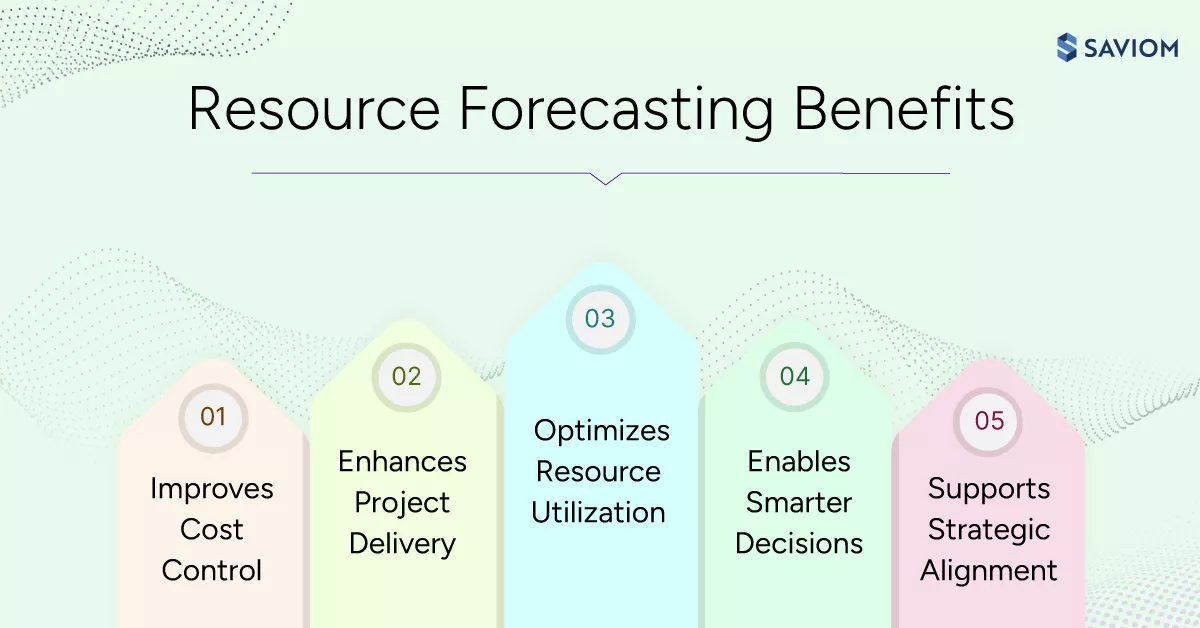
Improves Cost Control
With robust resource forecasting, organizations can anticipate future staffing needs and associated costs early. This allows managers to plan cost-effective resourcing strategies rather than react to urgent shortages. As a result, reliance on costly last-minute hiring is reduced, improving project budget control and cost predictability.
Understand what a cost overrun is and how to prevent it.
Enhances Project Delivery
Resource forecasting provides early visibility into demand and availability across projects. This helps managers identify potential capacity gaps before they impact schedules. By addressing resource risks in advance, teams avoid mid-cycle changes and maintain more predictable delivery timelines.
Optimizes Resource Utilization
Through effective resource forecasting, managers gain visibility into upcoming billable, non-billable, and strategic work. This enables them to deploy resources toward high-value, revenue-generating initiatives. Therefore, it ensures resources are used productively rather than sitting on the bench or being overextended. As a result, leaders optimize resource utilization across projects and improve overall profitability.
Read our blog on resource utilization.
Enables Data-Driven Decisions
Resource forecasting provides managers with early visibility into upcoming project demand. These insights help them streamline successive resource-centric workflows, such as capacity planning, resource allocation, utilization, etc. As a result, managers can make informed decisions, maintain balanced workloads, and improve overall operational efficiency.
Supports Strategic Alignment
Resource forecasting supports strategic alignment by translating organizational goals and strategic initiatives into clear, future resource requirements, ensuring the right skills are available at the right time. Organizations can assess whether planned work aligns with strategic objectives, proactively address capacity vs. demand gaps, and make data-driven investment decisions.
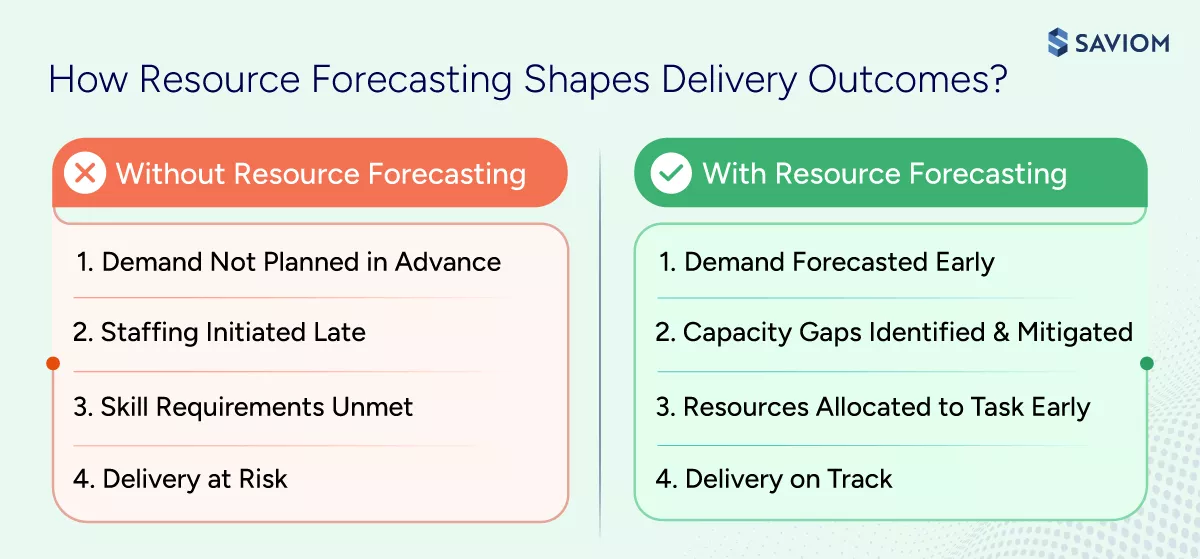
Now, let’s look at three resource management processes that serve different objectives. Understanding how each one works helps organizations apply the right approach at the right time.
Resource Forecasting vs. Resource Planning vs. Capacity Planning
Although the terms resource forecasting, capacity planning, and resource planning are often used interchangeably, they serve very different purposes. The following section outlines the key differences between them.
| Parameter | Resource Forecasting | Capacity Planning | Resource Planning |
|---|---|---|---|
| Primary Purpose | Predict future resource demand and supply for all projects in the pipeline | Assess whether available and planned capacity can meet forecasted demand | Allocate specific resources to approved work based on skills, cost, and availability |
| Key Question Answered | What resources and skills will we need in the future? | Can our resources meet current and future project demand? | Who should work on which tasks, and when? |
| Focus Area | Demand trends, skill demand projections, and workforce growth needs | Supply vs. demand balance, utilization limits, hiring feasibility | Allocation accuracy, workload balance, schedule fit |
| Inputs Used | Sales pipeline, project roadmaps, portfolio priorities, historical demand data | Available capacity, skillsets, productivity assumptions, and hiring timelines | Approved projects, task schedules, and real-time availability |
| Typical Outputs | Demand forecasts, skill requirement projections, and workforce scenarios | Capacity gap analysis, hiring or reskilling plans, utilization forecasts | Staffing plans, allocation schedules, workload distribution |
| Business Impact | Enables proactive workforce strategy and investment planning | Prevents overcommitment, burnout, and idle capacity | Improves execution efficiency and delivery coordination |
| Risks if Ignored | Reactive hiring, recurring skill shortages, and poor future readiness | Overutilization, bench time, unrealistic delivery commitments | Resource conflicts, missed deadlines, and frequent reassignments |
Now that the roles of forecasting, capacity planning, and resource planning are clear, let’s look at how resource forecasting actually works in practice.
How to Do Resource Forecasting: Step-by-Step Process
Resource forecasting is most effective when it follows a structured, repeatable workflow. The following section outlines a practical framework for effective resource forecasting process:
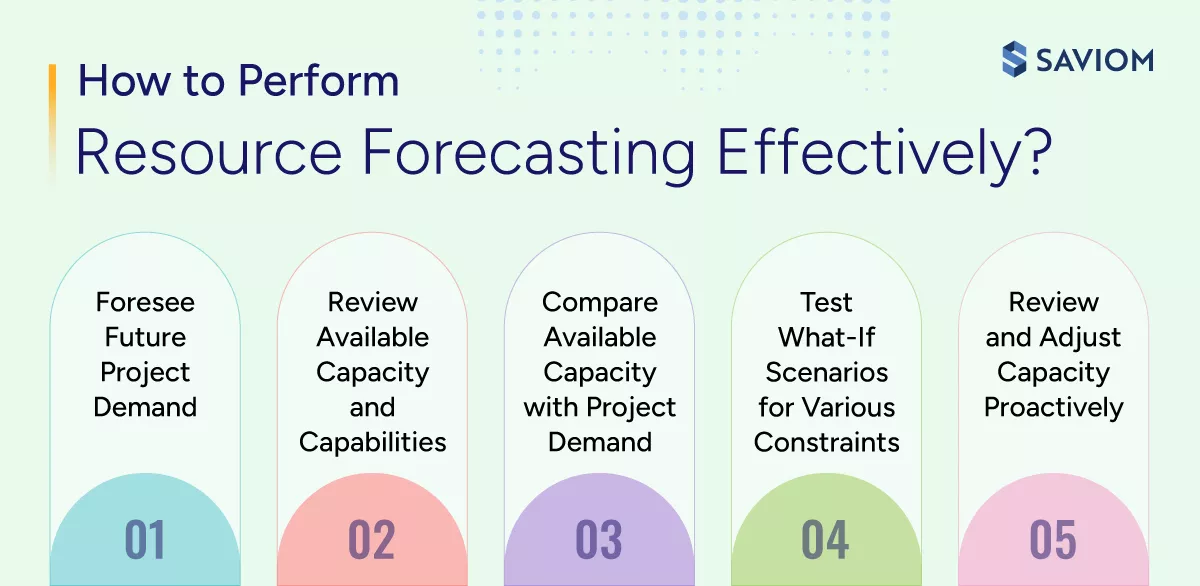
Step 1: Foresee Future Project Demand
Start by capturing resource requirements from approved projects, high-probability projects, and internal initiatives. Consolidate these data into a unified system to understand the overall resource requirements. This helps you prepare accurate resource management plans before project execution.
Step 2: Review Available Capacity and Capabilities
Next, assess available capacity by reviewing current project assignments, planned leave, and ongoing BAU work. This will help you understand the available capacity for upcoming projects. After that, evaluate whether available resources have the required capabilities to meet project demand.
Learn more about resource capacity planning.
Step 3: Compare Available Capacity with Project Demand
According to a McKinsey report, “90% of leaders consider capacity planning a pressing to-do that needs addressing now or soon.”
With resource demand and capacity defined, compare them across time periods, roles, and skills to identify capacity shortages and surpluses. Subsequently, use this insight to take necessary resourcing measures like hiring, retraining/upskilling, etc., to create an optimized talent pool ahead of the curve.
Step 4: Test What-If Scenarios for Various Constraints
After identifying resourcing gaps, the next step is to test scenarios to assess the impact of capacity deficit and excess on overall project delivery and business outcomes. Evaluating these scenarios before committing resources helps reduce delivery risks and safeguard project profitability.
Read more about scenario planning.
Step 5: Review and Adjust Capacity Proactively
Lastly, review demand forecasts regularly to capture changes in project priorities, scope, and delivery timelines. Adjust allocations as needed, rather than waiting for issues to arise. This keeps staffing aligned with actual demand and streamlines project delivery.
Read this eBook to understand what is resource forecasting in detail.
Now, let’s go through the various forecasting techniques.
Types of Resource Forecasting Models & Techniques
Listed below are some effective resource forecasting models and techniques that help firms manage project resources effectively. This section explains when to use data-driven models versus expert-based techniques for better efficiency.
Quantitative Forecasting Approaches
These project resource forecasting methods use historical and numerical data to predict future resource demand. They work best when past workload patterns and business trends are stable and measurable.
Trend-Based Forecasting
Trend-based forecasting is the process of projecting future resource demand by assessing past resource utilization and workload trends. It works well for teams with steady delivery patterns and similar project types. When demand remains consistent, historical trends provide a reliable starting point. However, this resource forecasting technique is less effective when business conditions or project mix change frequently.
Time-Series Forecasting Models
Time-series forecasting involves analyzing demand data at regular intervals to predict future resource needs during peak and low-demand periods. It is useful for businesses that experience regular peaks, such as audits, product launches, or regulatory cycles. This resource forecasting method improves short-term forecasts when demand follows predictable patterns.
Regression-Based Forecasting Models
Regression-based forecasting is the process of estimating resource demand by linking staffing needs to business drivers such as revenue, sales volume, or customer growth. It supports demand planning during business expansion or slowdowns and works best when workforce demand rises or falls in line with business performance.
Qualitative Forecasting Approaches
These project resource forecasting methods rely on expert judgment and business insights when data is limited or unreliable. They are helpful for new services, changing markets, or uncertain demand conditions.
Delphi Method
The Delphi method is a qualitative forecasting technique that estimates future demand by collecting structured inputs from multiple experts when historical data is limited or unreliable. These inputs are reviewed in several rounds to reach a consensus forecast, making the method useful for new services, new markets, or uncertain demand conditions.
Scenario-Based Forecasting
According to a GoodFirms’ survey, “34.2% of organizations leverage scenario planning for better forecasting.”
Scenario-based forecasting is the process of evaluating multiple possible demand outcomes instead of relying on a single estimate. It allows teams to assess how changes such as deal wins, delays, or scope shifts could affect staffing needs, helping organizations prepare contingency plans and reduce last-minute resourcing risks.
Using the right forecasting models is only part of the equation. To know whether forecasts are actually working, organizations must measure performance and track outcomes over time.
Key Metrics & KPIs for Successful Resource Forecasting
To ensure accurate resource forecasting, organizations must track the right performance indicators. Some critical resource forecasting KPIs are:
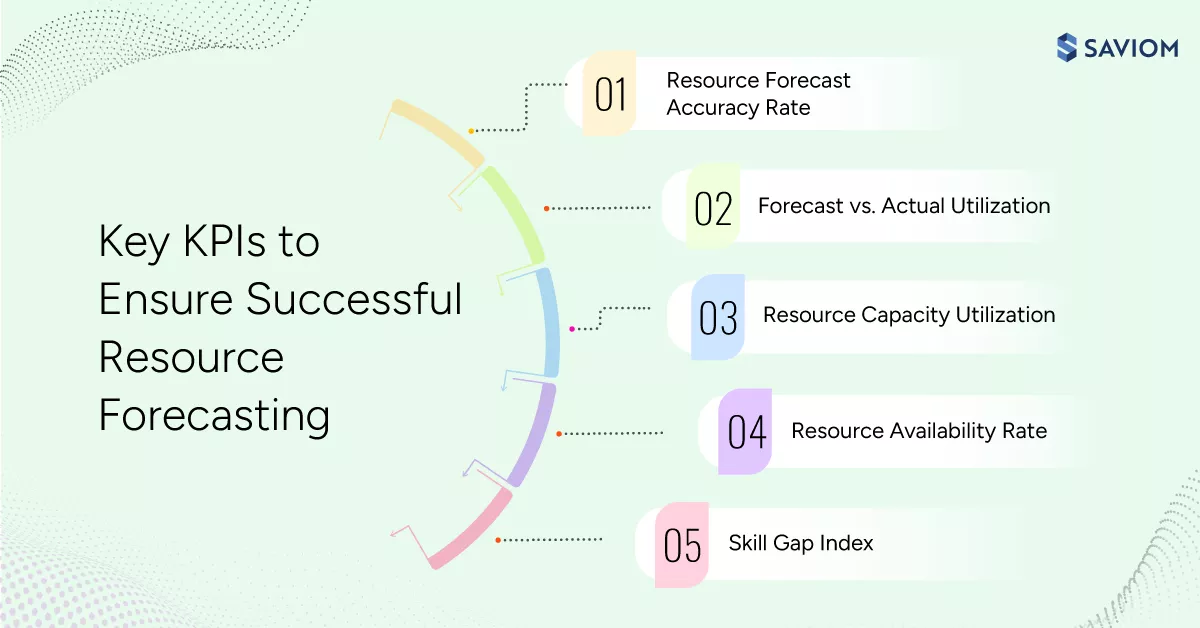
Resource Forecast Accuracy Rate
Resource demand forecast accuracy refers to the degree to which an organization’s forecasted resource demand matches actual demand. It helps firms evaluate the reliability of their resource planning and whether adjustments are necessary. Thus, the resource demand forecast accuracy metric empowers businesses to make data-driven decisions about hiring, allocation, and utilization.
Actual Demand) X 100
Forecast vs. Actual Utilization
This metric measures the variance between projected resource utilization and actual usage to assess the overall planning accuracy. A significant gap highlights forecasting issues that lead to either resource underutilization or overutilization, and higher resource costs. Thus, regularly tracking this KPI helps managers track progress, identify bottlenecks early, and make informed adjustments.
Forecasted Utilization] X 100
Resource Capacity Utilization
This KPI tracks the percentage of available capacity actively deployed to assigned work. Low utilization indicates unused capacity and prolonged bench time, impacting business productivity and profit margins. Meanwhile, extremely high utilization may signal over-allocation and burnout risks.
Resource Availability Rate
Resource availability rate is the percentage of time a resource is available to perform productive work within a specific timeframe. It quantifies the portion of a resource’s total capacity that can be assigned to tasks, accounting for current commitments, scheduled leave, maintenance, and other organizational constraints.
X 100
Read our blog on resource availability.
Skill Gap Index
According to a McKinsey & Company study, “87% of companies worldwide already have a skills gap or expect to have one within a few years.”
The skill gap index measures the difference between the skills an organization requires and those currently possessed by its workforce. It highlights critical roles or niche expertise that are in short supply, which can impact project execution and delivery. Monitoring this KPI enables organizations to address gaps and build a future-ready workforce proactively.
Number of Skills Required] X 100
To see how these practices and metrics translate into tangible business outcomes, let’s look at some industry-specific resource forecasting examples.
Resource Forecasting Examples Across Industries
Now let’s look at real-world resource forecasting examples across different industries where forward-looking demand and capacity insights helped firms control costs, secure delivery timelines, and improve operational efficiency.
IT Services Organizations
A global IT services firm used skill-level resource forecasting to anticipate demand for cloud, cybersecurity, and QA specialists across multiple parallel product releases. Instead of forecasting only approved projects, the firm included pipeline deals and internal transformation programs in its demand models.
Impact: By hiring and reskilling earlier, teams reduced last-minute skill gaps, maintained balanced utilization across delivery units, and achieved more reliable release schedules.
Professional Services Firms
A consulting organization implemented pipeline-weighted forecasting to prepare staffing plans based on deal probability and expected start dates. Delivery leaders reviewed forecasted demand weekly to adjust hiring and internal mobility plans before new engagements were signed.
Impact: The firm significantly reduced bench time, onboarded clients faster, and avoided frequent last-minute reassignments during busy sales cycles.
Audit, Accounting, and Legal Firms
An audit firm forecasted specialist demand for statutory audits and compliance engagements months before peak season. Forecasts incorporated engagement timelines, regulatory workload intensity, and historical seasonality to plan contract and permanent staffing needs.
Impact: By planning temporary staffing in advance, the firm reduced employee burnout, stabilized utilization, and met compliance deadlines without last-minute hiring.
Architecture, Engineering, and Construction (AEC) Firms
An engineering company used phase-level forecasting to align specialist availability with design, procurement, and construction project milestones. Instead of uniform staffing, resource demand was forecasted separately for each project phase and location.
Impact: This approach ensured specialists were available when needed, reduced idle time between phases, lowered subcontracting costs, and prevented delays caused by skill shortages.
Learn more on project milestones.
Healthcare Organizations
A hospital network applied demand forecasting to anticipate patient volume surges across emergency, ICU, and surgical units. Workforce forecasts accounted for regulatory staffing ratios, leave schedules, and historical admission patterns.
Impact: The hospital reduced patient wait times, adjusted staffing proactively, and maintained care quality during peak demand.
Manufacturing Enterprises
A manufacturing firm forecasted workforce demand for new production line launches and capacity ramp-ups. Maintenance, quality, and automation roles were forecasted based on commissioning schedules and throughput targets.
Impact: By ensuring skills were available ahead of peak production, the firm reduced equipment downtime and met output targets without rushed hiring or excessive overtime.
To execute resource forecasting practices consistently across the organization, the right technology is essential. This section outlines key factors to consider when selecting a resource forecasting tool.
Key Considerations Before Adopting Resource Forecasting Software
Before investing in a resource forecasting tool, organizations should assess whether the solution can support long-term planning, scale with business growth, and be used consistently across teams. Here are a few factors one must consider:
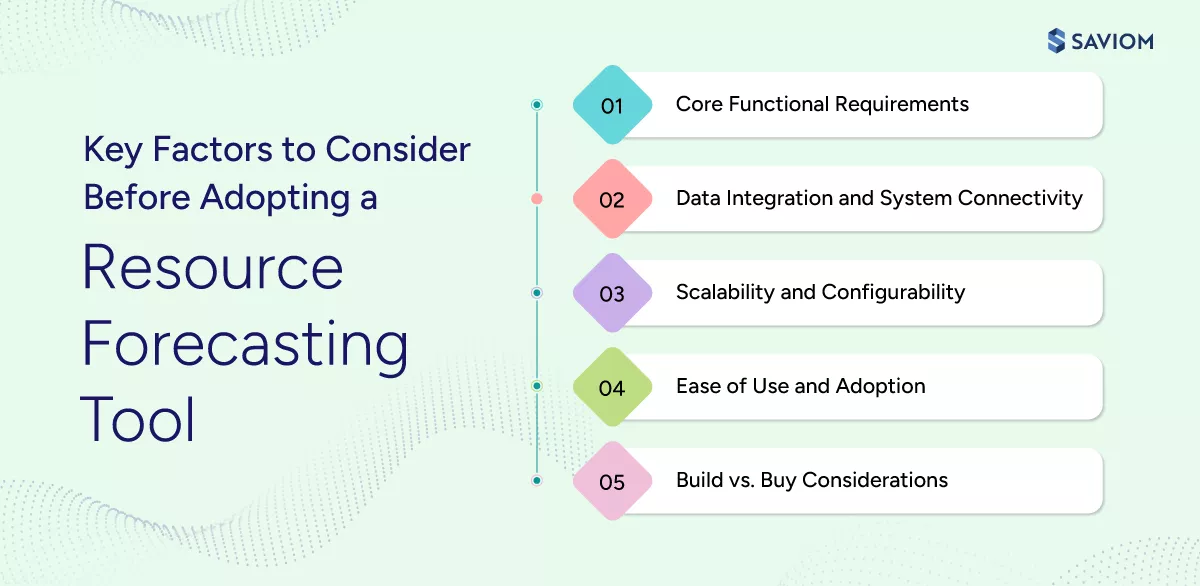
Core Functional Requirements
Most tools focus on tracking current work and lack features to forecast future demand or identify upcoming resource needs. Without demand modeling and scenario analysis, teams cannot evaluate whether upcoming work is feasible with available and planned capacity.
Hence, firms should assess whether the tool provides features such as multi-dimensional analysis, KPI forecasting, early warning systems, dynamic capacity planning, and what-if simulation capabilities that will help them streamline resource management processes.
Data Integration and Connectivity
Forecast accuracy depends on how well resource capacity and demand data stay aligned over time. When ERM, CRM, PPM, and HR systems operate in silos, forecasts quickly become outdated and unreliable.
Organizations should prioritize platforms that seamlessly integrate with their existing business ecosystem to create a unified data exchange framework. This helps ensure resource demand forecasts reflect real-time business changes and support informed decision-making.
Scalability and Configurability
Tools that work for small teams are often difficult to scale as portfolios, roles, and locations expand. Buyers should evaluate whether the platform can handle growing volumes of projects and resources without performance issues or data inconsistencies.
The system should also allow configuration of planning horizons, utilization thresholds, etc., so resource forecasting models remain relevant as delivery models and business strategies evolve.
Ease Of Use and Adoption
Even the best resource forecasting software fails if teams find it challenging to use. When workflows are complex and the learning curve is high, project stakeholders avoid using the system consistently and revert to spreadsheets or manual tracking.
Therefore, organizations should look for intuitive tools with easy-to-navigate interfaces to facilitate quick user adoption and ease the learning curve.
Build vs. Buy Considerations
Custom-built resource forecasting tools may suit organizations with highly specialized processes and strong internal IT infrastructure. However, they typically require high investments, long development cycles, continuous maintenance, and frequent enhancements as business needs change.
On the other hand, commercial off-the-shelf resource forecasting platforms provide faster deployment and ready-to-use functionalities, making it easier for organizations to scale forecasting capabilities without significant maintenance overhead.
Use SAVIOM’s advanced resource management software to identify, allocate, and optimize resources in real-time and ensure successful project delivery. Book a Demo Today.
As organizations mature, many move beyond manual forecasting toward AI-driven and predictive planning models. The following section explores how these technologies are shaping modern forecasting.
AI & Predictive Analytics in Resource Forecasting
Forecasting is evolving with AI and advanced analytics. This section explores emerging trends that improve early risk detection and faster decision-making.
Shift from Static Forecasts to Predictive Demand Analytics
Many organizations are moving away from static, spreadsheet-based forecasts toward predictive demand analytics that use both historical and current project data. These models identify upcoming workload trends and flag capacity risks early, allowing teams to act before projects are impacted and plan resources more proactively.
Growing Use of Skill-Level and Role-Based Forecasting
Forecasting is increasingly focused on specific roles and skills rather than overall headcount. This helps organizations identify competency gaps early, rather than discovering them during execution. As a result, hiring and reskilling can start sooner and remain aligned with actual delivery needs.
Read our blog on skill development.
Increased Adoption of Automated Scenario Simulation
More teams now use automated scenario modeling to test how the resource-centric constraints, such as skill shortages, high resourcing costs, limited capacity, etc., affect project and business outcomes. Accordingly, leaders can compare various scenarios before approving the best-fit resource plan, lowering project risks.
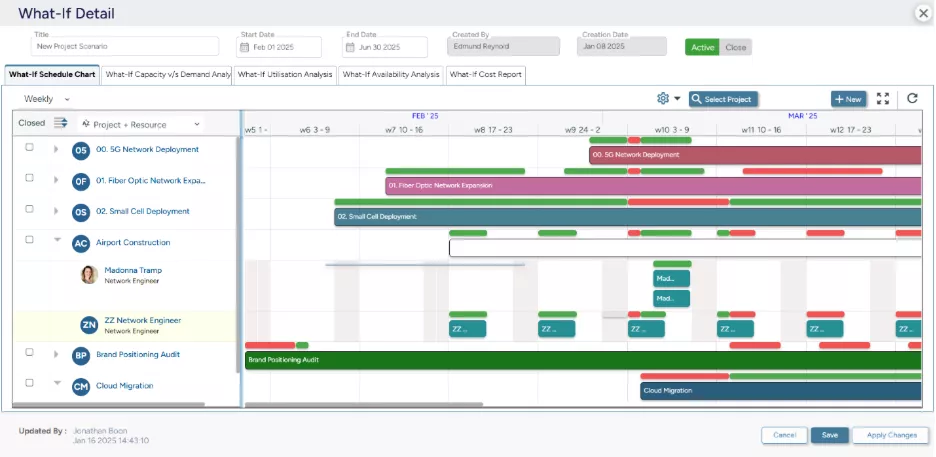 SAVIOM’s Scenario Modeling functionality enables managers to simulate different workforce scenarios in a sandbox environment and select the most profitable plan.
Machine Learning for Continuous Forecast Refinement
Machine learning is increasingly used to recalibrate forecasts as new utilization and delivery data become available. Rather than relying on fixed assumptions, these models adjust to constantly evolving project demand patterns, improving forecast accuracy in dynamic business environments.
Rise in the Prescriptive Analytics
Organizations are increasingly using prescriptive analytics, which goes beyond predicting future demand and actively recommends actions firms should take to address capacity and skill gaps. Based on forecasted demand and available capacity, these systems suggest steps such as hiring, reskilling, redeploying available resources, or using contingent workers.
In practice, inaccurate resource forecasting often leads to avoidable resource planning and project delivery issues. The following section explains common challenges and how to overcome them.
Common Resource Forecasting Challenges and How to Overcome Them
When forecasting is poorly executed, even firm plans can fall apart. This section highlights common roadblocks and how to address them.
| Challenge | Why Does It Happen | How to Overcome It |
|---|---|---|
| Lack of Enterprise-Wide Visibility | Resource-centric data is spread across teams, tools, or departments, making it hard to build a unified forecast | Centralize demand and resource data across portfolios, business units, and locations using integrated planning systems |
| Absence of Up-to-Date Skill Information | Skill profiles and certifications are outdated or incomplete, leading to inaccurate assumptions about workforce capability | Maintain a centralized, regularly updated skills inventory linked to resource profiles and project history |
| Difficulty Balancing Competing Priorities | Multiple projects and initiatives compete for the same resources or skills, requiring frequent revisions to demand and capacity forecasts as priorities shift | Apply portfolio-level prioritization and use scenario planning to test the capacity impact of shifting priorities |
| Mismatch Between Supply and Demand | Available capacity does not align with forecasted workload in terms of timing, volume, or skills | Run regular demand vs. capacity comparisons and plan early capacity actions such as hiring, reskilling, or subcontracting |
| Frequent Skill Gaps and Shortages | Future skill needs are not anticipated, resulting in last-minute hiring or dependency on external vendors | Forecast skill-level demand based on upcoming projects and invest in advanced training and workforce development |
| Lack of Visibility into Future Utilization | Organizations cannot predict when resources will be overutilized or underutilized in upcoming periods | Use forward-looking utilization forecasts to identify and rebalance workload before delivery starts |
Next, let us learn about the resource forecasting best practices.
Top Resource Forecasting Best Practices for Firms
When forecasting becomes a mature, repeatable practice, it stops being just a planning activity and starts delivering real competitive advantage. Below are the top resource forecasting strategies:
Know The Strengths & Weaknesses of Resources Within Your Project
Before assigning critical work, managers should review employees’ past performance, skills, experience, and other factors to assess their project readiness. This helps identify capability issues and avoid skill mismatches. Moreover, these insights help managers form the right mix of resources for every project and initiate targeted training, upskilling, or hiring in advance. The goal here is to ensure the required skills are in place before project initiation.
Understand The Skill Requirements for Your Project to Complete Delivery
Breaking deliverables into a clear work breakdown structure (WBS) helps identify task-level skill requirements. This prevents assigning generic resources to highly specialized work and vice versa. With proper skill mapping, firms assign the right people to the right tasks, ensuring better work quality and a seamless workflow. This resource forecasting strategy reduces late-minute resource reallocations and execution risk.
Conduct Capacity vs. Demand Gap Analysis & Identify Skill Gaps
Comparing forecasted work with available capacity quickly highlights capacity and skill gaps. This gives managers sufficient time to take corrective action to bridge the gap. Consequently, it prevents costly last-minute firefighting and ensures projects start on time.
Learn how to measure resource capacity and demand effectively.
Carefully Analyze Past Project Performance Data
Historical performance data highlights where estimates went wrong and where productivity dipped. These patterns help refine future effort and delivery timelines. Over time, this creates more stable project schedules and budgets. Furthermore, resource forecasts become grounded in reality rather than best-case assumptions.
Involve All Stakeholders in the Forecasting Process
Involving all stakeholders in the forecasting process helps improve accuracy, alignment, and adoption of resource plans. When PMOs, project managers, resource managers, and business leaders contribute their inputs, forecasts are based on realistic timelines, budgets, skill needs, and constraints rather than assumptions. This reduces blind spots, mitigates risks early, and ensures that resource forecasts reflect both strategic priorities and operational realities.
Understand who the project stakeholders are and how to manage them.
Regularly Check the Resource Utilization Levels
Forecasting future utilization helps spot overload and capacity wastage before employee productivity suffers. Managers can rebalance work or reassign resources early. This protects employee well-being while improving their overall billable contribution. It also reduces burnout-driven attrition over time.
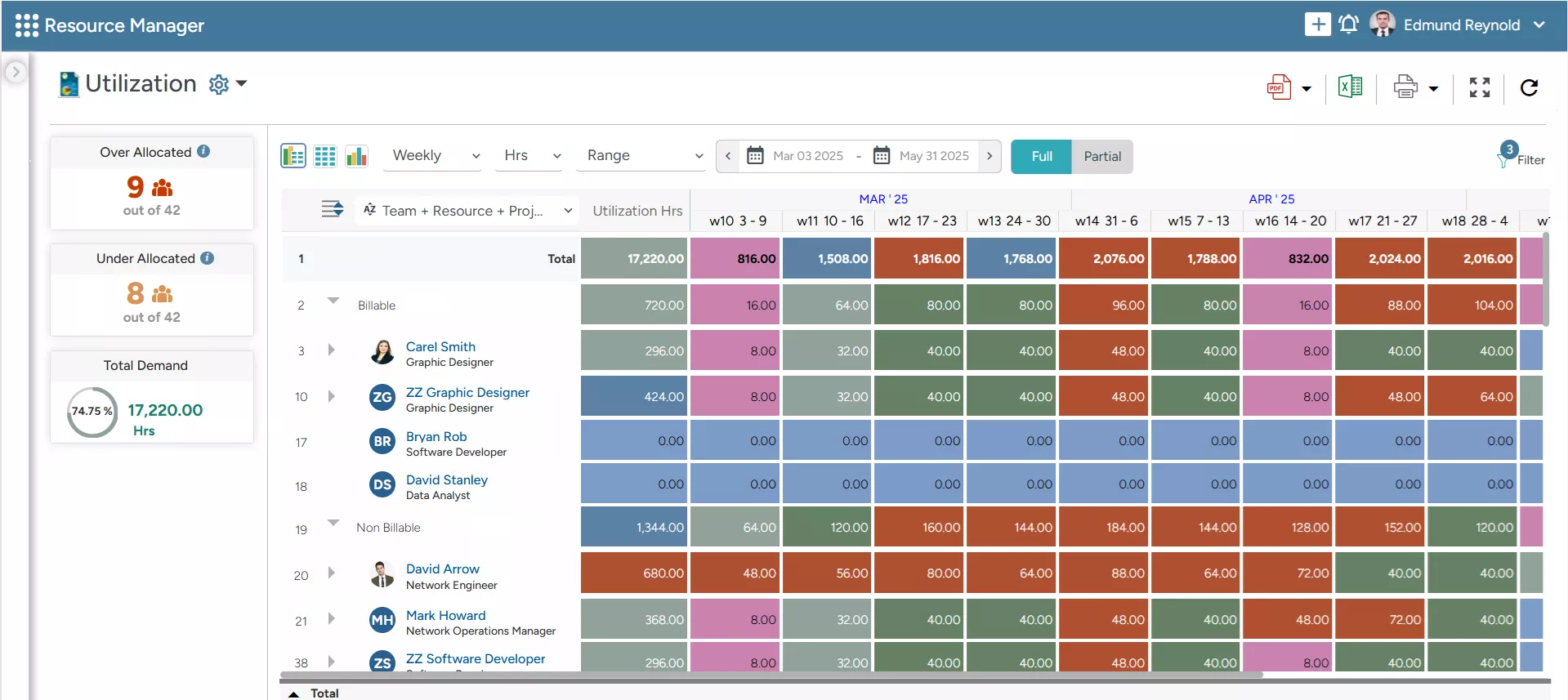 SAVIOM’s Color-Coded Heatmap helps forecast employees’ utilization levels, enabling leaders to identify imbalances and take proactive actions.
Acquire Or Release Resources as Per Delivery Commitments
Project timelines and priorities rarely stay fixed. Having contingency staffing plans allows teams to add or release resources as delivery needs change. This maintains delivery momentum without permanently increasing headcount and keeps resource costs under control during demand fluctuations.
Understand who contingent workers are and how they can be beneficial.
Keep An Eye on Industry Trends & Labor Market Conditions
By staying informed about industry trends and labor market conditions, organizations can anticipate changes in resource availability, skills demand, and emerging technologies that may impact their projects. This awareness helps resource managers keep workforce capabilities aligned with future needs, attract and retain top talent, and remain competitive.
Conclusion
An effective resource forecasting process enables managers to prepare for future demands by evaluating various probabilities and outcomes. By utilizing the appropriate forecasting tool, managers can generate tailored forecasts that contribute to successful project execution, ultimately boosting profitability and return on investment (ROI).
So, ready to take the necessary steps and reap the resource forecasting benefits?
Frequently Asked Questions (FAQs)
Resource forecasting is the process of predicting an organization’s future resource needs, such as people, skills, time, and budget, based on upcoming project demand, ensuring the right resources are available at the right time and projects start without delays.
Resource forecasting is important because it:
1. Improves cost control
2. Enhances project delivery
3. Optimizes resource utilization
4. Enables data-driven decisions
5. Supports strategic alignment
Resource forecasting focuses on predicting future demand for skills and resources based on upcoming projects and the business pipeline. Capacity planning, on the other hand, evaluates whether current and planned workforce capacity can meet that demand. Together, forecasting identifies what is needed, while capacity planning confirms what is feasible.
The key steps for an effective resource forecasting process are:
1. Step 1: Foresee future project demand
2. Step 2: Review available capacity and capabilities
3. Step 3: Compare available capacity with project demand
4. Step 4: Test what-if scenarios for various constraints
5. Step 5: Review and adjust capacity proactively
The common resource forecasting methods include:
1. Trend-based forecasting
2. Time-series forecasting model
3. Regression-based forecasting model
4. Delphi method
5. Scenario-based forecasting
Given below are the critical best practices that firms must implement for seamless resource forecasting:
1. Know the strengths and weaknesses of project resources
2. Understand the skill requirements for projects
3. Conduct capacity vs. demand gap analysis and identify skill gaps
4. Carefully analyze past project performance data
5. Involve all stakeholders in the forecasting process
6. Regularly check the resource utilization levels
7. Acquire or release resources as per delivery commitments
8. Keep an eye on industry trends and labor market conditions