

Introduction
Modern project-based organizations operate in an environment where speed, coordination, and adaptability matter more than ever. As initiatives grow larger and more cross-functional, businesses need a reliable way to keep teams aligned and delivery on course. Project management provides that foundation.
It introduces governance, structured methodologies, and execution controls that help firms plan more realistically, allocate resources strategically, and respond to changes faster. Moreover, project management helps reduce uncertainty, improve collaboration, and ensure all initiatives move forward seamlessly.
In this project management guide, we explore how it helps organizations deliver initiatives more predictably while ensuring long-term business resilience.
What is Project Management? (Enterprise Definition & Scope)
Project management is the structured discipline of planning, organizing, and managing tasks, resources, and timelines to achieve specific project objectives. It ensures that projects are completed within defined constraints, such as scope, time, cost, and quality, while aligning outcomes with organizational goals and stakeholder expectations.
The scope of project management spans the entire lifecycle, from defining objectives and developing plans to allocating resources, tracking progress, and managing risks. It also involves coordinating with project stakeholders and applying appropriate methodologies and governance frameworks to ensure initiatives remain aligned with organizational strategy and deliver intended business value.
Having understood the project management definition, let us move on to explore why it’s important for enterprises.
Why Project Management Matters for Business Performance?
Project management helps organizations execute initiatives with greater clarity, control, and coordination. As a result, organizations experience stronger operational performance and more reliable project delivery. The following points highlight the key enterprise project management benefits:
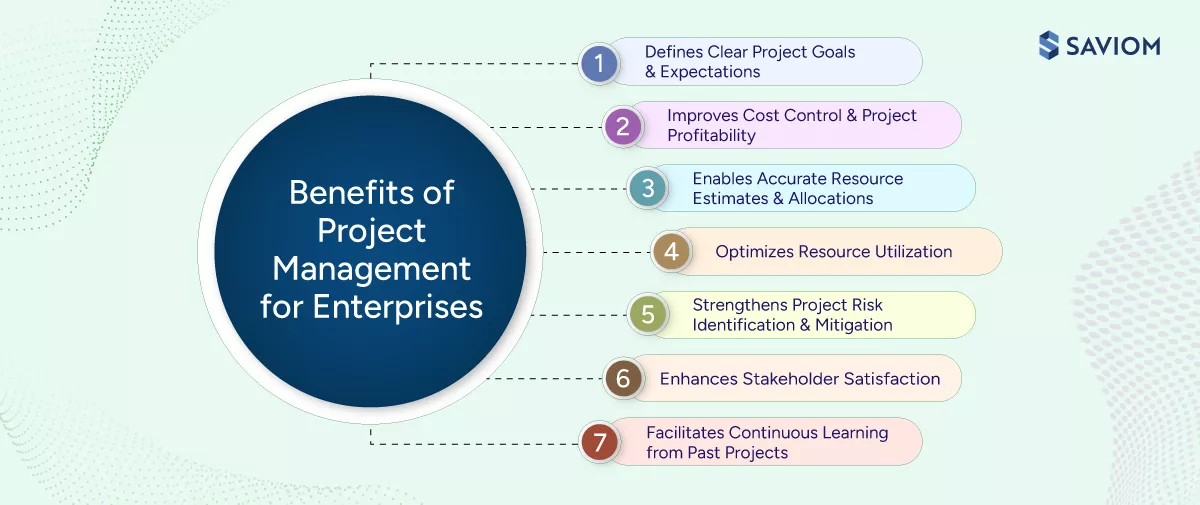
Defines Clear Project Goals and Expectations
A structured project management framework helps establish clear objectives, scope boundaries, and deliverables before execution begins. It also defines roles and responsibilities for each team member involved in the project. This clarity ensures the entire team understands what needs to be delivered, reduces miscommunication, and keeps efforts aligned with project goals.
Learn about project milestones and how to manage them effectively.
Improves Cost Control and Project Profitability
As per a PMI’s annual global survey of project professionals, “Organizations that invest in effective project management practices waste 28 times less money than those that do not.”
A disciplined project management process introduces structured resource cost estimation, budgeting, and continuous financial monitoring throughout execution. These practices help managers track spending against the predefined cost baseline, identify variances early, and take timely corrective actions. As a result, they can improve financial discipline, prevent cost overruns, and improve overall project profitability.
Enables Accurate Resource Estimates and Allocations
An effective project planning process enables managers to apply structured techniques, such as the Work Breakdown Structure (WBS), to divide projects into manageable tasks and estimate the number and type of resources required more accurately. This helps managers allocate suitable resources, balance workloads, and avoid last-minute staffing gaps, ensuring efficient project execution.
Explore effective strategies for resource estimation in project management.
Optimizes Resource Utilization
Project management enables managers to track resource utilization across billable, non-billable, strategic, and non-strategic work. This visibility helps identify underutilized capacity and mobilize resources from non-billable to billable work based on project demand. As a result, organizations can improve billable utilization while ensuring even workload distribution, reducing disengagement, and preventing employee burnout.
Strengthens Project Risk Identification and Mitigation
With an established project management process, managers can identify potential resource risks early and assess their likelihood and impact. This allows teams to plan appropriate mitigation strategies before risks escalate. As a result, organizations can reduce disruptions, safeguard timelines, and ensure successful project delivery.
Read our blog to learn about enterprise risk management.
Enhances Stakeholder Satisfaction
An effective project management approach ensures consistent communication and transparency throughout the project lifecycle. Managers regularly share updates on progress, milestones, and potential risks with key project stakeholders. This visibility helps manage expectations effectively and strengthens stakeholder confidence in the delivery process.
Facilitates Continuous Learning from Past Projects
Structured project management practices enable teams to conduct post-project reviews to evaluate performance, capture lessons learned, and identify areas for improvement. Over time, these insights become institutional knowledge that strengthens processes, improves decision-making, and enhances overall project management maturity.
After exploring the project management benefits, the next step is to understand its core components.
Core Components of Effective Project Management
Effective project management relies on several core disciplines and principles that guide how initiatives are planned, executed, and controlled. Each component addresses a specific aspect of delivery control, ensuring work progresses in a structured and coordinated manner. Here are the essential project management components:
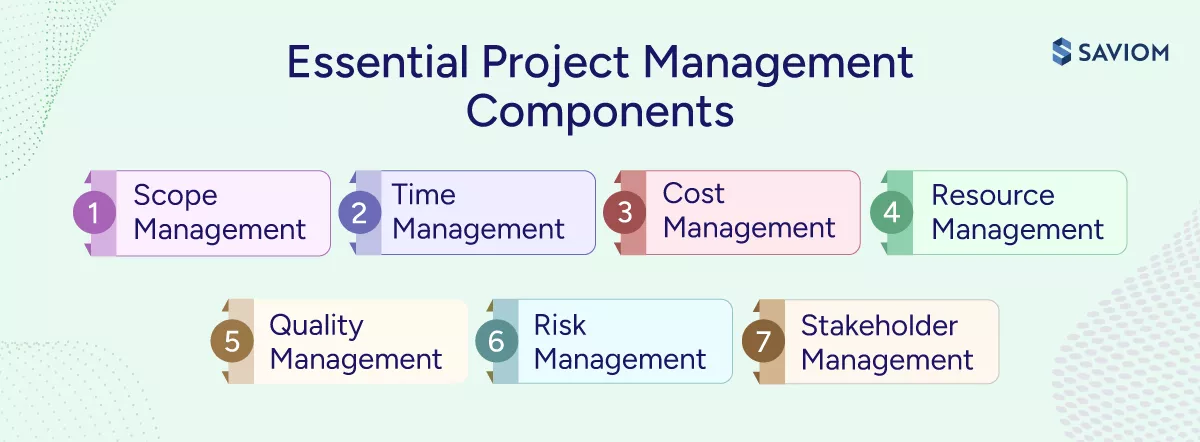
Scope Management
Scope management defines the boundaries of project work by documenting deliverables, requirements, and acceptance criteria. Clear scope definitions protect projects from scope creep, maintain focus on agreed objectives, and ensure teams deliver work that aligns with approved project expectations.
Understand what a project scope document is and how to create one effectively.
Time Management
Time management focuses on estimating task durations and controlling how effort is spent across project activities to ensure adherence to defined timelines. It involves planning, scheduling, and continuously tracking progress to minimize delays and prevent bottlenecks. This discipline helps teams stay aligned with timelines, improve coordination, and ensure timely project completion.
Cost Management
Cost management involves estimating resource-related expenses, establishing project budgets, and monitoring financial performance during project execution. Continuous cost tracking allows organizations to detect budget variances early and implement corrective measures before financial overruns occur.
Resource Management
Project resource management involves planning, acquiring, and allocating the right personnel, tools, and materials based on required skills, availability, and capacity. It enables organizations to leverage techniques, such as demand forecasting, utilization tracking, etc., to prevent over- or underutilization of resources, thereby enhancing overall project delivery.
Deep dive into resource management with our detailed guide.
Quality Management
Quality management establishes clear acceptance criteria and benchmarks for project deliverables. Monitoring outputs against these standards ensures that deliverables meet required specifications. Maintaining consistent quality reduces rework, improves stakeholder satisfaction, and strengthens project credibility.
Risk Management
Risk management in projects involves identifying potential project risks, evaluating their likelihood and impact, and preparing mitigation strategies in advance. It helps teams prevent issues from escalating into major disruptions. This strengthens organizational resilience and increases the probability of meeting project goals.
Learn how a risk matrix helps organizations develop robust project risk management plans.
Stakeholder Management
Stakeholder management focuses on identifying key stakeholders, understanding their expectations, and maintaining clear project communication. Regular engagement ensures stakeholders remain informed about project progress and key decisions. This builds trust, reduces conflicts, and ensures continued support for project objectives.
Having explored the essential project management components, let us now move on to learn about the different project management phases.
The Project Management Lifecycle Explained (End-to-End)
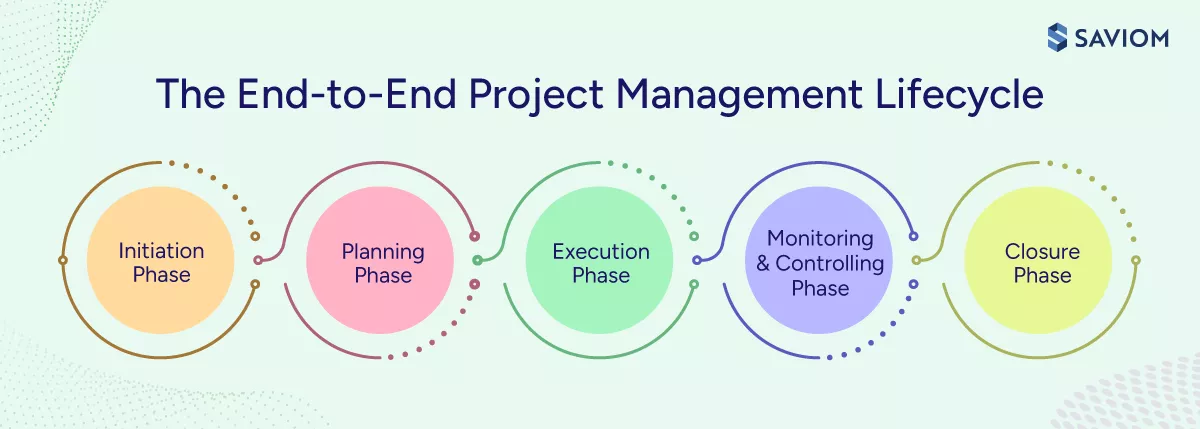
A structured project lifecycle breaks projects into defined stages, ensuring clarity, control, and accountability at each step. It helps teams manage execution systematically and maintain consistency across initiatives. Here are the different project management phases:
Initiation Phase
The initiation phase defines the project’s purpose, business need, high-level scope, and key stakeholders, typically documented through a project charter. It uses inputs, such as an approved project proposal, to ensure the initiative is strategically aligned and clearly understood. Formal approval at this stage authorizes the project before resources are committed.
Read about project initiation and why it’s important for organizations.
Planning Phase
The planning phase focuses on developing detailed scope statements, schedules, budgets, resource plans, quality standards, and risk strategies to guide execution. These elements are consolidated into a well-structured project plan that establishes clear baselines for measuring output. This enables coordinated execution and provides a foundation for tracking progress and managing deviations.
Execution Phase
The execution phase involves carrying out planned tasks, coordinating cross-functional teams, managing project interdependencies, allocating resources, and delivering outputs. Teams follow the defined project plan while maintaining alignment with scope and quality standards. Effective execution ensures that planned objectives are translated into tangible and measurable outcomes.
Monitoring and Controlling Phase
The project monitoring and controlling phase tracks project performance against scope, schedule, cost, and quality baselines. Managers continuously assess progress while also managing project constraints, risks, and change requests as they arise. This ongoing oversight helps identify variances early and ensures the project remains aligned with approved objectives.
Discover the importance of a proper change management process in project management.
Closure Phase
The closure phase involves finalizing deliverables, obtaining stakeholder acceptance, completing documentation, and releasing project resources. This stage ensures that all project requirements have been fulfilled and formally concluded. It also captures lessons learned to support continuous improvement in future project execution.
So far, we have explored the benefits of project management, its components, and phases. Let us now understand how organizations navigate different project management methodologies.
Navigating Methodologies: When to Choose Waterfall, Agile, or Hybrid
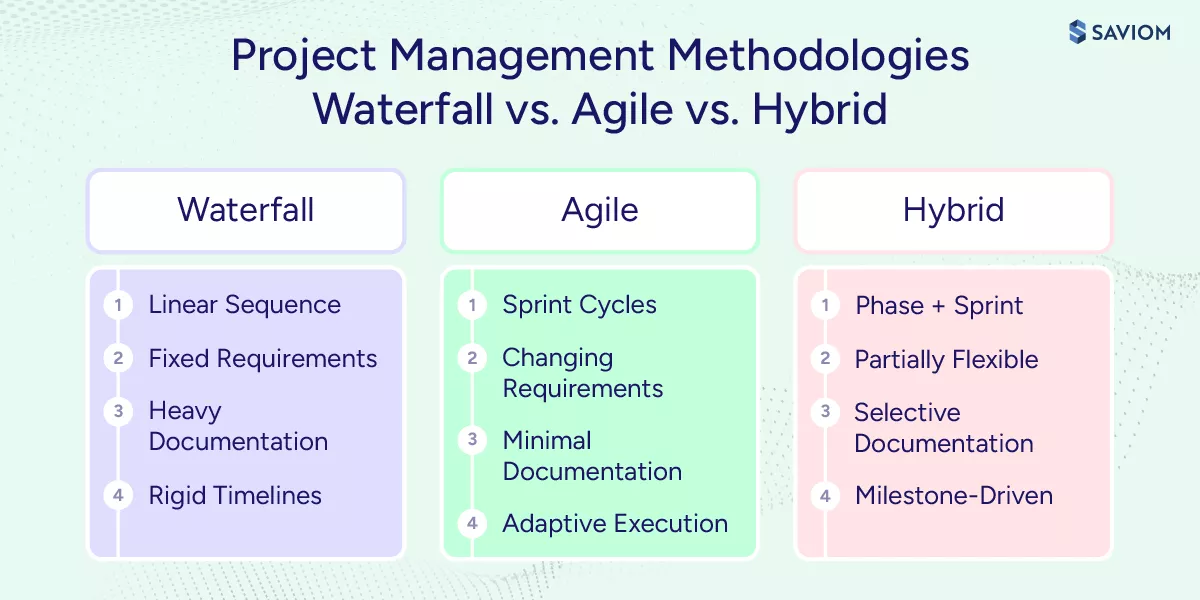
Selecting the right approach for each project is critical to ensure effective execution and control. Different project management methodologies are suited to different levels of complexity, requirement stability, and delivery expectations. Understanding when to apply Waterfall, Agile, or Hybrid methods helps organizations align their approach with project needs.
The following sections explain when organizations should use each methodology:
Waterfall Methodology
The Waterfall methodology follows a linear, phase-based approach in which each stage is completed before moving to the next. It relies on clearly defined requirements and detailed upfront resource planning. This approach emphasizes documentation, governance, and clearly defined timelines that remain stable throughout execution.
Best for: Projects with stable requirements and minimal expected changes, where outcomes can be clearly defined in advance.
Examples:
- Infrastructure development projects that follow a fixed and sequential workflow.
- Regulatory or compliance-heavy projects that require strict documentation and approvals.
- Large engineering design initiatives with clearly defined specifications and minimal scope changes.
Agile Methodology
According to Businesswire’s 17th State of Agile Report, “71% of organizations use Agile project management methodology in their software development lifecycle.”
Agile methodology follows an iterative approach, delivering work in short cycles or sprints. It encourages continuous stakeholder feedback and close cross-departmental collaboration. This flexibility allows teams to adapt quickly to changing client requirements while delivering incremental value.
Best for: Projects that require flexibility, rapid delivery, and frequent iteration, especially where requirements are expected to evolve throughout execution.
Examples:
- Mobile application development with frequent feature updates and user feedback loops.
- SaaS product development requires continuous enhancements and iterative releases.
- Website redesign projects involve evolving user requirements and design iterations.
Read our blog on agile project management.
Hybrid Methodology
Hybrid project management is an approach that combines elements of two or more methodologies within the same project to balance structured planning with flexibility. For instance, it allows project managers to follow a fixed plan for well-defined phases while using iterative delivery for evolving or uncertain components.
Best for: Large and complex initiatives where some components require stability while others need flexibility and iterative execution.
Examples:
- Enterprise software implementation programs with fixed planning and iterative development phases.
- Digital transformation initiatives involve both structured systems and evolving business requirements.
- System modernization projects in which legacy systems must remain stable while new components evolve iteratively.
Now that the right project management methodologies are defined, the next step is to understand how organizations plan and control projects across scope, schedule, cost, and risk.
Project Planning and Control: Scope, Schedule, Cost, and Risk
Effective project delivery depends on disciplined planning and continuous control across key parameters, including scope, schedule, cost, and risk. These elements provide the structure needed to manage execution, maintain stability, and respond to changes in a controlled manner. Let us understand how organizations plan and control these critical aspects of project delivery:
Define Project Scope and Requirements
Clearly defining the project’s scope and requirements establishes a strong foundation for planning and control. It ensures that all stakeholders share a common understanding of the project’s aims and success criteria.
Moreover, documenting requirements, assumptions, and acceptance criteria reduces ambiguity and prevents scope creep. With well-defined boundaries, teams can manage change requests effectively and maintain focus on agreed priorities throughout execution.
Build a Structured Project Schedule
A structured project schedule maps tasks, dependencies, milestones, and timelines, providing a clear roadmap for execution. It helps teams understand the sequence of activities, coordinate interdependent work, and track progress against planned milestones.
Tools such as the Work Breakdown Structure (WBS), Resource Breakdown Structure (RBS), and the Critical Path Method (CPM) help organize tasks, identify schedule-critical activities, and determine realistic timelines. This improves scheduling accuracy and supports better resource planning.
Understand resource scheduling and how it helps in successful project delivery.
Establish Project Budget and Cost Control
Effective project planning includes estimating costs, defining budgets, and establishing financial baselines. These baselines provide a reference point for monitoring project expenditures and evaluating financial performance throughout execution.
In addition, continuous cost tracking helps teams compare actual spending with planned budgets and take corrective actions when required. This control prevents cost overruns, maintains financial discipline, and protects the organization’s investment in the project.
Identify and Mitigate Project Risks
The project planning and management process also incorporates risk identification and impact assessment to address uncertainties early. Teams evaluate potential risks, such as resource constraints, technical challenges, scope changes, and schedule delays, that may affect project delivery.
By preparing contingency plans in advance, managers can respond to risks proactively instead of reactively. This strengthens project resilience, minimizes disruptions, and improves the likelihood of successful project delivery.
Explore the most common project management mistakes and their practical solutions.
Dive into our eBook to learn how organizations can reduce IT project costs by 10-30% with 5th gen resource management.
Moving on, let us understand how organizations can resolve project dependencies through effective resource capacity planning.
Resolving the Project Dependencies with Resource Capacity Planning
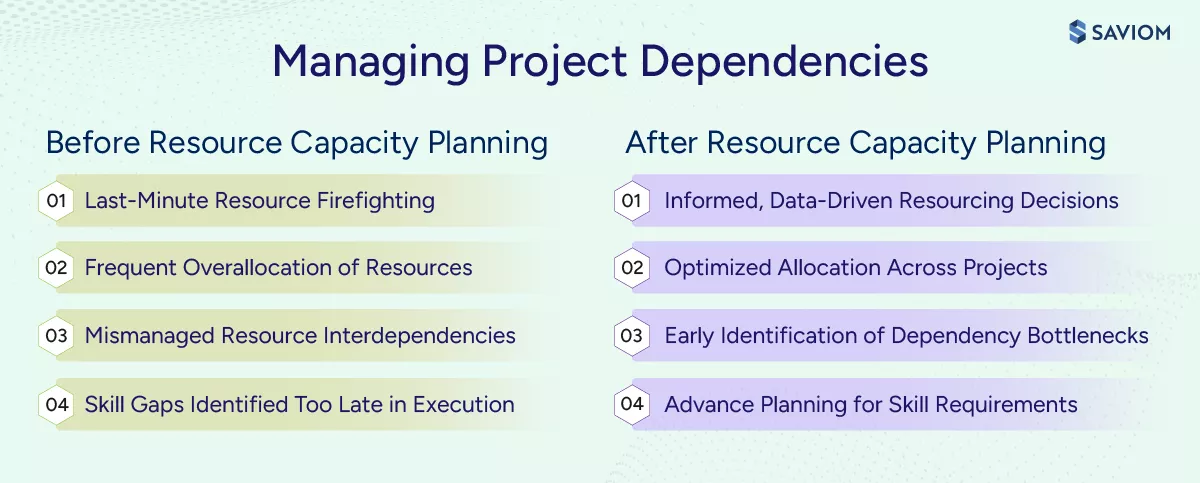
Managing project dependencies is critical to maintaining workflow continuity and avoiding delays. In complex environments, tasks often rely on shared resources, making progress dependent on resource availability. Without visibility into capacity and workloads, these dependencies create bottlenecks and disrupt schedules. Here is how resource capacity planning helps manage dependencies and maintain delivery stability:
Task and Resource Dependencies in Complex Projects
In complex projects, tasks are rarely independent. Activities often follow a defined sequence where the start or completion of one task depends on another, creating workflow dependencies across the project plan. These dependencies also span teams when different departments contribute to different stages of the lifecycle.
For instance, IT organizations often rely on shared or specialized resources, such as data engineers, QA specialists, or infrastructure teams, who support multiple initiatives. These shared roles create resource dependencies, where multiple initiatives depend on the availability of the same individuals or teams to move forward.
How These Dependencies Create Bottlenecks and Delays?
When dependencies are not properly coordinated, delays in one task can block several downstream activities in the project schedule. Similarly, if a required team or specialist is unavailable, dependent work remains stalled, slowing overall progress.
In multi-project environments, competing demands for the same resources further create scheduling conflicts and workload imbalances. Over time, these resource management challenges lead to missed milestones and cascading delays across multiple projects, impacting overall delivery timelines.
Learn the art of managing resources across multiple projects in our blog.
Leveraging Resource Capacity Planning to Manage Dependencies
Resource capacity planning provides the visibility needed to effectively align available workforce capacity with project demand. The following points explain how organizations can leverage resource capacity planning to manage dependencies effectively:
- Evaluates current commitments and upcoming project demand to identify where resources may become overallocated across projects.
- Helps managers anticipate resource constraints early and take corrective actions before dependencies are impacted.
- Enables more realistic project scheduling by aligning tasks with actual resource availability and workload capacity.
- Reduces resource bottlenecks and ensures continuity across interdependent tasks.
- Supports more predictable project timelines by minimizing delays caused by resource conflicts and dependency misalignment.
Next, let us understand how organizations align project execution with business ROI to ensure initiatives deliver measurable value.
Strategic Alignment: Aligns Project Execution with Business ROI
Ensuring that projects directly contribute to business objectives is critical to maximizing return on investment. Strategic alignment helps organizations prioritize the right initiatives and allocate resources where they create the most value. The following practices help align project execution with business goals and measurable outcomes:
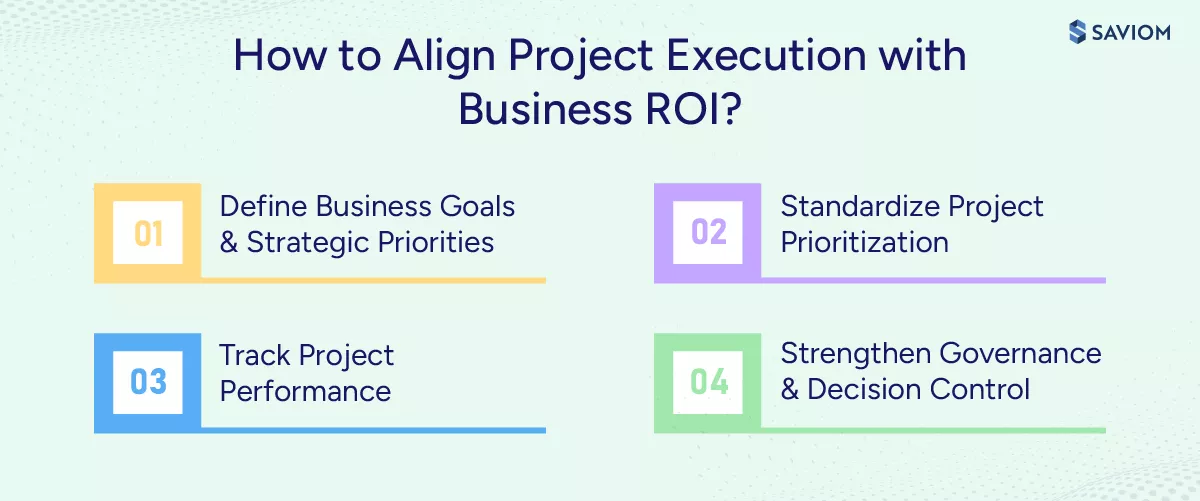
Define Business Goals and Strategic Priorities
The first step is to establish clear business goals, strategic priorities, and desired outcomes that guide investment decisions. These priorities set the direction for project intake. In addition, they enable organizations to evaluate initiatives against measurable objectives such as revenue growth, operational efficiency, innovation, or market expansion.
Standardize Project Prioritization to Maximize Business Value
Once priorities are established, evaluate and prioritize project proposals based on expected value, strategic relevance, ROI, and risk. This structured approach ensures consistent and objective decision-making across initiatives. It also helps managers allocate resources to projects that deliver the highest business impact and supports strategic portfolio alignment.
Read our detailed guide on project portfolio management.
Track Project Performance Using Earned Value Analysis
Next, leverage Earned Value Analysis (EVA) to compare planned progress with actual work completed and costs incurred. Additionally, track metrics, such as Cost Performance Index (CPI) and Schedule Performance Index (SPI), to identify deviations and take timely corrective actions. This improves forecasting accuracy and ensures projects remain aligned with planned objectives.
Strengthen Project Governance and Decision Control
Lastly, establish governance frameworks and structured oversight to review project progress, risks, and alignment with strategic priorities. With regular reviews, managers can monitor performance and identify areas requiring intervention. This enables informed decisions on project continuation, resource reallocation, or corrective actions to protect business investments.
Learn what is project ROI and how organizations can measure it.
Moving on, let us understand how organizations measure project success using critical performance indicators that reflect delivery efficiency and business impact.
7 Critical KPIs to Measure Project Success
Measuring project performance requires clearly defined metrics that reflect delivery efficiency, financial outcomes, and execution accuracy. The following KPIs provide objective insights into how well projects are performing against planned targets:
Net Profit Margin
Net profit margin measures the percentage of total revenue an organization retains after deducting all expenses. Tracking this project metric helps organizations assess true profitability and ensure projects contribute positively to overall business performance.
Where: Net Income = Revenue − Total Costs
Understand project financial management in detail.
Schedule Variance (SV)
Schedule Variance (SV) compares planned and actual progress to determine whether a project is ahead or behind schedule. Monitoring schedule variance enables early detection of schedule slippage and allows managers to take timely corrective actions to maintain project timelines.
Interpretation: SV > 0 → Ahead of schedule | SV < 0 → Behind schedule
Cost Variance (CV)
Cost Variance (CV) measures the difference between the planned project cost and the actual cost incurred. It helps managers determine whether project spending aligns with budget expectations and identify cost overruns early. This enables timely intervention when costs begin to exceed projections and control project spending.
Interpretation: CV > 0 → Under budget | CV < 0 → Over budget
Schedule Performance Index (SPI)
Schedule Performance Index (SPI) measures schedule efficiency by comparing earned value to planned value. It indicates how efficiently project time is being utilized relative to the original schedule. Monitoring SPI improves project and resource forecasting accuracy, enabling managers to assess whether the project is progressing at the expected pace.
Interpretation: SPI > 1 → Ahead of schedule | SPI < 1 → Behind schedule
Learn about employee scheduling and how it impacts timely project delivery.
Earned Value (EV)
Earned Value (EV) represents the value of work completed at a specific point in a project relative to the planned work. It reflects the budgeted cost of completed activities and provides an objective measure of project progress. By comparing earned value with planned value, organizations can assess schedule performance and determine whether the project is progressing as expected.
Resource Utilization Rate
The resource utilization rate indicates how much of a resource’s available capacity is devoted to productive, value-adding work. It helps managers assess how effectively resources are being used across projects relative to their total availability. By tracking utilization, organizations can balance workloads, reduce bench time, and prevent over- or under-allocation.
Read our in-depth resource utilization guide.
Return on Investment (ROI)
Return on Investment compares the financial gains generated by a project with the total investment made. It provides a clear measure of the value delivered relative to the resources committed. Evaluating ROI helps organizations prioritize high-value initiatives and ensure that project investments contribute meaningfully to business growth and performance.
Explore how organizations can enhance project planning, tracking, and team coordination using modern project management software. Book a free demo today!
Next, it is important to understand why projects fail and how organizations can prevent them through structured, systematic approaches.
Why Projects Fail and How to Prevent Them Systematically?
Even with structured planning and execution practices, projects can fail due to gaps in alignment, control, or coordination. Identifying these failure points helps organizations take preventive actions and strengthen delivery outcomes. The table below highlights the key reasons why projects fail and how organizations can address them.
| Reason for Failure | Impact on Projects | How to Prevent it? |
|---|---|---|
| Strategic Misalignment | Leads to investment in low-value or non-priority initiatives | Align project selection with business strategy and conduct periodic portfolio reviews |
| Unclear Objectives and Scope | Results in confusion, misaligned expectations, and frequent rework | Define clear project charters, measurable objectives, and approved scope baselines before execution |
| Uncontrolled Scope Creep | Causes cost overruns, schedule delays, and resource strain | Implement structured change control processes and enforce scope approval mechanisms |
| Poor Schedule Planning | Creates unrealistic deadlines and cascading delivery delays | Apply structured project scheduling techniques such as the Critical Path Method and realistic effort estimation |
| Inaccurate Cost Estimation | Results in budget overruns and reduced profitability | Use historical data, bottom-up estimation techniques, and cost validation reviews |
| Unforeseen Skill Gaps | Slows execution and increases resource dependency bottlenecks | Conduct early competency assessments and align workforce capacity with project demand |
| Weak Risk Management | Exposes projects to avoidable disruptions and financial losses | Perform proactive risk identification, mitigation planning, and continuous project monitoring |
| Inadequate Performance Monitoring | Delays the detection of cost and schedule deviations | Use KPIs, such as CPI, SPI, and variance analysis, for continuous tracking |
Explore the global project management challenges and how to solve them.
As project environments become more complex and data-driven, it is essential to understand how AI, analytics, and automation are transforming the future of project management and enabling more intelligent decision-making.
The Role of AI, Analytics & Automation in Project Management
According to Market.us research, “The AI in project management market is expected to grow at a CAGR of 16.7% and reach USD 11.2 billion by 2033.”
This statistic highlights how advancements in AI, analytics, and automation are reshaping how projects are managed and delivered. These technologies, often enabled through modern project management software, support faster decision-making, improve visibility into performance, and reduce manual effort across processes.
The following project management trends highlight how organizations are leveraging these capabilities to enhance project delivery and control:
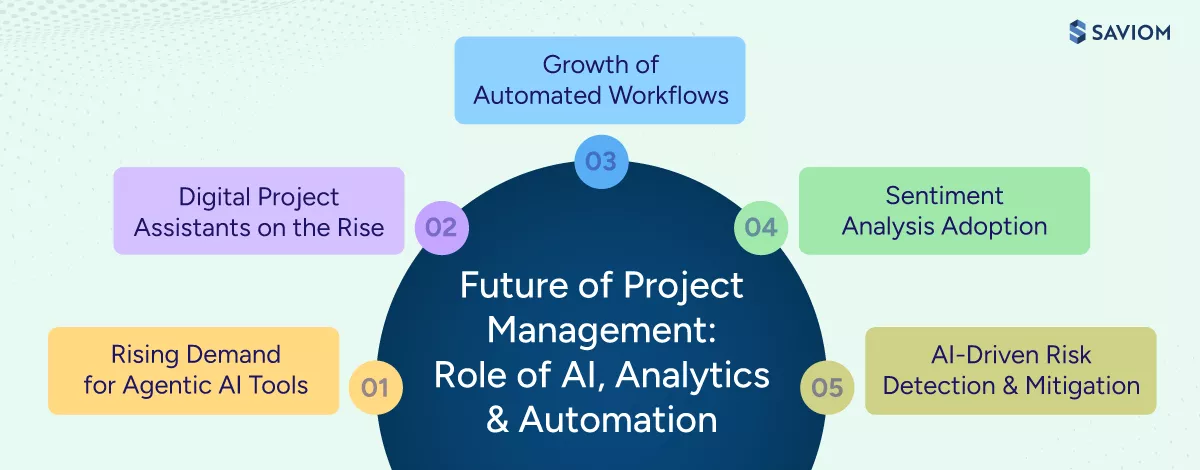
Increasing Demand for Agentic AI Tools
Agentic AI tools represent a shift toward autonomous systems that can monitor, analyze, and optimize project execution with minimal human intervention. These tools help improve decision speed and reduce reliance on manual oversight by enabling:
- Autonomous decision support: Agentic AI can independently monitor project data, identify risks, and recommend corrective actions without constant human intervention.
- Dynamic project optimization: These systems continuously analyze schedules, resource allocation, and dependencies to adjust project management plans when conditions change.
- Proactive workload balancing: Agentic AI identifies workload imbalances and resource constraints early by analyzing patterns across project timelines and historical data, enabling teams to redistribute work and maintain execution stability.
Rise in Digital Project Assistants
Digital project assistants are transforming how project managers handle day-to-day activities by reducing administrative effort and improving access to real-time insights. They enable teams to focus more on strategic decision-making through:
- Administrative task automation: Digital assistants handle routine activities such as scheduling project meetings, sending reminders, and updating project status.
- Real-time project summaries: These tools automatically generate progress reports, meeting notes, and insights based on live project data.
- Enhanced decision support: By aggregating information from tasks, schedules, and communications, assistants help managers make faster and more informed decisions.
Learn about the crucial project reports that impact decision-making in project management.
Emerging Use of Sentiment Analysis
Beyond operational efficiency, AI is also improving visibility into team dynamics and stakeholder engagement through sentiment analysis. This capability helps organizations address people-related risks by enabling:
- Early detection of team morale issues: Sentiment analysis evaluates communication patterns to identify signs of frustration, employee burnout, or disengagement within project teams.
- Stakeholder satisfaction monitoring: By analyzing emails, feedback, and meeting transcripts, AI gauges stakeholder sentiment and highlights potential dissatisfaction early.
- Improved conflict management: Detecting negative sentiment or communication tension enables managers to intervene and resolve conflicts proactively.
Growing Adoption of Automated Workflows and Reporting
Automation is streamlining project operations by standardizing processes and reducing manual intervention. It allows organizations to scale project management practices and enhance consistency through:
- Streamlined workflows: AI automates tasks such as task assignment, status updates, and timesheet approval, improving operational efficiency.
- Real-time reporting and insights: Automated tools generate live dashboards and performance reports, providing instant visibility into project progress, risks, and key metrics.
- Standardized and scalable project operations: Predefined workflows and reporting structures ensure consistency while enabling organizations to manage larger project portfolios effectively.
Leveraging AI for Risk Detection and Mitigation
AI-driven project risk management enhances the ability to anticipate and respond to uncertainties before they impact outcomes. It shifts risk handling from reactive to proactive decision-making by enabling:
- Risk detection through predictive analytics: AI analyzes historical data, performance trends, and external factors to identify risks before they escalate.
- Proactive mitigation planning: AI evaluates risk impact, suggests corrective actions, and helps managers implement mitigation strategies such as reallocating resources, adjusting timelines, or revising project scope.
- Scenario-based risk simulation: AI tools help model different project scenarios to assess how schedule changes or scope variations can increase overall project risk, enabling managers to make more informed mitigation decisions.
Read about the trends of AI in project management.
Conclusion
Successful project management provides the foundation for consistent and predictable delivery across complex initiatives. When supported by structured planning, strong governance, and aligned execution practices, organizations can drive better control and improved outcomes at scale.
As project environments continue to evolve, the integration of AI, analytics, and automation will redefine how decisions are made and how work is executed. Organizations that embed these capabilities alongside proven project management best practices will be better positioned to anticipate risks, optimize performance, and deliver sustained business value in an increasingly dynamic landscape.
Frequently Asked Questions (FAQs)
Project management is the practice of planning, organizing, and managing resources to successfully achieve specific project goals within a defined timeline and budget. It involves coordinating people, processes, and tools to deliver a unique product, service, or result while meeting scope, quality, and stakeholder expectations.
Here are the business benefits of project management for organizations:
1. Defines clear project goals and expectations
2. Improves cost control and project profitability
3. Enables accurate resource estimates and allocations
4. Optimizes resource utilization
5. Strengthens project risk identification and mitigation
6. Enhances stakeholder satisfaction
7. Facilitates continuous learning from past projects
The key components of project management are:
1. Scope Management
2. Time Management
3. Cost Management
4. Resource Management
5. Quality Management
6. Risk Management
7. Stakeholder Management
A project management framework is a structured set of guidelines, processes, and best practices for planning, executing, and controlling projects. Frameworks provide consistency in how projects are managed and often include defined roles, documentation standards, and governance models to help teams deliver projects efficiently and successfully.
The core phases of a project management lifecycle are:
1. Initiation
2. Planning
3. Execution
4. Monitoring & Control
5. Closure
Project management focuses on planning and executing a single project with defined goals, timelines, and deliverables. Program management oversees multiple related projects that work together to achieve broader strategic objectives. While project managers handle execution and delivery, program managers coordinate projects, manage interdependencies, and ensure strategic alignment.
Some of the critical project management challenges are as follows:
1. Strategic misalignment
2. Unclear objectives and scope
3. Uncontrolled scope creep
4. Poor schedule planning
5. Inaccurate cost estimation
6. Unforeseen skill gaps
7. Weak risk management
8. Inadequate performance monitoring
Project management ensures predictable delivery by establishing clear objectives, structured timelines, and defined resource allocation from the outset. It enables continuous monitoring of progress against the plan, helping teams identify and address deviations early. This improves control over execution, minimizes risks, and ensures consistent delivery outcomes.