

Introduction
Why do project-based organizations with well-defined strategies still struggle to deliver results?
It’s a question that surfaces in leadership conversations time and again, and one that underscores the fundamental purpose of the Enterprise PMO (EPMO).
A well‑structured EPMO is more than a governance function; it is the central engine that translates business strategy into measurable outcomes. It establishes project governance, standardizes processes, and ensures every initiative remains anchored to strategic objectives. Therefore, EPMO creates the organizational structure needed to optimize portfolio performance and maximize business value.
In this guide, we explore how EPMOs drive strategic alignment, strengthen governance, and enable enterprises to execute projects with precision.
What is Enterprise PMO (EPMO)?
An Enterprise Project Management Office (EPMO) is a centralized governance function that manages and aligns the organization’s entire portfolio of projects and programs with its strategic business objectives. Unlike traditional PMOs that focus primarily on project delivery, the EPMO operates at a higher, strategic level, shaping priorities and standardizing execution practices.
The EPMO provides enterprise-wide visibility into project performance, resource capacity, and financials, enabling leaders to make faster, data-driven decisions and balance competing priorities. In addition, it improves cross-team coordination, optimizes resource utilization, and ensures consistent project delivery.
Having understood the enterprise PMO meaning, let us focus on its key benefits.
The Strategic Role of an EPMO in Enterprise Decision-Making
As per the State of the PMO 2025 report, “36% of large firms are more likely to have an enterprise PMO than mid-size or small organizations.”
This statistic underscores the growth of enterprise PMOs in organizations. As portfolios expand, leadership needs stronger governance, sharper prioritization, and better visibility into resources, risks, and investment value. This is where enterprise PMO becomes crucial. Let us look into the strategic areas where EPMO helps:
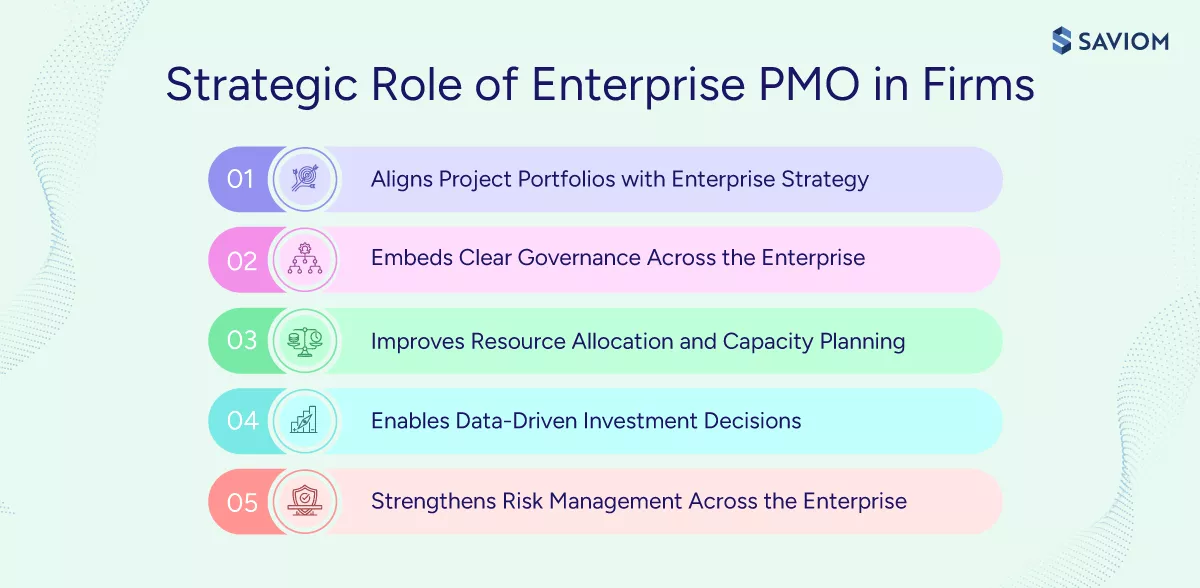
Aligns Project Portfolios with Enterprise Strategy
The EPMO ensures that projects and programs are selected based on their contribution to strategic objectives and priorities such as growth, innovation, and operational efficiency. This prevents low-value projects from consuming resources and ensures investments are directed toward high-impact initiatives.
Embeds Clear Governance Across the Enterprise
The enterprise PMO establishes standardized governance frameworks that bring consistency across projects, programs, and portfolios. It defines decision-making models, escalation paths, and performance tracking mechanisms. In addition, with a unified governance approach, EPMO helps leadership gain reliable insights into risks or financial performance to make informed decisions.
Learn the 12 key project management principles for successful execution.
Improves Resource Allocation and Capacity Planning
The EPMO maintains a centralized view of enterprise resources, facilitating competent allocation across initiatives. It supports accurate capacity planning and demand forecasting to prevent last-minute shortages or excesses. By matching the right skills to the right projects, it improves workforce productivity. It also ensures critical initiatives remain adequately staffed with dynamic reallocation.
Enables Data-Driven Investment Decisions
Investment decisions often involve complex trade-offs between strategic impact, cost, and risk. The enterprise PMO gathers and consolidates data into a centralized system, enabling leaders to evaluate and select profitable initiatives based on factors such as expected project ROI, strategic alignment, and resource feasibility. This reduces financial waste and ensures objective prioritization.
Check out our blog on project financial management and its importance.
Strengthens Risk Management Across the Enterprise
The EPMO monitors interdependencies across projects, helping identify risks that can cascade across multiple initiatives. It establishes enterprise risk management that defines how risks are identified, assessed, prioritized, and mitigated across the organization. This enables EPMO managers to take proactive, data-driven decisions and improve overall delivery reliability.
Given the strategic role of the enterprise project management office, let us move on to its core functions.
What are the Core Functions of an Enterprise PMO?
The effectiveness of an enterprise PMO depends on a few critical operational pillars that connect strategic intent with day-to-day execution. These functions enable leadership to maintain control, visibility, and alignment across portfolios. Given below are some of them:
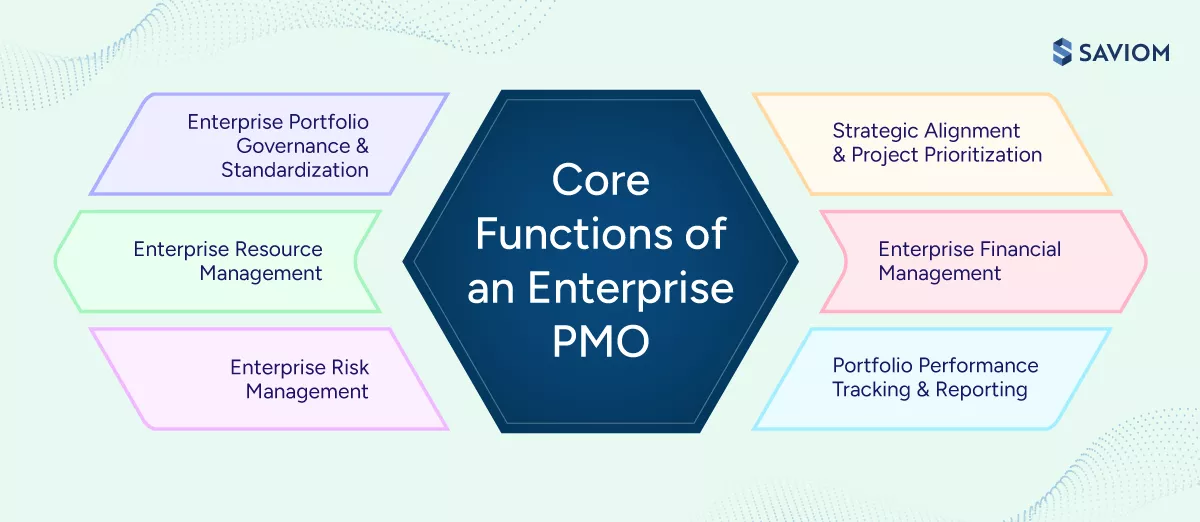
Enterprise Portfolio Governance and Standardization
This function establishes consistent governance frameworks, decision protocols, and delivery standards across project portfolios and business units. Standardized methodologies ensure projects follow unified reporting structures, approval processes, and delivery practices, enabling enterprise-wide control.
Read our comprehensive guide on project portfolio management.
Strategic Alignment and Project Prioritization
Strategic alignment and project prioritization ensure initiatives are evaluated and prioritized based on strategic alignment, business impact, and financial value. It embeds structured prioritization frameworks that help leadership focus investments on high-value initiatives, maximizing long-term business outcomes.
Enterprise Resource Management
Enterprise resource management provides a consolidated view of resource capacity, skills, and project demand across portfolios. This enables effective resource planning, facilitates competent allocations, and ensures optimal utilization in a multi-project environment.
Explore our blog on project resource management.
Enterprise Financial Management
Enterprise financial management governs how capital is allocated across the project portfolio. It ensures investments are directed toward high-value initiatives and prevents cost overruns. Ultimately, this maximizes return on investment and improves the organization’s financial performance.
Enterprise Risk Management
According to the PMI Report, “Organizations achieve 28% greater resilience and 23% improved project outcomes with mature risk management capabilities.”
Enterprise risk management standardizes how risks are identified, assessed, and managed across the entire portfolio. By providing real-time visibility of project interdependencies and establishing risk assessment frameworks, it helps detect cascading risks and implement accurate mitigation strategies.
Read our complete blog on risk matrix in project management.
Portfolio Performance Tracking and Reporting
This function focuses on monitoring parameters such as project performance, financial health, resource utilization, and strategic alignment through standardized dashboards and reports. This enables consistent performance evaluation, early detection of deviations, and timely interventions.
As organizations scale, the limitations of a traditional project management office become increasingly evident. In the next section, let’s understand the common differences between traditional PMO and enterprise PMO.
Enterprise PMO vs. Traditional PMO
While enterprise PMO and traditional PMO models may appear similar initially, they operate at different levels of strategic influence and decision-making. Understanding this distinction allows leadership to implement governance models that drive better alignment, prioritization, and execution outcomes.
| Dimension | Traditional PMO | Enterprise PMO (EPMO) |
|---|---|---|
| Primary Purpose | Ensures projects adhere to standardized processes, methodologies, and delivery frameworks to maintain consistency across project execution | Drives enterprise strategy execution by aligning and governing portfolios, ensuring initiatives contribute to overarching business objectives |
| Core Focus | Focuses on delivery control, status reporting, and ensuring compliance with predefined project management standards | Emphasizes strategic alignment, value realization, and enterprise-wide governance to maximize business impact |
| Decision Authority | Operates with limited authority, primarily providing guidance, templates, and process oversight without controlling strategic decisions | Holds authority over enterprise portfolio governance, influencing investment decisions, prioritization, and execution direction |
| View of Work | Manages work at the level of individual projects or programs, often within specific departments or business units | Oversees enterprise-wide initiatives, including cross-functional programs, value streams, and large-scale transformation efforts |
| Resource Management | Allocates resources at the project level, focusing on task assignments and short-term staffing needs | Manages enterprise-wide capacity planning, ensuring optimal utilization, skill alignment, and resource allocation across portfolios |
| Financial Governance | Tracks budgets and costs at the individual project level to ensure financial discipline within projects | Governs enterprise-level investment, monitors portfolio spend, and ensures financial resources deliver measurable value |
| Executive Involvement | Provides periodic updates and reports to leadership, typically focused on project status and delivery metrics | Acts as a strategic partner, offering continuous insights and portfolio-level decision support |
| Success Metrics | Measures success based on delivery performance such as on-time completion, budget adherence, and scope compliance | Evaluates success through strategic outcomes, enterprise impact, benefits realization, and long-term value creation |
Read more about PMO roles and responsibilities.
Gain actionable insights to enhance PMO capabilities and improve project delivery performance with 5th gen resource management. Get your eBook now.
With a clear understanding of how a traditional PMO differs from an Enterprise PMO, the next step is to explore how organizations can transition toward an EPMO model.
How Do Enterprises Upgrade from PMO to EPMO?
Most organizations begin with a traditional PMO to standardize and streamline project delivery. However, as portfolios expand and complexity increases, it often falls short. To scale effectively, organizations need an integrated approach that connects strategy, investments, and execution. Here is how businesses can make the shift to an Enterprise PMO (EPMO):
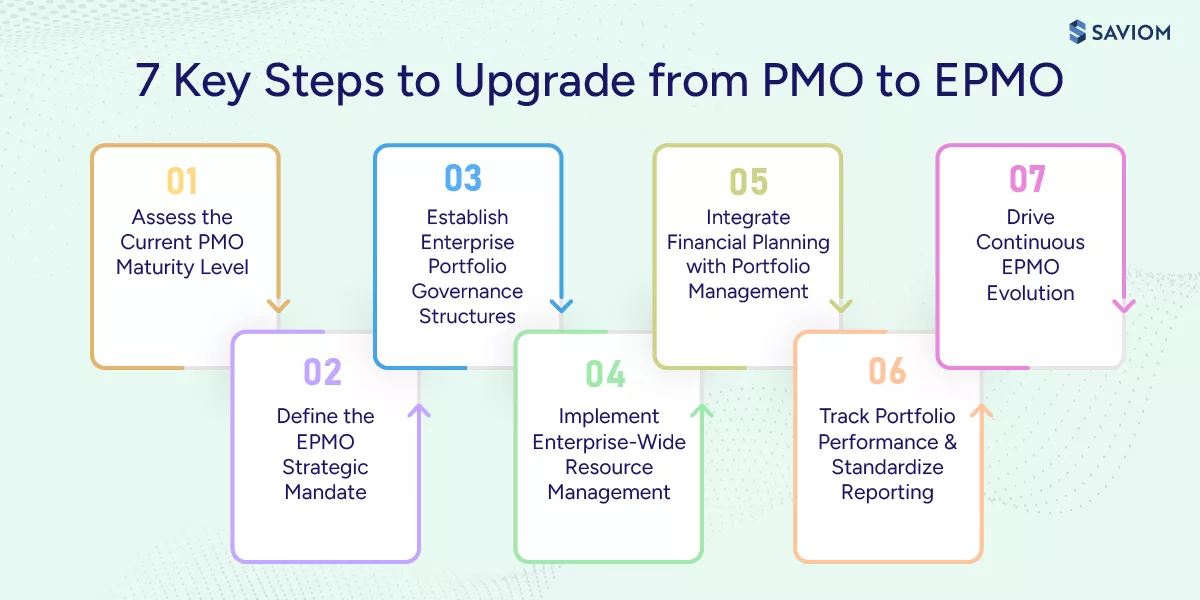
Assess the Current PMO Maturity Level and Organizational Needs
Organizations must begin by evaluating the existing PMO structure, capabilities, and governance frameworks against evolving needs such as market expansion, digital transformation, scaling operations, etc. This assessment helps identify gaps in enterprise-level visibility into projects, inefficiencies in resource management, and misalignment between initiatives and business priorities.
Define the Strategic Mandate for the Enterprise PMO
Here, the leadership must clearly define the EPMO’s role in connecting the overall business strategy. This is to ensure that business needs are translated into well-prioritized, feasible initiatives that can be executed at scale. It includes defining authority over portfolio governance, investment oversight, and value realization. By doing so, firms establish EPMO as a central decision-making and coordination layer.
Explore the 25 business objectives that firms must track.
Establish Enterprise Portfolio Governance Structures
Next, executives must standardize governance frameworks that guide how initiatives are evaluated, approved, and monitored across the organization. This includes setting up portfolio review boards and strategic decision forums where leadership can assess priorities, allocate investments, and address risks. These forums create a centralized mechanism for evaluating trade-offs and ensuring alignment with business objectives.
Implement Enterprise-Wide Resource Management
This step includes establishing a centralized resource management framework to align talent with high-impact initiatives. It requires building visibility into resource demand, capacity, and skills to support informed allocation decisions. With a centralized view, leaders can proactively balance workloads, prevent skill shortages, and avoid resource overutilization across the enterprise.
Check out our blog on portfolio resource management.
Integrate Financial Planning with Portfolio Management
To maximize strategic impact, organizations must integrate financial planning with portfolio management. This involves strengthening financial oversight, aligning investments with business priorities, and establishing portfolio-level budgeting. Continuous monitoring of costs, benefits, and financial performance ensures capital is directed toward high-value initiatives that deliver measurable returns.
Monitor Portfolio Performance and Standardize Reporting Structure
This step involves defining consistent KPIs, dashboards, and a clear reporting hierarchy where project-level updates aggregate into program and portfolio-level views, enabling leadership to assess overall performance. Well-defined escalation paths ensure that risks, delays, or deviations are surfaced to the right stakeholders at the right time, preventing issues from compounding.
Explore 12 key project reports that enterprises must use.
Drive Continuous EPMO Evolution
As the final step, firms must embed EPMO into workplace culture to ensure governance becomes integral to everyday decision-making. For that, teams and leadership must be trained in portfolio practices for consistent adoption. Moreover, as portfolio complexity grows, EPMO capabilities must also evolve for smooth execution.
Having explained the key steps to upgrading firms from traditional to enterprise PMO, we will shift our focus to learn how it helps align the three critical elements: strategy, portfolio, and execution.
How Do Enterprise PMOs Align Strategy, Portfolios, and Execution?
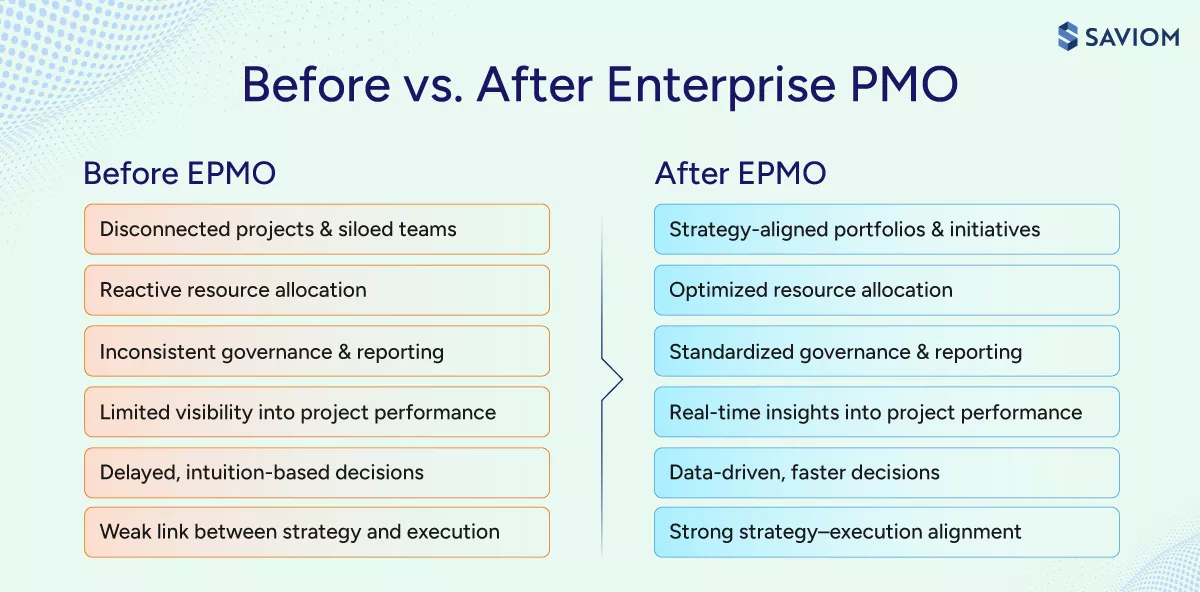
Enterprise PMOs align strategy, portfolios, and execution by acting as a central bridge between high-level business goals and on-the-ground project delivery. They translate organizational strategy into prioritized portfolios of programs and projects, ensuring that investments are directed toward initiatives that deliver the most value. This involves setting governance frameworks, defining standardized processes, and using performance metrics to evaluate how well projects support strategic objectives.
On the execution side, PMOs ensure consistency, visibility, and accountability across projects by providing tools, methodologies, and reporting structures. They continuously monitor progress, manage risks, and adjust priorities based on changing business needs, enabling organizations to stay agile while remaining aligned with long-term strategy.
Having understood the role of the Enterprise PMO in aligning business strategy with initiatives, let’s now explore how resource capacity planning bridges portfolio strategy and execution.
Enterprise Resource Capacity Planning: Converting Strategy into Execution
Strategy often fails when organizations commit to initiatives that exceed available workforce capacity. Enterprise resource capacity planning ensures that strategic initiatives align with available resources by bringing visibility into resource demand and capacity. Let us see how it helps organizations overcome execution bottlenecks:
Establish Enterprise-Wide Demand Visibility
The first step in enterprise resource capacity planning is to consolidate demand across all approved and upcoming projects. This enterprise-wide visibility allows managers to forecast demand by roles, skills, and time horizons, enabling realistic estimates.
For example, in an audit and accounting firm, demand often comes from services such as statutory audits, internal audits, and tax filings. To prepare effectively for these, firms can forecast demand in advance by analyzing historical engagement data, seasonal workload trends, and client pipelines. This helps estimate the need for roles like audit managers, tax specialists, compliance analysts, etc.
Assess Resource Capacity and Capabilities
Here, managers must evaluate the resource capacity, skills, and availability across the enterprise while accounting for actual working hours, planned leaves, BAUs, etc. This assessment determines whether the organization has sufficient capacity and capabilities to support planned initiatives.
Now, after forecasting demand, the firm must assess whether it has enough qualified senior auditors and specialists available during peak periods. This involves checking resource calendars, tracking allocations, and analyzing the skill matrix to determine whether there is enough capacity and capability available.
Read our blog on resource capacity forecasting.
Compare Resource Capacity vs. Demand Gap
Next, managers should compare available resource capacity and demand across estimated roles, skills, time horizons, etc. This helps identify potential resource shortages or excesses.
Continuing with the same example, the managers are comparing the demand for senior auditors across multiple client engagements with the available capacity for the same period. They are seeing a huge shortage of experienced auditors, while some junior resources remain underutilized.
Use Scenario Planning to Bridge the Gap
As per a Goodfirms survey, “Scenario planning is used by 33.6% of organizations for improved decision-making.”
Now, managers must simulate multiple scenarios under different conditions, like shifting priorities, resource constraints, budget issues, etc. This helps them compare and evaluate how these factors impact project delivery timelines. Accordingly, managers can make data-driven decisions and choose the best resource plan.
Here, the managers start simulating different scenarios such as reallocating senior auditors across high-priority clients, delaying lower-priority engagements, or adjusting timelines based on resource constraints. This helps them analyze how each scenario impacts delivery deadlines, team workloads, and client commitments, to select the feasible resource plan.
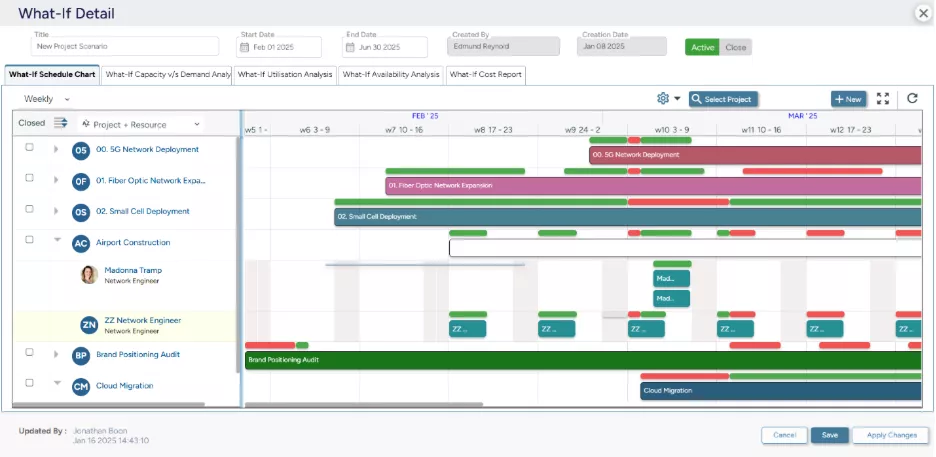 SAVIOM’s Scenario Modeling functionality enables managers to simulate different workforce scenarios in a sandbox environment and select the most profitable plan.
Align Resource Supply with Portfolio Demand
Once the ideal cost-efficient resource plan is selected, the final step is to implement the plan. Now, managers must mitigate the identified shortages and excesses through strategies like upskilling/training, planned hiring, or expediting project timelines. By doing so, firms can ensure that high-priority initiatives get the talent they require.
Finally, managers are now reallocating senior auditors to high-priority client engagements while adjusting timelines for lower-priority audits. They are also onboarding temporary staff and assigning trained junior auditors to support peak workloads. This ensures that critical engagements are adequately staffed while maintaining overall delivery balance.
Understand how workload management improves business efficiency.
With a clear understanding of how resource capacity planning supports efficient execution, we can now examine the critical enterprise PMO success metrics that measure its effectiveness.
Measuring Enterprise PMO Success: Metrics and KPIs That Matter
It is essential for organizations to track the right set of metrics to effectively evaluate portfolio health, identify performance gaps early, and make informed decisions. By monitoring the right KPIs, firms can proactively address issues and improve overall outcomes. Here are some critical KPIs that organizations should track regularly:
Strategic Alignment Ratio
Strategic alignment ratio measures how effectively the organization’s initiatives support long-term business objectives. A high alignment ratio indicates effective resource allocation and drives operational efficiency.
The formula to calculate this is:
Objectives / Total Number of Initiatives) x 100
Learn more about seven critical project metrics that firms must track.
Portfolio Value Realization Rate
Portfolio value realization rate assesses how effectively portfolio initiatives deliver the planned financial and operational benefits. It measures both quantitative outcomes, such as revenue growth and cost savings, and qualitative impacts, including customer experience. This helps organizations evaluate whether investments are translating into real business value.
The formula to calculate this is:
Portfolio ROI
Portfolio ROI measures the overall financial return generated from the organization’s entire project portfolio. This metric helps leadership assess the effectiveness of investment decisions, identify underperforming areas, and take corrective actions.
The formula to calculate Portfolio ROI is:
Read our blog on cost baseline in project management.
Resource Utilization Rate
Resource utilization rate measures how effectively enterprise resources are deployed across projects and programs. It provides visibility into whether teams are overutilized, underutilized, or optimally utilized, helping organizations avoid employee burnout and minimize bench time.
The formula to calculate this is:
Hours) x 100
Budget Variance
Budget variance measures how effectively the organization controls portfolio spending by comparing actual expenses against the approved project budget. It helps PMO managers identify systemic issues such as inaccurate forecasting, scope creep, weak cost controls, etc., to enable timely corrective actions.
Here is the formula to calculate budget variance:
Budget] x 100
Transform how your enterprise plans, executes, and measures performance with advanced enterprise PMO software. Book your demo today.
Given the key EPMO metrics, it becomes easier to assess current capabilities and identify gaps in execution. Building on this understanding, let us now explore how organizations can progress across different maturity levels of the enterprise PMO.
The Enterprise PMO Maturity Model
To understand how organizations progressively build enterprise-wide portfolio governance, resource management, and execution capability, it is important to examine the evolution of the enterprise PMO. It develops across different maturity stages, from fragmented coordination to fully optimized, strategy-driven execution. The five levels of the EPMO maturity model are as follows:
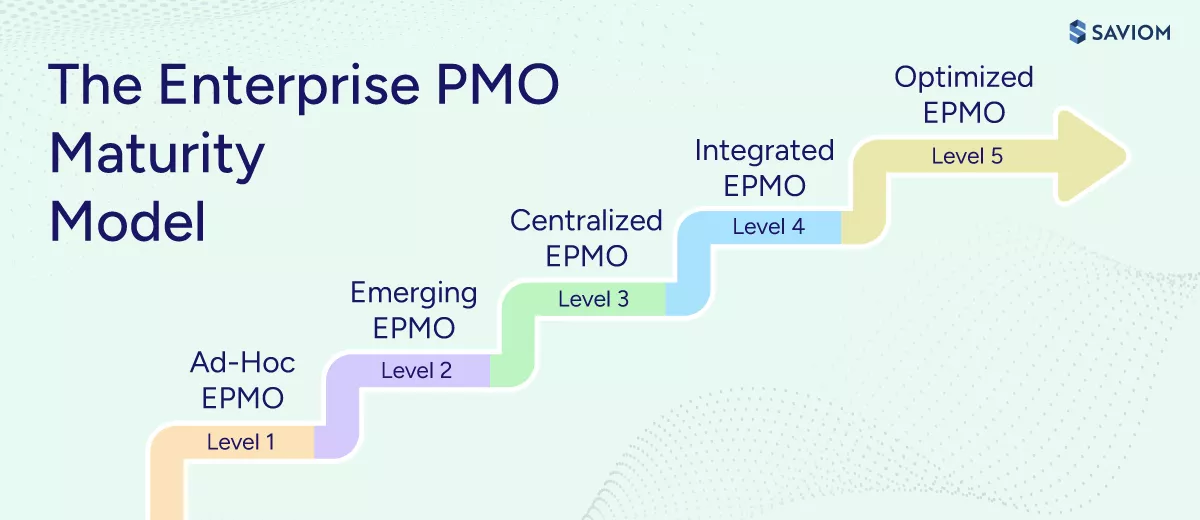
Level 1: Ad-Hoc EPMO
At this level, projects are managed independently across departments with minimal to no enterprise-wide coordination. This results in fragmented execution, limited visibility, and weak alignment with organizational strategy. Governance practices are also often inconsistent or absent, leading to reactive and disconnected decision-making.
Learn more about ad hoc projects and ways to manage them effectively.
Level 2: Emerging EPMO
At this stage, organizations begin to introduce basic governance frameworks and standardized reporting. These improvements enhance portfolio visibility, introduce structure to project delivery, and support initial cross-departmental coordination. However, inconsistent adoption across business units continues to limit full strategic alignment.
Level 3: Centralized EPMO
At this level, the enterprise PMO evolves into a central authority for portfolio governance, overseeing project intake, prioritization, and investment decisions. It becomes responsible for evaluating and prioritizing projects based on strategic value, financial impact, and resource availability to ensure alignment with organizational priorities.
Read more to understand the project intake process in detail.
Level 4: Integrated EPMO
In this next level, enterprise strategy, portfolio planning, and execution frameworks become fully integrated, ensuring that standardized processes are applied consistently across initiatives. Moreover, resource capacity, budgets, and delivery timelines are managed at the enterprise-level to balance demand and utilization.
Level 5: Optimized EPMO
At this final level, enterprise PMO acts as a strategic governance hub that continuously optimizes portfolios. It leverages advanced analytics, predictive insights, and scenario planning to proactively anticipate risks and refine investment decisions to maximize enterprise value.
Understand the complete project lifecycle and its best practices.
Now that we have understood the maturity levels, it is equally important to examine the practical challenges organizations encounter while implementing and scaling an Enterprise PMO. The following section outlines key enterprise PMO challenges and their solutions.
Common Enterprise PMO Challenges (and How to Avoid Them)
Even with a well-established EPMO framework, organizations often encounter operational and structural challenges that can impact overall project performance. Understanding these challenges is critical for strengthening execution discipline and improving decision-making. Given below are a few common challenges, their impact, and solutions:
| Challenges | Impact | How to Avoid Them |
|---|---|---|
| Poor Project Prioritization | Low-value initiatives dilute focus resulting in resources spread thin and leadership attention fragmented | Use value-based scoring to align prioritization with strategy |
| Lack of Enterprise-Wide Portfolio Visibility | Limited tracking of progress and risks leading to fragmented reporting and weak portfolio evaluation | Implement centralized dashboards and standardize reporting frameworks |
| Inconsistent Governance Across Business Units | Varied practices cause inconsistent delivery, reporting, and weak accountability | Establish enterprise governance frameworks to enforce standardized processes |
| Resistance to Organizational Change | Teams resist centralized control resulting in slow adoption and weak enterprise alignment | Communicate EPMO value and drive change with leadership sponsorship & training |
| Limited Performance Measurement | Without clear KPIs, leadership cannot effectively measure strategic outcomes or justify continued investment in the EPMO | Define KPIs and embed them into real-time performance dashboards to continuously track EPMO’s performance |
| Weak Risk Management | Hidden dependencies cause cascading delivery delays and impacts strategic outcomes | Introduce enterprise-level risk management frameworks to conduct regular reviews & implement mitigation measures |
Explore 10 common project management mistakes and solutions.
While addressing current challenges strengthens execution, the next phase of enterprise PMO evolution lies in how organizations adapt to emerging technologies and increasingly dynamic business environments.
The Future of EPMO: AI-Driven Intelligence and Agile Transformation
As business environments become more dynamic and data-driven, the role of the EPMO is rapidly evolving beyond governance into a strategic engine powered by intelligence, adaptability, and continuous transformation. So, here are some AI trends that are reshaping enterprise PMO:
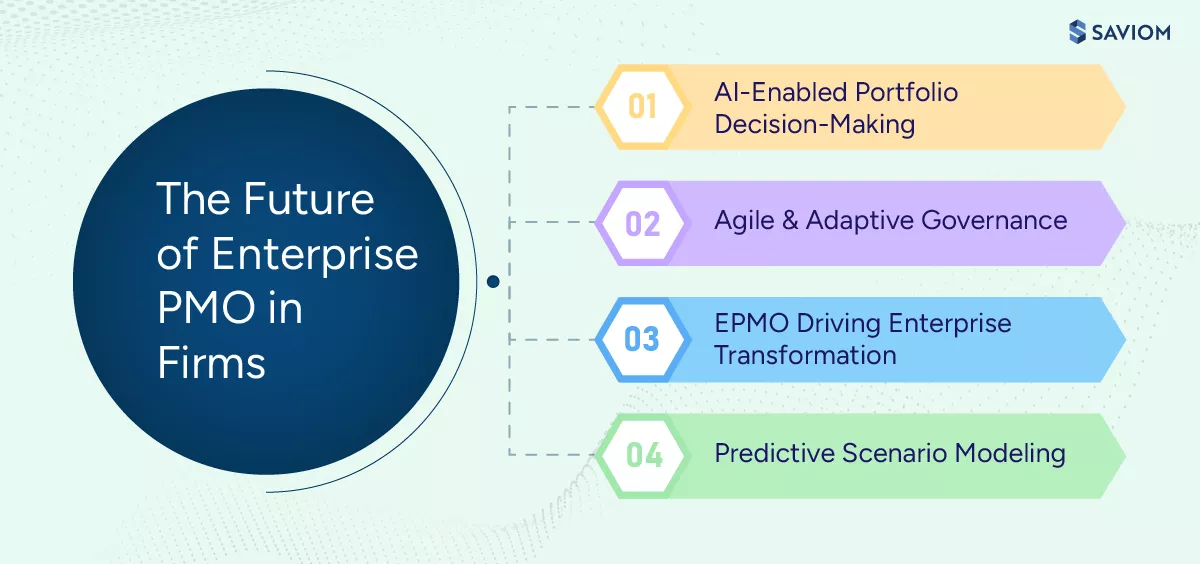
Adoption of AI for Data-Driven Portfolio Decision-Making
AI-powered analytics enable the EPMO to evaluate multiple variables such as strategic alignment, expected ROI, risk exposure, resource availability, etc. This ensures a more objective, data-driven approach to selecting and sequencing initiatives. Moreover, continuous portfolio monitoring helps detect anomalies early, allowing leadership to take proactive corrective actions and optimize performance.
Shift Towards Agile and Adaptive Portfolio Governance
Enterprises are increasingly moving away from rigid, one-size-fits-all governance models toward flexible frameworks that support traditional, agile, and hybrid delivery approaches. Adaptive governance enables EPMOs to retain strategic oversight while giving delivery teams the flexibility to respond quickly to changing market conditions, customer needs, and evolving priorities.
Learn more about agile project management.
Rise of Predictive Scenario Modeling
Predictive scenario modeling enables EPMOs to simulate multiple future outcomes by leveraging historical data and AI-driven algorithms. This allows firms to evaluate how different variables like resource availability, budget constraints, or shifting priorities impact portfolio performance. It also helps anticipate potential risks early, enabling leaders to implement mitigation strategies proactively.
Conclusion
As enterprise portfolios grow in scale and complexity, execution challenges shift from managing individual projects to coordinating priorities, resources, and investments across the organization. The Enterprise PMO (EPMO) addresses this by bringing structure to decision-making, visibility to portfolios, and discipline to how initiatives are planned and delivered.
By connecting strategy with delivery, finances with outcomes, and resources with demand, the enterprise PMO enables organizations to operate with greater control and agility. Over time, this positions the EPMO not just as a governance function, but as a core operational capability that strengthens execution resilience and drives sustained business performance.
Frequently Asked Questions (FAQs)
An Enterprise Project Management Office (EPMO) is a centralized governance function that oversees how an organization selects, prioritizes, funds, and executes strategic initiatives across the enterprise. It provides leadership with enterprise-wide visibility into portfolios, enabling better decision-making, optimized resource allocation, and improved delivery of high-value initiatives.
An Enterprise PMO (EPMO) differs from a traditional PMO in scope and focus. A traditional PMO manages and standardizes project delivery within a department or business unit, ensuring projects are completed on time, within scope, and within budget.
In contrast, an EPMO operates at the enterprise level, aligning projects and programs with business strategy. It oversees portfolios, prioritizes investments, manages resource capacity, and supports executive decision-making.
It is important to implement an effective EPMO because it:
1. Aligns project portfolios with enterprise strategy
2. Embeds clear governance across the enterprise
3. Improves resource allocation and capacity planning
4. Enables data-driven investment decisions
5. Strengthens risk management across the enterprise
An Enterprise PMO (EPMO) aligns projects with business strategy by prioritizing initiatives based on strategic goals, value, and resource availability. It standardizes governance and tracks performance against objectives, ensuring execution stays aligned with business priorities and delivers measurable outcomes.
Some of the key KPIs used to measure EPMO success are:
1. Strategic Alignment Ratio
2. Portfolio Value Realization Rate
3. Portfolio ROI
4. Resource Utilization Rate
5. Budget Variance
Key EPMO challenges include:
1. Poor project prioritization
2. Lack of enterprise-wide portfolio visibility
3. Inconsistent governance across business units
4. Resistance to organizational change
5. Limited performance measurement
6. Weak risk management
Organizations transition from a traditional PMO to an Enterprise PMO by expanding their focus from project-level control to enterprise-wide strategy execution. This typically involves strengthening governance frameworks, introducing portfolio-level decision-making, and aligning project selection with strategic business objectives.