

Introduction
Modern enterprises operate amid persistent market volatility, cost pressures, accelerated project timelines, and evolving workforce dynamics. In such an environment, resource management serves as the structural backbone that aligns corporate priorities, portfolio investments, workforce capacity and capabilities, financial constraints, and delivery timelines into a cohesive operating model.
It has evolved from a purely administrative role to a strategic function, ensuring human and non-human assets are utilized effectively to meet project and organizational goals. It introduces discipline and predictability through techniques such as demand forecasting, resource capacity planning, and utilization optimization.
This blog covers the principles, processes, and best practices that help enterprises mature their resource management capabilities. Let’s first define resource management.
What is Resource Management?
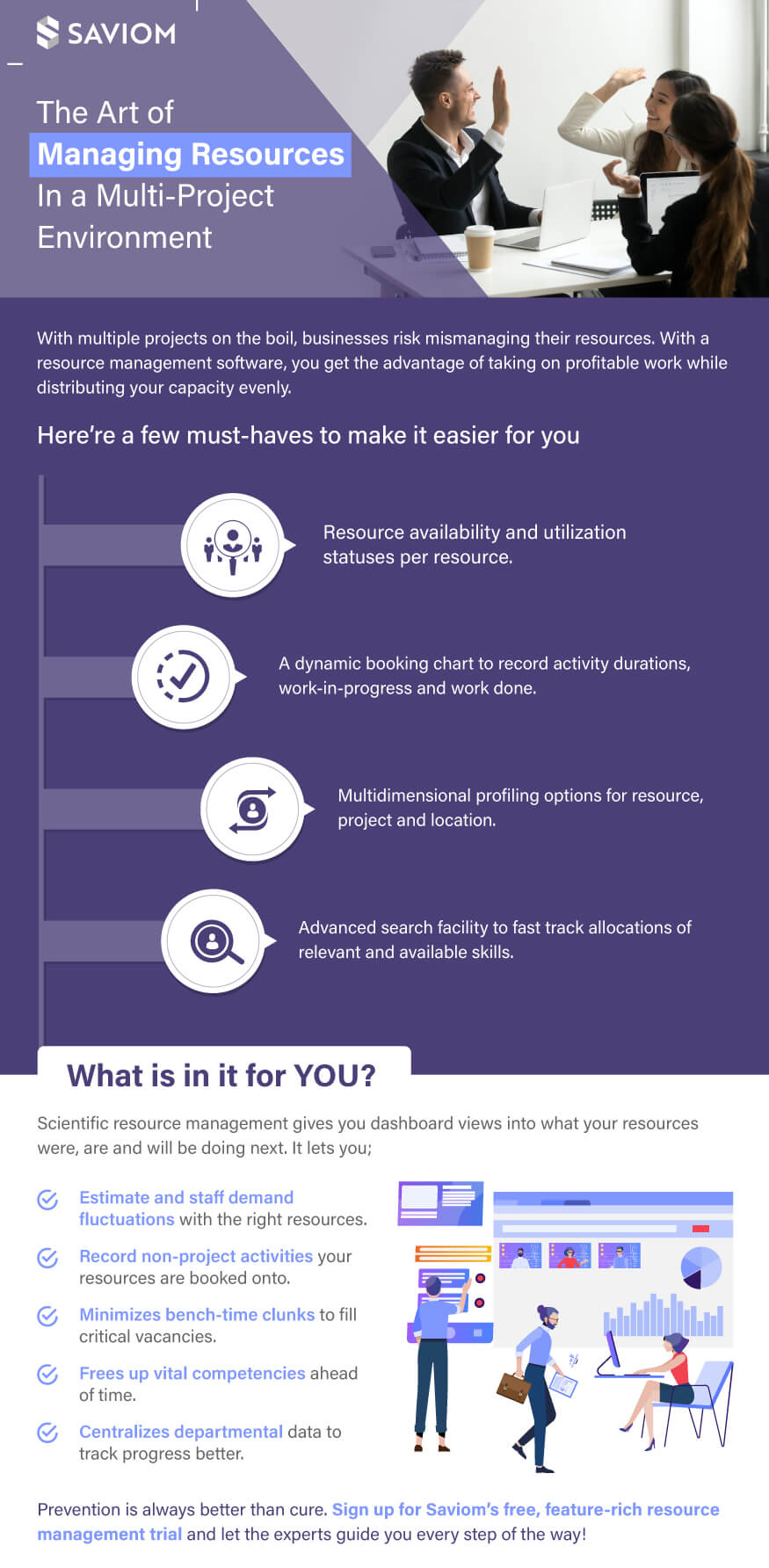
Resource management is the structured process of planning, allocating, and optimizing resources such as people, equipment, finances, and tools across projects to maximize utilization, improve strategic alignment, and reduce costs and delivery time.
It involves aligning project requirements with the most suitable available resources and continuously optimizing their utilization. By balancing capacity with demand, organizations can prevent over-allocation, reduce burnout, and keep projects on track. This ensures steady delivery while improving operational efficiency.
To understand the basics of resource management and how it has evolved, read our detailed article
Now that the definition is clear, let’s turn to why resource management is important for modern organizations.
Why Resource Management Matters for Modern Organizations?
Resource management is a critical business function that streamlines resource-centric workflows, optimizes costs, and enhances project outcomes. Let’s deep dive to understand resource management benefits:
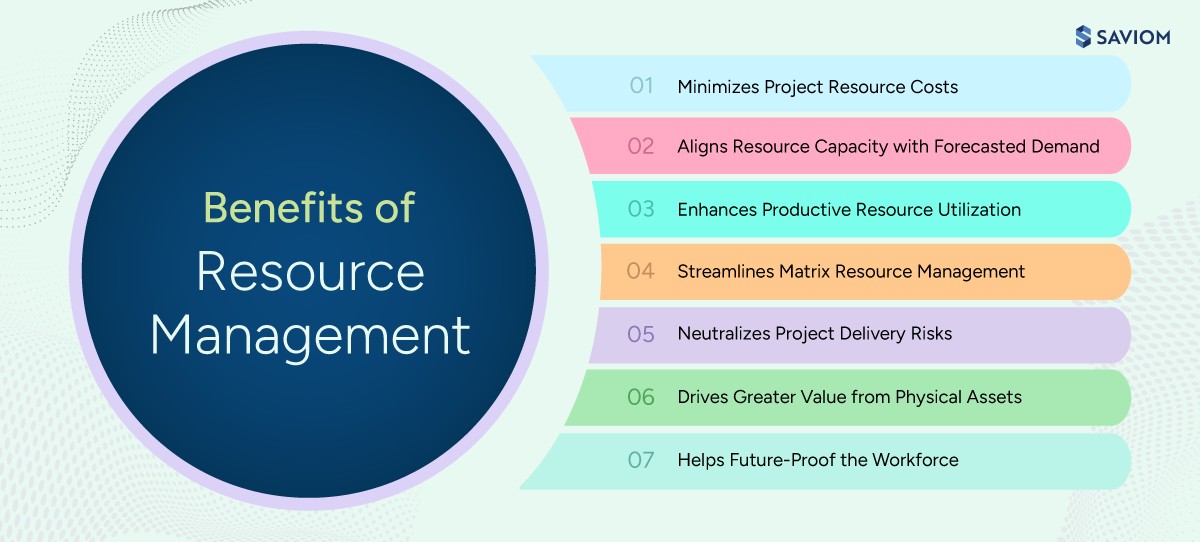
Minimizes Project Resource Costs
Enterprises can keep project budgets under control and prevent cost overruns with a well-defined resource management process. Instead of defaulting to familiar teams, firms can strategically mix local, global, permanent, and on-demand talent based on project complexity and financial constraints. It helps assign the best-fit resources to every project, maximizes existing capacity, and prevents unplanned expenses.
Read our blog on project cost management.
Forecasts and Aligns Resource Capacity with Demand
Robust resource management connects sales pipelines with delivery planning, helping firms accurately forecast and align internal capacity with current and future project demand. It allows them to leverage capacity planning to identify talent shortages or surpluses and take corrective action, such as reallocating, upskilling, or hiring to bridge the gap.
Improves Productive Resource Utilization
Effective resource management maximizes workforce value by ensuring the right skills and tools are assigned to the right projects. It prevents resource underutilization and overallocation by maintaining a balanced workload distribution. Moreover, it allows proactive redeployment from non-billable to strategic or revenue-generating work, improving overall productive utilization.
Simplifies Matrix Resource Management
Resource management provides a single source of truth across the enterprise. It enables cross-functional and cross-geographical allocation without double-booking or scheduling conflicts. Moreover, standardized approval workflows ensure resources are assigned based on priority rather than informal negotiations. This structured approach strengthens coordination in matrix environments and improves enterprise-wide performance.
Neutralizes Project Delivery Risks
Effective resource management reduces delivery risks by providing visibility into key project resource metrics. It ensures the right resources are aligned with critical milestones, improving on-time completion across concurrent initiatives. Beyond that, continuous monitoring helps teams address shortages or overallocation before they escalate.
Drives Greater Value from Physical Assets
Resource planning extends beyond people to include equipment, infrastructure, and digital tools. Centralized visibility helps organizations align asset availability with project schedules and prevent idle time. It ensures balanced distribution across teams and reduces delays caused by asset conflicts. For capital-intensive industries, this improves return on investment and avoids unnecessary expenditure.
Future-Proofs the Workforce
With effective resource management, organizations can compare future pipeline demand with existing capabilities and identify emerging skill gaps early. It supports targeted upskilling, reskilling, and strategic hiring aligned with long-term objectives. By planning ahead, firms reduce dependency on last-minute, high-cost recruitment. This forward-looking approach builds a resilient and adaptable workforce.
Check out our blog on the importance of resource management.
Now that we have learned about the importance of resource management, let’s understand the types of resource management in the following section.
Types of Resource Management
Enterprise resource management spans multiple categories, each addressing a different dimension of organizational capacity.
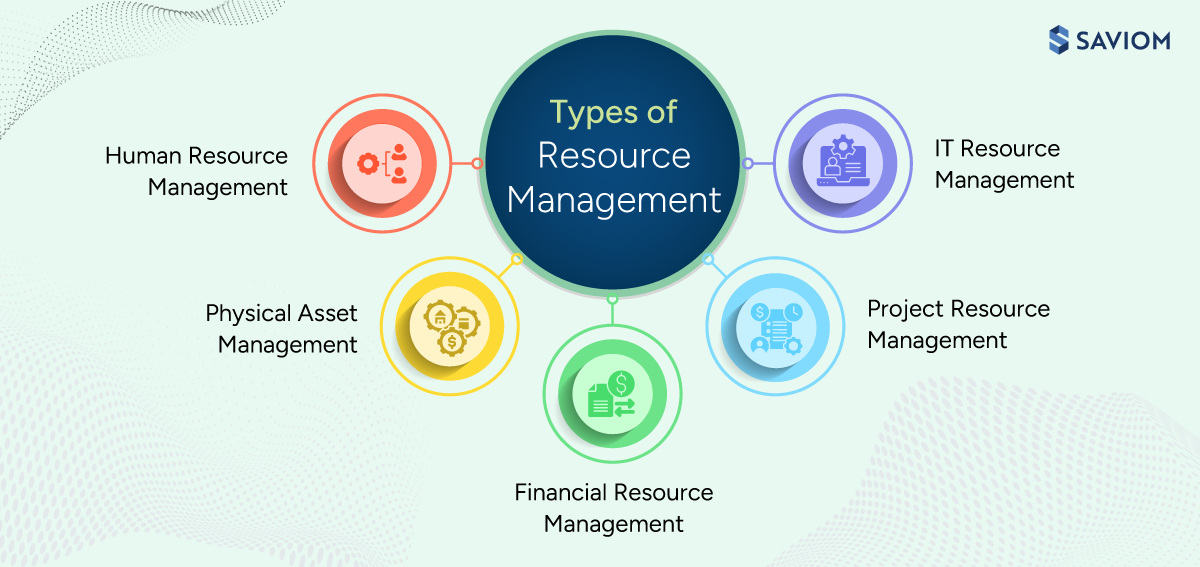
Human Resource Management
Human resource management is the practice of planning, allocating, and optimizing workforce capacity to ensure the right people with the right skills are assigned to the right work at the right time. It goes beyond simple scheduling by aligning talent with operational and strategic business objectives.
This involves maintaining a centralized skill matrix, monitoring real-time utilization, and managing dynamic allocation workflows. By balancing productivity targets with employee well-being, organizations can reduce burnout, improve retention, and enhance delivery performance.
Physical Asset Management
Physical asset management is the process of tracking, allocating, and optimizing materials, tools, machinery, and other operational assets essential for project execution. It ensures assets are available when needed and prevents both shortages and idle resources.
Effective asset management integrates availability with project schedules, demand forecasts, and inventory controls. Organizations that implement centralized visibility systems can reduce delays, avoid waste, and shift from reactive procurement to proactive, data-driven optimization.
Financial Resource Management
Financial resource management involves planning, tracking, and controlling budgets to ensure disciplined spending and maximize organizational profitability. It connects financial planning with resource allocation across projects and portfolios.
The scope includes integrating financial data with workforce and asset management systems to enable informed investment decisions. Governance ensures that funds are allocated to strategically prioritized initiatives, improving margin performance while supporting long-term business objectives.
Project Resource Management
Project resource management is the practice of planning and coordinating people, skills, tools, and assets across multiple projects to meet timelines, milestones, and strategic objectives. It focuses on matching resource availability with project demand while minimizing conflicts.
This includes structured allocation, scheduling, and prioritization processes. Leaders must ensure high-priority projects receive adequate capacity without disrupting ongoing work, thereby enhancing delivery predictability and overall project success.
IT Resource Management
IT resource management is the strategic allocation and optimization of technology assets, infrastructure, and IT workforce capacity to support business operations. It ensures hardware, software, cloud resources, and digital platforms are effectively utilized to meet enterprise needs.
The scope involves integrating IT planning with overall resource strategy to align technology investments with business objectives. Organizations benefit from scalable, cost-efficient IT operations, stronger operational resilience, and a foundation for digital transformation initiatives.
Next, let’s discuss the different components of resource management.
Core Components of Resource Management
Effective resource management is built on interconnected components. The table below breaks down these core elements.
| Component | What It Does | Why It Matters | Governance & Execution Focus |
|---|---|---|---|
| Resource Planning | Defines what resources are needed, when, and for how long across projects and portfolios | Aligns workforce and assets with business goals, improving delivery readiness and resource health | Requires leadership alignment with portfolio priorities and structured intake processes |
| Resource Forecasting | Predicts future demand using pipeline data and historical trends | Prevents reactive hiring and delivery delays by anticipating needs early | Must operate as a rolling forecast reviewed quarterly, not a static annual plan |
| Resource Capacity Planning | Assesses available capacity against forecasted demand by role, skill, and availability | Identifies capacity excesses or shortages before they impact performance or cost | Cross-functional reviews ensure realistic assumptions and balanced trade-offs |
| Resource Capability Management | Maintains a centralized inventory of skills, certifications, and experience | Enables strategic workforce development aligned with market and portfolio shifts | Requires ongoing skills audits and integration with L&D and succession planning |
| Resource Allocation & Scheduling | Assigns the right resources to the right work at the right time | Reduces delays, skill mismatches, and costly rework | Needs centralized approval workflows to prevent double-booking and priority conflicts |
| Resource Utilization Management | Tracks how effectively resources are used versus available capacity | Protects margins while monitoring burnout and bench time | Leadership must define healthy utilization thresholds and review trends consistently |
| Resource Optimization | Continuously improves deployment across cost, quality, and timeline dimensions | Maximizes enterprise value with minimal waste | Requires data-driven adjustments rather than intuition-based decisions |
| Resource Risk Management | Identifies risks such as shortages, attrition, or overutilization | Improves resilience and reduces delivery disruptions | Embed risk reviews into portfolio governance and scenario analysis |
| Scenario Planning | Models “what-if” scenarios based on shifting demand or priorities | Enables informed trade-offs before committing resources | Executive sponsorship ensures decisions reflect strategic intent |
| Time Tracking | Captures actual effort across billable and non-billable work | Improves costing accuracy, forecasting precision, and performance insights | Data discipline and compliance standards are critical for reliability |
Discover key resource management techniques that help manage resources efficiently.
Now that we are familiar with resource management techniques and components, let’s discuss the ERM framework.
Enterprise Resource Management Framework (ERMF)
The Enterprise Resource Management Framework (ERMF) provides a structured, end-to-end approach to aligning business strategy with workforce planning, project execution, and continuous optimization. It elevates resource management from an operational activity to a strategic, ongoing decision-making framework that connects leadership priorities with execution and measurable outcomes.
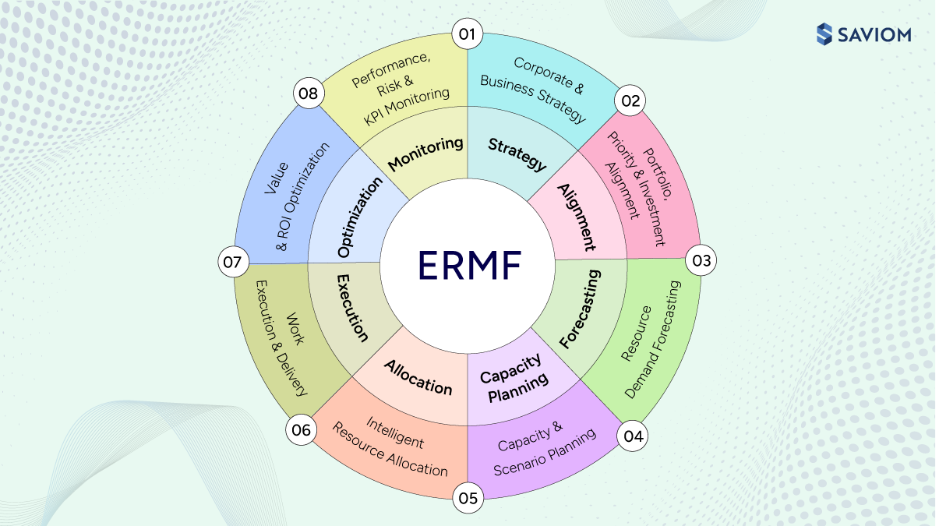
Corporate and Business Strategy
Enterprise resource management begins with a business strategy. At this stage, leadership defines organizational goals, such as revenue growth, market expansion, cost optimization, or innovation initiatives.
Key focus areas include:
- Strategic goals and growth objectives
- Target markets, services, and delivery models
- Financial targets and risk appetite
- Long-term workforce and capability vision
This stage ensures that resource planning is not driven solely by short-term demand, but by where the organization intends to go.
Portfolio, Priority, and Investment Alignment
Once a strategy is defined, organizations evaluate which initiatives should move forward. This stage focuses on portfolio alignment and project intake, ensuring that only strategically relevant projects enter execution.
Key questions addressed include:
- Does the initiative align with business strategy?
- Does it justify investment relative to other priorities?
- Can the organization deliver it with available capacity?
Effective alignment at this stage prevents overcommitment, protects critical initiatives, and reduces downstream resource strain.
Resource Demand Forecasting
With a validated project portfolio in place, organizations can forecast resource demand. This is not just headcount estimation, but a role- and skill-based demand forecast tied directly to approved projects.
At this stage, leaders assess:
- What roles and skills are required?
- When are they needed?
- For how long and at what level of effort?
Accurate resource forecasting provides early visibility into future requirements and supports proactive hiring, upskilling, or redeployment decisions.
Capacity and Scenario Planning
In this stage, capacity planning helps enterprises assess resource demand against available capacity. On the other hand, scenario planning allows leaders to test multiple approaches before committing. This results in realistic, data-driven capacity decisions.
This stage focuses on:
- Assessing whether capacity can meet forecasted demand
- Identifying skill shortages or excess capacity
- Evaluating options to address gaps
Cumulatively, capacity and scenario planning allow organizations to identify, analyze, and prepare for various resource risks and ensure seamless operational workflows.
Intelligent Resource Allocation
Once demand and capacity are aligned, organizations assign resources to current and future projects. These allocation decisions are made based on skills, availability, cost, and priority.
This stage ensures that:
- Critical initiatives receive the right talent
- Resources are not overutilized or underutilized
- Workloads remain balanced even when priorities shift
The result is optimized deployment of resources, aligned with both business priorities and operational constraints.
Work Execution and Delivery
This stage ensures continuous monitoring and adjustment throughout the project lifecycle. When capacity falls short, schedules are revised, or additional talent is onboarded. Conversely, when there is excess capacity, resources are redeployed or inducted into skill development initiatives.
At this stage, organizations track:
- Planned versus actual effort
- Workload imbalances and delivery risks
- Changes in project scope or business priorities
This continuous recalibration keeps delivery on track and aligned with business objectives.
Value and ROI Optimization
Beyond execution, organizations must ensure resources deliver measurable value. This stage focuses on maximizing return on investment across all business initiatives.
Key activities include:
- Assessing utilization against business value delivered
- Redirecting resource capacity to high-impact initiatives
- Reducing inefficiencies caused by skill mismatches or extended bench time
- Optimizing cost through better project resource mix
Such value optimization ensures that resources contribute directly to strategic and financial outcomes.
Performance, Risk, and KPI Monitoring
The final stage of the framework establishes ongoing measurement and governance. Organizations monitor these performance and risk indicators to maintain control and alignment.
It involves measuring resource management metrics, such as:
- Resource utilization, demand forecast accuracy, and availability rate
- Revenue per resource and workload health indicators
- Financial KPIs related to cost and ROI
Continuous monitoring provides early warning signals and enables timely course correction, ensuring resource management remains accountable and aligned with business goals
To gain a better understanding of resource management fundamentals, read our comprehensive eBook.
Now that the enterprise resource management framework is clear, we can move into practical resource management techniques.
Scenario Modeling and Capacity Optimization
In complex enterprises, static planning assumptions quickly become outdated. Market volatility and talent constraints require organizations to test alternatives before committing resources. This is where scenario modeling and capacity optimization together provide a structured mechanism to anticipate change, evaluate trade-offs, and protect delivery performance.
Scenario Modeling to Evaluate Resource Outcomes
Scenario planning simulates different demand, timeline, and priority shifts to assess operational impact before commitments are made. Managers can test scenarios such as accelerated projects, delayed hiring, or sudden pipeline growth to uncover risks and constraints early.
This enables informed trade-offs between cost, capacity, and delivery timelines. In practice, quarterly portfolio reviews supported by real-time data make scenario planning actionable rather than theoretical. The result is faster, evidence-based decision-making across the enterprise.
Capacity Optimization to Balance Supply and Demand
Capacity optimization continuously aligns the available workforce and asset capacity with actual and forecasted demand. It identifies overutilization, underutilization, and skill imbalances so companies can rebalance workloads proactively.
Structured redeployment, hiring adjustments, or reprioritization ensure delivery quality is not compromised. Establishing clear utilization benchmarks and monitoring mechanisms is essential to sustain both productivity and workforce health.
Read our blog on resource optimization to learn more.
How They Improve Enterprise Efficiency
Together, these practices improve productivity, resource utilization, and cost efficiency at scale. By reducing last-minute firefighting and staffing disruptions, firms achieve more predictable delivery outcomes. Beyond that, proactive alignment of supply and demand strengthens financial performance and operational resilience, enabling sustainable growth and competitive advantage.
Even with advanced resource planning practices in place, resource management is rarely without challenges. Understanding these common obstacles is essential to improving outcomes. Let’s take a closer look.
Common Resource Management Challenges and Ways to Fix Them
Despite their efforts, organizations still encounter several roadblocks that hinder efficient resource management in project management. Some of the most common resource management challenges are:
| Challenge | Impact on the Organization | Recommended Solution |
|---|---|---|
| Lack of Enterprise-Wide Visibility | Limited insight into skills, availability, utilization, and costs leads to poor allocation, underutilization, and higher delivery risk | Implement a centralized resource management system with real-time dashboards, standardized skill tagging, and enterprise-wide data visibility |
| Capacity and Demand Imbalances | Frequent shortages or excess capacity cause delays, increased costs, and reactive firefighting | Use rolling forecasts, pipeline visibility, and scenario modeling to continuously align supply with demand |
| Resource Cost Overruns | Actual costs exceed budgets due to inefficient allocation or reliance on high-cost resources, reducing profit margins | Track planned vs. actual costs at the resource level and optimize allocation based on skill fit and cost efficiency |
| Skill Mismatches, Talent Gaps, and Shortages | Poor skill alignment reduces productivity and quality while limiting the ability to deliver complex projects | Maintain a skills inventory, align assignments with competencies, and invest in targeted upskilling and strategic hiring |
| Recurring Resource Scheduling Conflicts | Overlapping bookings cause delays, rescheduling efforts, and productivity loss | Use centralized scheduling tools, real-time availability tracking, and clear prioritization frameworks |
| Sub-Optimal Asset Utilization | Idle assets in some areas and shortages in others increase capital expenditure and reduce ROI | Implement centralized asset tracking, monitor utilization rates , and redeploy assets before investing in new ones |
Read in detail about resource management challenges and how to solve them.
The following section discusses the important resource management KPIs that help organizations track workforce and asset performance.
Key Resource Management Metrics
Here are the essential resource management KPIs every manager should track to ensure projects are delivered on time and within budget. Let’s take a closer look.
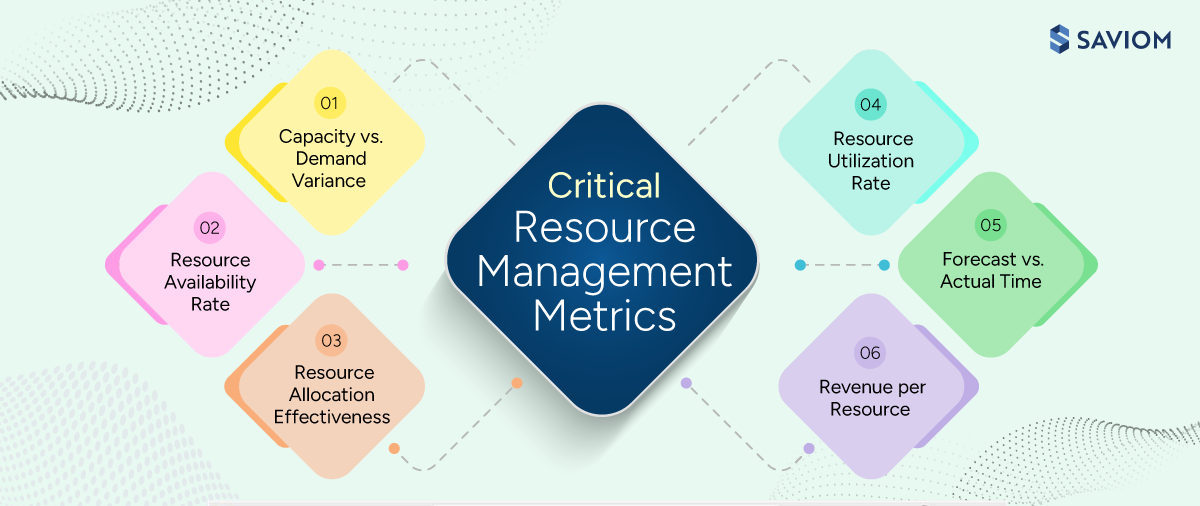
Capacity vs. Demand Variance
Capacity vs. demand variance compares available resource capacity with forecasted and actual demand to reveal imbalances. A persistent gap signals either shortages that may delay delivery or excess capacity that increases overhead costs. Monitoring this variance allows companies to take corrective actions early, such as hiring, redeploying, or reprioritizing work before disruptions occur.
Resource Availability Rate
Resource availability rate indicates the percentage of time resources remain deployable after accounting for assignments, leave, and non-billable commitments. It provides a realistic view of usable capacity rather than theoretical headcount. Tracking this metric enables managers to make faster staffing decisions and reduce scheduling conflicts.
Resource Allocation Effectiveness
Resource allocation effectiveness evaluates how accurately people are matched to project requirements based on skill fit, availability, and timing. Weak alignment often results in productivity loss, rework, delays, and unnecessary costs. Measuring allocation quality helps organizations identify assignment gaps and improve decision-making.
Resource Utilization Rate
Resource utilization rate reflects how effectively available capacity is converted into productive work. It highlights overutilization that may cause burnout and quality issues, as well as underutilization that leads to cost leakage. Maintaining sustainable utilization thresholds supports both productivity and workforce well-being.
Forecast vs. Actual Time
Forecast vs. actual time measures the variance between planned effort and the actual time spent on tasks or projects. Large deviations reveal estimation errors, scope creep, or planning inefficiencies. Analyzing these differences helps companies refine forecasting accuracy and improve scheduling reliability.
Revenue per Resource
Revenue per resource captures the average income generated by each deployed resource within a specific period. It provides insight into workforce productivity and the effectiveness of allocation strategies. Monitoring this metric helps firms assess whether high-value skills are optimally deployed and appropriately priced.
Discover 15 resource management KPIs that facilitate informed decision-making.
Now, let us walk through the proven resource management best practices.
Best Practices for Enterprise-Scale Resource Management
In today’s competitive market, making the most of every resource is essential to drive business growth. Below are key resource management strategies that organizations should implement to achieve this.
Establish a Single Source of Truth Across the Enterprise
A centralized system provides complete visibility into resource skills, availability, capacity, cost, and utilization across departments and geographies. Consolidating data eliminates silos, reduces inconsistent reporting, and ensures managers make decisions based on accurate, shared information. This transparency accelerates allocation decisions and aligns resources with strategic business priorities.
Forecast and Bridge Capacity Gaps Proactively
Effective resource management depends on anticipating demand rather than reacting to it. By leveraging pipeline insights, historical performance data, and rolling forecasts, organizations can identify and address potential shortages, excess capacity, and emerging skill gaps early. Therefore, this approach balances supply with demand, reduces delivery risks, and enhances operational resilience.
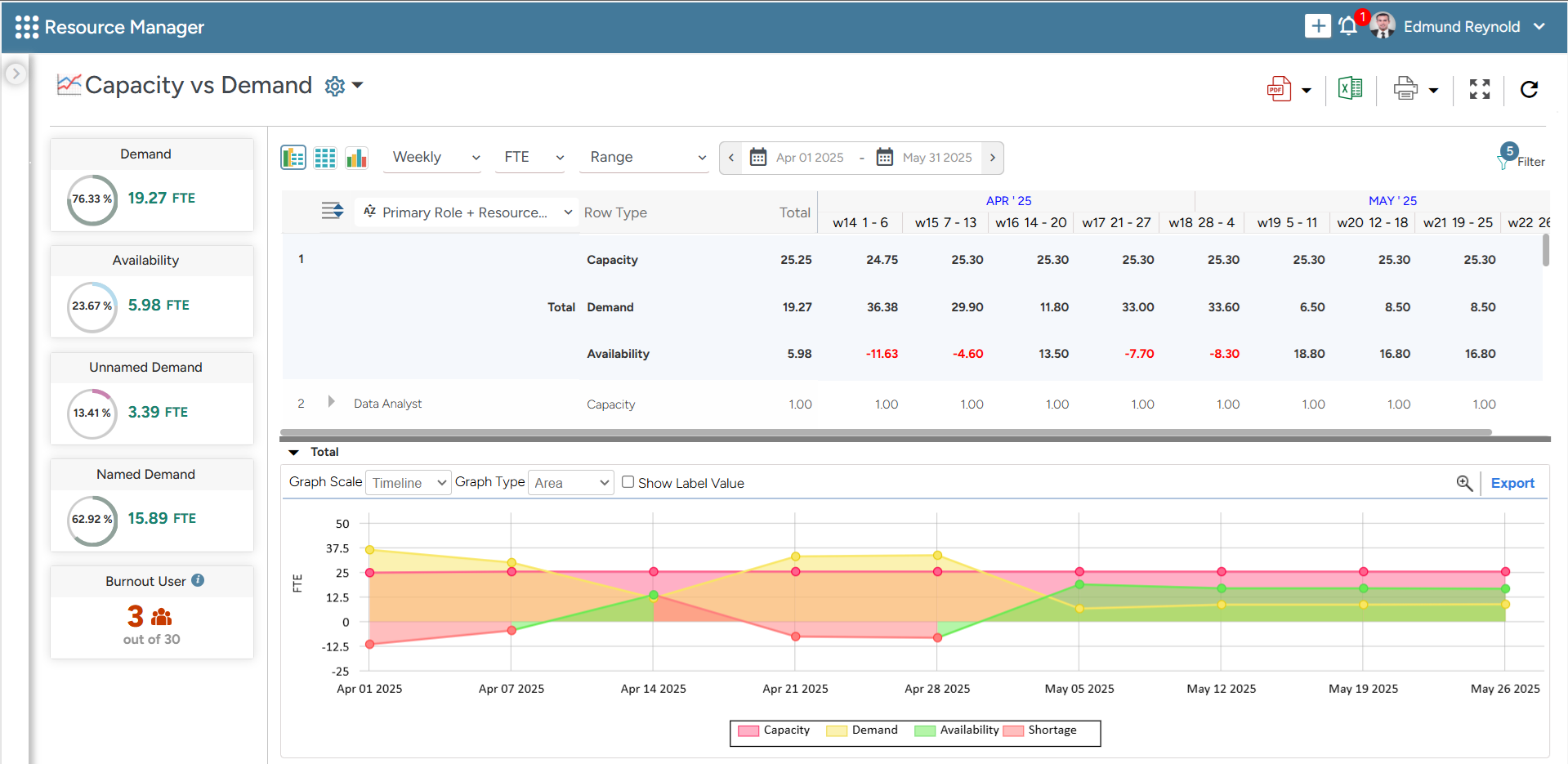
SAVIOM’s Capacity vs. Demand dashboard helps managers identify demand gaps, enabling quick, data-driven decisions.
Streamline Resource Requisition Workflow
A standardized resource requisition workflow provides managers with sufficient lead time to forward plan and assign best-fit resources. It automates submissions, approvals, and tracking, reducing manual coordination and fragmented communication. Furthermore, clearly defined ownership ensures transparency, maintains an audit trail for allocations, and supports consistent project execution.
Optimize Resource Allocation with Scenario Modeling
According to GoodFirms’ 2025 survey, “31.1% of organizations have lowered operating costs by using scenario planning.”
Before committing resources to initiatives, organizations should conduct scenario-based modeling and simulation to understand the impact of workforce and asset constraints on various parameters. They can simulate different resource allocation strategies across projects and select the most profitable plan. This helps overcome resourcing bottlenecks, maintain project momentum, and safeguard profit margins.
Track and Maximize Productive Utilization of Resources
Tracking resource utilization across billable, strategic, and non-billable work ensures employees and tools are deployed effectively. By identifying underutilized and overutilized resources early, managers can rebalance workloads proactively. Establishing sustainable utilization thresholds protects workforce well-being while maintaining productivity.
Maintain a Balanced Mix of Permanent and Contingent Workers
A diversified workforce improves flexibility in dynamic markets. Strategically combining full-time employees with contract and on-demand professionals allows organizations to scale capacity with fluctuating demand. This approach controls fixed costs, ensures access to specialized skills, and maintains delivery standards.
Foster Data-Driven Decision-Making with Real-Time Business Intelligence
Integrating real-time dashboards and advanced analytics into resource management processes enables objective and timely decision-making. Tracking key KPIs such as utilization, allocation effectiveness, capacity variance, and cost efficiency provides early visibility into resource risks and performance gaps. Such data transparency strengthens cross-functional collaboration and executive oversight, elevating enterprise-wide resource performance.
Next, let us learn about the resource management maturity model.
Resource Management Maturity Model
Higher resource management maturity reduces costs, improves utilization, and streamlines allocation. Here’s how organizations can get there.
What is a Resource Management Maturity Model?
Resource Management Maturity Model is an enterprise-wide framework that enables organizations to assess and enhance their resource management processes and capabilities. It encapsulates strategies, tools, methodologies, and informed decision-making that help firms utilize business resources effectively and efficiently.
The model provides a structured approach to systematically evaluate an organization’s current resource management practices, identify areas of improvement, and create a roadmap to achieve the desired maturity level.
Understanding Different Maturity Levels
Understanding different maturity levels in resource management allows organizations to benchmark their current capabilities and identify areas for improvement. Here are the different resource management maturity levels:
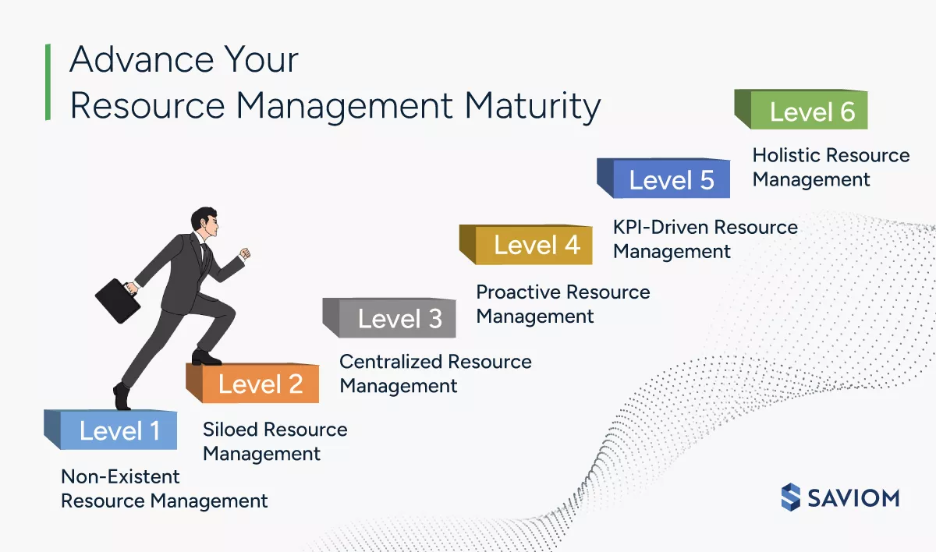
Maturity Level 1: Non-Existent Resource Management
At maturity level one, resource management is not recognized as a formal practice within the organization. There are no defined processes in place. Instead, delivery leaders or line managers are directly responsible for acquiring and assigning resources. This often results in last-minute, reactive decision-making regarding resource scheduling.
Maturity Level 2: Siloed Resource Management
At maturity level two, resource management processes and governance are fragmented and typically managed independently at the team or department level. Some departments may have designated resource managers, but their roles are limited in scope. Most planning and tracking are done using spreadsheets or internally developed tools, with minimal integration across teams.
Maturity Level 3: Centralized Resource Management
At maturity level three, resources are viewed as part of a shared pool that can be allocated across different projects within the organization. Processes and governance models are standardized and centrally coordinated to support all departments. Resource managers operate in a federated model within individual departments or business units, ensuring alignment with the enterprise’s overall goals.
Maturity Level 4: Proactive Resource Management
At maturity level four, the organization has established mature resource management processes that enable forecasting and forward planning for ongoing and upcoming projects. This approach ensures that the right resources are available at the right time, helping reduce costs and supporting timely and budget-compliant project delivery.
Maturity Level 5: KPI-Driven Resource Management
At maturity level five, a resource manager is accountable for meeting key performance indicators (KPIs) related to resource utilization, forecasting accuracy, allocation efficiency, bench strength, fill rates, and more. These metrics support data-driven decision-making and enable continuous optimization of resource allocation across teams and departments, thereby contributing to higher project success rates.
Maturity Level 6: Holistic Resource Management
At maturity level six, resource management is fully integrated into the organization’s strategic planning. It addresses both short- and long-term resource needs for project and non-project work. This holistic model covers the entire resource lifecycle, from onboarding to off-boarding, and plays a key role in driving sustainable growth and maintaining a competitive edge in a dynamic business environment.
Assessing Current Maturity Model
Firms can assess their current maturity model to evaluate how well their resource management practices align with their long-term goals. Below are the key steps for this assessment.
- Conduct a structured evaluation of existing resource management practices to establish a clear baseline for maturity assessment.
- Identify core strengths, recurring inefficiencies, and operational bottlenecks within resource planning, forecasting, and allocation workflows.
- Examine the effectiveness of current tools, data integration, and reporting mechanisms in delivering real-time visibility and supporting timely decision-making.
- Engage cross-functional stakeholders, including PMO, HR, Finance, and Delivery, to collect qualitative insights and validate perceptions of current maturity levels.
- Analyze governance frameworks, process standardization, and ownership structures to uncover inconsistencies, redundancies, or risk-prone areas.
Determining the Targeted Maturity Model and Roadmap
Defining a targeted maturity model and roadmap helps organizations pinpoint the desired state of their resource management capability and outline how to reach it. The following steps provide a structured approach to this process.
- Define a clear and measurable target state for resource management maturity that aligns with the organization’s broader business strategy and transformation goals.
- Map the desired end-state across key dimensions, such as tools, processes, governance, skills, and data architecture.
- Highlight the gaps between current and targeted maturity levels and translate them into actionable focus areas.
- Create a phased roadmap with prioritized initiatives, aligned to business needs and organizational readiness (e.g., centralizing data, enabling scenario-based forecasting, building skills inventory).
- Guide stakeholders in selecting or enhancing tools and platforms that can scale with maturity and support multidimensional forecasting, analytics, and collaboration.
- Secure leadership buy-in and define clear roles and sponsorship to drive roadmap execution.
Implementing the Maturity Model
Putting the maturity model into practice enables organizations to translate their resource management vision into actionable steps. The following section focuses on building core capabilities, embedding governance, and driving continuous improvement. Let’s understand.
- Implement foundational capabilities first, such as centralized resource inventory, standardized planning workflows, integrated tooling, etc., to build early momentum.
- Embed cross-functional governance and steering mechanisms to ensure alignment, accountability, and escalation channels.
- Deliver robust change management programs including stakeholder communication, leadership alignment, and capability-building across resource managers, PMs, and operational leaders.
- Create feedback loops via KPIs and health metrics (e.g., utilization %, forecast accuracy, resource lead time, skills availability) to measure progress and course correct.
- Continuously evolve practices through quarterly retrospectives, maturity reassessments, and cross-team learnings to move toward a culture of strategic resource management.
Learn how to accelerate your resource management maturity model.
Advance your maturity level with SAVIOM’s resource management software. Book a demo today to see it in action.
Now that we understand the different maturity levels, let’s examine some real-world case studies and examples.
Real-World Resource Management Case Studies and Examples
The following examples highlight how structured resource management improves visibility, utilization, and delivery outcomes across industries.
IT Services Organization
In a multi-region IT services firm, resource management starts with centralizing employee skills, certifications, and availability into a single system. Project managers use this data to forecast demand based on client pipelines, run scenario simulations for upcoming projects, and assign the right teams to the right tasks. Automated dashboards track utilization, identify bench time, and highlight potential skill gaps, allowing proactive upskilling or hiring to ensure projects are staffed efficiently and delivered on time.
Professional Services and Consulting Firm
For a global consulting firm, resource management integrates consultant schedules, practice-level demand, and billing priorities into enterprise-wide capacity planning. Managers can allocate consultants across regions based on skill, cost, and availability, while real-time reporting highlights under- and overutilized staff. By combining demand forecasting with resource tracking, the firm ensures high-value projects are fully staffed, internal initiatives are supported, and last-minute staffing conflicts are minimized.
Audit, Accounting, and Legal Firm
In audit, accounting, and legal firms, resource management balances seasonal demand with internal capacity. Advanced forecasting tools predict high-demand periods and map them against team capacity, while blended workforce models mix permanent staff with contingent workers. Managers monitor utilization in real time, reassign work proactively, and plan overtime strategically, ensuring deadlines are met without overloading staff or relying on reactive hiring.
Architecture, Engineering, and Construction (AEC) Industry
AEC firms manage multiple projects with specialized skills and critical equipment. Resource management systems track both personnel and assets, linking project schedules with staff availability, certifications, and equipment status. Resource capacity planning tools help run multi-project simulations to prevent conflicts, optimize allocation of specialists and machinery, and identify potential bottlenecks. This structured approach ensures projects start on time, resources are efficiently used, and delays or cost overruns are minimized.
Now that we have explored industry-specific examples, let’s go through the future advancements in resource management.
Next-Gen Trends: AI, Automation, and Data-Driven Forecasting
Emerging technologies are reshaping how organizations plan, allocate, and optimize resources. AI, automation, and advanced analytics are transforming resource management from reactive coordination to predictive and strategic enablement.
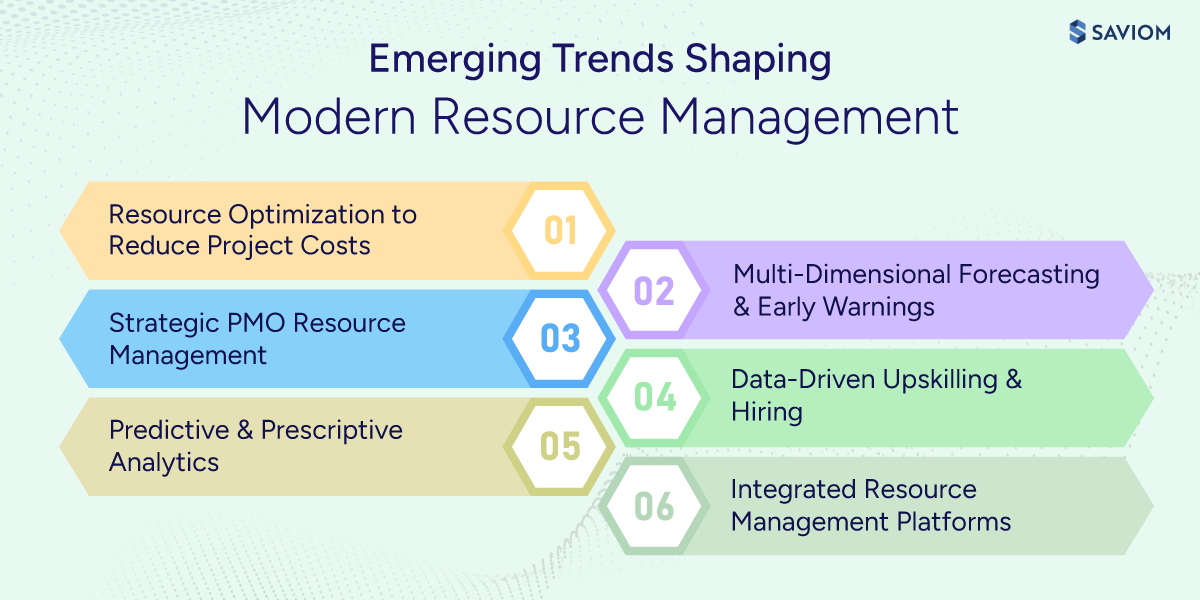
Leveraging Resource Optimization to Reduce Project Costs
Amidst hypercompetition and rising costs, firms increasingly rely on resource optimization to control project expenses. These practices enable firms to ensure competent resource allocation and prevent over- and underutilization. As a result, organizations can reduce employee burnout, minimize bench time, and avoid financial inefficiencies.
Multi-Dimensional Forecasting and Early Warning Systems
Multi-dimensional forecasting enables enterprises to assess future resource needs across roles, skills, teams, and departments. Combined with early warning systems, it helps managers proactively address risks, such as overbooking, burnout, bench time, and under- and overutilization.
PMO Resource Management Becoming More Strategic
The PMO roles and responsibilities have evolved from an operational reporting function to a strategic planning authority. They play a pivotal role in streamlining critical resource-centric workflows, including planning, allocation, and utilization. This shift allows organizations to align talent deployment with portfolio priorities and long-term business objectives.
Data-Driven Upskilling and Hiring Decisions
Resource management is becoming increasingly data-centric. Real-time and historical performance data help identify existing and future skill gaps. Organizations can then align training programs and hiring strategies with estimated demand. This approach replaces assumption-based decisions with measurable, business-aligned workforce investments.
Predictive and Prescriptive Analytics
Predictive analytics leverage historical and live data to forecast demand patterns, utilization trends, and capacity risks. Prescriptive models go further by recommending optimal actions, such as hiring, redeployment, or reskilling. Together, these capabilities enable faster and more confident decision-making. The outcome is improved agility and reduced planning uncertainty across the enterprise.
Integrated and Holistic Resource Management Tools
Next-generation resource management software unifies people, skills, costs, time, and assets within a single ecosystem. By integrating resource data with project, financial, and portfolio systems, organizations achieve end-to-end visibility. This holistic approach eliminates silos and supports enterprise-wide optimization. Ultimately, integrated platforms provide the foundation for scalable, intelligent resource management.
Explore resource management trends that help organizations stay agile and build productive teams.
Conclusion
Effective resource management is no longer a back-office coordination function—it is a strategic capability that directly influences delivery performance, cost control, and long-term growth. As organizations scale operations, manage distributed teams, and balance complex project portfolios, structured planning and real-time visibility become essential.
Resource Management FAQs
Resource management is the structured process of planning, allocating, and optimizing business resources such as people, equipment, finances, and tools across projects to maximize utilization, improve strategic alignment, and reduce costs and delivery time.
Resource management is important because it:
1. Minimizes project resource costs
2. Forecasts and aligns resource capacity with demand
3. Improves productive resource utilization
4. Simplifies matrix resource management
5. Neutralizes project delivery risks
6. Drives greater value from physical assets
7. Future-proofs the workforce
The main types of resource management include human resource management, physical asset management, financial resource management, project resource management, and IT resource management. Together, these categories cover both people and non-human resources required for successful project execution and operational efficiency.
The core components of resource management include:
1. Resource planning
2. Resource forecasting
3. Resource capacity planning
4. Resource capability management
5. Resource allocation and scheduling
6. Resource utilization management
7. Resource optimization
8. Resource risk management
9. Scenario planning
10. Time tracking
Resource management is a broad enterprise-wide framework that covers end-to-end planning, allocation, monitoring, and optimization of business assets. Resource capacity planning specifically focuses on evaluating the supply vs. demand gap to identify resource shortages or excesses. In essence, capacity planning is a key subset of resource management.
Common resource management challenges include:
1. Lack of enterprise-wide visibility
2. Capacity and demand imbalances
3. Resource cost overruns
4. Frequent skill mismatches, talent gaps, and shortages
5. Recurring resource scheduling conflicts
6. Sub-optimal asset utilization
Resource management best practices include:
1. Establish a single source of truth across the enterprise
2. Forecast and bridge capacity gaps proactively
3. Streamline resource requisition workflow
4. Optimize resource allocation with scenario modeling
5. Track and maximize productive utilization of resources
6 .Maintain a balanced mix of permanent and contingent workers
7. Foster data-driven decision-making with real-time business intelligence