

Introduction
Managing one project is challenging; managing dozens in parallel is far more complex. As portfolios expand, priorities shift, and resources are shared across initiatives, maintaining control over workloads, schedules, and budgets becomes increasingly difficult.
Project resource management brings structure to this complexity by helping teams forecast demand, match work with the right skills, and allocate resources based on availability and priorities. It enables managers to ensure balanced workload distribution, resolve resource conflicts early, control project costs, and maintain steady delivery even as project conditions change.
In this guide, we will explore the project resource management definition, its benefits, challenges, and proven best practices. We will also learn the step-by-step approach to creating an effective PRM plan.
What is Project Resource Management?
Project resource management is the process of identifying, planning, allocating, and managing resources such as people, time, budget, and equipment needed to deliver a project successfully. It ensures that the right resources are available at the right time and are used efficiently to meet the project’s scope, schedule, budget, and quality objectives.
It also involves monitoring resource availability, utilization, and changing project demands throughout the project lifecycle. As priorities shift, project resource management helps managers make informed trade-offs, redirect resources where they are needed most, and control costs. This ensures steady project progress while avoiding resource shortages, underutilization, team overload, or missed deadlines.
For an in-depth understanding of benefits, types, components, and framework, read our resource management guide.
Having explored the project resource management definition, we will now understand what common types of project resources are.
Types of Resources in Project Management
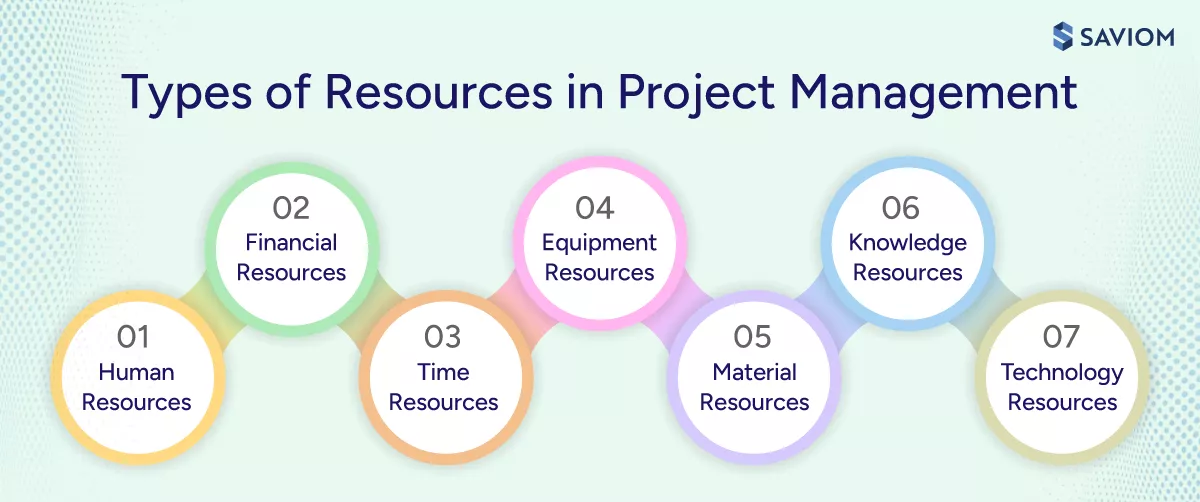
Every project relies on multiple resource types working together to deliver outcomes. Understanding these helps managers plan more accurately, avoid gaps, and ensure that each requirement is accounted for at the right stage of the project lifecycle.
Human Resources
Human resources include all individuals involved in executing and managing project work, such as project managers, team members, specialists, and contractors. Their skills, experience, and availability directly impact execution quality and delivery speed. Assigning the right people to the right tasks ensures efficient progress, reduces rework, and helps maintain consistency across project activities.
Financial Resources
Financial resources refer to the budget allocated for labor, procurement, tools, and other project-related expenses. Proper financial planning ensures that required resources can be secured and sustained throughout the project lifecycle. It also helps managers track spending, control cost variations, and prevent cost overruns during execution.
Read in detail about project financial management and its importance.
Time Resources
Time resources refer to the duration available to complete project tasks, milestones, and deliverables within a planned schedule. Effective time planning ensures that tasks are sequenced correctly, dependencies are managed, and resources are utilized within realistic timeframes. Poor time management can lead to delays, scheduling conflicts, and missed project milestones.
Equipment Resources
Equipment resources include the physical tools, machinery, technology, and infrastructure required to carry out project activities. Their availability and scheduling play a key role in maintaining workflow continuity. Limited or poorly managed equipment can create bottlenecks and delay dependent tasks.
Learn about project interdependencies and how to manage them effectively.
Material Resources
Material resources consist of the consumables, raw materials, and supplies required to complete project activities. Proper planning and timely procurement ensure that materials are available when needed, preventing shortages and avoiding unnecessary delays. Efficient material management also reduces excess inventory, minimizes waste, and controls costs.
Knowledge Resources
Knowledge resources include the expertise, documentation, and domain understanding required to perform project tasks effectively. Access to the right knowledge supports better decision-making, enhances problem-solving, and reduces errors during execution. It also helps maintain consistency, avoid repeated mistakes, and improve efficiency across similar projects.
Technology Resources
Technology resources include software applications used for project and resource planning, collaboration, reporting, and tracking. These tools improve visibility into resource availability, workload distribution, and project progress. They also support better coordination, faster decision-making, and more efficient management of shared resources across multiple projects.
Explore the key types of business resources used in project management.
After exploring the definition and types of project resources, let us now explore the importance of project resource management.
Why is Project Resource Management Important?
Project resource management plays a critical role in ensuring that projects are planned realistically, staffed correctly, and executed without unnecessary delays or cost overruns. The following points highlight the importance of project resource management:
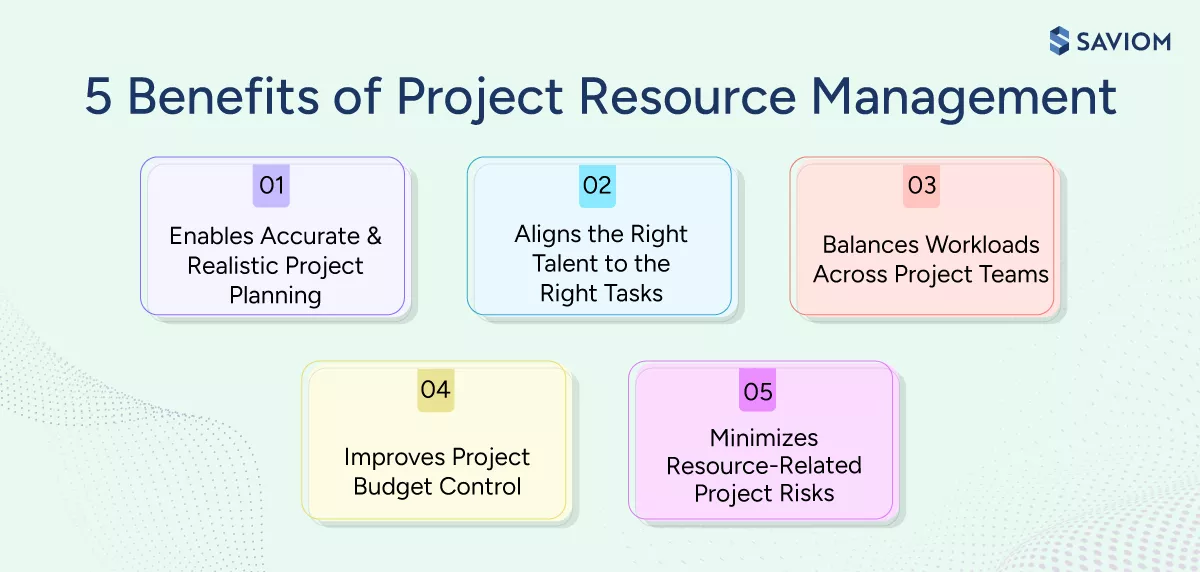
Enables Accurate and Realistic Project Planning
Accurate planning starts with understanding what resources are needed, when they are needed, and whether they are realistically available. Project resource management:
- Helps project managers estimate the people, skills, effort hours, tools, equipment, and budget required to complete project tasks.
- Aligns project scope, timelines, and dependencies with actual resource availability.
- Ensures that project plans are built on real constraints rather than ideal assumptions.
Ensures the Right Talent is Assigned to the Right Project Tasks
According to a PMI survey, “Around 36% of organizations consistently use resource management practices to allocate resources effectively.”
Once the project plan is in place, assigning the right talent to the right tasks becomes essential. With an effective project resource management plan, managers can:
- Match project tasks with team members who have the right skills, experience, availability, and role fit.
- Improve task execution by reducing skill gaps, rework, delays, and quality issues.
- Boost productivity by allowing team members to work on tasks that best match their expertise.
Balances Workloads Across Project Teams
Balanced workloads help teams maintain steady progress without overburdening critical resources or leaving available capacity unused. Project resource management:
- Ensures project work is distributed based on each resource’s capacity, availability, current commitments, and project priorities.
- Prevents resource overutilization while reducing bench time for underused resources.
- Supports sustainable team performance by keeping workloads realistic and manageable.
Improves Budget Control Throughout the Project Lifecycle
Because resource costs are a major part of project budgets, effective resource management directly supports stronger financial control. It enables managers to:
- Leverage the right mix of local and global, junior and senior, and permanent and contingent resources.
- Prevent budget overruns caused by over-allocation, underutilization, bench time, or last-minute hiring.
- Tack planned vs. actual resource costs throughout the project lifecycle to identify and manage cost variances early.
Minimizes Resource-Related Project Risks
Resource-related risks can disrupt timelines, quality, and costs, so identifying them early is critical for successful delivery. With project resource management in place, managers can:
- Identify resource constraints such as skill gaps, limited availability, or equipment shortages early.
- Perform capacity and demand analysis and redeploy, upskill, or hire resources accordingly.
- Improve project resilience by preparing teams for resource changes before they disrupt execution.
Read our project management guide to learn why it matters for enterprises.
Next, let us explore the project resource management process.
Project Resource Management Process: A Step-by-Step Approach
A structured project resource management process helps teams ensure that resources are identified, allocated, and monitored systematically. Consequently, project execution remains stable and aligned with timelines and budgets. The steps below outline how resources are planned and managed throughout the project lifecycle using a practical example:
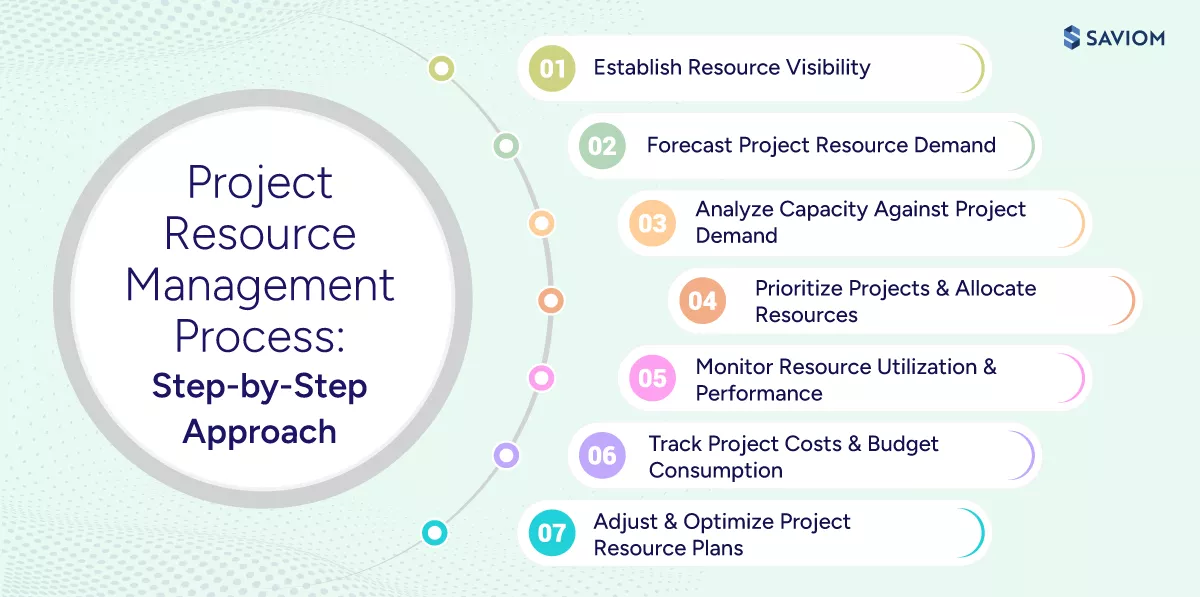
Step 1: Establish Resource Visibility
This first step focuses on creating a clear, project-level understanding of available resources and capabilities. It consolidates information such as skills, roles, experience, cost rates, and availability, reducing information silos. This transparency helps determine whether the required resources are available for the project and allows managers to identify underutilized skills.
For example, an IT services company planning a customer portal project may review available frontend developers, backend engineers, and QA testers across active projects. The manager checks current assignments, upcoming roll-offs, and relevant skill sets to determine who can realistically be assigned. This ensures that planning begins with actual resource availability rather than assumptions.
Step 2: Forecast Project Resource Demand
The second step involves forecasting future resource needs by role, skills, and time horizon based on upcoming project demands and business priorities. Here, managers must also factor in project start dates, duration, and effort requirements, along with seasonality and growth assumptions. This enables them to convert high-level plans into realistic demand forecasts.
Based on available resource visibility, the manager then breaks down the customer portal project into phases, including UI design, backend development, and integration. For each phase, they estimate resources required, the skills needed, and the duration of involvement. They also account for overlaps between phases and potential delays, ensuring the demand plan reflects actual execution conditions.
Explore the fundamentals of resource forecasting and its business benefits.
Step 3: Analyze Capacity Against Project Demand
In this step, managers analyze resource capacity and demand to identify shortages or excesses that could impact project execution. Once the gap is identified, they take corrective measures such as cross-training, upskilling, or hiring to address shortages, and adjusting timelines or allocations to manage excesses.
Continuing with the above example, the manager conducts capacity vs. demand analysis. They discover that while frontend resources are sufficient, there is a shortage of backend engineers during the development phase. Identifying this gap early allows them to explore options such as reallocating internal resources, delaying non-critical work, or onboarding contractors before the shortage affects project execution.
Step 4: Prioritize Projects and Allocate Resources
Now, managers should make deliberate, value-based decisions on which projects to prioritize and how to assign resources. They can evaluate projects against strategic importance, risk, urgency, and business impact, ensuring that limited resources are directed toward the highest-priority work. Ultimately, this protects revenue streams while advancing long-term strategic outcomes.
To address the identified shortage, the manager reviews all ongoing projects and prioritizes the customer portal project based on its client’s importance and strategic value. They reassign a skilled backend engineer from a lower-priority initiative and allocate other team members according to skill fit, availability, and project needs. This ensures that critical tasks are staffed first without disrupting overall delivery.
Learn how effective resource allocation improves business performance.
Step 5: Monitor Resource Utilization and Performance
This step focuses on continuously tracking resource utilization to understand workload, billability, productivity, and delivery risks. With real-time visibility into emerging issues such as burnout or underutilization, managers can take corrective actions before they affect timelines or quality.
As execution begins, the manager continuously tracks how each resource is utilized across project tasks. They notice that one QA tester is underutilized during the early development phase while a developer is slightly overbooked. To maintain balance, they temporarily reassign the tester to support documentation tasks and redistribute some development work to avoid overloading a single resource.
Step 6: Track Project Costs and Budget Consumption
Next, managers must regularly compare planned vs. actual costs to gain clear visibility into financial performance and project budget consumption. This insight helps them quickly identify variances, understand their root causes, and take corrective actions, such as reassigning resources or adjusting forecasts, to prevent budget overruns.
In the above example, the manager compares planned effort hours with the time logged by the team. They observe that backend development is taking longer than expected due to unexpected technical complexity. By identifying this variance early, the manager redistributes tasks, updates the cost forecast, and reassesses timelines. This helps control budget consumption while keeping the project aligned with delivery commitments.
Explore the fundamentals of project cost management.
Step 7: Adjust & Optimize Project Resource Plans as Scenarios Change
Project resource plans need to be revisited as project conditions change, whether due to shifting priorities, timeline changes, new demands, or resource constraints. Ongoing adjustment and optimization help teams stay aligned with project needs while improving resource utilization, efficiency, and delivery stability.
As the customer portal project progresses, the manager encounters a change request from the client that adds new features and extends development effort. Based on current allocations and workload, they revise the resource plan by extending certain roles, reallocating tasks, and adjusting timelines. This ensures the project continues smoothly without causing overload, delays, or budget issues.
In the next section, we will understand how capacity planning and what-if scenarios help with project resource management.
Capacity Planning & What-If Scenarios in Project Resource Management
Capacity planning and what-if analysis strengthen project resource management by helping managers assess whether a project can be delivered with the available resources. They allow teams to evaluate feasibility early, make informed resourcing decisions, and align resource availability with project requirements to maintain delivery stability.
Role of Capacity Planning in Project Resource Management
Capacity planning compares project demand with available resource supply to determine whether the team has enough capacity, skills, and time to execute the work as planned. Here is how capacity planning supports project resource management:
- Helps managers identify shortages, excesses, and timing gaps across the project lifecycle.
- Validates whether the project can be realistically executed with the available resources before commitments are made.
- Enables proactive resource adjustments such as reallocation, upskilling, hiring, or timeline changes to prevent execution issues.
Role of “What-If” Scenario in Project Resource Management
According to a Goodfirms survey, “33.6% of firms use scenario modeling to enhance decision-making processes.”
What-if analysis evaluates how changes in timelines, scope, priorities, budget, or resource availability may impact project execution before decisions are finalized. Here is how what-if analysis supports project resource management:
- Helps assess the impact of changes such as scope increase, budget reduction, timeline compression, or resource shortages on project delivery.
- Allows managers to create and compare resourcing options, including reallocating internal resources, extending timelines, adding contractors, or postponing non-critical work.
- Highlights trade-offs between cost, timelines, and resource availability, helping managers select the most feasible resource management plan.
Explore the nitty-gritty of scenario planning, its benefits, and best practices.
Combined Strategic Value
Together, capacity planning and what-if analysis make project resource management more proactive and controlled by linking strategic planning with execution realities. Capacity planning highlights whether the required resources are available, while what-if analysis helps evaluate how different decisions will impact project timelines, costs, and workloads before they are finalized.
This combined approach enables project managers to commit to realistic plans, reduce uncertainty during execution, and respond to changes with greater clarity. As a result, projects are less likely to face last-minute staffing issues, resource conflicts, or avoidable delays, leading to more stable and predictable delivery outcomes.
Having understood how these capabilities enable firms to overcome uncertainties, let’s understand another critical factor of effective project resource management: costs.
Managing Project Resource Costs and Controlling Variances
Resource costs are among the largest contributors to overall project budgets, making it essential to plan, track, and control them closely. Without proper oversight, even small deviations in effort estimates, staffing levels, resource rates, or project timelines can quickly lead to cost overruns. Here is how project resource management helps managers maintain financial control:
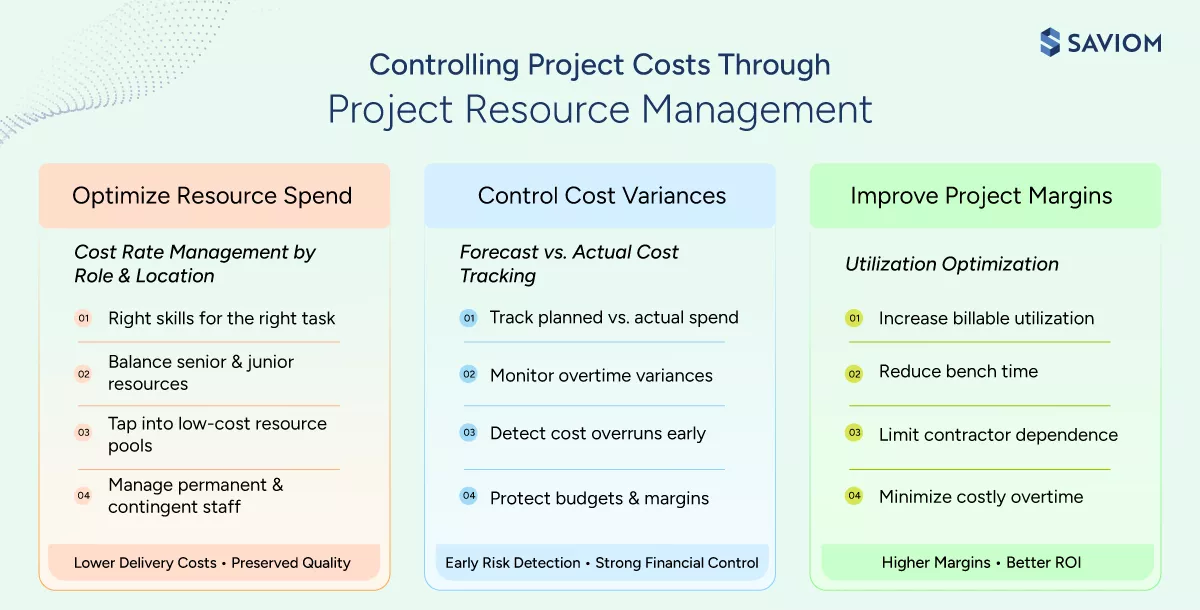
Cost Rate Management by Role and Location
Project resource costs vary by role, seniority, location, and employment type, making staffing decisions a key driver of overall project spend. By selecting the right mix of resources based on skill requirements and cost rates, project managers can ensure that tasks are completed efficiently without overpaying for expertise. This helps maintain cost control while still meeting project quality and delivery expectations.
Discover effective strategies to reduce resource costs.
Forecast vs. Actual Cost Tracking
Project cost planning begins with estimated resource effort and cost rates, but actual spending often shifts during execution due to changes in effort, timelines, or staffing. By continuously comparing the cost baseline with actual resource consumption, project managers can identify variances early and take corrective action. This ensures that cost deviations are controlled before they impact the overall project budget.
Improving Margins Through Utilization Optimization
Effective utilization of project resources ensures that assigned team members are neither underused nor overextended during execution. By optimizing how resources are deployed across project tasks, managers can reduce bench time, avoid unnecessary overtime, and limit reliance on additional hiring. This improves cost efficiency at the project level and helps maintain better financial outcomes without compromising delivery.
To gain a deeper understanding of benefits, metrics, and best practices, read our resource utilization guide.
Explore this eBook to learn how 5th gen resource management helps firms leverage advanced capabilities to allocate resources effectively and improve project quality.

In the next section, let us take a look at the common project resource management roadblocks organizations face and the solutions to them.
Common Project Resource Management Challenges and How to Solve Them
Project resource management often breaks down when planning assumptions do not align with execution realities. These challenges directly impact project timelines, staffing, and costs, making it essential to identify and address them early. Below are the most common issues faced at the project level and how managers can resolve them effectively:
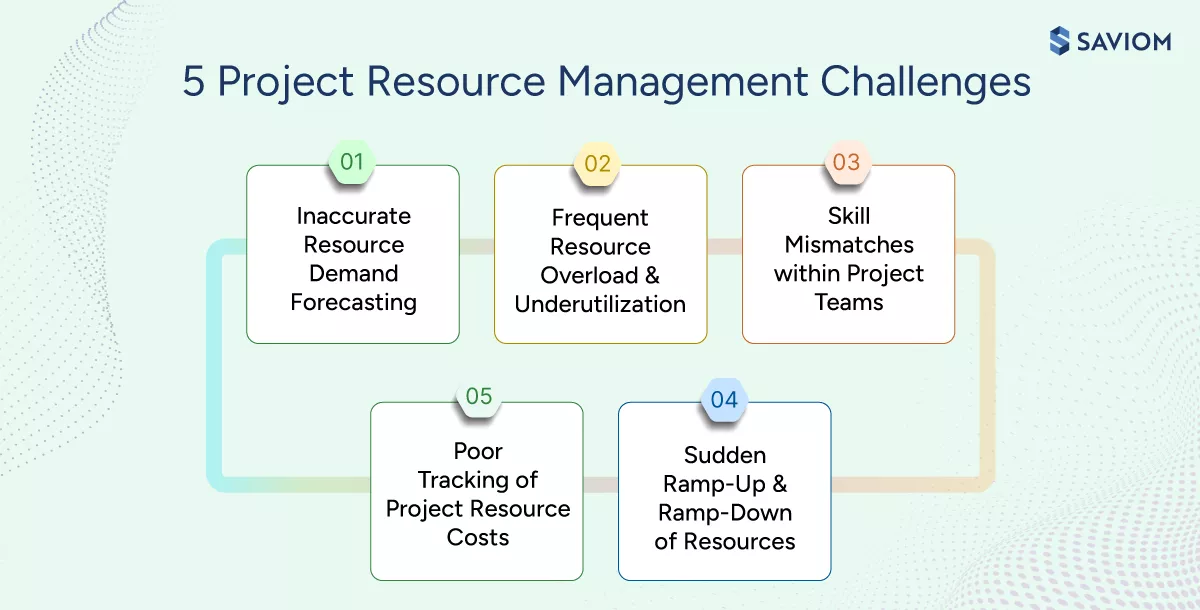
Inaccurate Resource Demand Forecasting
Project managers often estimate resource demand without fully accounting for task complexity, dependencies, or variations in effort across phases. As the project progresses, this leads to unexpected resource overallocation or shortages, forcing teams to make reactive adjustments that disrupt timelines and execution flow.
Solution: Managers should break work into detailed tasks and estimate resource needs at the role and effort levels, rather than relying on broad assumptions. Moreover, they should regularly revisit and refine these estimates as the project evolves. This helps maintain alignment between planned demand and actual execution requirements.
Frequent Resource Overload and Underutilization
In multi-project environments, managers often overbook some resources while others remain partially utilized. This imbalance slows key deliverables, increases burnout risk, and reduces overall project productivity. It also impacts billable utilization when available capacity is not effectively assigned to project work.
Solution: Managers must regularly monitor workloads and adjust allocations based on actual capacity and priorities. By redistributing tasks, aligning resources with suitable project work, and minimizing bench time, managers can maintain balanced workloads, improve team efficiency, and ensure better utilization without overloading resources.
Learn what workload balancing is and why it matters.
Skill Mismatches within Project Teams
Organizations sometimes assign resources based on availability rather than the specific skills required for the task. This results in slower execution, increased rework, and quality issues, especially in projects that require specialized expertise or domain knowledge.
Solution: To avoid this, managers must align task requirements with resource competencies before finalizing allocations. Maintaining visibility into skills, experience levels, and expertise helps ensure that the right person is assigned to the right task from the start.
Sudden Ramp-Up and Ramp-Down of Resources
When organizations lack visibility into future resource requirements and release timelines, they experience sudden ramp-ups during project execution and large, unplanned ramp-downs during closure phases. This drives unnecessary hiring, increases bench time, and inflates project costs.
Solution: Managers can use resource capacity planning to forecast ramp-up and ramp-down early and plan redeployment, cross-training, or phased releases in advance. This prevents last-minute firefighting and ensures smooth workforce transitions.
Poor Tracking of Project Resource Costs
When managers fail to track resource costs consistently against planned estimates, small deviations in effort or staffing often go unnoticed. Over time, these accumulate into significant budget overruns, making it difficult to maintain financial control at the project level.
Solution: Managers must continuously compare planned vs. actual costs and monitor effort consumption across tasks. Early visibility into cost variances enables them to adjust allocations, control spending, and keep the project within budget.
Learn how the cost breakdown structure supports better budgeting.
Moving on, let’s understand the project resource management best practices that help organizations implement PRM successfully at scale.
Best Practices for Implementing Project Resource Management (PRM)
Implementing project resource management effectively requires consistent planning, clear ownership, and continuous monitoring. Without structured practices, even well-defined processes can break down during execution. The following best practices help project teams apply PRM in a more disciplined and scalable way:
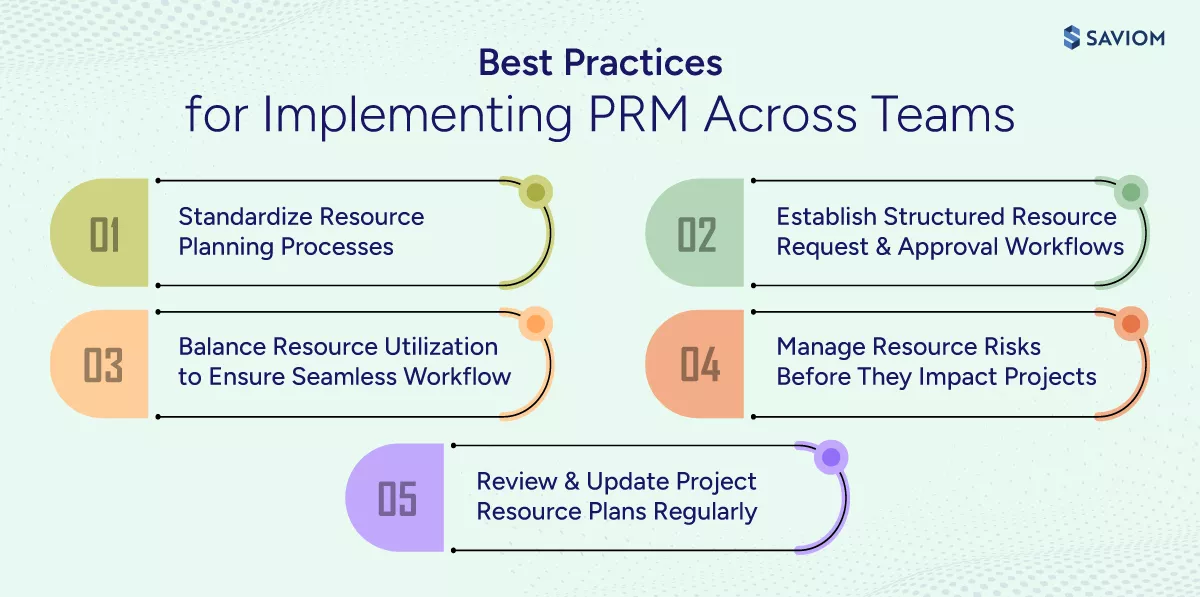
Standardize Resource Planning Processes
Standardized resource planning workflows ensure forecasting and capacity planning are performed consistently across projects. It also helps map resource requirements to project timelines and budgets, ensuring optimal utilization while keeping delivery within approved cost limits. Standardization also enables continuous tracking of performance KPIs to identify resource risks and correct deviations early.
Read our resource planning guide to understand how it supports business growth.
Establish Structured Resource Request and Approval Workflows
A streamlined resource requisition workflow uses standardized templates to capture roles, skills, timelines, and cost rates, enabling more accurate staffing approvals. This reduces delays, prevents double booking, and minimizes conflicts between managers. Built-in audit trails and approval hierarchies further ensure that resourcing decisions align with project priorities and workforce capability rather than individual preferences.
Balance Resource Utilization to Ensure Seamless Workflow
As per Gallup’s State of the Global Workplace report 2025, “Unmanageable workload is the second‑highest factor contributing to increases in employee burnout.”
Maintaining balanced utilization across project teams helps prevent both overbooking and underutilization of resources. When workloads are distributed based on capacity and availability, teams can sustain productivity without burnout or idle time. This also ensures that resources remain engaged in meaningful project work, supporting smoother execution and consistent delivery progress.
Learn how a utilization report helps managers ensure balanced workloads.
Manage Resource Risks Before They Impact Projects
Resource-related risks such as skill gaps, availability conflicts, or dependency on critical resources can disrupt project timelines if not addressed early. Project managers should identify these risks during planning and create contingency strategies such as backup resources, cross-skilling, or phased staffing. This proactive approach helps maintain project stability even when uncertainties arise.
Review and Update Project Resource Plans Regularly
Project conditions often change due to shifting priorities, delays, or new requirements, making static project resource management plans ineffective. Regularly reviewing resource plans and adjusting them based on actual progress ensures that the project remains aligned with current needs. This continuous refinement helps teams respond to changes without disrupting overall execution.
Discover how to build an effective project plan.
Now that we have the project resource management best practices explained, let’s shift our focus to emerging trends in PRM.
Emerging Trends in Project Resource Management
Project resource management is becoming more data-driven, with AI and analytics improving how managers plan, allocate, and optimize resources. These technologies help identify skill matches, detect risks earlier, and support faster, more accurate project-level resourcing decisions.
Predictive insights are also enabling teams to forecast demand, identify potential capacity gaps, and adjust plans before issues impact execution. This shift reduces reliance on reactive decision-making and improves overall planning accuracy across project phases.
At the same time, integrated platforms and automation are improving visibility into resource availability, utilization, and performance. This enables project teams to respond quickly to changing priorities, control costs, and maintain stronger delivery outcomes.
Discover the top emerging project management trends shaping the future.
As we reach the final section, let’s examine the key criteria for selecting the right project resource management system.
How to Choose the Right Platform for Project Resource Management?
Selecting the right project resource management software is essential for improving planning accuracy, resource visibility, and execution control. The right tool should support project-level decision-making without adding unnecessary complexity, helping managers align resources with demand and maintain delivery stability.
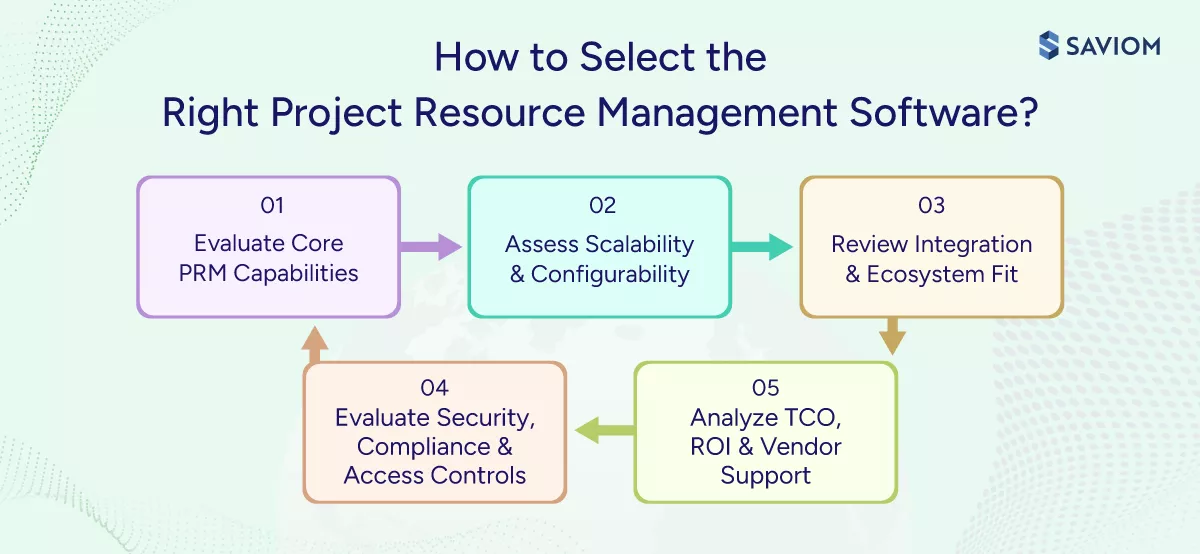
Evaluate Core PRM Capabilities
The first step is to assess whether the platform supports core project resource management functions such as resource planning, forecasting, capacity visibility, allocation, and utilization tracking. It should enable accurate matching of resources to tasks based on skills and availability while helping identify shortages or excess capacity early in the planning stage.
Assess Scalability and Configurability
It is important to evaluate whether the platform can support increasing project volumes, larger teams, and more complex resource structures over time. Moreover, the project resource management software should allow teams to customize workflows, approval processes, dashboards, planning views, and reporting formats. This flexibility ensures that the system can adapt to existing business processes.
Review Integration and Ecosystem Fit
The platform should integrate seamlessly with systems used for project execution, workforce data, finance, and time tracking. Strong integration helps maintain data consistency, reduces manual effort, and provides a unified view of resource demand, availability, and performance across projects.
Learn how to select resource management software.
Evaluate Security, Compliance, and Access Controls
A suitable platform must provide robust security features, including role-based access control, data protection, and audit trails. These capabilities ensure that sensitive project and resource data is protected while allowing appropriate access to stakeholders involved in project delivery.
Analyze TCO, ROI, and Vendor Support
Finally, evaluate the total cost of ownership by considering licensing, implementation, training, and ongoing maintenance. At the same time, assess the expected resource management ROI in terms of improved efficiency, better resource utilization, and reduced project risks. Additionally, review the level of vendor support to ensure a smooth onboarding experience and long-term usability.
See how SAVIOM’s advanced resource management software helps you scale confidently with secure integrations and enterprise-grade compliance. Book your free demo now.

Conclusion
Effective project resource management ultimately comes down to making informed decisions at the right time. When managers have clear visibility into demand, capacity, skills, and costs, they can avoid reactive adjustments and keep projects aligned with their original goals.
As projects grow in complexity, the ability to plan ahead, adapt quickly, and maintain control over resources becomes a key differentiator. A well-implemented PRM approach not only improves execution but also builds consistency, predictability, and confidence across project delivery.
Project Resource Management FAQs
Project resource management is the process of planning, allocating, scheduling, and optimizing the resources needed to deliver a project successfully. It ensures the right people, skills, time, budget, and other resources are available when needed so project goals can be achieved efficiently.
The business benefits of project resource management include:
1. Enables accurate and realistic project planning
2. Ensures the right talent is assigned to the right project tasks
3. Balances workloads across project teams
4. Improves budget control throughout the project lifecycle
5. Minimizes resource-related project risks
The main types of resources in project management are:
1. Human resources
2. Financial resources
3. Time resources
4. Equipment resources
5. Material resources
6. Knowledge resources
7. Technology resources
To manage project resources effectively, organizations should follow this step-by-step approach:
1. Establish resource visibility
2. Forecast project resource demand
3. Analyze capacity against project demand
4. Prioritize projects and allocate resources
5. Monitor resource utilization and performance
6. Track project costs and budget consumption
7. Adjust and optimize project resource plans as scenarios change
Teams face the following challenges when managing resources across projects:
1. Inaccurate resource demand forecasting
2. Frequent resource overload and underutilization
3. Skill mismatches within project teams
4. Sudden ramp-up and ramp-down of resources
5. Poor tracking of project resource costs
The best practices for managing resources across projects are:
1. Standardize resource planning processes
2. Establish structured resource request and approval workflows
3. Balance resource utilization to ensure seamless workflow
4. Manage resource risks before they impact projects
5. Review and update project resource plans regularly
Organizations usually use spreadsheets, project or resource management software, and time-tracking systems. These tools help managers plan allocations, track availability, monitor utilization, forecast demand, manage workloads, and control resource costs across projects.
The effectiveness of project resource management can be measured through metrics such as resource utilization, forecast accuracy, allocation effectiveness, cost variance, and schedule adherence. These metrics indicate whether resources are being deployed efficiently and whether resource decisions support successful project delivery.