

Introduction
Business growth, project success, and operational efficiency all depend on how well an organization uses its available resources. But when multiple projects compete for the same people, budgets, and time, keeping work on track becomes increasingly difficult.
That is why more businesses are paying closer attention to what is resource management and the role it plays in improving execution. A structured approach to managing resources helps organizations enhance capacity planning, respond better to changing priorities, reduce inefficiencies, and make more informed decisions.
In this article, we will explore what resource management is, along with its evolution, major benefits, key components, and practical applications.
What is Resource Management? Definition & Overview
Resource management is the process of planning, allocating, and optimizing an organization’s people, skills, time, budget, and tools to meet project and business goals efficiently. It ensures that the right resources are available at the right time for the right work.
In a business context, resource management helps organizations align available capacity with project demand so teams can deliver work efficiently, control costs, and improve profitability. It is not just about assigning people to tasks. It also involves balancing workloads, matching skills to project requirements, forecasting future needs, and improving overall resource utilization across the business.
When done well, resource management increases delivery predictability, reduces bottlenecks and inefficiencies, lowers resource-related risks, and supports better staffing and investment decisions. It also helps organizations maintain consistent performance while creating a stronger foundation for long-term growth.
Now that we’ve learned the definition of resource management, let’s look at how it has evolved over time.
Evolution of Resource Management
Understanding how resource management has evolved helps organizations identify why modern tools and practices are essential for scalability and control. Let’s explore how it has progressed across different generations:
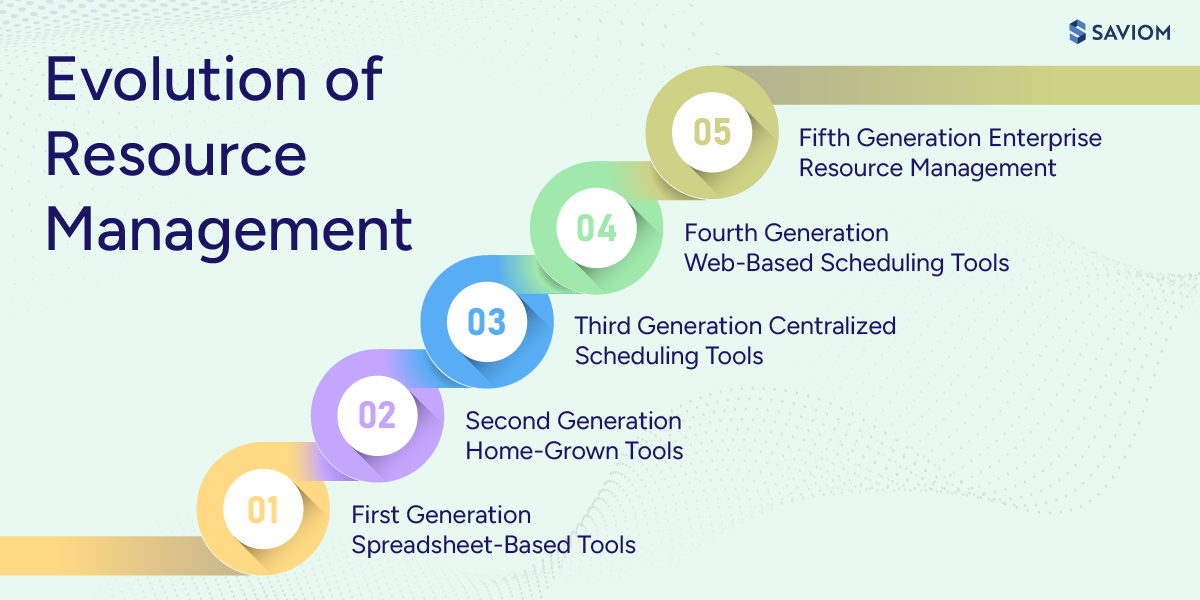
First Generation Spreadsheet-Based Tools
Initially, organizations relied on siloed spreadsheets for basic resource management practices such as allocation. It was the earliest attempt to create an internal resource planning solution in the 1990s. While spreadsheets were relatively simple to develop, it was time-consuming, restrictive, and extremely difficult to maintain.
Learn how using excel for resource planning can lead to inefficiencies.
Second Generation Home-Grown Tools
To overcome the limitations of spreadsheets, organizations began developing homegrown resource allocation tools. While these solutions offered more control, they were often underdeveloped, expensive to maintain, and limited in functionality, requiring continuous support from internal IT teams for updates.
Third Generation Centralized Scheduling Tools
With the maturity of client-server technology around the early 2000s, organizations began adopting commercially available resource scheduling tools. These solutions introduced centralized databases and drag-and-drop interfaces, enabling real-time resource scheduling and improving visibility across teams.
Fourth Generation Web-Based Scheduling Tools
With the emergence of the internet, web-based three-tier architecture became the standard for software development. This led to the development of web-based resource scheduling tools that improved accessibility and collaboration. However, they offer limited planning capabilities.
Read in detail about resource scheduling and how it supports successful project delivery.
Fifth Generation Enterprise Resource Management
As globalization increased competition and access to lower-cost employees across regions, organizations began re-evaluating their resource-related strategies. This shift led to the adoption of enterprise-grade resource management solutions that enable integrated forecasting, planning, and optimization.
Having examined its evolution, it is essential to understand the business benefits resource management offers.
Benefits of Resource Management
Effective resource management directly influences profitability, operational efficiency, and long-term scalability. Let’s look at the key benefits it delivers to organizations:
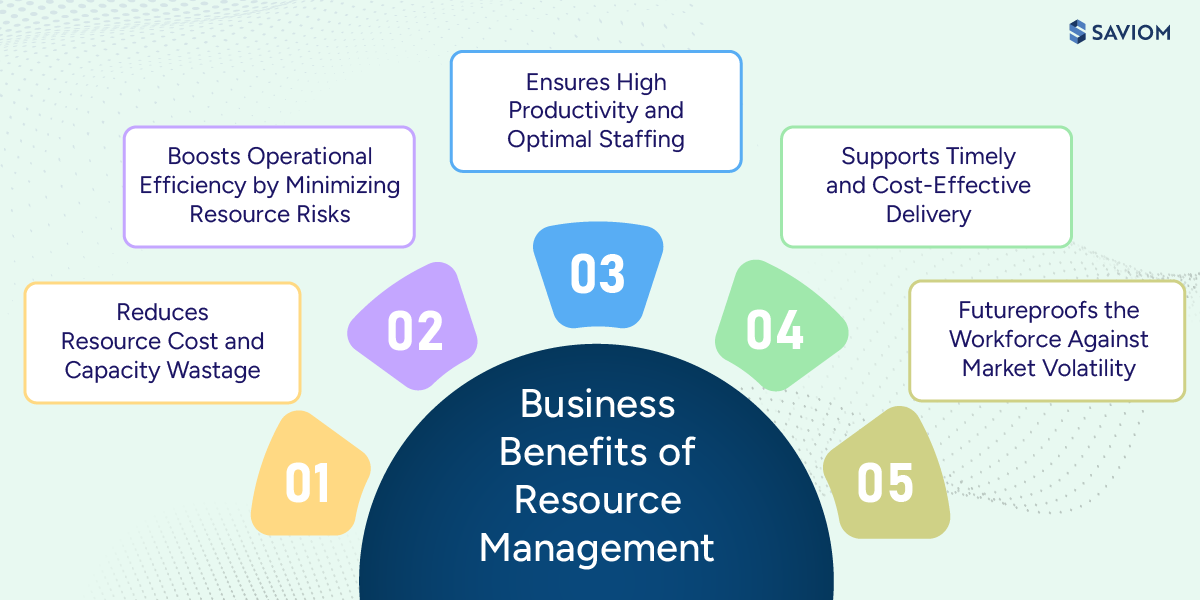
Reduces Resource Cost and Capacity Wastage
Resource management helps lower costs by assigning work more strategically and making full use of available capacity. Instead of relying on expensive last-minute hiring, businesses can distribute work based on project needs, skills, and resource availability. This improves utilization, reduces unnecessary spending, and ensures that every resource contributes more effectively to business goals.
Explore effective resource cost reduction strategies and how they can help improve profitability.
Boosts Operational Efficiency by Minimizing Resource Risks
Resource management improves operational efficiency by reducing common risks that disrupt project execution, such as scheduling conflicts, skill mismatches, and unplanned workforce shortages. It helps organizations keep projects moving without interruptions and avoid inefficiencies that slow teams down. This creates smoother workflows, better cross-departmental coordination, and a more stable operating environment.
Ensures High Productivity and Optimal Staffing
Higher employee productivity depends on having the right people assigned to the right work. An effective resource planning approach supports balanced workloads, better skill alignment, and staffing decisions that match business priorities. This creates a more productive work environment where teams can perform consistently, maintain quality standards, and contribute effectively to organizational success.
Supports Timely and Cost-Effective Project Delivery
Resource management enables timely and cost-effective delivery by aligning resource plans with project timelines from the start. When organizations secure the right talent in advance, they can avoid delays, reduce rework, and limit the financial impact of rushed staffing decisions. This helps projects stay on schedule and maintain budgets.
Futureproofs the Workforce Against Market Volatility
According to a Gartner survey, “62% of organizations say uncertainty around future skills poses a significant risk to business performance.”
Long-term business stability requires a workforce that can respond quickly to changing market conditions, shifting demand, and evolving skill needs. Here, resource management adds strategic value by helping firms plan ahead, strengthen workforce agility, and prepare for future talent gaps. This helps businesses adapt faster to uncertainty and build a more resilient workforce for sustainable growth.
Understand how effective workforce planning can create a resilient talent pool.
To gain a better understanding of how 5th gen resource management benefits project-based businesses, read our ebook.
With the benefits established, let’s look at the key components.
Key Resource Management Components
The key components of resource management work together to ensure effective workforce planning, allocation, and utilization. Let’s take a look at each of them:
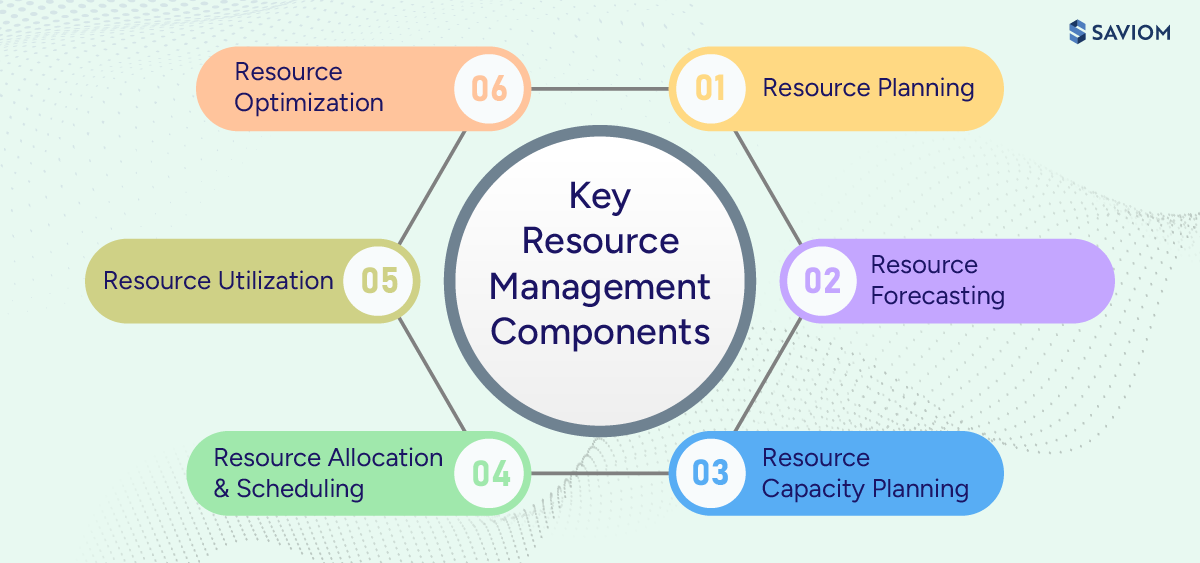
Resource Planning
Resource planning is the process of determining how people, skills, and capacity should be deployed to meet current and future business objectives. It provides a structured framework for aligning workforce availability with project pipelines, operational priorities, and strategic goals so organizations can ensure the right resources are available when they are needed most.
Learn how resource planning improves workforce efficiency and project outcomes.
Resource Forecasting
Resource forecasting is the practice of predicting future resource requirements by evaluating upcoming project demand, business trends, pipeline changes, and historical workforce data. It helps anticipate what skills, roles, and capacity will be needed over a given period, allowing firms to prepare in advance rather than react when shortages arise.
Resource Capacity Planning
Resource capacity planning determines whether the current workforce capacity can support upcoming business demand. It compares available hours, skills, and team strength against upcoming demand to identify capacity shortages and surpluses. This allows organizations to take timely action such as hiring, upskilling, and reallocation, to ensure projects can start and progress without avoidable delays.
Discover how to effectively measure resource capacity and demand.
Resource Allocation and Scheduling
Resource allocation and scheduling involve assigning the right resources to the right work at the right time based on skills, availability, project requirements, and delivery priorities. While resource allocation focuses on selecting the most suitable resources for a task or project, scheduling determines when and for how long those resources will be engaged. Together, they help firms create realistic project plans, manage dependencies effectively, and ensure work is distributed equitably.
Resource Utilization
Resource utilization measures how effectively an organization’s available resource capacity is being used for productive, strategic, or billable work. It serves as an important indicator of whether resources are underused, fully engaged, or stretched beyond sustainable limits. Moreover, it helps firms maintain a balance between maximizing productivity and avoiding under- or- overallocation.
Learn how to track and optimize resource utilization to maximize business outcomes.
Resource Optimization
Resource optimization is the continuous process of improving how resources are deployed so that business demand is met with maximum efficiency and minimum waste. It focuses on refining allocations, balancing workloads, and making adjustments in response to shifting priorities, timelines, or capacity constraints.
Types of Resource Management
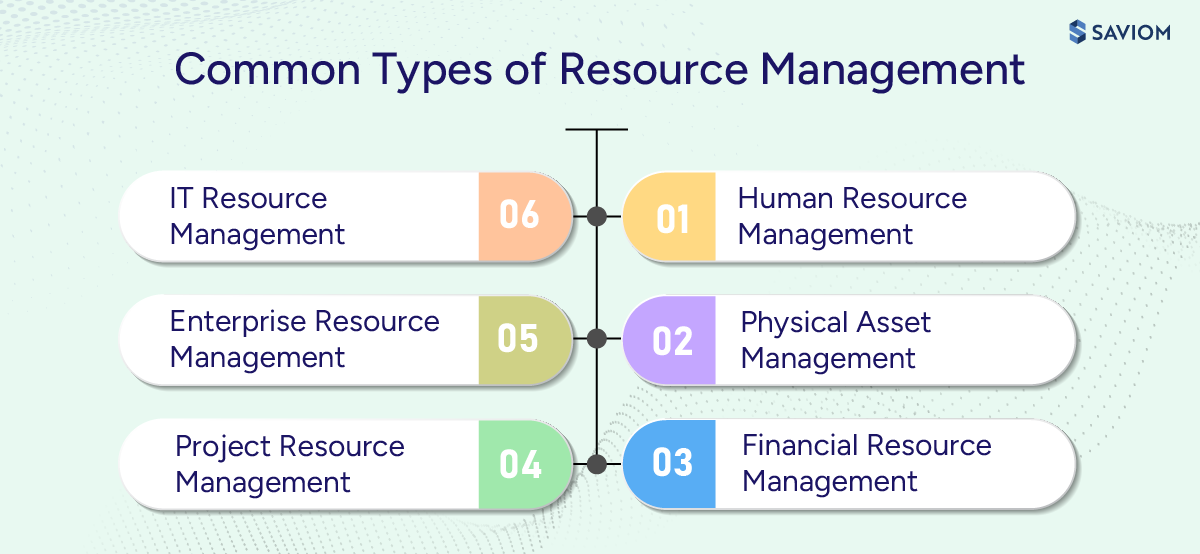
Organizations approach resource planning differently based on the resources involved and their unique business needs. Let’s explore the key types of resource management:
Human Resource Management
Human resource management focuses on managing workforce capacity, availability, and skill alignment across business needs. It ensures effective distribution of talent across initiatives, enabling organizations to maintain balanced workloads and consistent performance.
Understand the basics of human resource planning and unleash the true potential of your workforce.
Physical Asset Management
Physical asset management focuses on ensuring that equipment, infrastructure, and systems are used efficiently across operations. It helps organizations avoid idle assets, prevent overutilization, and ensure consistent availability to support ongoing business activities.
Financial Resource Management
Financial resource management focuses on controlling how budgets are allocated and used across business activities to ensure spending aligns with organizational priorities. It enables better financial visibility, helping organizations manage costs effectively while supporting informed investment decisions.
Project Resource Management
Project resource management focuses on managing allocation within project constraints such as timelines, budget, and scope. It ensures that resources are distributed effectively, enabling better prioritization and minimizing conflicts between concurrent initiatives.
Explore how project resource management helps plan and manage resources across projects.
Enterprise Resource Management
Enterprise resource management integrates all resource types into a unified system, providing centralized visibility and enabling informed decision-making. It allows leaders to manage resource capacity, allocation, and utilization holistically, ensuring better coordination across departments and improved strategic alignment.
IT Resource Management
IT resource management focuses on ensuring that technology infrastructure, systems, and technical capacity are effectively utilized to support ongoing business operations. It helps organizations ensure systems can handle workload requirements, avoid performance bottlenecks, and support business activities without disruption.
Following the discussion on different types, it is important to distinguish between closely related concepts like management and planning to avoid confusion in application.
Resource Management vs. Resource Planning
Understanding the difference between resource management and resource planning ensures that each practice is applied appropriately to support effective decision-making and execution.
| Aspect | Resource Management | Resource Planning |
|---|---|---|
| Scope | End-to-end process including forecasting, planning, allocation, utilization, and optimization | Focuses primarily on identifying resource needs and planning accordingly |
| Focus | Execution, monitoring, and optimization | Demand estimation and preparation |
| Time Horizon | Ongoing, dynamic process | Typically, forward-looking and project-specific |
| Components | Includes forecasting, capacity planning, scheduling, utilization tracking, and optimization | Primarily involves capacity estimation and workforce planning |
| Business Impact | Directly affects delivery efficiency and profitability | Supports readiness and strategic alignment |
| Complexity | High, involves multiple processes | Relatively narrower in scope |
Explore how advanced resource management software can transform how you manage your resources. Book a free demo today!
Having explored the distinction between these concepts, let’s explore how resource management is applied in a real-world context.
A Resource Management Example
Consider an IT services company managing a website redesign project for a retail client. The website must be launched before the client’s seasonal sale, making effective resource management essential for meeting deadlines, controlling costs, and maintaining quality.
The process begins with resource forecasting. The project manager breaks the project into phases—planning, design, development, and testing—and identifies the roles, timelines, and effort required for each stage. Key resources include a project manager, business analyst, UX/UI designers, developers, and a QA tester.
Next, the resource manager conducts capacity planning by reviewing team schedules, workloads, and skill availability. This helps identify gaps early. In this case, the UI designer is unavailable for part of the design phase, one frontend developer has limited availability, and the QA tester is already fully booked.
The next step is resource allocation. To keep the project on track, the team reschedules design tasks, assigns an additional frontend developer, and brings in an external QA contractor for testing support.
During execution, the project manager monitors resource utilization and makes adjustments as needed to resolve bottlenecks and avoid overloading team members.
Finally, at project closure, the team reviews resource performance, utilization, and planning gaps. These insights help improve future forecasting, allocation, and overall resource management practices.
Conclusion
Resource management is no longer a tactical function; it is a strategic driver of business performance. By aligning resource supply with demand, organizations can improve utilization, reduce costs, and ensure consistent delivery outcomes. Moreover, as enterprises face increasing complexity, investing in robust resource planning software becomes essential for maintaining agility and competitiveness.
Resource Management FAQs
Resource management is the process of aligning available resources with business demand to ensure efficient utilization, smooth project execution, and improved profitability. It enables organizations to match the right skills and capacity to the right work, improving delivery predictability, reducing inefficiencies, and supporting better staffing and investment decisions.
The benefits of resource management include:
1. Reduces resource cost and capacity wastage
2. Boosts operational efficiency by minimizing resource risks
3. Ensures high productivity and optimal staffing
4. Supports timely and cost-effective delivery
5. Futureproofs the workforce against market volatility
The key components of resource management are:
1. Resource planning
2. Resource forecasting
3. Resource capacity planning
4. Resource allocation and scheduling
5. Resource utilization
6. Resource optimization
The different resource management types are:
1. Human resource management
2. Physical asset management
3. Financial resource management
4. Project resource management
5. Enterprise resource management
6. IT resource management