

Introduction
Traditional resource management approaches weren’t built for the complexity enterprises face today.
When organizations scale across portfolios, functions, and geographies, traditional resource management becomes harder to sustain. Assigning people to projects and tracking short-term availability may solve immediate needs, but it often leads to bigger challenges, such as limited visibility, poor capacity planning, and overutilized teams.
Enterprise resource management changes that. It provides a more structured and integrated approach to managing resources across the entire organization. Instead of operating in silos, teams gain a unified view of current and future project demand, workforce capacity, and resource utilization. This enables better coordination, accurate planning, and informed decision-making at every level.
This guide explores what enterprise resource management is, covering the framework, strategy, and best practices that help organizations make it work at scale.
What is Enterprise Resource Management (ERM)?
Enterprise Resource Management (ERM) is a strategic approach to planning, allocating, and optimizing the workforce across the entire organization, aligning project demand, workforce capacity, utilization, and financial outcomes.
At an enterprise level, resource management is no longer limited to allocating resources to projects. Organizations must coordinate multiple work types, including project portfolios, operational activities, and strategic initiatives, while ensuring optimal use of limited skills and capacity.
ERM provides a unified system that connects:
- What work needs to be delivered
- What workforce capacity is available
- How resources are utilized
- What financial outcomes are achieved
In essence, ERM provides a single platform to manage workforce demand, capacity, utilization, and financials, ensuring better alignment between resources and business priorities. In the next section, we will see the key benefits of enterprise resource management in organizations.
Read our detailed guide to understand the fundamentals of resource management.
Business Benefits of Enterprise Resource Management
At an enterprise level, ERM delivers measurable improvements by aligning work demand, workforce capacity, and financial outcomes.
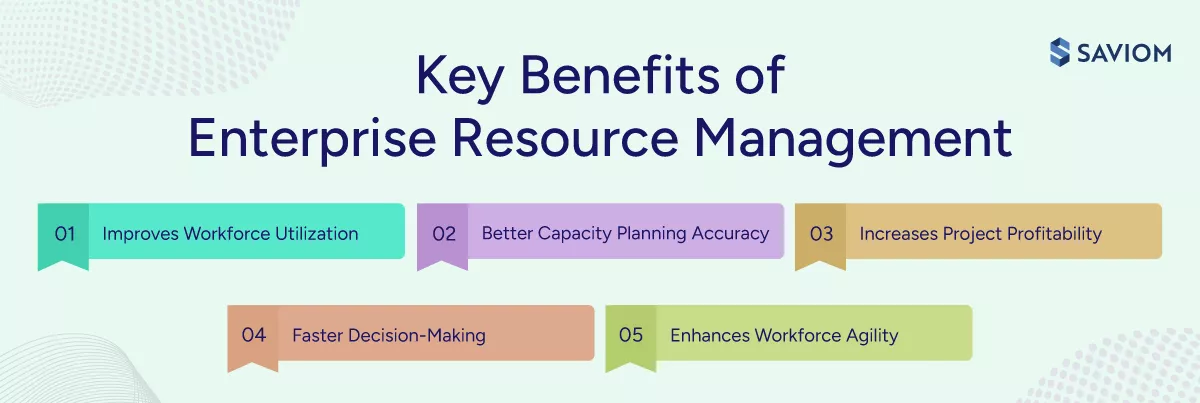
Improves Workforce Utilization
Gain complete visibility into capacity and allocation to maximize productive use of resources.
- Identify underutilized resources and redeploy effectively
- Prevent resource overutilization and balance workloads
- Improve utilization across teams and functions
Learn ways to optimize resource utilization in firms.
Better Capacity Planning Accuracy
Plan workforce capacity with greater precision by combining demand forecasting with real-time insights.
- Forecast demand across projects and operations
- Identify capacity gaps and skill shortages early
- Use scenario modeling to evaluate workforce strategies
Increases Project Profitability
Align workforce decisions with financial outcomes to improve margins.
- Optimize resource mix based on cost and skills
- Improve billable utilization and minimize bench time
- Track cost and profitability in real time
Read more about billable utilization and how it helps improve profitability.
Faster Decision-Making
Enable faster, data-driven decisions with unified workforce visibility.
- Access real-time dashboards across teams and portfolios
- Evaluate the impact of resource decisions instantly
- Identify resource risks and opportunities early
Enhances Workforce Agility
Adapt quickly to changing demand and business priorities.
- Reallocate resources based on real-time needs
- Respond to shifting project and operational demands
- Support flexible workforce strategies
Check out our blog on agile capacity planning.
To summarize, ERM provides enterprise-wide operational clarity, enabling more coordinated, proactive decision-making. In the next section, we will explore the enterprise resource management framework.
The Enterprise Resource Management Framework
Enterprise Resource Management operates as a multi-layered framework that integrates planning, execution, and optimization across the organization.
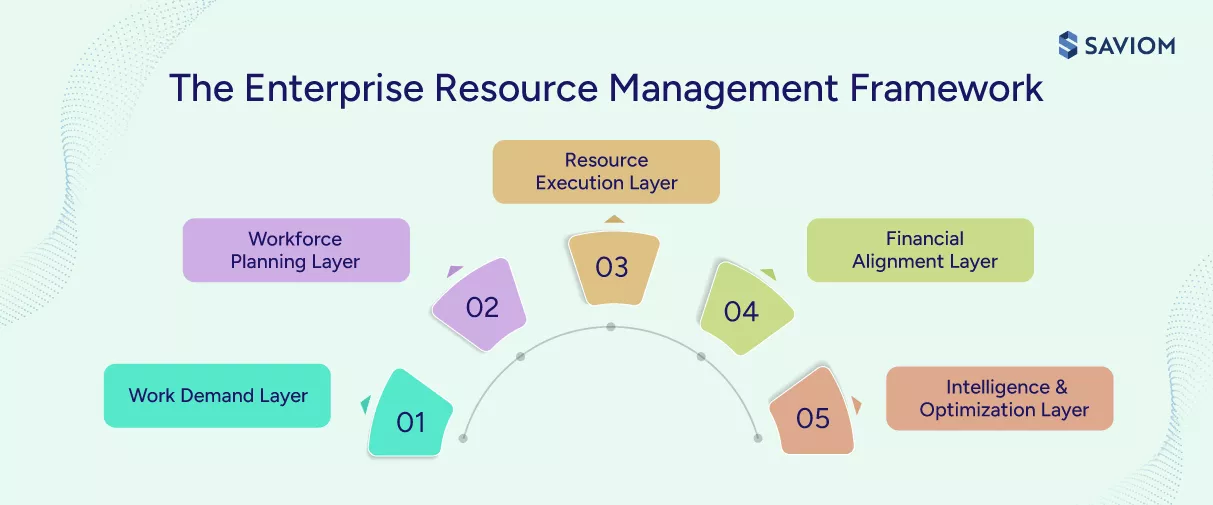
Work Demand Layer
This layer defines what work needs to be delivered across the enterprise. It includes not only active projects but also pipeline opportunities, operational activities, and strategic initiatives.
By consolidating all sources of demand, organizations can move from fragmented planning to a holistic demand model.
Workforce Planning Layer
This layer aligns workforce supply with demand across both strategic and operational horizons.
It includes:
- Long-term workforce planning (skills, hiring, capacity strategy)
- Short-term capacity planning (availability, readiness)
- Scenario planning to evaluate different workforce strategies
This is where Enterprise Workforce Planning (EWP) integrates directly into ERM.
Check out our detailed blog on strategic workforce planning.
Resource Execution Layer
Once planning is established, organizations must ensure effective execution across both project and non-project work through:
- Resource scheduling and allocation across projects, operations, and BAU activities
- Multi-project and operational coordination across teams and functions
- Workload balancing across billable, non-billable, and strategic initiatives
- Real-time adjustments to changing priorities, availability, and demand
This layer ensures that plans are translated into actionable resource decisions across the entire organization.
Financial Alignment Layer
At an enterprise level, resource decisions must be tied to financial outcomes.
This includes:
- Workforce cost forecasting across projects and pipeline work
- Project budget alignment with resource allocation and workforce plans
- Project profitability tracking based on resource costs and revenue
- Margin optimization through effective utilization and cost control
This ensures resource decisions directly support financial performance and profitability.
Read our blog on project budget and how to develop one effectively.
Intelligence and Optimization Layer
This layer enables continuous improvement through data and analytics.
Organizations can:
- Track resource utilization, capacity, and performance trends
- Forecast future demand, capacity, and workforce needs
- Identify optimization opportunities across projects and operations
- Support data-driven decision-making at all levels
Together, these layers create a closed-loop system from work demand and planning to execution, optimization, and continuous improvement. The following section discusses why traditional resource management is not ideal for complex project environments.
Why Traditional Resource Management Breaks at Enterprise Scale?
As organizations scale, the complexity of managing resources increases exponentially. Traditional approaches, often reliant on spreadsheets or disconnected tools, fail to provide the coordination required at an enterprise level.
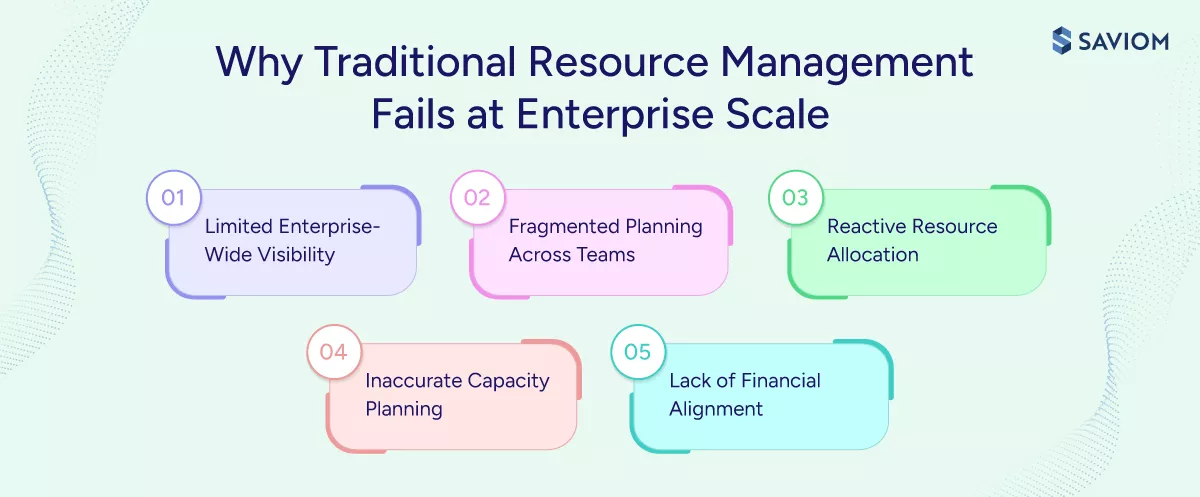
Fragmented Planning Across Teams
Different departments manage resources independently, leading to inconsistent planning assumptions and conflicting priorities. Without a centralized system, organizations cannot effectively balance demand across portfolios.
Learn why Excel is not ideal for resource planning.
Limited Enterprise-Wide Visibility
Leaders lack a consolidated view of workforce capacity, availability, and utilization across business units. This makes it difficult to make informed decisions at a strategic level.
Reactive Resource Allocation
Resource decisions are often made after issues arise, such as project delays or skill shortages, rather than proactively planning ahead.
Understand what resource overallocation is and ways to avoid it effectively.
Inaccurate Capacity Planning
Short-term capacity planning overlooks pipeline demand and future initiatives, resulting in either overutilization or bench capacity.
Lack of Financial Alignment
Resource allocation decisions are rarely linked to financial metrics, such as cost, revenue, or margins, limiting the organization’s ability to optimize profitability.
Learn more about project financial management.
At scale, these limitations lead to inefficiencies, delivery risks, and reduced business performance. In the next section, we will understand the key differences between traditional and enterprise resource management.
How Enterprise Resource Management Extends Traditional Resource Management?
Traditional resource management focuses on planning and allocating resources at a project level. On the other hand, enterprise resource management (ERM) extends these capabilities across the organization to deliver unified visibility, planning, and control.
| Aspect | Resource Management | Enterprise Resource Management |
|---|---|---|
| Scope | Project-level | Enterprise-wide |
| Planning | Project-focused | Demand, capacity, and workforce planning |
| Visibility | Team or project-based | Unified across portfolios and functions |
| Decision-Making | Execution-focused | Forward-looking and data-driven |
| Financial Alignment | Limited | Integrated with cost and profitability |
Check out our blog on project resource management.
ERM builds on core resource management capabilities, expanding them to support enterprise-wide planning, execution, and financial alignment. Given the differences in resource management, let us explore its role across various platforms.
ERM vs. PPM, PSA, and Workforce Planning
Enterprise Resource Management overlaps with adjacent systems, but its role is distinct across planning, execution, and optimization.
ERM vs. Project Portfolio Management (PPM)
Project portfolio management focuses on selecting and prioritizing the right projects based on strategic goals. At the same time, ERM ensures the organization has the capacity, skills, and availability to execute those projects effectively. It connects portfolio decisions with real workforce constraints and delivery readiness.
Understand more about portfolio resource management.
ERM vs. Professional Services Automation (PSA)
Professional services automation systems manage service delivery, billing, and client engagements within PS teams. ERM complements this by optimizing resource capacity, allocation, and utilization across all work, such as projects, operations, and strategic initiatives. It provides enterprise-wide visibility beyond service delivery functions.
ERM vs. Workforce Planning
Workforce planning defines future workforce needs based on business strategy and demand forecasts, while ERM operationalizes those plans by aligning capacity, allocation, and utilization in real execution environments. It ensures that workforce strategies translate into actionable, measurable outcomes.
Read our blog on the business benefits of workforce planning in PS firms.
ERM serves as the operational bridge between strategic planning and real-time execution, ensuring workforce decisions are grounded in actual capacity and delivery realities. Now, we will explore the core capabilities of an ERM system.
Key Capabilities of the Enterprise Resource Management System
A comprehensive ERM system includes several core capabilities that work together to optimize workforce performance.
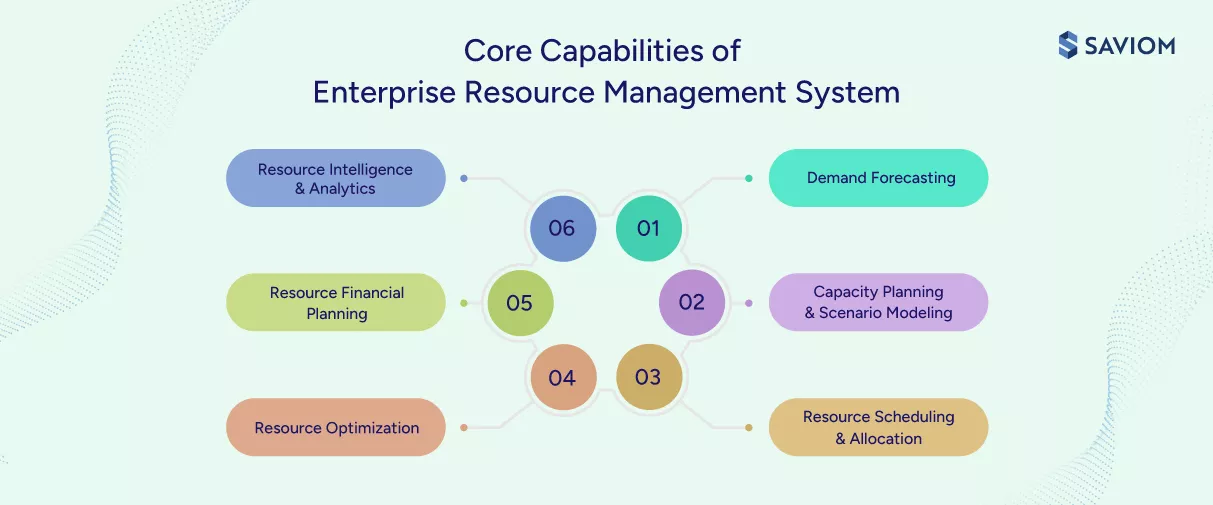
Demand Forecasting
Predict future demand across projects, pipelines, and portfolios to support proactive resource planning.
Capacity Planning & Scenario Modeling
Evaluate workforce capacity and simulate different scenarios to balance supply and demand effectively.
Learn more about resource capacity planning.
Resource Scheduling & Allocation
Assign the right resources to the right work based on skills, availability, and priorities.
Resource Optimization
Monitor and improve workforce utilization while avoiding overloading critical resources.
Understand why resource optimization is important for enterprises.
Resource Financial Planning
Align workforce decisions with financial goals by forecasting costs and optimizing budgets.
Resource Intelligence & Analytics
Provide real-time insights into workforce performance, planning accuracy, and optimization opportunities.
Learn why business intelligence in resource management is critical for firms.
These capabilities, when combined, form an integrated system that enables end-to-end workforce management. The following section discusses how ERM helps in effective workforce planning.
How ERM Enables Enterprise Workforce Planning?
Enterprise Workforce Planning (EWP) becomes significantly more effective when integrated with ERM. It ensures that workforce planning is not limited to long-term strategy but is continuously refined based on real-time execution data.
Align Strategic and Operational Planning
ERM connects long-term workforce strategies with short-term execution needs, ensuring consistency across planning horizons.
Improve Demand and Capacity Alignment
By integrating demand forecasting with capacity planning, organizations can better match workforce supply with evolving business needs.
Learn more about demand planning.
Enable Continuous Workforce Planning
Real-time insights enable organizations to adjust workforce plans, improving agility and responsiveness continuously.
Ultimately, without ERM, workforce planning remains theoretical. With ERM, it becomes actionable and measurable. Having understood the role of ERM in workforce planning, let us understand ways to implement it effectively in an enterprise.
How to Implement Enterprise Resource Management?
Successful ERM adoption requires alignment across demand, workforce, and financial planning.
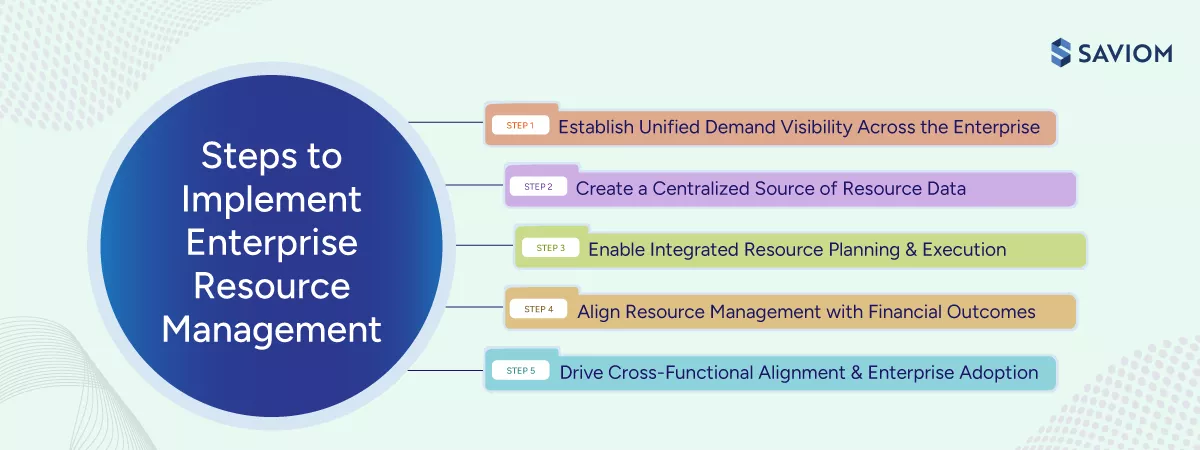
Establish Unified Demand Visibility Across the Enterprise
Consolidate all demand sources like projects, pipeline opportunities, and operational work into a single, standardized system. This ensures complete visibility into incoming and ongoing work, eliminating fragmented demand signals and enabling consistent prioritization.
Read more about resource capacity forecasting.
Create a Centralized Source of Resource Data
Develop a unified repository that captures resource profiles, including skills, roles, availability, and capacity. Standardized and up-to-date data enables accurate planning and eliminates inconsistencies across departments.
Enable Integrated Resource Planning and Execution
Connect resource forecasting, capacity planning, and allocation into a continuous workflow. This integration ensures that plans are directly translated into execution without disconnects between planning and delivery.
Understand how to create an effective resource management plan.
Align Resource Management with Financial Outcomes
Incorporate cost, budget, and profitability considerations into resourcing decisions. This ensures that resource allocation strategies are not only operationally efficient but also financially optimized.
Drive Cross-Functional Alignment and Enterprise Adoption
Establish shared processes and collaboration across the project management office (PMO), operations, and finance teams. Consistent adoption across functions ensures that ERM operates as an enterprise-wide capability rather than a siloed practice.
Check out our blog on enterprise PMO.
This approach establishes a connected operating model that unifies demand, resources, and financials, enabling coordinated planning and seamless execution across the enterprise. Next, we shall explore some key ERM best practices.
Enterprise Resource Management Best Practices
Successful enterprise resource management requires aligned processes, accurate data, and continuous optimization across the enterprise.
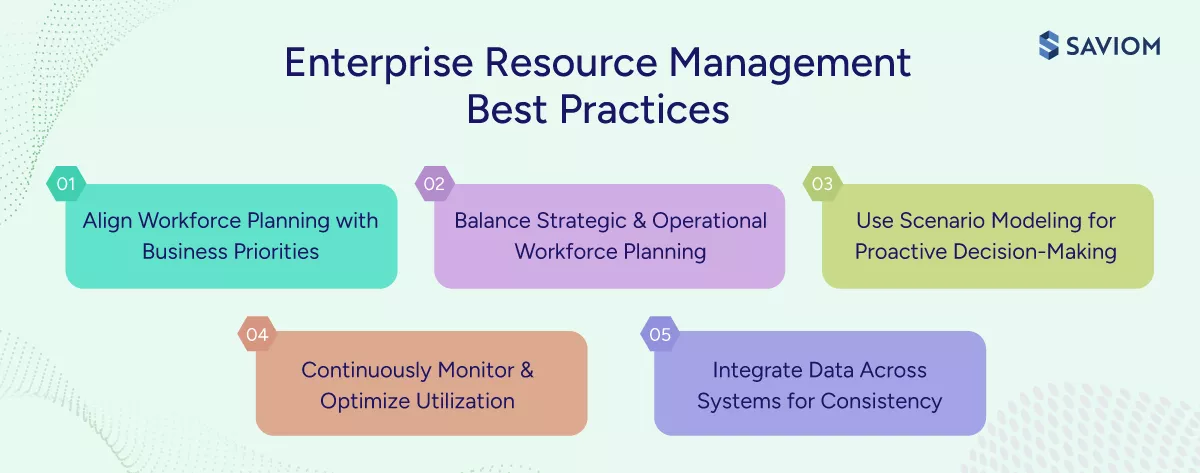
Align Workforce Planning with Business Priorities
Ensure workforce decisions reflect strategic business goals and priorities.
- Prioritize high-value and strategic initiatives
- Align resource allocation with business outcomes
- Coordinate planning across PMO, operations, and finance
Balance Strategic and Operational Workforce Planning
Integrate long-term workforce strategy with short-term execution to ensure plans remain aligned and actionable.
- Align hiring and capacity strategy with future demand
- Adapt short-term plans based on real-time execution
- Maintain consistency across planning horizons
Explore our blog on strategic planning and how it helps in long-term business success.
Use Scenario Modeling for Proactive Decision-Making
Evaluate multiple capacity and demand scenarios to anticipate risks and optimize workforce strategies.
- Assess the impact of hiring, outsourcing, or redeployment
- Identify risks before they affect delivery
- Support data-driven decision-making
Continuously Monitor and Optimize Utilization
Track and optimize utilization to ensure balanced workloads and sustainable productivity.
- Identify overutilization and burnout risks
- Detect resource underutilization and redeploy them
- Maintain optimal utilization across teams
Integrate Data Across Systems for Consistency
Establish a unified data foundation to enable accurate planning and decision-making.
- Centralize workforce, demand, and financial data
- Ensure consistency across systems and reports
- Improve forecasting and reporting accuracy
Read our blog on resource management best practices.
These practices help organizations scale ERM effectively while maintaining alignment, accuracy, and continuous optimization. Now, we will learn about the common challenges enterprises face when adopting an ERM system.
Common Challenges in ERM Adoption
While ERM delivers significant value, adoption requires overcoming organizational and cross-functional challenges.
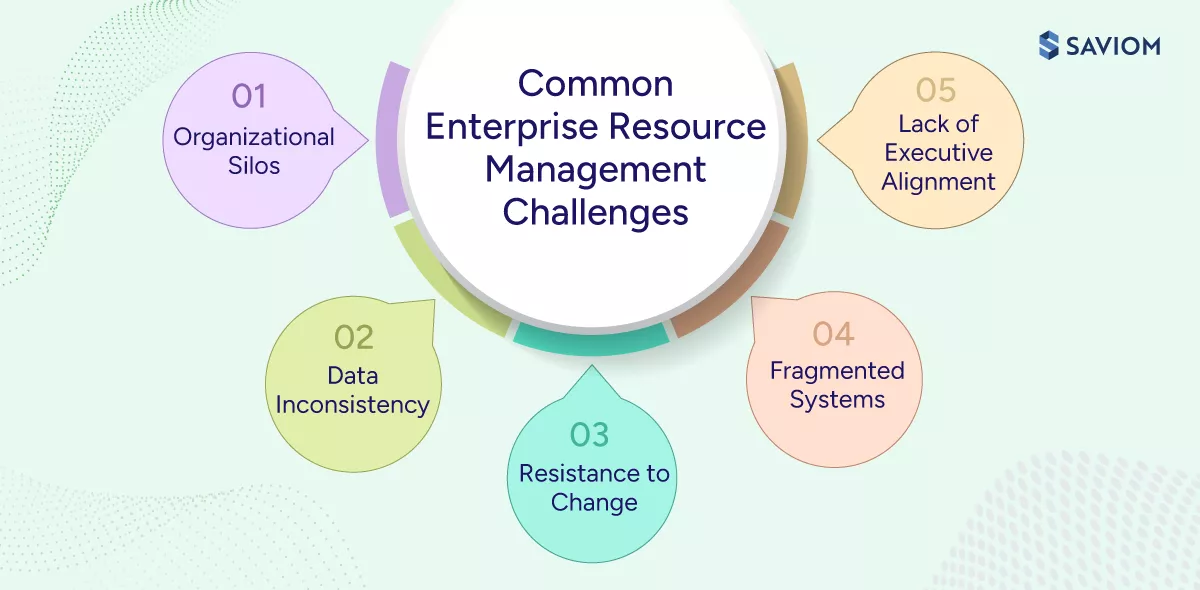
Organizational Silos
Disconnected planning across teams limits visibility and strategic alignment, making enterprise-wide coordination difficult.
Data Inconsistency
Inaccurate or fragmented data reduces planning accuracy and undermines trust in decision-making.
Resistance to Change
Shifting to unified planning and increased transparency can face resistance without clear communication and support.
Learn more about change management in project management.
Fragmented Systems
Multiple disconnected tools create inefficiencies, inconsistent insights, and delayed decision-making.
Lack of Executive Alignment
Without strong leadership and cross-functional ownership, ERM adoption remains limited and inconsistent.
Addressing these challenges is critical to realizing the full value of Enterprise Resource Management. Finally, we will explore the emerging trends of ERM.
The Future of Enterprise Resource Management
Enterprise Resource Management is evolving toward more intelligent, connected, and adaptive workforce planning.
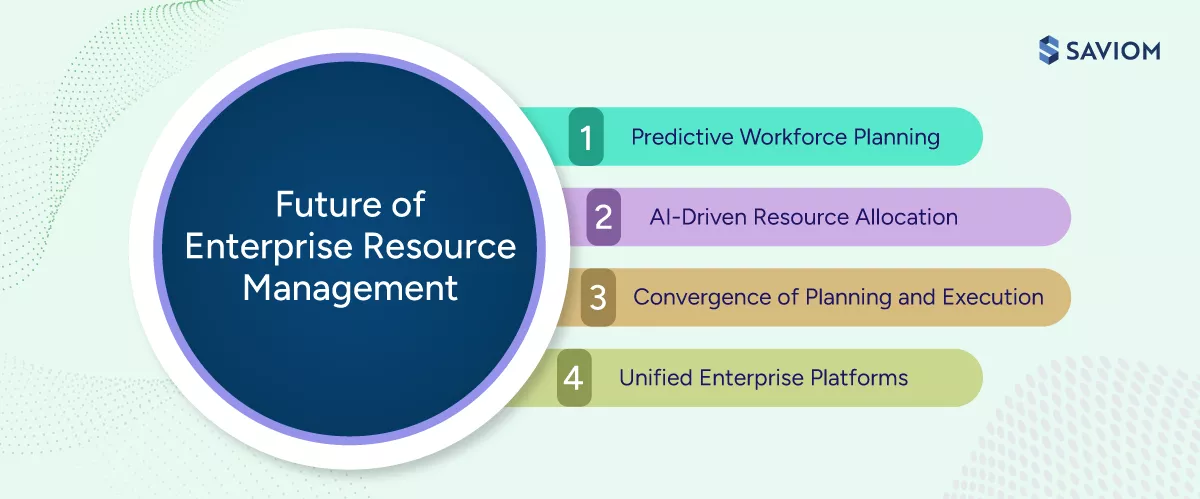
Predictive Workforce Planning
Organizations are moving from reactive planning to predictive, data-driven forecasting of demand, capacity, and skills.
Check out our detailed guide on workforce capacity planning.
AI-Driven Resource Allocation
AI is enhancing resource allocation by improving matching, optimization, and decision speed across complex environments.
Convergence of Planning and Execution
Planning and execution are becoming increasingly integrated, enabling continuous, real-time planning cycles.
Unified Enterprise Platforms
Organizations are adopting integrated platforms that connect workforce, financials, and analytics into a single system.
Explore how resource management software enables data-driven decision-making.
ERM is evolving into a connected, intelligent system that continuously aligns workforce decisions with business outcomes.
Conclusion
As work becomes more dynamic, interconnected, and resource-intensive, enterprises must move beyond fragmented planning toward a unified, enterprise-wide approach. By connecting demand, workforce capacity, execution, and financial outcomes, ERM enables organizations to operate with greater coordination, transparency, and control.
It transforms resource management from a reactive, project-level activity into a strategic discipline that drives execution readiness and business performance. Ultimately, organizations that adopt ERM are better positioned to navigate complexity, respond to change, and sustain long-term growth.
Frequently Asked Questions
Enterprise Resource Management (ERM) is a system for planning, allocating, and optimizing workforce resources across the enterprise, aligning demand, capacity, utilization, and financial outcomes to improve efficiency and profitability.
Resource management focuses on assigning resources to projects, while ERM operates at an enterprise level, integrating strategic planning, operational execution, and financial alignment.
ERM is used by PMOs, resource managers, operations leaders, CIOs, and executives in organizations that manage multiple projects, portfolios, or complex workforce environments.
No. ERP systems focus on financial and operational processes, while ERM focuses specifically on workforce planning, allocation, and optimization across all work.