

Introduction
Picture this: A critical project deadline is fast approaching, but your consultants are already stretched thin across multiple engagements. Managers need quick, reliable insights into resource availability and project timelines, yet the data is scattered across spreadsheets and disconnected tools. The result? Limited visibility, slower decision-making, and increased project risk just when clarity matters most.
Professional Services Automation (PSA) software solves this challenge by unifying project planning, resource management, time tracking, billing, and analytics into a single platform. With real-time insights into projects, resources, and financials, teams can make faster decisions, coordinate better, and deliver projects more efficiently.
In this guide, we explore what PSA software is and how it helps service organizations maximize project delivery and business revenue.
What is Professional Services Automation (PSA) Software?
Professional services automation (PSA) software is a specialized tool that helps service-based organizations manage the entire project lifecycle, from bid to bill. It integrates project management, resource management, time and expense tracking, invoicing, and analytics to improve operational efficiency, resource utilization, and business profitability.
Furthermore, PSA software automates core business workflows with pre-built templates. Its dynamic reporting and analytics provide actionable insights into key metrics such as billable hours, project costs, and client satisfaction. Finally, the tool integrates seamlessly with other business applications to establish a single source of truth, giving professional services organizations greater control over their project and resource data.
Having understood what professional services automation is, let us now explore the benefits of PSA software.
Why Professional Services Automation Matters for Profitable Growth?
As per Fortune Business Insights, “The professional service automation software market is projected to grow from USD 16.55 billion in 2026 to USD 50.33 billion by 2034.”
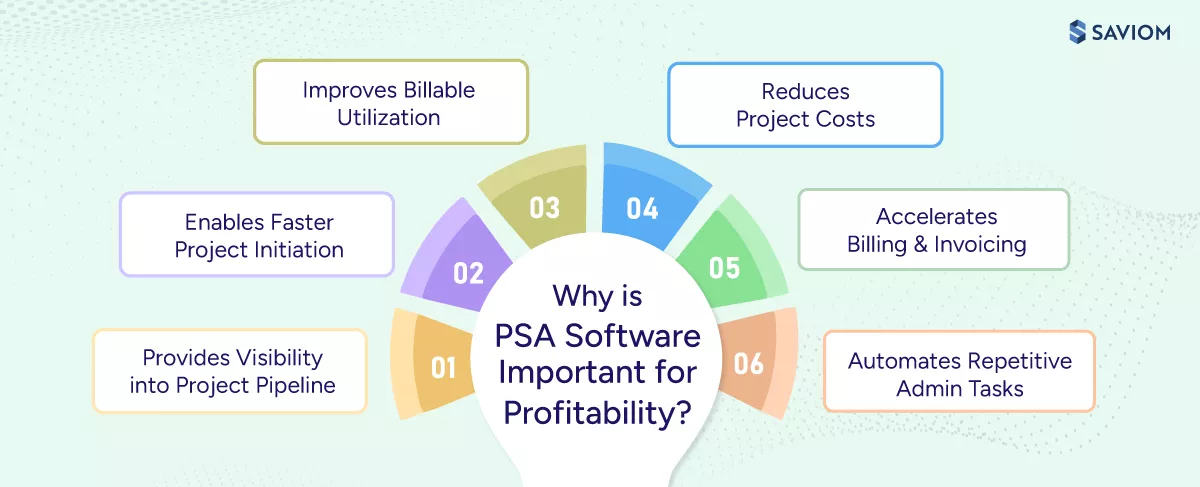
This rapid market growth reflects the growing reliance on PSA software as organizations seek better ways to manage service delivery and financial performance at scale. By bringing projects, resources, and financial operations into a unified system, professional services automation helps organizations improve business efficiency and profitability. Let us explore the key benefits of PSA software.
Provides Real-Time Visibility into Project Pipeline
Professional services automation tools provide real-time visibility into the project pipeline, enabling sales and delivery teams to collaborate and prioritize the most viable opportunities. Early insight into upcoming deals allows organizations to assess resource readiness and refine their sales pitch. As a result, professional services firms can manage proposals and contracts more effectively, increasing the likelihood of winning profitable engagements.
Enables Faster Project Initiation with Resource Capacity Insights
A robust professional services automation software centralizes workforce availability, skill sets, and current workloads, enabling managers to quickly identify the most suitable resources when new projects are approved. By aligning project demand with available capacity, professional services organizations can accelerate project initiation, minimize scheduling delays, and ensure projects start with the right expertise.
Read our guide to explore how resource capacity planning impacts project success.
Improves Billable Utilization and Workforce Productivity
Using professional services automation software, organizations can track the utilization levels of every consultant in real-time. Moreover, the tool provides visibility into future billable and strategic resource allocations. These insights help managers mobilize resources from non-billable tasks to high-value, revenue-generating initiatives. As a result, professional services organizations can improve workforce productivity, maximize billable utilization, and increase revenue per employee.
Reduces Project Costs and Improves Revenue
With professional services automation software, firms can strengthen financial discipline across the bid-to-bill lifecycle. Accurate time and expense capture, automated invoicing, and structured financial reporting help professional services organizations detect early signs of cost overruns and prevent revenue leakage. Combined with flexible pricing models and stronger financial forecasting, firms can control delivery costs, stabilize cash flow, and improve overall service profitability.
Learn more about project cost management.
Speed Up Billing and Invoicing with Smart Automation
PSA software automates billing and invoicing by capturing billable hours, expenses, and project milestones directly within the system. Invoices can be generated automatically based on contract terms, time and expense entries, or project progress, eliminating the risk of errors or delays. As a result, professional services organizations can shorten billing cycles, prevent revenue leakage, and maintain healthier cash flow.
Automates Repetitive Administrative and Reporting Tasks
Routine activities such as time tracking, expense recording, invoicing, and approval workflows are automated within the professional services automation platform. This reduces administrative effort while ensuring accurate and consistent data across systems. As a result, organizations can improve operational efficiency and allow teams to focus more on revenue-generating and strategic activities.
Next, let us understand the components of PSA software that enable professional services organizations to manage projects, resources, and financial operations more effectively.
Core Components of Professional Services Automation Software
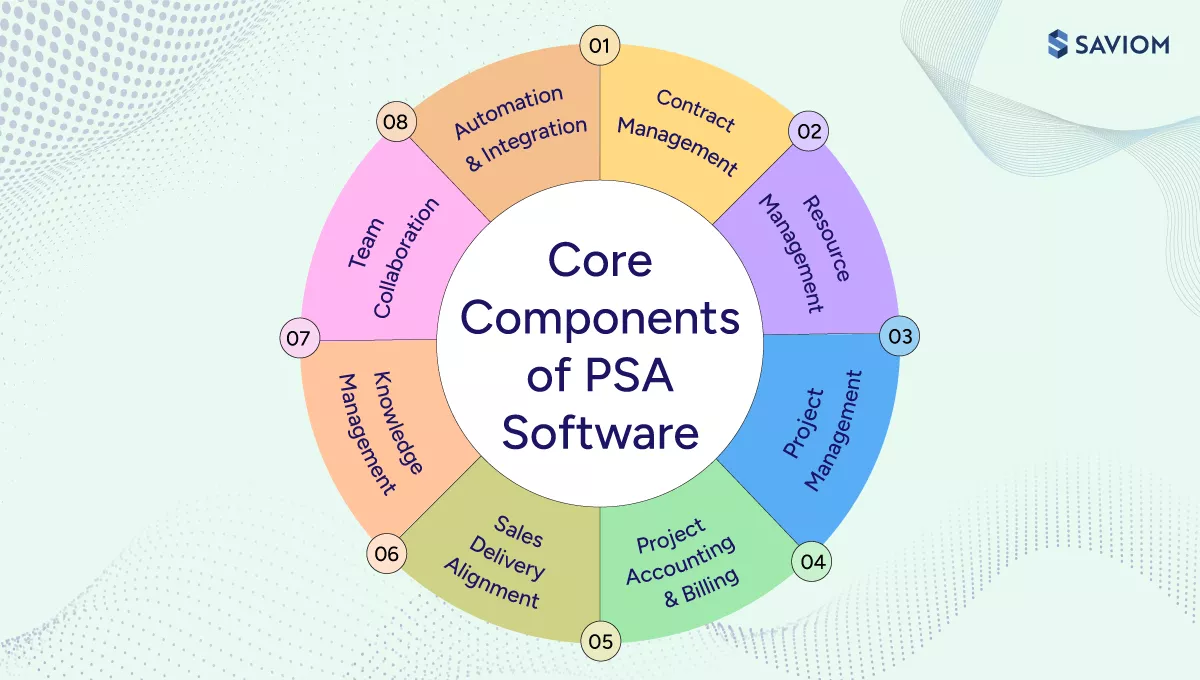
Professional services automation tools combine several capabilities that help organizations manage service operations more effectively. These capabilities support activities such as project planning, resource allocation, financial tracking, and team collaboration. Let us examine the core components of a PSA platform.
Contract Management
Contract management centralizes the creation, negotiation, approval, and tracking of client agreements. Searchable repositories, customizable templates, and automated alerts for contract changes and renewals help reduce Time-to-Revenue (TTR). In addition, audit trails and configurable risk scoring enable managers to monitor changes and proactively mitigate contract risks.
Resource Management
Resource management provides visibility into resource skills, availability, and current workloads. Resource forecasting and capacity planning help PSOs anticipate and bridge demand–supply gaps, while drag-and-drop scheduling enables quick resource allocation. In addition, BI-powered utilization reports, KPI forecasting, and scenario modeling support data-driven decision-making and allow managers to simulate different resource plans before execution.
Explore why resource management is important for business success.
Project Management
Project management within PSA software enables efficient planning, scheduling, and tracking of projects and tasks. Standardized templates accelerate planning, while visual tools such as Gantt charts and Kanban boards help managers monitor progress and address bottlenecks. Integrated collaboration tools further support communication and task updates, improving coordination and project delivery.
Project Accounting & Billing
Project accounting and billing track project-level costs, revenue, and margins, linking financial performance to delivery activities. By leveraging time entries, expenses, and project milestones, the system automatically generates invoices aligned with agreed contract terms and billing models such as fixed fees or time and materials. This helps organizations maintain financial control, ensure accurate invoicing, and protect project profitability.
Learn about project financial management and how to implement it effectively.
Sales-Delivery Alignment
Sales delivery alignment connects sales and delivery teams through a shared view of opportunity pipelines, project scope, timelines, and resource requirements within the PSA platform. This helps delivery teams understand commitments made during the sales cycle and validate feasibility based on available skills and capacity. As a result, organizations can reduce expectation gaps, improve coordination, and deliver projects more reliably.
Knowledge Management
Knowledge management captures project artifacts, best practices, and reusable assets in a centralized repository within the professional services automation system. This enables teams to access past project insights and apply proven approaches to new engagements. Consequently, organizations can improve delivery consistency, reduce rework, and accelerate onboarding for new projects and team members.
Team Collaboration
Team collaboration provides shared workspaces where project stakeholders can access plans, documents, and updates in one place. This improves communication and keeps teams aligned throughout the delivery lifecycle. As a result, organizations can strengthen cross-departmental collaboration and keep projects progressing smoothly.
Learn how to improve cross-departmental collaboration in your organization.
Automation and Integration
Automation streamlines routine workflows such as reporting, time consolidation, and billing preparation, reducing manual administrative effort. Integration connects PSA software with systems such as CRM, finance, and HR, enabling seamless data flow across platforms. Together, they reduce operational overhead, improve data accuracy, and support scalable service operations.
After understanding the components of PSA software, the next step is to examine how these capabilities work together to enable scalable, predictable, and profitable service delivery.
How PSA Software Enables Predictable & Profitable Service Delivery?
Delivering services profitably requires tight coordination between sales forecasts, resource planning, project execution, and financial monitoring. The following points explain how professional services automation platforms help connect these processes and support scalable service delivery.
Connects Sales, Delivery, and Finance into a Unified System
In many professional services organizations, sales commitments are made without full visibility into delivery capacity or financial constraints, creating challenges once a project moves into execution. PSA software brings sales, delivery, and finance onto a shared system where pipeline data, project details, and financial assumptions are visible to all teams from the outset.
As a result, professional services organizations benefit from:
- Reduced friction between teams and smoother project execution from day one
- Fewer handoff errors as projects transition from sales to delivery
- Stronger budget adherence and better margin control across the project lifecycle
Enables Real-Time Visibility Throughout the Project Lifecycle
Managing projects without timely insight into progress, resource utilization, or financial status often leads to delayed interventions and delivery surprises. Professional services automation software addresses this by providing centralized dashboards and reporting that track project progress, utilization levels, budget consumption, and revenue performance.
With this visibility, professional services firms can:
- Identify delivery deviations early before they escalate
- Make informed decisions using real-time project and financial data
- Improve delivery predictability and avoid late-stage surprises
Aligns Resource Capacity with Changing Portfolio Demand
As priorities shift and timelines evolve, project portfolios often experience fluctuations in resource demand. Managing these changes without a centralized system can lead to imbalanced workloads, skill mismatches, or reduced utilization. PSA solutions help professional services organizations align workforce availability and skillsets with evolving project requirements across the portfolio.
This enables professional services firms to:
- Adjust staffing quickly as portfolio demand fluctuates
- Prevent both overstaffing and underutilization across projects
- Improve billable utilization while maintaining healthy delivery margins
Read our detailed guide on portfolio resource management.
Embeds Scope and Financial Controls into Execution
Scope changes and weak financial oversight can quickly erode project margins during execution. PSA software integrates governance checkpoints, approval workflows, and budget controls directly into the project management process, ensuring delivery activities remain aligned with agreed scope and financial plans.
As a result, professional services organizations can:
- Prevent unauthorized work and uncontrolled scope creep
- Maintain continuous visibility into project financial performance
- Address potential cost overruns before they impact profitability
Enables Proactive Risk Identification and Early Intervention
Project risks often remain unnoticed until delays, budget overruns, or delivery issues begin to affect outcomes. Professional services automation software helps overcome this by providing real-time insights into project health indicators and variance tracking. These systems also offer early warning signals to highlight potential risks during execution.
This enables teams to:
- Detect potential delivery risks early in the project lifecycle
- Intervene quickly to correct schedule, cost, or resource issues
- Protect client satisfaction and project profitability
Learn about enterprise risk management and how to implement it effectively.
Standardizes Delivery Frameworks for Scalable Growth
As service organizations grow, inconsistent delivery practices across projects can lead to inefficiencies and unpredictable outcomes. Professional services automation addresses this by enabling reusable project templates that embed standardized phases, tasks, timelines, and resource roles. This ensures that every engagement follows a consistent delivery framework built on proven methodologies.
With standardized delivery structures, organizations can:
- Maintain consistent quality and governance across a growing project portfolio
- Accelerate project initiation using predefined project plans and staffing structures
- Scale service operations while preserving delivery efficiency and profitability
Learn how 5th gen resource management helps professional services firms forecast demand, allocate skills, and optimize workforce utilization for better business outcomes.

Having examined how professional services automation software supports scalable and predictable service delivery, let us now understand the key service delivery metrics it helps organizations improve.
What Key Service Delivery Metrics Does PSA Software Improve?
Professional services firms rely on certain KPIs to understand how efficiently projects are delivered and how effectively resources generate revenue. Clear visibility into these metrics helps organizations identify inefficiencies and improve financial performance. Let us examine the key service delivery metrics that PSA software helps improve.
Billable Utilization Rate
According to SPI Research, “Organizations that use professional services automation (PSA) software achieve a higher billable utilization rate of 70.9%, higher than firms that do not use PSA tools.”
Billable utilization rate measures the percentage of a resource’s available time spent on billable project work. PSA software helps improve this metric by providing real-time visibility into project demand and resource availability, enabling smarter resource allocation and preventing bench time. Moreover, it also supports accurate time tracking, ensuring billable work is properly captured and managed.
Understand what is billability and how to calculate it accurately.
Project Gross Margin
Project gross margin indicates the percentage of revenue retained after deducting direct project delivery costs. PSA software offers a holistic view into project costs, revenue, and margin performance throughout the delivery lifecycle. Consequently, PS firms can monitor profitability to make more informed pricing and bidding decisions for future engagements.
Revenue Forecast Accuracy
Revenue forecast accuracy measures how closely projected revenue aligns with actual financial outcomes over a specific period. PSA software improves forecast accuracy by linking real-time project and resource data with financial forecasting models, replacing static projections and disconnected spreadsheets with data-driven insights.
Read our guide on resource capacity forecasting and explore how it benefits enterprises.
Customer Satisfaction Score (CSAT)
Customer Satisfaction Score (CSAT) assesses how satisfied clients are with the quality, delivery, and overall experience of services provided during a project. PSA software improves this metric by enabling structured project execution, milestone tracking, and better coordination across delivery teams. This ensures consistent service delivery, clearer client communication, and stronger long-term client relationships.
Earned Value (EV)
Earned value reflects the value of completed work against the planned project schedule and budget. PSA software improves earned value tracking by connecting project progress, time entries, and financial data within a single system. This enables managers to continuously evaluate planned vs. actual performance and maintain tighter control over project delivery.
Annual Recurring Revenue (ARR)
Annual Recurring Revenue (ARR) represents the predictable revenue generated from ongoing client contracts and recurring service engagements over a year. PSA software supports ARR growth by enabling accurate billing, tracking contract renewals, and maintaining consistent service delivery. This helps professional services firms sustain long-term client relationships and build more stable revenue streams.
Learn how timesheets help track planned vs. actual effort in projects.
While the PSA tool improves key service delivery metrics, achieving these outcomes largely depends on how effectively organizations manage resources and plan capacity. The next section explains how resource management and capacity planning strengthen professional services automation.
How PSA Tool Enables Smarter Resource Management & Capacity Planning?
Resource management and capacity planning are critical disciplines in professional services firms, where limited talent and fluctuating demand are constant challenges. Yet without connected, real-time data, these practices become reactive and fragmented. Let us understand how PSA software strengthens both and enables smarter, forward-looking resourcing decisions.
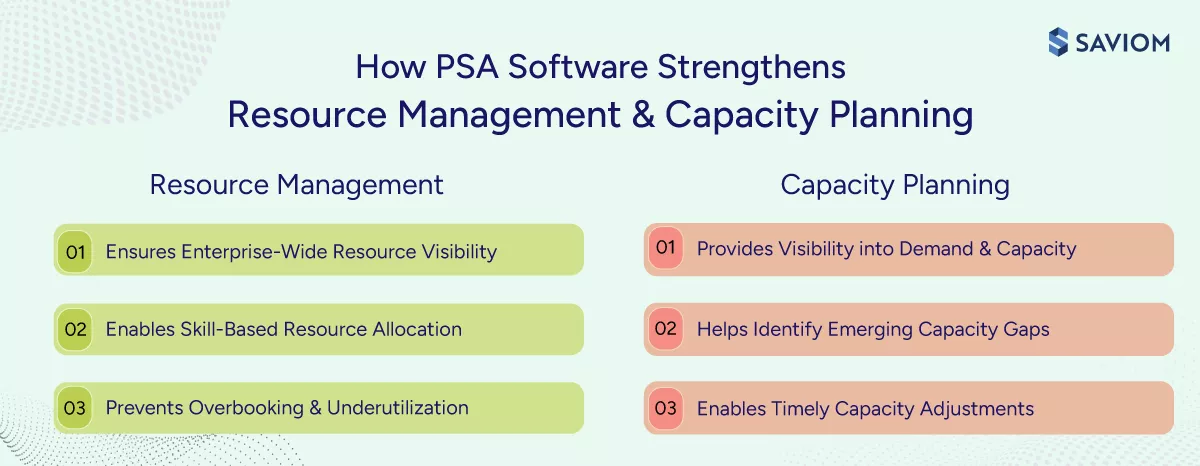
How PSA Software Strengthens Resource Management?
Effective resource management depends on allocating the right resources at the right time, often across multiple projects and competing priorities. Here’s how PSA strengthens resource management in practice:
- Ensures Enterprise-Wide Resource Visibility: Centralizes resource-related information across projects and business units to provide a unified visibility to managers. This helps eliminate fragmented resourcing decisions and enables more coordinated staff deployment.
- Enables Skill-Based Resource Allocation: Matches project requirements with verified competencies, certifications, etc., to ensure the best-fit resources are assigned to each task. This improves delivery quality while aligning staffing costs with project expectations.
- Prevents Overbooking and Underutilization: Provides visibility into resource utilization levels, enabling managers to maintain balanced workload distribution and minimize productivity loss from rising disengagement or resource burnout.
Read our detailed guide on project resource management.
How PSA Software Helps Improve Capacity Planning?
Capacity planning requires organizations to anticipate future project demand and ensure the right workforce capacity is available to meet it. Without integrated visibility into project pipelines and resource availability, planning often becomes reactive. Here is how PSA software enhances the capacity planning process:
- Provides Visibility into Resource Demand and Capacity: Consolidates pipeline opportunities and ongoing commitments to estimate total resource capacity and demand. This allows managers to determine whether the current workforce can support projected revenue plans.
- Helps Identify Emerging Capacity and Capability Gaps: Enables managers to evaluate required skills, effort estimates, and delivery timelines against available workforce bandwidth, helping organizations detect potential capacity or skill shortages early, before delivery or financial commitments are finalized.
- Enables Timely Capacity Adjustments: Allows managers to take corrective action by adjusting resource plans in response to demand-capacity imbalances. These proactive adjustments help ensure delivery commitments are met without overutilizing resources or compromising quality.
Explore the benefits of capacity planning for professional services organizations.
After understanding how professional services automation strengthens resource management and capacity planning processes, the next step is to see how PSA software differs from other enterprise systems.
PSA vs. ERP vs. PPM vs. Project Management Tools
Professional services organizations often rely on multiple enterprise systems to manage projects, financials, and operational activities. However, each platform serves a different role within the broader technology ecosystem. The following table explains how professional services automation (PSA) differs from ERP, PPM, and traditional project management tools.
| Parameter | Professional Services Automation Software | Enterprise Resource Planning Software | Project Portfolio Management Software | Project Management Tool |
|---|---|---|---|---|
| Primary Purpose | Manage the end-to-end lifecycle of professional service delivery | Manage enterprise-wide business processes and financial operations | Plan, prioritize, and govern portfolios of projects and strategic initiatives | Manage project tasks, timelines, and team collaboration |
| Best Fit For | Professional services organizations delivering client projects | Large enterprises managing finance, operations, supply chain, HR, or manufacturing | PMOs and executives overseeing multiple strategic initiatives | Individual teams executing and coordinating project work |
| Core Focus Area | Project delivery, resource utilization, billing, and service profitability | Enterprise transactions, accounting, procurement, supply chain, and HR operations | Portfolio prioritization, investment planning, and strategic alignment | Task management, collaboration, and progress tracking |
| Financial Management Depth | Project financials, billing, margins, and services revenue tracking | Comprehensive enterprise accounting, financial reporting, and compliance | High-level portfolio budgeting and investment tracking | Limited or basic budgeting capabilities |
| Resource Management Capability | Advanced resource planning, skills tracking, utilization, and capacity management | Workforce records and HR management | Portfolio-level resource allocation across initiatives | Task assignment and basic team workload tracking |
| Project Delivery Support | Built specifically for managing billable service delivery and project execution | Supports projects indirectly through financial and operational systems | Strong portfolio planning and governance with limited execution management | Focused on day-to-day task execution and collaboration |
| Typical Users / Teams | Services leaders, resource managers, delivery teams, and finance | Finance, HR, procurement, and operations teams | PMO leaders, executives, and portfolio managers | Project managers and project team members |
| When to Use | When managing service delivery, resource utilization, and project profitability | When managing enterprise financials, transactions, and operations | When prioritizing and governing multiple projects or strategic initiatives | When coordinating tasks and activities within individual projects |
Learn more about project portfolio management in our detailed guide.
After understanding how professional services automation software differs from other enterprise systems, let us now see how organizations apply it in real operational scenarios.
PSA Software Use Cases for Service-Based Organizations
Professional services organizations operate across diverse industries, each facing unique operational and delivery challenges. The following use cases illustrate how professional services automation helps different services firms streamline operations, improve resource utilization, and deliver projects more effectively.
Audit and Accounting Firms
Audit and accounting firms often handle multiple client engagements simultaneously, especially during peak tax seasons. Coordinating workloads across different teams and ensuring that deadlines are met can become difficult when data is scattered across spreadsheets, emails, and separate systems. This limited visibility into resource availability leads to uneven workload, delayed invoicing, and last-minute firefighting.
The professional services automation system helps firms address this challenge by providing real-time resource workloads and project timelines. This enables managers to monitor team availability, proactively redistribute assignments, and ensure the right resources are working on the right projects, thereby reducing operational stress during peak periods.
Read our blog to explore how audit and accounting firms can optimize resources.
Legal Services Firms
Legal services firms often struggle to consistently capture billable hours, disbursements, and case-related expenses. When time entries, case updates, and expense records are tracked across disconnected systems or entered late, firms may experience delayed invoicing, revenue leakage, and poor project profitability.
The PSA software addresses this by centralizing case management, time tracking, and billing processes within a single platform. It allows attorneys and staff to record billable hours and expenses directly. Also, with real-time visibility into case progress, managers can effectively monitor resource utilization and financial performance. This helps create accurate invoices and improve revenue realization.
IT Services Firms
IT services organizations frequently manage projects where the scope evolves as client requirements change during implementation. Without clear visibility into project progress, effort consumption, and financial performance, these changes can disrupt delivery schedules and erode project margins. Therefore, teams may struggle to detect scope creep or effort overruns early enough to take corrective action.
PSA software connects project tracking with real-time financial and effort data, linking work performed directly to its cost and revenue impact. As tasks progress, the system continuously updates actual effort and costs against the plan. This enables managers to detect scope changes early and manage them more effectively. Consequently, service firms can maintain delivery timelines and protect project margins.
Explore how IT organizations benefit from efficient workforce planning.
AEC Firms
Architecture, engineering, and construction firms manage complex projects that progress through multiple phases, including design, procurement, construction, inspection, and handover. When coordination between these teams is fragmented, milestones can slip, and communication gaps may delay critical project deliverables, affecting overall performance.
The professional services automation tool consolidates project information in a single system, enabling teams to track progress, coordinate activities, and monitor upcoming milestones more effectively. This helps AEC firms maintain schedule predictability, improve cross-departmental collaboration, and keep projects on track.
Consulting Firms
Consulting firms often face uncertainty when translating sales pipeline opportunities into delivery readiness. Without clear visibility into upcoming project demand and consultant availability, firms may either experience resource underutilization or struggle with last-minute shortages. These gaps can disrupt project planning and affect overall utilization levels.
PSA software connects sales pipeline data with resource planning, allowing firms to anticipate upcoming project demand earlier. By aligning opportunity forecasts with workforce availability, managers can prepare staffing plans before engagements begin. This enables consulting firms to deploy consultants more efficiently, maintain stronger utilization levels, and support more predictable service delivery.
Moving on, let us understand the maturity stages that organizations typically progress through as they adopt and optimize professional services automation software.
Professional Services Maturity Model: From Reactive to Predictive Operations
As per the professional services maturity benchmark established by SPI Research, service organizations evolve from reactive operations to more structured and predictive service delivery. Understanding these stages helps firms evaluate their current maturity and identify opportunities for operational improvement.
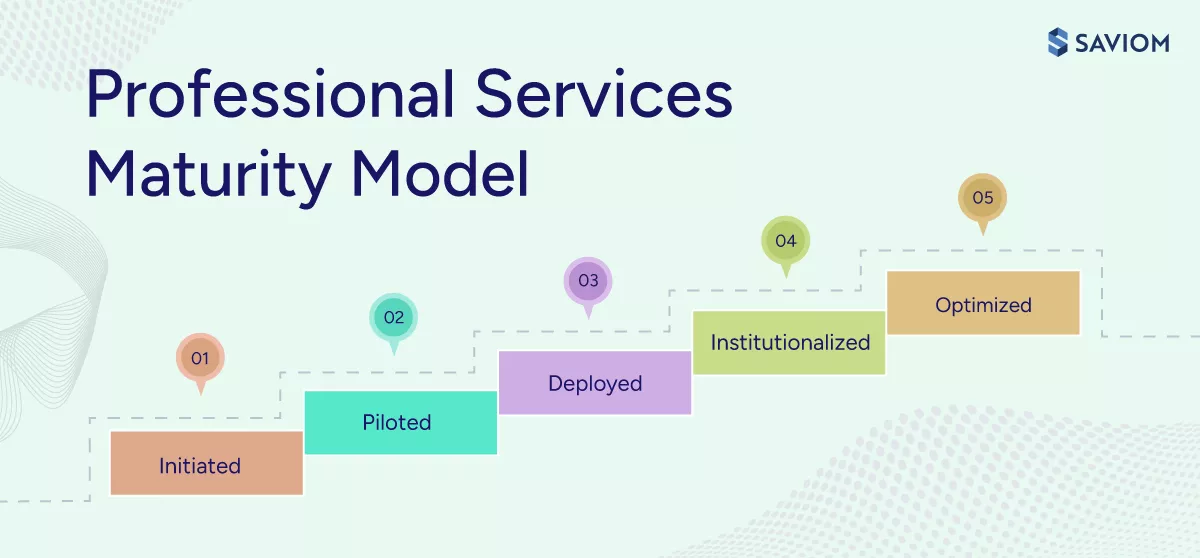
Level 1 – Initiated (The Heroic Stage)
At the initiation stage, service operations rely heavily on informal processes and individual expertise rather than standardized systems. Teams often depend on experienced employees to coordinate projects and resolve delivery issues as they arise. Because processes are inconsistent and poorly documented, performance varies across engagements, and scalability remains limited.
Level 2 – Piloted (The Functional Stage)
At this stage, professional services organizations begin introducing repeatable operating processes within certain departments or teams. Activities such as project tracking, time capture, and reporting start following more consistent practices in those areas. However, these processes have not yet been adopted across the entire organization. As a result, operational consistency and coordination remain uneven.
Level 3 – Deployed (The Project Excellence Stage)
During the deployed stage, professional services firms establish standardized processes and operating principles across major service delivery functions. Project execution, resource coordination, and performance monitoring become more aligned across teams. This improved consistency strengthens collaboration and leads to more reliable project-level performance.
Level 4 – Institutionalized (The Portfolio Excellence Stage)
At this stage, professional services organizations embed formal operational metrics, performance dashboards, and governance structures to manage service operations actively. Leaders gain clearer visibility into project outcomes and operational performance across the portfolio. These controls enable stronger governance and data-driven decision-making.
Level 5 – Optimized (The Collaborative Stage)
As per the SPI research, “Organizations at the highest level of maturity report 250% boost in project margins.”
At the highest maturity stage, professional services firms focus on continuous improvement across all service delivery processes. Teams use performance insights, analytics, and structured feedback loops to refine operational practices. This enables highly predictable outcomes, ongoing efficiency gains, and greater adaptability to changing business demands.
Learn how organizations can advance their resource management maturity model.
After understanding the different levels of professional services automation maturity, let us now explore how AI and analytics are increasingly important in modern PSA platforms.
The Role of AI and Analytics in Modern PSA Software
According to research by Thomson Reuters, “AI adoption in professional services organizations almost doubled to 40% in 2026, compared to 22% in 2025.”
This statistic highlights how professional services firms are increasingly using AI and analytics to improve operational insight and decision-making. These technologies help analyze large volumes of project, financial, and resource data to uncover patterns and opportunities. The following points highlight how AI and analytics enhance modern PSA platforms.
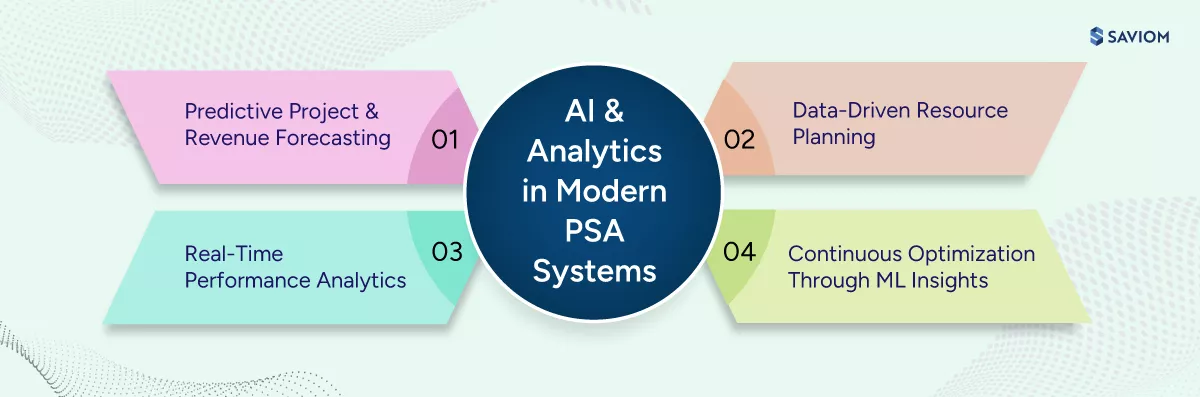
Enables Predictive and Prescriptive Project and Revenue Forecasting
AI and advanced analytics analyze historical project data, financial records, and utilization trends to generate forward-looking forecasts. These insights help organizations anticipate revenue outcomes and identify project or resource risks earlier in the delivery lifecycle. As a result, leaders gain more accurate revenue visibility and can take proactive corrective actions, reducing the likelihood of end-of-quarter surprises.
Facilitates Intelligent Resource Planning and Skill Matching
AI-empowered professional services automation software helps managers make more informed resourcing decisions by analyzing employee skills, availability, demand patterns, and project requirements. These insights guide managers toward assigning the most suitable resources to each project task. As a result, organizations can improve utilization, accelerate staffing decisions, and ensure stronger alignment between project needs and team capabilities.
Learn how a skill matrix helps organizations assign the right talent to the right projects.
Delivers Real-Time Performance and Margin Analytics
Embedded analytics provide live visibility into project health, budget consumption, and key resource management metrics through unified dashboards. With this real-time view, managers can continuously monitor operational performance instead of relying on delayed reports. This helps teams detect issues earlier, protect profit margins, and make more confident operational decisions.
Supports Continuous Optimization Through Machine Learning Insights
Machine learning models analyze historical project outcomes and operational data to identify patterns that improve future planning and execution. Over time, this helps the professional services automation software refine resource forecasts, pricing strategies, and delivery approaches. This continuous learning enables organizations to steadily improve performance and build a more adaptive, resilient service operation.
Read our blog to explore how AI is transforming project management.
Transform how you manage projects, resources, and financials across the service delivery lifecycle with next-gen PSA software. Book a free demo today!

Having understood the role of AI and analytics in modern PSA tools, the next step is to evaluate how organizations can choose the right professional services automation software.
How to Evaluate and Choose the Right PSA Software?
Selecting the right professional services automation software requires careful evaluation of both operational needs and long-term business objectives. The following considerations can help professional services organizations structure their evaluation process and choose a solution that aligns with their goals:
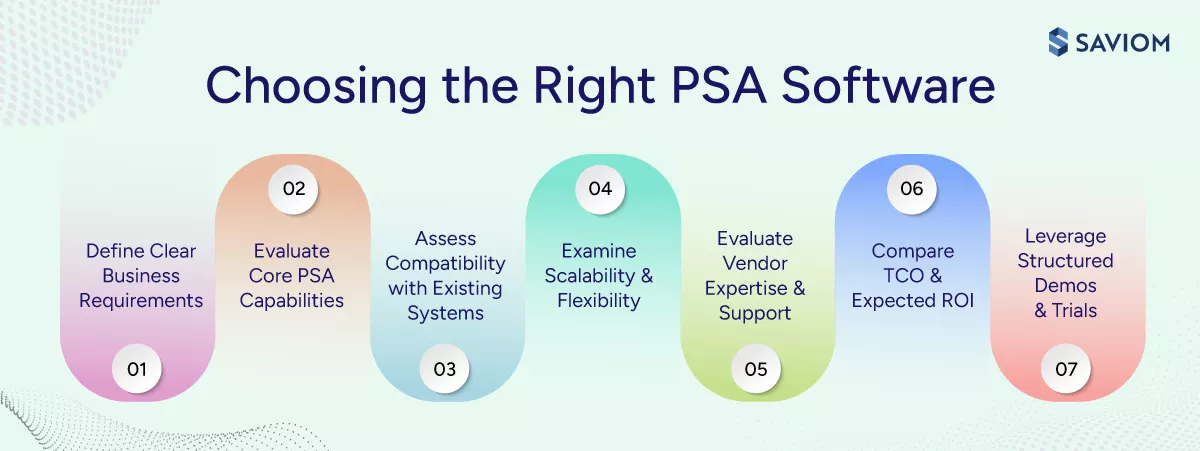
Define Clear Business and Operational Requirements
Organizations should begin by clearly identifying their business goals, service delivery challenges, and success metrics. Defining these requirements early helps ensure the evaluation remains aligned with organizational priorities. This clarity creates a more focused selection process and increases the likelihood of successful adoption of PSA software.
Evaluate Core PSA Software Capabilities and Feature Depth
The next step is to assess how well the platform supports essential PSA software functions such as project management, resource management, financial tracking, and automation. Evaluating the depth of these capabilities ensures the solution can effectively support daily service operations. A well-rounded platform reduces reliance on workarounds or additional tools.
Assess Integration Compatibility with Existing Tech Stack
PSA solutions should integrate smoothly with existing systems such as CRM, ERP, HR, and financial applications. Strong integration capabilities allow data to move seamlessly across systems without manual intervention. This helps eliminate operational silos while improving reporting accuracy and process efficiency.
Discover the key factors to consider when selecting the right resource management software.
Examine Scalability, Flexibility, and Deployment Model
Organizations should evaluate whether the professional services automation solution can scale as the business grows and service models evolve. Flexibility in workflows and configurations ensures the system can adapt to changing operational needs. Choosing a scalable platform helps protect investment over the long term.
Evaluate Vendor Expertise, Support, and Implementation Services
Vendor expertise and implementation support play a major role in successful PSA software adoption. Professional services firms should assess the vendor’s industry experience, onboarding approach, and availability of training and support resources. Strong implementation guidance reduces deployment risks and accelerates time-to-value.
Compare Total Cost of Ownership and Expected ROI
A thorough evaluation should consider the full cost of ownership (TCO) rather than focusing only on licensing fees. Implementation costs, customization requirements, and long-term maintenance expenses should all be reviewed. This helps stakeholders balance upfront investment with expected business value.
Read about project ROI and how to measure it effectively.
Leverage Structured Demos and Trials for Final Selection
Product demonstrations, proofs-of-concept, and trial environments help validate whether the platform meets operational requirements. Using structured evaluation scorecards during these sessions enables stakeholders to compare solutions objectively. This approach improves confidence before making the final purchase decision.
Conclusion
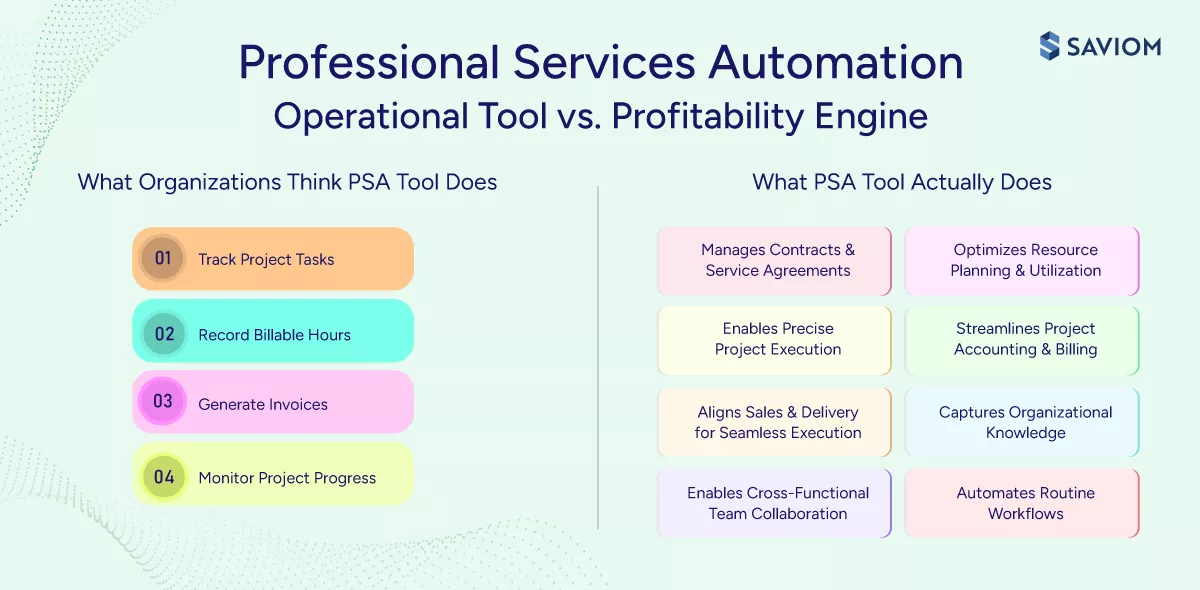
Professional services automation software has evolved from a simple operational tool into a strategic platform for managing service-driven businesses. By bringing projects, resources, and financials into a unified system, organizations can improve delivery predictability and protect margins.
As service organizations continue to scale, modern PSA tools enhanced with analytics and automation will play an increasingly strategic role. Firms that invest in these capabilities are better positioned to improve operational efficiency, strengthen profitability, and sustain long-term competitive advantage.
Frequently Asked Questions (FAQs)
Professional services automation software is a specialized tool that helps service-based organizations manage the entire project lifecycle, from resource planning and project delivery to billing and revenue tracking. By bringing projects, people, and financial data into one platform, PSA improves visibility, resource utilization, and service delivery efficiency.
Professional services automation (PSA) is important because it:
1. Provides real-time visibility into the project pipeline
2. Enables faster project initiation with resource capacity insights
3. Improves billable utilization and workforce productivity
4. Reduces project costs and improves profit margins
5. Speed up billing and invoicing through smart automation
6. Automates repetitive administrative and reporting tasks
The core components of professional services automation (PSA) are:
1. Contract Management
2. Resource Management
3. Project Management
4. Project Accounting and Billing
5. Sales Delivery Alignment
6. Knowledge Management
7. Team Collaboration
8. Automation and Integration
Some of the important service delivery metrics that PSA software improves are:
1. Billable Utilization Rate
2. Project Gross Margin
3. Revenue Forecast Accuracy
4. Customer Satisfaction Score (CSAT)
5. Earned Value (EV)
6. Annual Recurring Revenue (ARR)
PSA software is designed for service-based organizations and integrates project management, resource planning, and financial tracking into a single system. In contrast, traditional project management (PMS) tools primarily focus on task management, timelines, and team collaboration. While PMS tools support project execution, professional services automation software enables end-to-end service delivery and profitability management.
To choose the right professional services automation software, organizations should:
1. Define clear business and operational requirements
2. Evaluate core PSA software capabilities and feature depth
3. Assess integration compatibility with the existing tech stack
4. Examine scalability, flexibility, and deployment of the model
5. Evaluate vendor expertise, support, and implementation services
6. Compare the total cost of ownership and expected ROI
7. Leverage structured demos and trials for final selection
The different stages of PSA software maturity are:
1. Level 1 – Initiated (The Heroic Stage)
2. Level 2 – Piloted (The Functional Stage)
3. Level 3 – Deployed (The Project Excellence Stage)
4. Level 4 – Institutionalized (The Portfolio Excellence Stage)
5. Level 5 – Optimized (The Collaborative Stage)
An organization should consider implementing PSA software when managing projects, resources, and financials across disconnected tools, as this can lead to operational inefficiencies. Signs often include limited visibility into resource utilization, delayed billing cycles, or unreliable demand forecasts. PSA software helps centralize service operations and improve delivery control.