

Introduction
Is your resource management strategy delivering measurable business value?
In many organizations, resource-related decisions are made without a clear understanding of their financial impact. While teams invest in resource planning, forecasting, and allocation, they often lack visibility into how these actions influence revenue and profit margins.
Resource management ROI addresses this gap by linking resourcing decisions directly to financial outcomes. It enables organizations to evaluate how effectively capacity is utilized, where value is being lost, and how improvements in resource planning translate into measurable gains.
This guide explains what resource management ROI is, key business drivers that impact it, and how to build a compelling business case for investing in an effective resource management approach.
Why Resource Management Investment Needs a Strong Business Case?
Resource management investments influence multiple cost and revenue drivers, yet their impact is often difficult to quantify. Without a clear financial narrative, organizations struggle to justify the investment, secure stakeholder buy-in, and prioritize it against competing initiatives. A structured business case helps translate operational improvements into measurable business value.
Key reasons why a strong business case is essential include:
- Financial impact is not immediately visible: The benefits of improved resource allocation, higher utilization, and reduced inefficiencies are often indirect. Without structured analysis, organizations struggle to demonstrate clear financial returns.
- Fragmented systems limit visibility: Disconnected tools and inconsistent data prevent organizations from linking resource decisions to financial outcomes. This lack of transparency weakens ROI clarity and delays decision-making.
- Inefficiencies remain hidden in operations: Underutilized capacity, delayed staffing, skill mismatches, and reactive allocations are often embedded in daily workflows. As a result, the true cost of these inefficiencies goes unnoticed.
- Benefits are distributed across functions: Resource management impacts PMO, delivery, finance, and operations teams. Since value is spread across functions, it becomes harder to consolidate benefits into a unified investment case.
- Stakeholders evaluate value differently: Finance focuses on cost and margin impact; delivery teams emphasize utilization, and leadership looks for scalability. Without a structured business case, it becomes difficult to align these perspectives.
Now, let us understand what actually the ROI of resource management is.
What is the ROI of Resource Management?
Resource management ROI refers to the measurable business value gained from effectively planning, allocating, and utilizing resources compared to the investment made in resource management processes and tools. It evaluates how improvements in capacity planning, allocation, and resource utilization translate into better project margins, optimized costs, and higher overall profitability.
In simple terms, resource management ROI measures how efficiently an organization converts available workforce capacity into productive, revenue-generating outcomes while minimizing bench time and overallocation. A higher ROI indicates that resources are being used strategically to maximize business value and improve operational performance.
After the definition, let us take a look at the key drivers that impact resource management ROI.
Key Business Drivers That Impact Resource Management ROI
Understanding the business drivers of resource management ROI is essential for building a measurable and sustainable value narrative. These drivers highlight where inefficiencies originate and where resource optimization can deliver the greatest financial impact. Listed below are the key drivers:
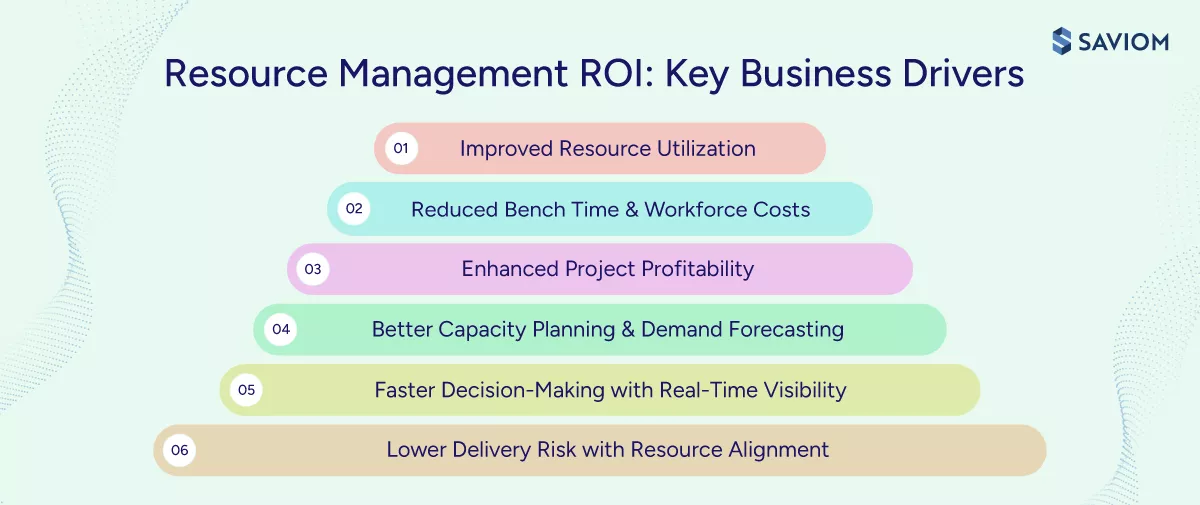
Improved Resource Utilization
One of the most significant contributors to resource management ROI is improved utilization. When organizations deploy resources effectively, they can deliver more work without increasing headcounts. This includes minimizing gaps between assignments, increasing billable deployment, and ensuring high-value skills are used on the right initiatives.
Learn how to optimize resource utilization to improve productivity and minimize inefficiencies.
Reduced Bench Time and Workforce Costs
When resources remain idle, organizations continue to incur payroll costs without generating value. Effective resource management minimizes bench time by redeploying available talent faster, thereby limiting avoidable workforce expenses. It also reduces unnecessary contractor hiring that often occurs due to poor visibility into internal capacity.
Enhanced Project Profitability
When organizations align resource cost with project budgets and leverage the right mix of junior/senior, local/global, and permanent/contingent staff, they can control delivery costs more effectively. This helps prevent margin leakage caused by overqualified staffing, inefficient allocation, last-minute or unnecessary resourcing decisions. As a result, projects become more predictable and financially sustainable.
Better Capacity Planning and Demand Forecasting
When organizations can accurately forecast project demand and compare it with available capacity, they avoid both overstaffing and understaffing. This enables earlier identification of skill shortages, improves workforce planning, and reduces costly, last-minute hiring. As a result, teams can proactively balance capacity and demand, optimize utilization, and control workforce costs more effectively.
Faster Decision-Making with Real-Time Visibility
Real-time visibility into resource availability, utilization, and demand enables faster and more informed decision-making. Instead of relying on fragmented spreadsheets or delayed updates, managers can respond quickly to changes in project priorities or workforce capacity. This improves responsiveness, reduces allocation delays, and helps teams act on live insights, all of which contribute to higher ROI.
Lower Delivery Risk Through Better Resource Alignment
Effective resource alignment prevents project delays caused by skill mismatches and reduces burnout from repeated resource overutilization. It also ensures better project outcomes and timely delivery. As a result, organizations can avoid costly disruptions and strengthen resource management ROI.
Learn how to identify and mitigate resource risks to ensure timely project delivery.
Next, let us learn about the cost components of resource management software.
Cost Components of Resource Management Software
Evaluating the cost components of resource management software is essential to understanding the total investment. Factoring in these elements helps ensure accurate ROI calculations and a clear view of the total cost of ownership. Here are the key cost factors that influence the total cost of ownership:
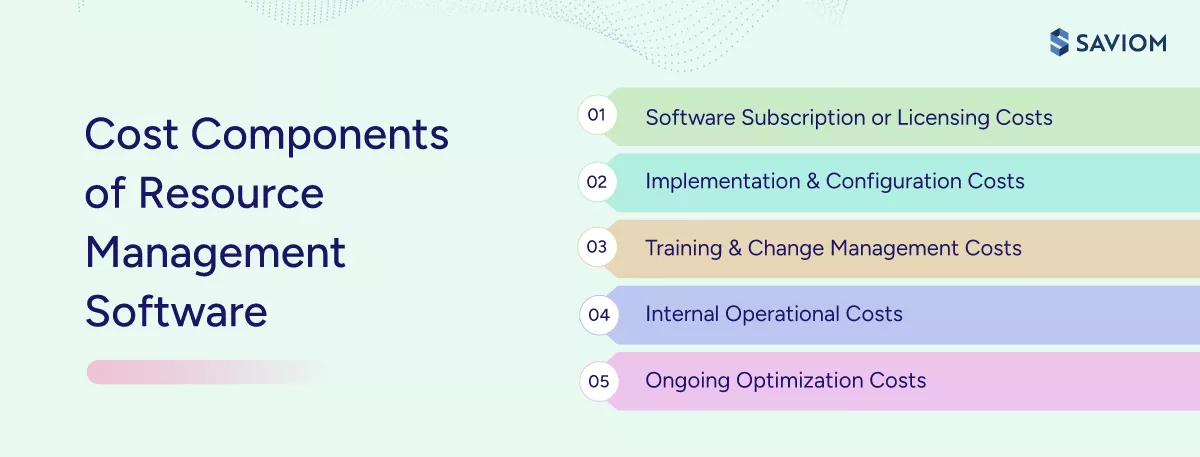
Software Subscription or Licensing Costs
This includes the core cost of the resource management platform. Pricing may vary based on user count, modules, or enterprise-wide access. Organizations typically pay annual or subscription-based fees depending on the pricing structure and deployment scale.
Implementation and Configuration Costs
Implementation costs cover platform setup, integrations with existing systems, data migration, and workflow alignment. This may also include configuration of roles and permissions, and creation of initial dashboards and reports tailored to business needs.
Training and Change Management Costs
Successful adoption requires user onboarding and structured change management. These costs include training sessions, documentation, governance setup, and enabling teams to transition from manual or fragmented planning approaches to a centralized system.
Internal Operational Costs
Organizations should also account for internal effort during rollout. This includes time invested by PMO, IT, finance, and operations teams for setup, validation, and process alignment. Temporary productivity dips may also occur during the transition phase.
Ongoing Optimization Costs
After deployment, ongoing costs include system administration, reporting refinement, and process improvements. As adoption grows, organizations may expand usage across additional teams, geographies, or business units, which may require further configuration and governance support.
Check out our blog to learn how to evaluate and select software using cost-benefit analysis.
Read our comprehensive eBook to understand how 5th gen resource management drives better visibility, higher utilization, and improved business profitability.
 Now, let us take a look at the steps to calculate resource management ROI.
How to Calculate Resource Management ROI? (Step-by-Step Framework)
Calculating resource management ROI requires evaluating current inefficiencies, estimating improvement potential, and comparing financial gains against investment costs. The following step-by-step framework helps organizations calculate the ROI of resource management:
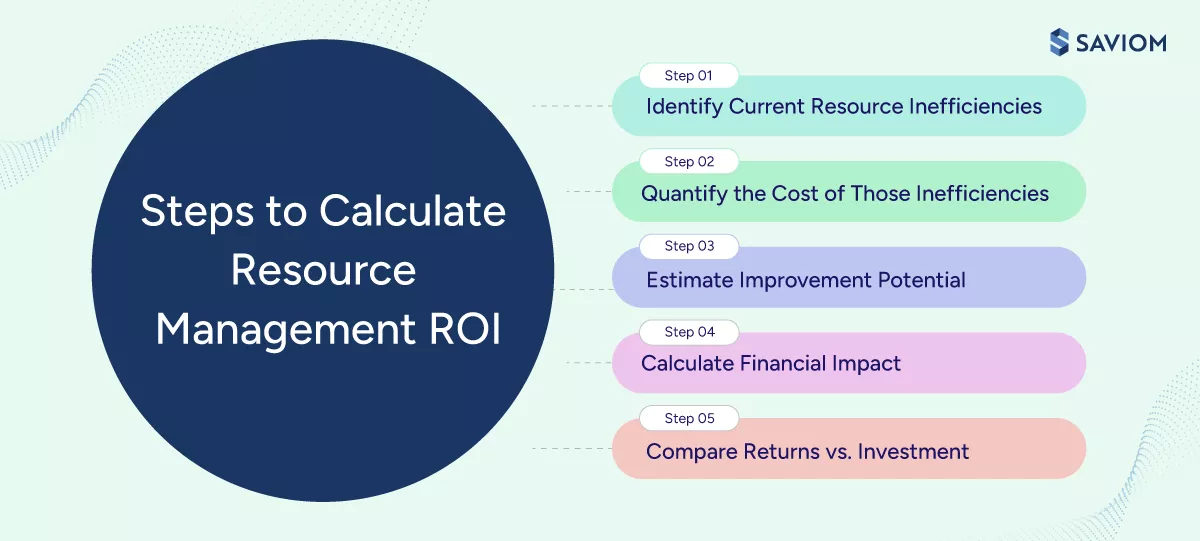
Step 1: Identify Current Resource Inefficiencies
Managers can start by examining where their current resource management process creates friction and waste. These may include resource underutilization, overutilization, skill mismatches, bench time, delayed staffing, and heavy reliance on expensive external resources. By identifying these gaps first, organizations can create a clear baseline for measuring improvement in ROI.
Explore common resource management challenges and their solutions.
Step 2: Quantify the Cost of Those Inefficiencies
Next, managers can assign financial value to each inefficiency, so they can understand its true business impact. In addition, they should calculate lost revenue from unbilled billable hours, the cost of bench time, margin loss from poor resource mix, and the impact of project delays or missed opportunities. This step turns operational challenges into measurable cost drivers.
Step 3: Estimate Improvement Potential
In this step, managers can estimate the expected gains from better resource management. This may include more accurate resource forecasting, improved utilization, reduced bench time, and lower contractor dependency. Organizations may also benefit from faster staffing cycle times and improved alignment between available skills and project needs.
Step 4: Calculate Financial Impact
Now, managers can convert those expected improvements into measurable financial outcomes that project stakeholders can easily evaluate. They can measure the revenue gain from better utilization, the cost savings from reduced bench time, the margin improvement from optimized allocations, and the savings from avoiding unnecessary hires or contractor spend.
Learn how project financial planning helps track costs, revenue, and improve profitability.
Step 5: Compare Returns vs. Investment
Finally, managers can compare the total investment in the resource management solution against the financial benefits it generates. This includes software, implementation, and change management costs weighed against annual savings and revenue gains. Finally, they can calculate the payback period and ROI percentage to show how quickly the investment delivers value.
To understand the steps better, let us go through an example.
Sample ROI Calculation (Illustrative Example)
By applying real-world assumptions and numbers, organizations can better understand how improvements in enterprise resource management impact financial outcomes. This approach makes it easier to communicate value to stakeholders and build confidence in the investment. The following example walks through a simplified scenario to demonstrate how ROI can be calculated in practice.
Scenario
Consider a professional services firm with 500 billable consultants, an average billing rate of $100 per hour, and a current utilization rate of 70%. Due to limited visibility into availability and utilization, some consultants remain underutilized while others are overbooked. This workload imbalance lowers billability, creates bench time, and leads to inefficient use of high-value skills. As a result, the organization misses opportunities to maximize revenue from existing capacity.
Before vs. After Resource Management Implementation
- Before implementation: Resource planning is reactive, resulting in uneven workloads, higher bench time, and loss of billable hours.
- After improvement: Centralized visibility and structured resource planning result in an even workload distribution, reduced bench time, and alignment of the right skills with the right projects. This improves billability and enables better use of existing capacity without increasing headcount.
Read our blog to understand what is resource management and how it can positively impact businesses.
Revenue Impact of Increasing Utilization
Organizations can increase overall utilization by leveraging workload balancing and improving allocation. For instance, a 6% utilization improvement (from 70% to 76%) adds significant billable hours across the 500-person workforce. These additional productive hours directly increase service revenue without increasing workforce costs, improving overall profitability.
Cost Savings from Reduced Bench Time
Improved visibility into utilization levels reduces under-allocation and reduces idle capacity. As more consultants are deployed on billable work, the cost of bench time decreases. Better planning also reduces the need for hiring contingent workers, helping control external workforce spending.
Sample ROI and Payback Output
| Metric | Value |
|---|---|
| Additional Annual Revenue | $6M |
| Cost Savings | $1.5M |
| Total Annual Benefit | $7.5M |
| ROI | 400% |
| Payback Period | < 6 months |
This example shows how improved visibility into resource attributes and balanced workload distribution can increase billability, reduce bench time, and deliver substantial financial returns from existing capacity.
Learn how to measure project ROI and evaluate financial returns more effectively.
Now, let us understand the challenges firms face in justifying resource management investment.
Common Challenges in Justifying Resource Management Investment
Justifying resource management investment often comes with practical and organizational challenges that can slow decision-making. These challenges typically stem from limited visibility, fragmented data, and difficulty in quantifying impact. The following are the most common barriers that organizations encounter when building a strong business case.
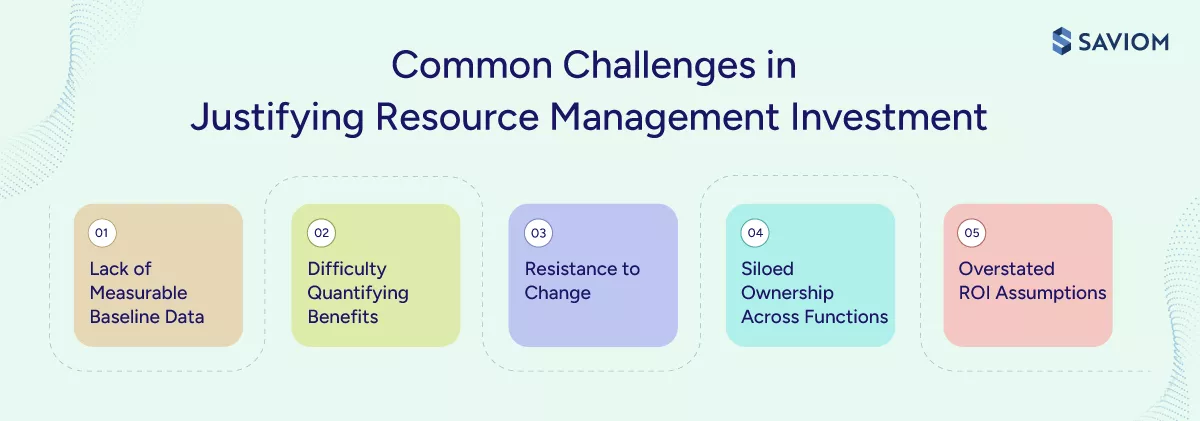
Lack of Measurable Baseline Data
Many organizations lack clear baseline data on utilization, bench size, and allocation efficiency, making it difficult to build a credible investment case. Resource metrics are often tracked inconsistently across teams, limiting leadership’s ability to gain a clear view of current capacity and performance. As a result, organizations struggle to quantify inefficiencies and confidently justify investment in resource management processes.
Difficulty Quantifying Benefits
Organizations often find it difficult to translate improvements like better visibility, faster decision-making, and strategic planning into clear financial terms. Although these outcomes drive utilization and enhance billability, their impact is often indirect and not immediately visible. Consequently, stakeholders may question the value of the investment when the projected returns do not seem concrete enough.
Resistance to Change
Teams often view new resource management processes as additional overhead rather than as part of normal operational improvement. At the same time, many employees prefer familiar ways of working, especially when existing habits feel easier or more predictable. Due to this resistance, organizations may face hesitation, slower adoption, and weaker support for the investment overall.
Siloed Ownership Across Functions
Ownership of resource management often sits across multiple functions, which creates fragmentation in accountability and decision-making. Since each group may operate with different priorities, goals, and planning methods, alignment becomes harder to achieve. This lack of cross-departmental collaboration can weaken the investment case and make the need for a unified resource management approach appear less urgent.
Overstated ROI Assumptions
Some business cases rely on overly optimistic return on investment assumptions, which can quickly reduce trust among stakeholders. Moreover, when projected benefits seem unrealistic or unsupported, finance and leadership teams may question how the estimates were developed. In turn, overpromising can undermine confidence in the overall case and make the proposed investment harder to defend.
Next, let us learn how to build an effective business case for resource management software.
Building a Business Case for Resource Management Software
Building a strong business case for resource management software requires aligning operational improvements with clear financial outcomes. It involves translating efficiency gains, utilization improvements, and cost savings into measurable business value. Here are the key elements needed to create a compelling and credible business case.
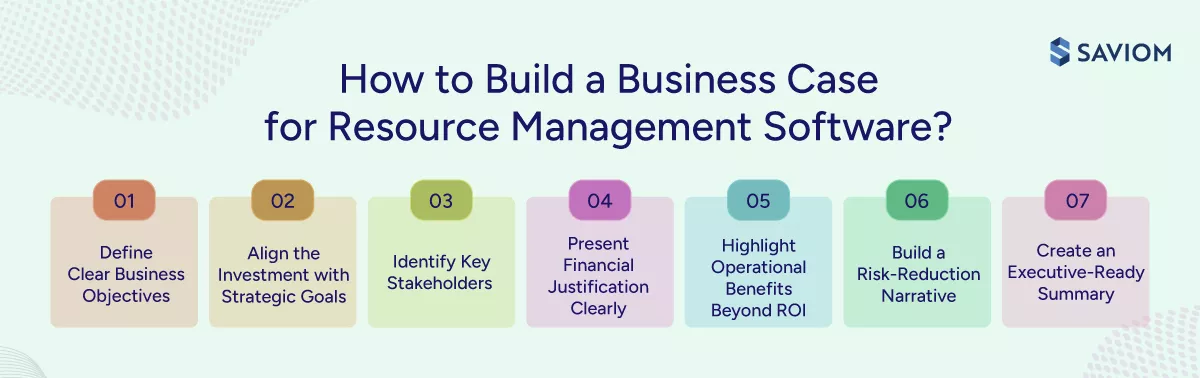
Define Clear Business Objectives
Managers can begin by defining clear business objectives such as improving efficiency, increasing profitability, supporting scalable growth, and enhancing workforce agility. When firms anchor the investment in specific outcomes, they give the business case more focus and make success easier to measure. This clarity also helps stakeholders understand why the investment matters.
Explore the 25 business objectives that firms must measure for success.
Align the Investment with Strategic Goals
Next, managers can align the investment with broader strategic goals such as digital transformation, workforce optimization, growth enablement, or margin improvement. This alignment strengthens executive interest and shows that the investment supports long-term business direction, not just operational change.
Identify Key Stakeholders
The third step includes identifying the key stakeholders early, including the CFO, CIO, PMO leaders, resource managers, and delivery and operations leaders. Since each group evaluates the investment from a different perspective, organizations must address their priorities within the business case. This stakeholder alignment helps build consensus, strengthen sponsorship, and reduce resistance during adoption.
Read this blog to understand who project stakeholders are and how to manage them.
Present Financial Justification Clearly
Managers must present the financial justification clearly by outlining current inefficiencies, expected gains, projected ROI percentage, and estimated payback period. When firms quantify the case in straightforward terms, they make it easier for decision-makers to assess value and compare alternatives. Moreover, a clear financial view also helps finance teams evaluate the investment with greater confidence.
Highlight Operational Benefits Beyond ROI
Now, managers can highlight operational benefits such as better visibility, faster staffing decisions, and improved resource planning. These advantages show that the investment creates value not only through cost or margin improvement, but also through better day-to-day execution. As a result, the business case becomes more persuasive for stakeholders who focus on operational efficiency and delivery outcomes.
Check out our blog to learn strategies for improving operational efficiency.
Build a Risk-Reduction Narrative
This step involves building a risk-reduction narrative by showing how the investment can reduce delivery risk, margin leakage, and resource planning blind spots. At the same time, position the value in terms of both upside opportunity and downside protection to create a more balanced case. This framing helps leadership see the software as a tool for protecting performance as well as improving it.
Create an Executive-Ready Summary
Lastly, managers can create an executive-ready summary that consolidates key costs, assumptions, resource risks, benefits, and the expected timeline to value in one page. By presenting the most important points in a concise format, managers can make it easier for senior leaders to review and act quickly. This summary improves decision-readiness and ensures the business case communicates value with clarity.
In the next section, let us understand how to improve resource management ROI.
How to Improve Resource Management ROI?
To improve resource management ROI, organizations must move beyond measurement and adopt practices that enhance resource utilization, reduce waste, and strengthen planning accuracy. Below are the key strategies to maximize the return on investment and sustain long-term performance.
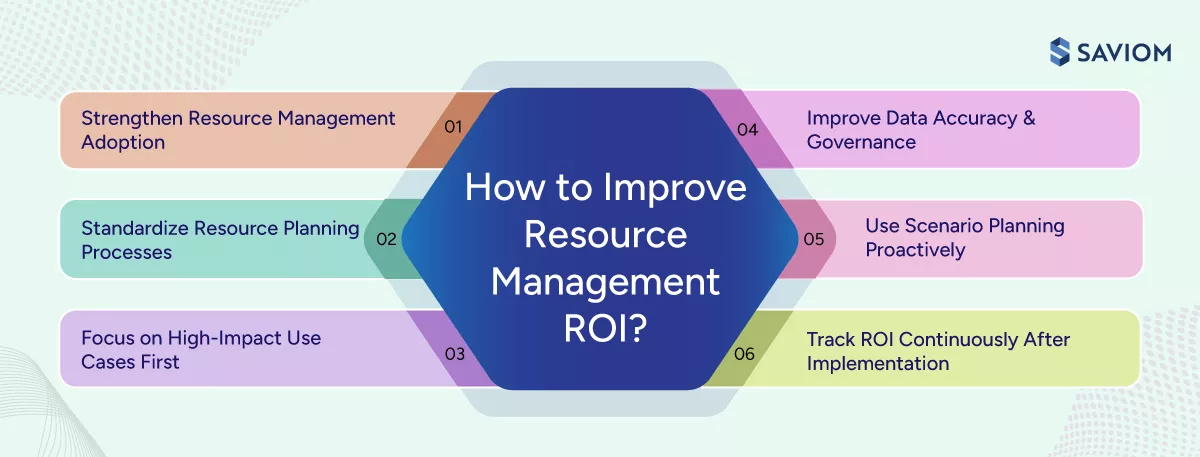
Strengthen Adoption of Resource Management Practices
Resource management ROI depends on how effectively the practices are used, not just on implementation. Organizations should expand adoption across PMO, delivery, operations, and leadership teams to ensure consistent planning and allocation decisions. Broader adoption improves visibility, reduces silos, and increases the overall value generated from the solution.
Standardize Resource Planning Processes
Standardizing resource planning processes helps organizations create a consistent approach to forecasting, allocation, and optimization. By aligning teams around common methods, firms can reduce friction, improve collaboration, and eliminate avoidable data inconsistencies. This helps managers compare resource capacity and demand more accurately and make faster, more confident planning decisions.
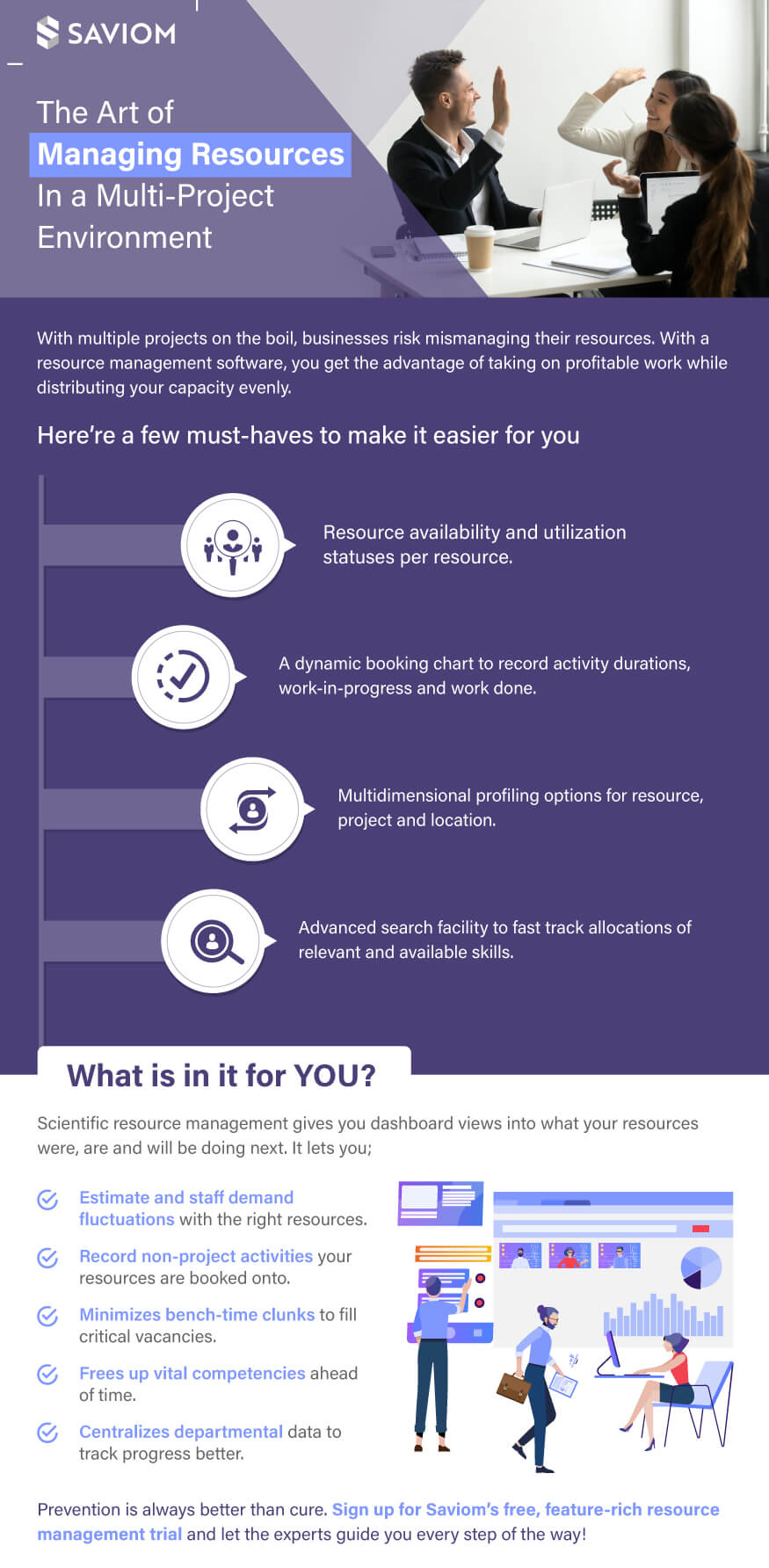
Understand how to manage and plan resources efficiently across multiple projects.
Focus on High-Impact Use Cases First
Managers should start with use cases that deliver measurable value quickly, such as improving billable utilization, reducing bench time, or optimizing high-value staffing decisions. Prioritizing these areas helps capture early wins, demonstrate impact, and build momentum for broader adoption.
Improve Data Accuracy and Governance
Accurate skills, demand, and capacity data are essential for effective resource decisions. Organizations should assign ownership, define governance guidelines, and conduct regular reviews to maintain data quality. Accurate data helps firms improve forecasting accuracy and strengthen ROI outcomes.
Use Scenario Planning Proactively
Managers can leverage scenario planning to shift from reactive staffing toward more forward-looking decisions. By testing different allocation scenarios before committing resources, they can evaluate trade-offs and choose the best path with greater confidence. This proactive approach reduces uncertainty and helps the business respond faster to changing demand and capacity conditions.
Track ROI Continuously After Implementation
Continuous tracking of ROI helps organizations compare actual results against the assumptions in the original business case. This ongoing measurement allows managers to confirm what is working, identify gaps early, and refine the approach over time. In turn, the organization can expand proven success across more teams and functions while improving long-term value.
Next, let us take a look at the best practices that can help strengthen an organization’s business case.
Best Practices to Strengthen Your Business Case
Strengthening your business case requires a balance of clear financial justification and practical, real-world evidence. It’s important for organizations to align projected outcomes with strategic goals while addressing potential risks and assumptions upfront. The following best practices can make a business case more persuasive and actionable.
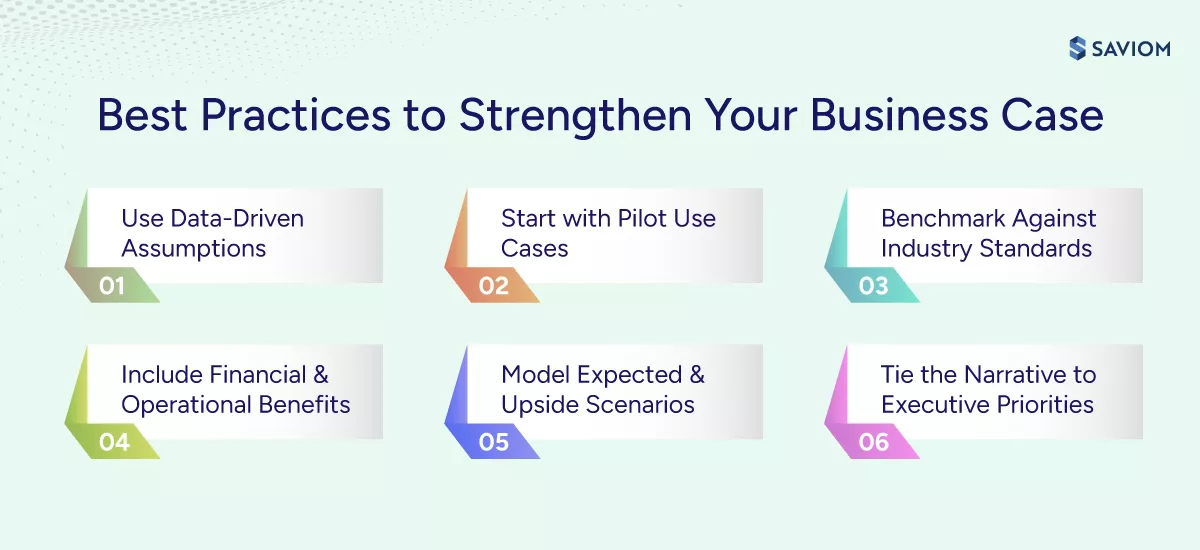
Use Data-Driven Assumptions
Managers should build the business case based on actual utilization, bench size, margins, and staffing patterns wherever possible. By grounding assumptions in real-time data, they can make the case more credible and easier to defend. This approach also helps avoid vague value claims and presents a clearer picture of expected impact.
Start with Pilot Use Cases
To validate the value in a controlled setting, managers typically start with a pilot case in one team, geography, or business unit. This focused approach allows them to test adoption, measure outcomes, and refine the rollout strategy before scaling further. Consequently, this builds confidence and supports broader enterprise deployment.
Benchmark Against Industry Standards
Next, managers should compare current performance against accepted utilization, capacity, or planning benchmarks in the industry. This helps highlight where the organization falls behind and where it can improve with the right investment. At the same time, benchmarking adds urgency while reinforcing the potential upside.
Include Financial and Operational Benefits
In addition, managers should strengthen the business case by combining financial returns with operational gains such as better visibility, increased agility, and stronger governance. This balanced view helps different stakeholders evaluate value from their perspective. As a result, the case becomes more persuasive across finance, operations, and executive leadership.
Discover why resource management is important for driving operational efficiency.
Model Conservative, Expected, and Upside Scenarios
To build confidence in the investment, managers should model multiple scenarios using conservative, expected, and upside assumptions. This range-based approach improves trust by demonstrating that both resource constraints and opportunities have been considered. It also shows that the business case remains resilient across varying conditions.
Tie the Narrative to Executive Priorities
Finally, organizations should connect the investment narrative directly to executive priorities such as growth, profitability, cost discipline, and scalability. When leadership sees a clear alignment with strategic goals, they are more likely to support the initiative with confidence. This alignment makes the recommendation more relevant and easier to support at the leadership level.
Learn in detail how to build a business case for a new initiative.
Now, it is time to understand how robust enterprise resource management software can maximize return on investment.
How Enterprise Resource Management Software Maximizes ROI?
Enterprise resource management software maximizes ROI by bringing visibility, control, and intelligence into workforce planning and execution. It enables organizations to align resources with demand more accurately, reducing inefficiencies and revenue leakage. Let us look at the key ways such software delivers measurable and sustained business value.
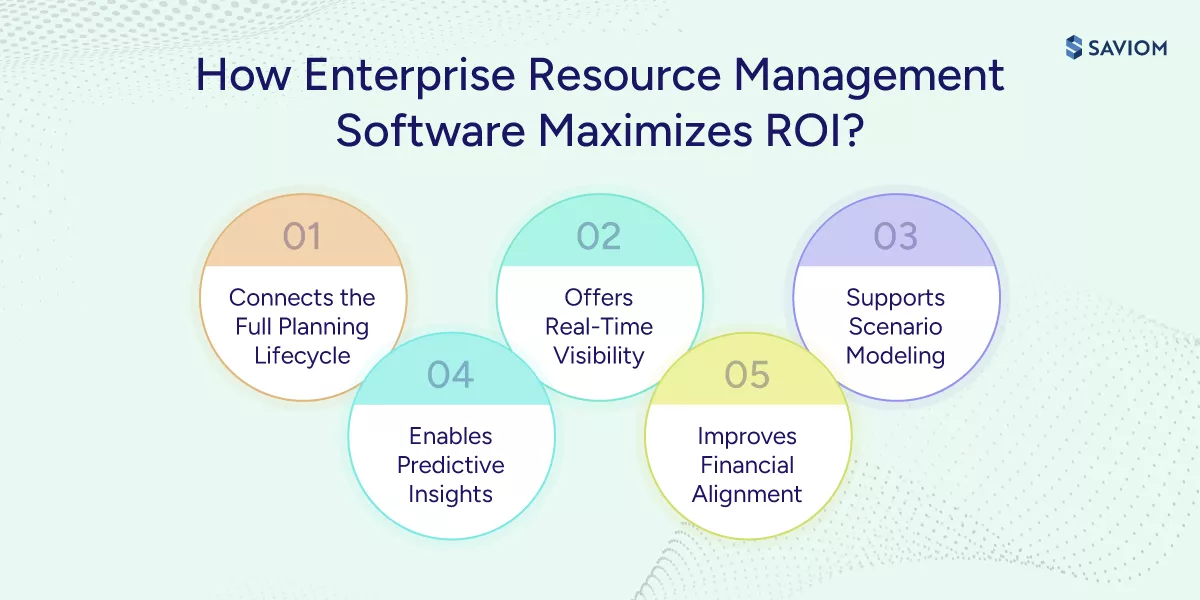
Connects the Full Planning Lifecycle
An integrated platform connects demand, capacity, allocation, utilization, and financial outcomes in one unified system. As a result, managers can plan with shared data instead of relying on disconnected tools, spreadsheets, and manual handoffs. This end-to-end visibility reduces fragmentation across departments and helps the business make faster, better-coordinated decisions.
Read this blog to understand why you should not use spreadsheets for resource planning.
Offers Real-Time Visibility
Enterprise resource management software gives decision-makers a current view of resource capacity, availability, and project demand. Decision-makers can quickly identify underutilized resources, address overallocation risks, and balance workloads. This real-time visibility improves both the timing and the quality of resource-related decisions across the organization.
Supports Scenario Modeling
Enterprise resource management software allows teams to test different staffing and demand scenarios before committing resources. Instead of making assumptions, managers can compare outcomes, weigh trade-offs, and choose the most effective path forward. This scenario-based approach improves resource planning confidence, especially when business conditions remain uncertain or change quickly.
Enables Predictive Insights
A robust enterprise resource management software uses historical and current data to anticipate shortages, excess capacity, and utilization imbalance. With these predictive insights, managers can spot issues early and take redeployment, upskilling, or hiring decisions before they affect delivery or performance. As a result, the organization moves from reactive management to proactive resource optimization.
Improves Financial Alignment
Enterprise resource management software connects workforce decisions directly to revenue, cost, and profitability outcomes. This connection helps managers understand how resource choices affect financial performance at both the project and business levels. In turn, they can track ROI more consistently and make smarter decisions that support long-term growth.
Read this blog to learn how to select the right resource management software.
Next, let us see how SAVIOM can prove beneficial for organizations that wish to achieve a measurable return on investment.
How Can SAVIOM Help You Achieve Measurable ROI?
SAVIOM helps organizations achieve measurable ROI by enabling end-to-end visibility across resource capacity, demand, and utilization. Its data-driven approach allows businesses to identify inefficiencies, optimize allocation, and improve billable utilization. The following features highlight how SAVIOM’s capabilities translate into tangible and sustained business value.
- All-in-One Resource Planner: Provides a unified view of resource data, enabling better visibility and more informed decision-making across teams.
- Embedded Capacity Planner: Supports forward-looking planning and helps identify capacity gaps early, reducing reactive decision-making.
- KPI Forecaster: Provides real-time insights into critical resource management metrics, including availability, utilization, burnout, and skill gaps.
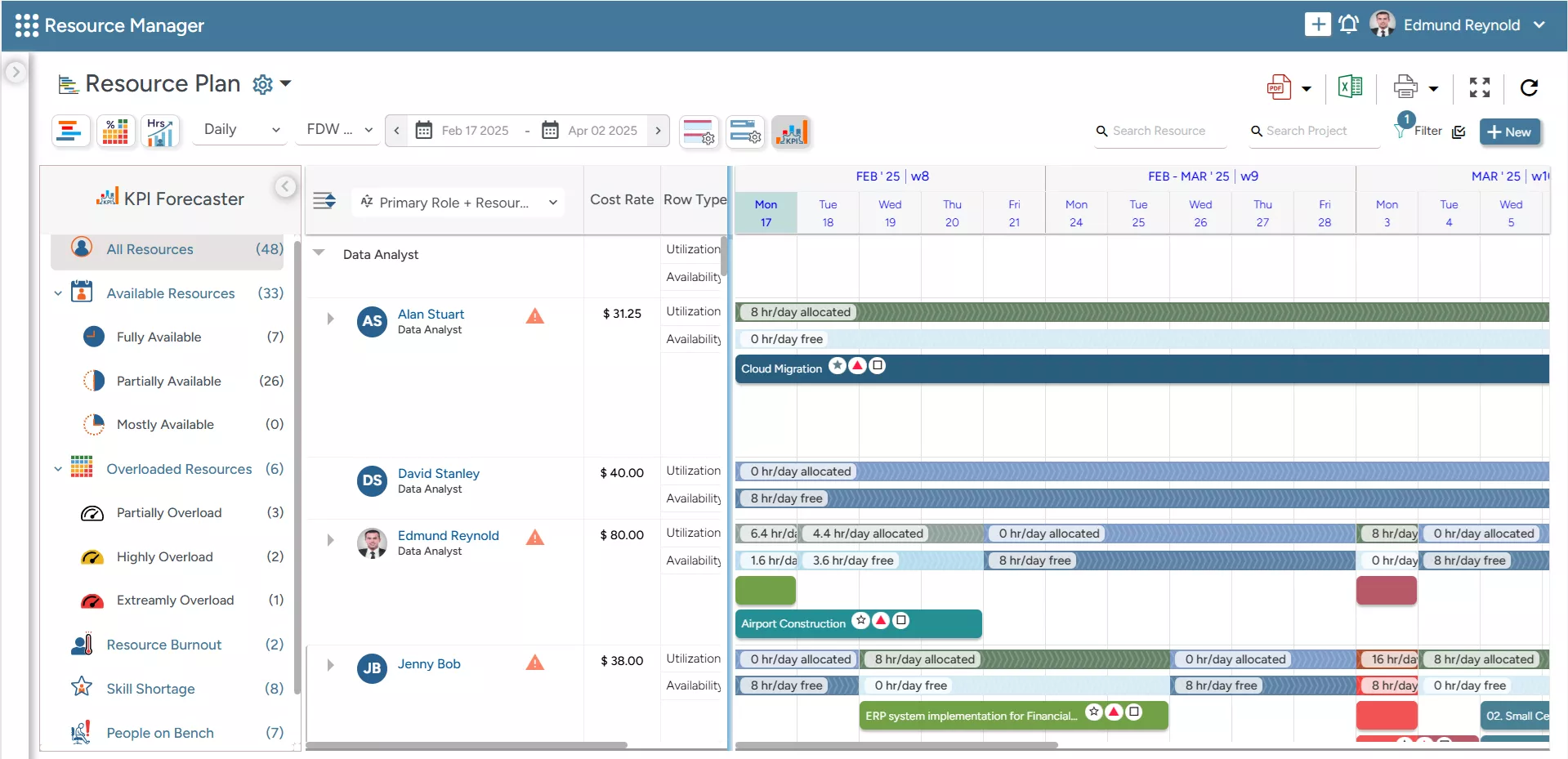 SAVIOM’s KPI Forecaster enables managers to track crucial resource metrics in real-time, allowing them to take proactive, data-driven resourcing decisions.
- Embedded Utilization Heatmaps: Visual indicators highlight over- and underutilization, enabling quick adjustments that improve employee productivity and reduce bench time.
- Intelligent Matchmaking: Ensures each project is staffed with the best-fit resources based on their skills, roles, experience, cost, etc., ultimately improving delivery quality.
- Competency Matrix: Centralizes skills, experience, and certifications, enabling managers to assess skill readiness and identify gaps.
- Real-Time BI Reports and Dashboards: Delivers insights into performance metrics such as utilization, project vacancies, and forecast accuracy, strengthening ROI tracking.
- What-If Analysis: Allows simulation of multiple scenarios to identify optimal resource plans and improve decision-making under uncertainty.
Explore how SAVIOM enables better resource planning, improves utilization, and drives higher profitability. Book your free demo today.
 Lastly, let us go through the checklist that decision makers must follow.
Resource Management ROI Checklist for Decision Makers
A resource management ROI checklist helps decision makers evaluate investments with greater clarity and confidence. It ensures that all critical factors are thoroughly considered. By following a structured checklist, organizations can avoid gaps in analysis and strengthen their decision-making process.
| Category | Checkpoints | |
|---|---|---|
| Current-State Assessment | Have you identified utilization gaps and inefficiencies across teams and roles? | |
| Can you measure bench time, idle capacity, and staffing delays accurately? | ||
| Do you have visibility into skills, availability, and demand across the organization? | ||
| Financial Readiness | Can you quantify lost revenue from underutilization and wasted workforce costs? | |
| Have you modeled potential gains using conservative assumptions? | ||
| Can you compare expected benefits against total investment costs clearly? | ||
| Planning Readiness | Can you forecast demand accurately across the pipeline and delivery? | |
| Can you align capacity with the expected workload effectively? | ||
| Can you identify future skill shortages early? | ||
| Organizational Readiness | Do you have executive sponsorship for the initiative? | |
| Are key stakeholders aligned on goals and expectations? | ||
| Is there a clear adoption and governance plan in place? |
Conclusion
Resource Management ROI is no longer optional; it’s a critical lens for evaluating how effectively organizations convert workforce capacity into business value. When approached systematically, even small improvements in utilization, planning, and visibility can generate significant financial returns.
The key lies in translating operational inefficiencies into measurable outcomes, building a credible business case, and sustaining value through disciplined execution. Organizations that succeed in this journey gain not just cost efficiency, but a scalable advantage in delivery performance and profitability.
Resource Management ROI FAQs
A good ROI depends on current inefficiencies, but even a 3–5% utilization improvement can generate significant financial returns in most organizations. Organizations that combine better visibility, standardized planning, and proactive forecasting often achieve the highest ROI.
Most organizations begin to see ROI from resource management software within the first few months of implementation, with meaningful returns typically realized within the first year. Early gains often come from improved visibility, faster staffing decisions, and reduced bench time.
Utilization improvement is measured by comparing the percentage of productive or billable time before and after implementing better resource management practices. It shows how effectively your workforce is being deployed on value-generating work.
Yes, Resource management ROI is measurable across most industries, including IT, professional services, audit and accounting and construction. While the specific metrics may vary, organizations can still quantify improvements in utilization, cost control, and planning efficiency.
Key metrics include:
1. Resource utilization rate
2. Bench cost
3. Billable hours
4. Project margin
5. Contractor spends
6. Resource forecast accuracy
7. Staffing cycle time
The common challenges in justifying resource management challenges are:
1. Lack of measurable baseline data
2. Difficulty quantifying benefits
3. Resistance to change
4. Siloed ownership across functions
5. Overstated ROI assumptions
Below are the best practices to strengthen the business case:
1. Use data-driven assumptions
2. Start with pilot use cases
3. Benchmark against industry standards
4. Include financial and operational benefits
5. Model conservative, expected, and upside scenarios
6. Tie the narrative to executive priorities