

Introduction
The difference between smooth project execution and constant firefighting often comes down to one thing: planning. Even meticulously crafted plans collapse without clear visibility into future work and team availability. Result? Employee burnout, project delays, and budget overruns.
This is where resource forecasting vs. resource capacity planning becomes essential. Although both are often used interchangeably, they serve different purposes. Resource forecasting helps predict future demand, while resource capacity planning answers a harder question: can your existing workforce actually deliver it?
In this article, we break down the differences, explore when each approach matters most, and offer a practical way to align them for enterprise-scale planning.
What is Resource Forecasting?
Resource forecasting is the process of predicting future resource requirements, such as skills, equipment, time, budget, etc., based on historical data, project pipelines, and current workloads, to support timely and cost-effective delivery.
The resource capacity forecasting process involves:
- Analyzing historical data and current workloads to identify demand patterns.
- Evaluating the sales pipeline and business plans to anticipate resource needs.
- Estimating demand based on skills, roles, and efforts.
- Mapping demand across specific timelines or project phases.
- Continuously refining forecasts based on new data and changing priorities.
Now that we have established the resource forecasting definition and its process, let us understand capacity planning.
What is Resource Capacity Planning?
Resource capacity planning is a strategic process used to assess available capacity, such as people, equipment, tools, and budget, and align it with current and future project demands. This enables organizations to make informed staffing decisions, ensure optimal utilization, and deliver projects on time.
The resource capacity planning process involves:
- Assessing capacity based on resource availability, schedules, and skills.
- Comparing available capacity with resource demand.
- Identifying resource shortages and excesses.
- Planning reallocation, upskilling, or hiring as needed.
- Adjusting resource plans based on changing priorities or demand.
Having defined the resource capacity planning meaning, let us focus on the critical dimension, i.e., the difference between resource forecasting and capacity planning.
Resource Forecasting vs. Resource Capacity Planning: Key Differences
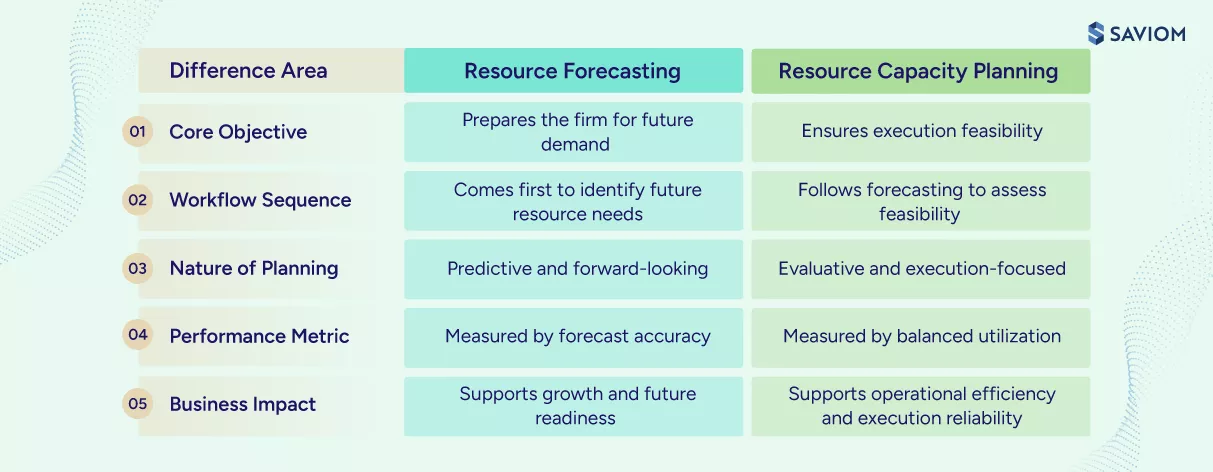
Resource forecasting and resource capacity planning are two sides of the same coin, yet they operate differently throughout the planning process. Understanding how they differ enables organizations to make more informed, balanced, and execution-ready decisions.
Core Objective: Planning Ahead vs. Ensuring Execution Feasibility
Resource forecasting helps organizations prepare for future work by estimating upcoming demand and possible shifts in resource needs. Resource capacity planning, in contrast, ensures that this planned or forecasted work can actually be delivered using available people, tools, and equipment. Together, they bridge the gap between strategic planning and operational reality.
Focus Area: Anticipating Demand vs. Managing Supply
Resource forecasting focuses on the demand side by identifying future workloads based on project pipelines and expected business activity. Resource capacity planning focuses on the supply side by evaluating available resources and determining how efficiently they can meet that demand. This distinction helps organizations align demand with available capacity.
Learn what underutilization of resources is and effective ways to mitigate it.
Workflow Sequence: Forecasting Insights vs. Capacity-Based Execution
Resource forecasting comes first, as it helps organizations understand what skills and capacity may be needed in the future. Resource capacity planning is followed by assessing whether those needs can be met with the current workforce. This sequence ensures that decisions are based on both anticipated demand and the feasibility of actual delivery.
Nature of Planning: Predictive vs. Evaluative
Resource forecasting is predictive because it relies on historical data, trends, and sales pipeline insights to estimate future demand. Capacity planning is evaluative because it uses current resource availability and workloads to determine whether the organization can handle that demand. This makes forecasting more forward-looking and capacity planning more execution-focused.
Level of Planning Detail: High-Level vs. Execution-Level
Resource forecasting usually works at a broader level, focusing on roles, skills, departments, or time periods rather than specific individuals. Resource capacity planning is more detailed, looking at individual availability, current assignments, and workload distribution. Together, they provide both strategic visibility and operational precision.
Risk Focus: Demand Uncertainty vs. Capacity Constraints
Without resource forecasting, organizations risk being unprepared for future demand, leading to sudden shortages, rushed hiring, or missed opportunities. Without resource capacity planning, teams may face overload, underutilization, or missed deadlines because available resources are not aligned with actual work. Both are essential for reducing planning and delivery risks.
Read our blog on resource risks and learn strategies to mitigate them effectively.
Output: Demand Plans vs. Allocation Plans
Resource forecasting produces outputs such as future resource requirements and role or skill projections that support future planning. Capacity planning supports allocation plans, upskilling, or hiring projections that support execution. These outputs serve different but connected stages of the resource planning process.
Performance Metrics: Forecast Accuracy vs. Capacity Utilization
The success of resource forecasting is measured by how accurately predicted demand matches actual workload over time. The success of resource capacity planning is measured by how effectively resources are utilized, with balanced workloads and realistic delivery expectations. Together, they help ensure that the right resources are available and used effectively.
Explore key resource management metrics that firms must track to ensure optimal project performance.
Impact on Business Outcomes: Growth vs. Efficiency
Resource forecasting supports growth by helping organizations prepare for new opportunities, future projects, and scaling needs in advance. Resource capacity planning supports efficiency by optimizing resource use, preventing bottlenecks, and improving delivery performance. Together, they ensure operational excellence.
Now that we have established the difference between resource forecasting vs. resource capacity planning, let us shift our focus to choosing the right approach at the right time for maximum operational efficiency.
When to Use Resource Forecasting and Resource Capacity Planning?
Resource forecasting and resource capacity planning serve complementary roles in demand management, workforce planning, and project execution. Understanding when to use each helps organizations maintain operational efficiency, avoid resource imbalances, and achieve better project outcomes.
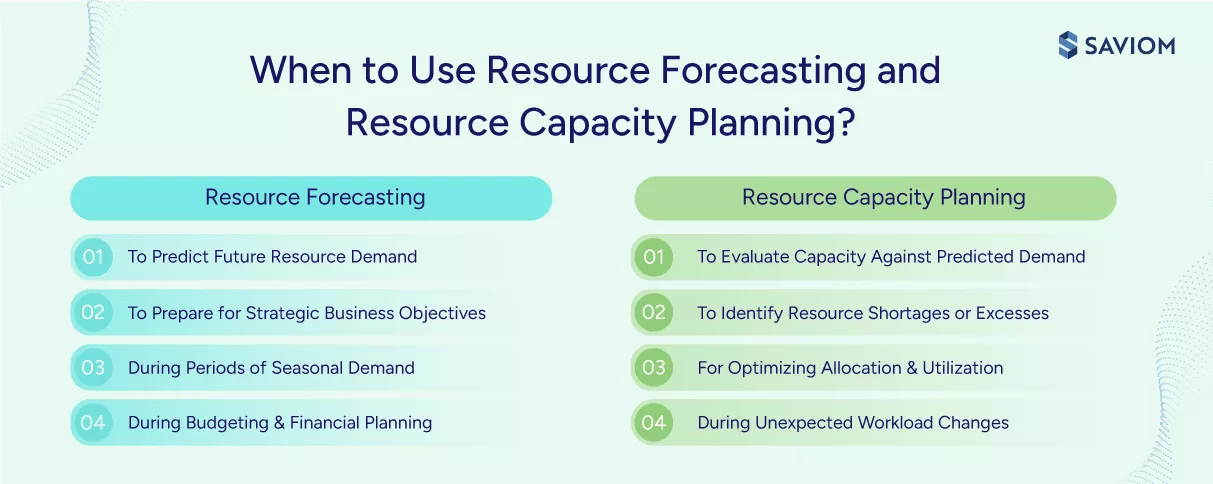
When to Use Resource Forecasting?
Resource forecasting is used to identify future resource needs early in the project planning cycle. It enables organizations to stay ahead of demand, reduce uncertainty, and build a more predictable and scalable delivery model. Common situations include:
- When evaluating pipeline-to-capacity alignment: Forecasts expected demand from the sales pipeline to determine whether future opportunities can be supported with available or planned resources.
- When preparing for strategic business changes: Anticipates resource implications of mergers, restructuring, product launches, or major transformation initiatives.
- When prioritizing projects across the portfolio: Forecasts demand across multiple initiatives, helping leadership make informed decisions about which projects to pursue or delay.
- When managing seasonal or cyclical demand: Predicts workload spikes during peak periods, enabling organizations to prepare resources ahead of time and maintain service quality.
- When budgeting and financial planning are underway: Provides insights into future staffing costs and resource investments, helping finance teams align budgets with expected demand.
When to Use Resource Capacity Planning?
Resource capacity planning assesses whether available resources can meet current and future work demands. It helps organizations make informed allocation decisions, prevent resourcing bottlenecks, and ensure project commitments remain realistic and achievable. It is especially useful in the following situations:
- When evaluating current workload against available capacity: Assesses whether existing resources can handle ongoing commitments without overloading teams or impacting delivery timelines.
- When identifying resource shortages or excess availability: Compares upcoming demand with available capacity to highlight shortages or surpluses, enabling timely adjustments, such as retraining/upskilling, or planned hiring.
- Before allocating resources to active projects: Helps identify the best-fit resources based on availability, skills, and current assignments to ensure efficient and realistic allocation decisions.
- When teams are consistently overutilized or underutilized: Highlights workload imbalances and supports redistribution of work to optimize resource utilization, prevent employee burnout, and reduce bench time.
- When responding to unexpected changes in workload: Re-evaluates capacity in real time to adapt to shifting priorities, new projects, or sudden resource unavailability.
Read our blog to learn ways to measure resource capacity and demand for successful project delivery.
For practical insights into resource capacity planning, dive into our comprehensive eBook.
Having understood when organizations should use resource forecasting vs. resource capacity planning, we will now learn how they work together.
How Do Resource Forecasting and Capacity Planning Work Together?
Resource forecasting and capacity planning work together to balance demand and supply. Understanding how they work together helps organizations bridge the gap between what is needed and what can actually be delivered.
The End-to-End Workflow
Organizations that achieve consistent project delivery outcomes follow a structured workflow that connects forecasting insights with execution decisions, ensuring effective resource management. Each layer ensures that demand is validated, resources are aligned, and plans remain realistic throughout the project lifecycle.
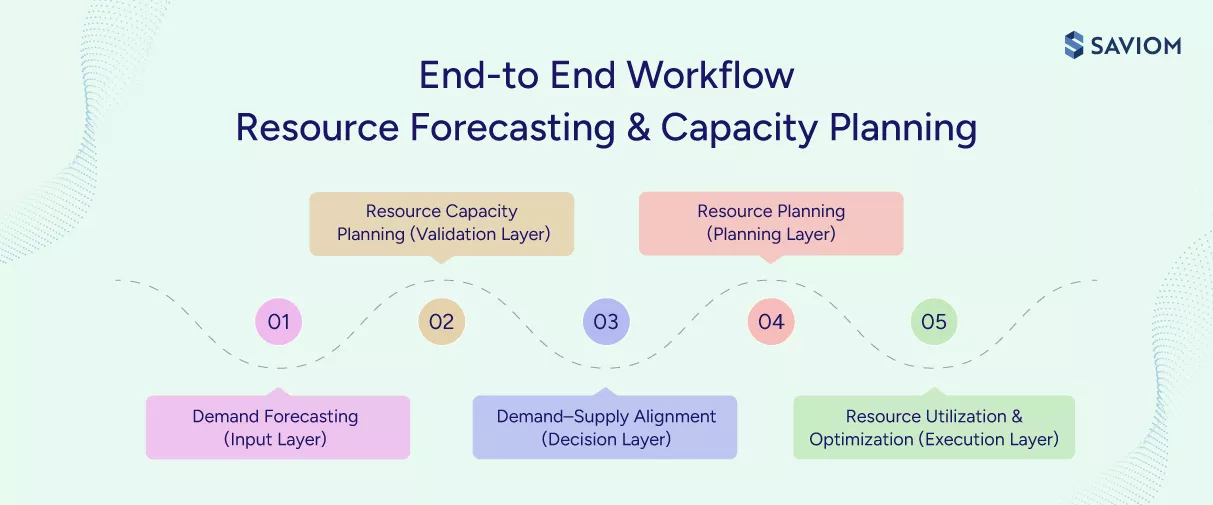
- Demand Forecasting (Input Layer): Captures future resource demand using pipeline visibility, historical data, and strategic priorities, creating a forward-looking baseline for planning decisions.
- Resource Capacity Planning (Validation Layer): Assesses whether available capacity can meet forecasted demand, highlighting resource constraints and enabling proactive decision-making.
- Demand–Supply Alignment (Decision Layer): Refines plans by matching forecasted needs with capacity realities, ensuring only feasible resource plan moves forward.
- Resource Planning (Planning Layer): Allocates resources effectively by matching skills and availability with project requirements, enabling smooth execution.
- Resource Utilization & Optimization (Execution Layer): Continuously tracks and optimizes resource usage to prevent overutilization, minimize bench time, and maintain productivity.
Why You Need Both (Not Either/Or)
Resource forecasting and resource capacity planning are interdependent and deliver maximum value only when used together. Forecasting without capacity validation remains incomplete, as estimating future demand does not guarantee it can be fulfilled. Conversely, relying solely on capacity planning leads to reactive decisions, as resources are managed without a clear view of future demand.
While resource forecasting defines future demand for talent, tools, and equipment, resource capacity planning ensures that available resources can realistically meet that demand. Together, they create a seamless flow from demand anticipation to execution feasibility, aligning strategic planning with operational delivery and improving overall efficiency, utilization, and project outcomes.
So far, we have established the distinction between resource forecasting and resource capacity planning in the project lifecycle. In the next section, we shall explore key mistakes firms make when implementing these processes.
Common Mistakes Firms Make When Implementing Resource Forecasting & Capacity Planning
Even mature organizations struggle not with concepts, but with mistakes in applying forecasting and capacity planning, which often result in misaligned decisions and reduced planning effectiveness. Here are some common mistakes that firms make:
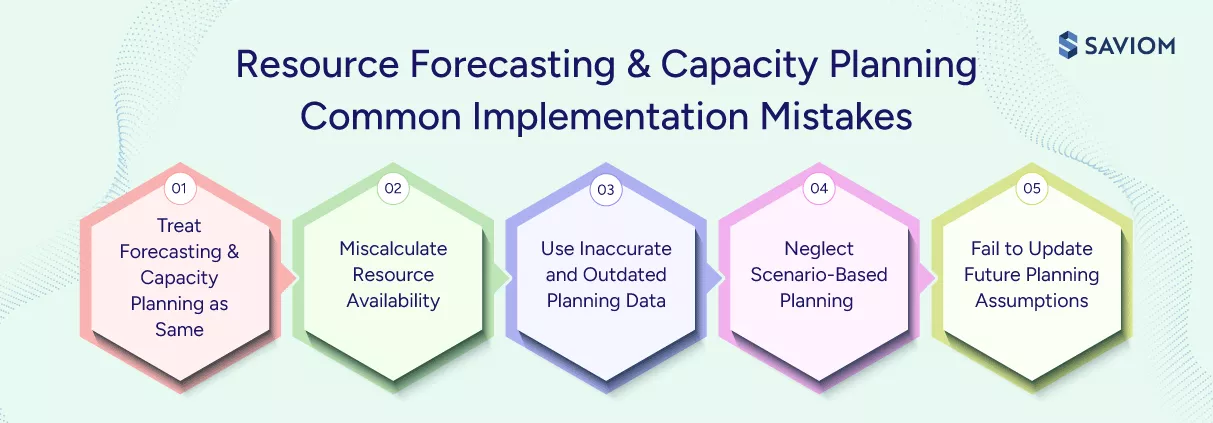
Considering Forecasting & Capacity Planning as Interchangeable
Many organizations treat resource forecasting and resource capacity planning as interchangeable processes, assuming they address the same planning needs. This misunderstanding leads to misaligned efforts, where demand is either estimated without pipeline visibility or capacity is managed without validating availability. As a result, planning becomes unstructured.
Miscalculating Resource Availability Risks
Firms often build resource forecasting and capacity planning assumptions as if the workforce will remain fully available and stable. In reality, resource availability can be affected by unexpected absences or unplanned attrition. Ignoring these risks makes forecasts overly optimistic and reduces the accuracy of capacity plans. As a result, firms struggle with last-minute firefighting and subsequent delays.
Relying on Inaccurate and Outdated Planning Data
When organizations rely on outdated utilization figures, incomplete skill inventories, or inaccurate availability data, the entire planning process becomes unreliable. This creates a disconnect between projected demand and actual resource capacity. The result is often inefficient utilization, poor staffing decisions, cost overruns, and reduced trust in the planning process across leadership.
Neglecting Scenario-Based Planning
According to the Financial Times, “Many organizations fall into ‘wishful thinking’ by relying on one future model instead of multiple scenarios.”
Firms often rely on a single scenario planning simulation, which often increases the risk of project execution disruptions. When businesses lack the foresight to prepare for demand fluctuations or unexpected changes in project scope, they are less able to respond quickly and effectively. This leads to reactive staffing decisions, resulting in higher project costs and delayed delivery.
Failing to Adjust Assumptions Based on Future Planning
Firms often continue using outdated planning assumptions even when actual delivery outcomes clearly highlight gaps and inaccuracies. This disconnect leads to repeated forecasting errors and persistent capacity mismatches, as planning decisions are based on conditions that no longer reflect reality. Over time, this results in ineffective decision-making and poor resource allocation processes.
In the next section, we will explore why firms need an advanced resource capacity planning solution to overcome these challenges effectively.
Tools and Software for Resource Forecasting and Capacity Planning
Without the right tools, even well-defined forecasting and capacity planning processes struggle to deliver accurate and actionable outcomes. Manual efforts often lead to errors, delays, and inconsistent planning results. This makes it critical to understand where legacy tools fall short and what modern solutions offer.
Why Legacy Tools Fail During Planning?
Legacy tools rely on static data and manual inputs, which makes it hard for organizations to keep up with changing demand and shifting business needs. As a result, planning often becomes disconnected from execution, creating gaps between what is expected and what teams can realistically deliver. The lack of real-time visibility into availability and resource utilization further reduces the accuracy of capacity planning.
Moreover, without scenario-based forecasting, firms cannot effectively plan for best-, expected-, and worst-case demand scenarios. In addition, poor integration with systems such as project management and finance creates data silos and inconsistent inputs. Together, these limitations make planning more reactive, fragmented, and unreliable.
Learn seven reasons why Excel should not be used for resource planning in firms.
What Advanced Resource Capacity Planning Software Offers?
Firms must use robust resource capacity planning software like SAVIOM, which offers next-gen capabilities that help plan demand accurately, align supply effectively, and execute projects efficiently. Let us look into the critical features that enable the same:
- All-in-One Resource Planner: Provides a comprehensive view of current and future pipeline projects and resource data, enabling managers to make informed, data-driven decisions.
- Embedded Capacity Planner: Compares resource capacity and demand to identify shortages/excesses and implement course-corrective measures.
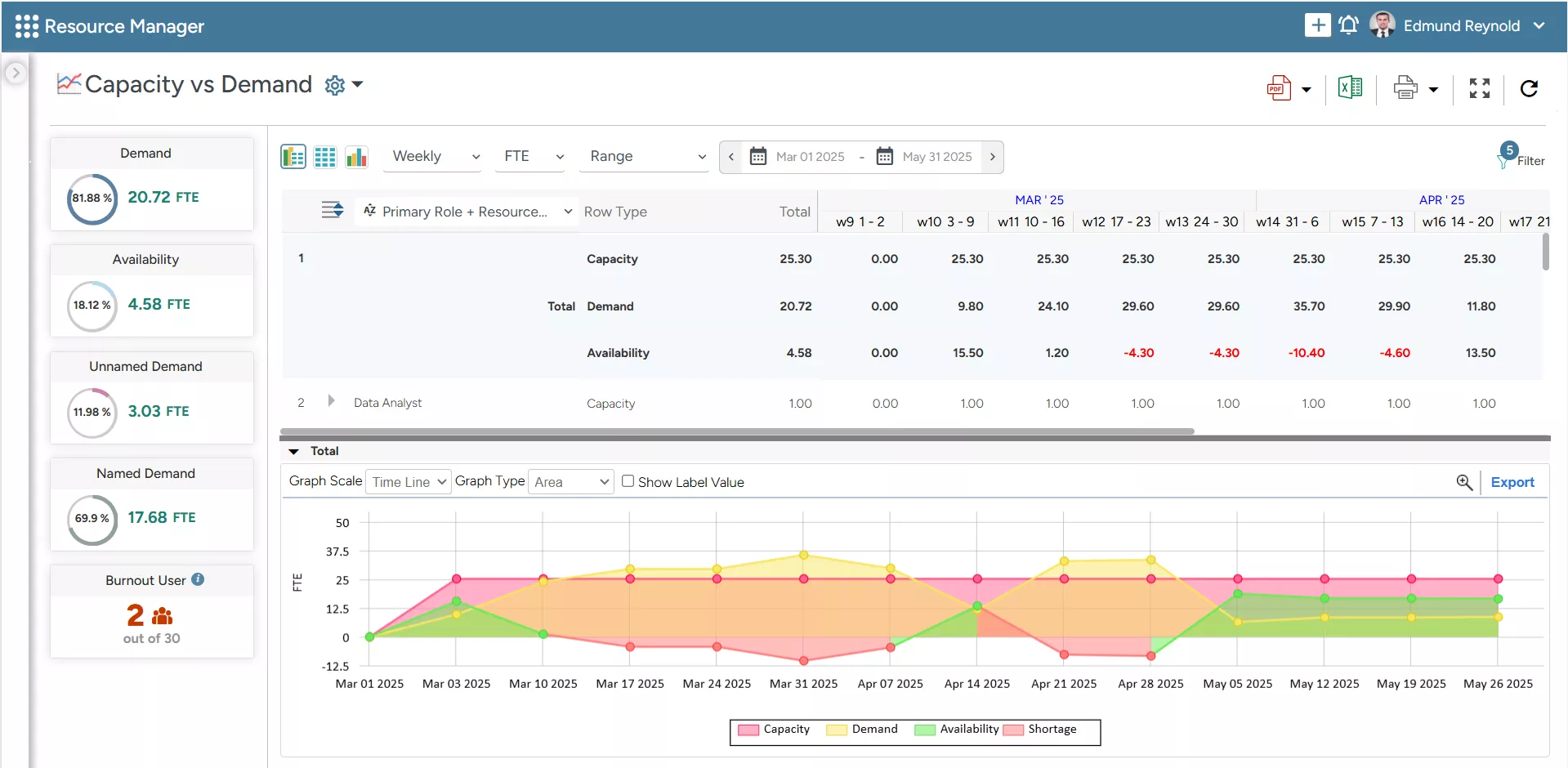 SAVIOM’s Capacity vs. Demand Graph enables managers to quickly spot resource shortages or excesses and take timely action to balance supply and demand.
- KPI Forecaster: Provides up-to-date insights into resource availability and utilization, empowering managers to adjust resource plans accordingly.
- Embedded Resource Heatmaps: Highlights resource over-/underutilization with color-coded heatmaps, enabling managers to ensure fair workload distribution.
- Intelligent Matchmaking: Assigns resources to tasks by evaluating skills, availability, and other key factors, ensuring precise and effective allocation decisions.
- Early Warning Signals: Identifies issues like overallocation of resources and scheduling conflicts early, helping teams protect timelines and avoid last-minute disruptions.
- Competency Matrix: Helps track and record each employee’s skills, competencies, experience, etc., enabling managers to identify gaps and plan upskilling initiatives or hiring.
- Real-Time Business Intelligence: Provides real-time reports and analytics on utilization, project vacancy, people on the bench, and more, facilitating smooth resource capacity planning.
- Scenario Modeling: Helps simulate and compare multiple forecasting scenarios under various constraints, such as budget, availability, scope changes, etc., to arrive at the most feasible and cost-efficient resource plan.
Explore how SAVIOM’s 5th gen resource management solution helps streamline forecasting and capacity planning processes. Book your demo now!

In the final section, we will understand how resource forecasting vs. resource capacity planning work across different industries.
Real-World Applications of Resource Forecasting and Capacity Planning
Different industries face unique planning challenges, and resource forecasting and capacity planning play a critical role in addressing these in practical, real-world contexts. Here’s how:
Professional Services Firms
Professional services firms operate in a highly dynamic, billable environment where multiple client engagements run simultaneously, often competing for the same pool of skilled resources. This makes it difficult to maintain optimal staffing levels without creating either shortages or excesses. The challenge is further compounded by fluctuating demand across sales pipelines, along with tight deadlines.
Resource forecasting enables firms to anticipate demand across upcoming engagements and identify required skills and billable capacity in advance. Moreover, resource capacity planning then ensures that the available workforce can realistically meet this demand, supporting efficient utilization, preventing overbooking, and minimizing bench time.
IT Services Firms
IT services firms operate in an environment shaped by dynamic demand, rapidly evolving client requirements, and iterative delivery models such as Agile. This makes resource needs highly variable, as priorities shift frequently, and projects require different technical skills at different stages. Managing this variability becomes challenging without overloading resources or compromising delivery timelines.
Forecasting allows firms to predict demand for specific technical skills based on project pipelines and technology needs. Capacity planning then ensures that teams have sufficient bandwidth and the right skill mix to support these changing workloads. This results in balanced resource utilization and consistent delivery.
AEC Firms (Architecture, Engineering, and Construction)
Projects in AEC firms are long-term and phase-driven, with multiple initiatives running across design, planning, and execution stages. These phases often overlap and compete for the same specialized roles across sites. This makes it difficult to ensure the right expertise is available at the right time without delays, conflicts, or inefficient resource deployment.
Forecasting enables firms to estimate resource requirements for each stage in advance, providing a clear view of future demand. Capacity planning then ensures that critical roles are available when needed. This helps organizations prevent shortages, reduce delays, and enable more efficient allocation of specialized resources across projects.
Audit, Accounting, and Legal Firms
Firms in audit, accounting, and legal domains operate in highly cyclical and deadline-driven environments, where peak periods such as audits, tax seasons, and legal proceedings create sharp spikes in demand. These fluctuations are often time-sensitive and require specialized expertise, making it challenging to maintain balanced workloads or risk delays during critical periods.
Resource forecasting helps anticipate these spikes and plan the required expertise in advance, while capacity planning ensures the availability of skilled professionals. Together, they enable balanced work distribution, prevent overutilization, and support timely delivery during peak periods.
Conclusion
Choosing between resource forecasting and resource capacity planning is not about selecting one over the other. It is about understanding how each supports a different stage of effective resource planning. Resource forecasting helps organizations anticipate future demand, while resource capacity planning ensures that available resources can meet that demand in a realistic and sustainable way.
When used together, they create a more balanced and reliable planning approach, one that combines strategic foresight with execution readiness. This enables organizations to make smarter staffing decisions, improve resource utilization, reduce delivery risks, and respond more confidently to changing business needs.
Resource Forecasting vs. Resource Capacity Planning FAQs
Resource capacity planning is the process of assessing available resources and aligning them with project demands to ensure optimal utilization, prevent overloading, and support timely project delivery.
Resource forecasting is the process of estimating future resource needs, such as skills, time, and budget, based on historical data, current workloads, and project pipelines to ensure projects are delivered efficiently.
Resource forecasting predicts future resource demand based on pipeline, trends, and expected work, while resource capacity planning evaluates available resources to meet that demand. In short, forecasting focuses on what is needed, whereas capacity planning focuses on what is possible.
You can use resource forecasting to predict future demand and prepare for upcoming resource needs. By contrast, you can use resource capacity planning to assess whether available resources can meet current or near-term work demands. In simple terms, forecasting helps you plan ahead, while capacity planning helps ensure that work can be delivered effectively.
Yes, resource forecasting and capacity planning are complementary. Forecasting identifies future demand, while capacity planning ensures resources are available to meet that demand, creating a balanced planning approach.
No. Resource forecasting is not a part of capacity planning, but the two are closely connected. Forecasting focuses on predicting future resource demand, while capacity planning evaluates whether available resources can meet that demand. In practice, forecasting often comes first and informs capacity planning, but each serves a distinct purpose in the planning process.
Resource forecasting helps organizations anticipate future workload, resource needs, and skill requirements before work begins. By using historical data, pipeline visibility, and expected demand patterns, it enables more realistic staffing and scheduling decisions. This reduces the risk of resource shortages, overcommitment, and last-minute