

Introduction
“Agile teams produce a continuous stream of value, at a sustainable pace, while adapting to the changing needs of the business.” – Elisabeth Hendrickson
Rightly said! This quote encapsulates the core of agile methodology: consistently delivering value while staying adaptable to changing demands. Central to this flexibility is agile capacity planning, a vital practice that helps businesses align resources with product backlogs and achieve successful project outcomes.
When done right, agile capacity planning gives managers clear visibility into resource availability and workload. It enables proactive responses to demand changes across sprints, ensures timely skill-based allocation, and maintains balanced workloads without burnout. The result is higher productivity and consistently high-quality sprint outcomes.
This blog delves into the details of agile resource capacity planning, covering its benefits, challenges, and practical tips for effective implementation.
What is Agile Capacity Planning?
Agile capacity planning is the process of comparing project demand with available team capacity to determine how much work can be realistically completed in a sprint or iteration.
It involves estimating resource availability by factoring in workloads, skills, sprint backlog, planned time off, and iteration length. The primary objective of agile capacity planning is to set realistic sprint deadlines, optimize resource utilization, and meet project goals.
Read our resource capacity planning eBook to learn how to plan capacity accurately, avoid overcommitment, and deliver predictably.

Now that you know the definition, let’s explore the benefits of agile capacity planning.
Why Agile Capacity Planning Matters for Successful Project Delivery?
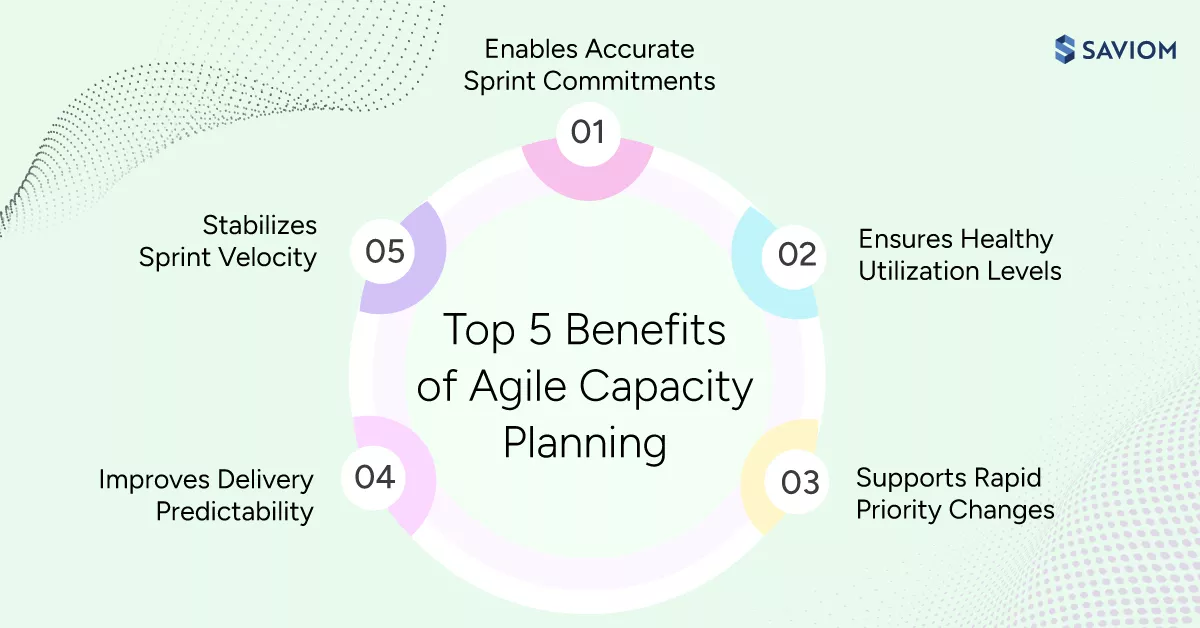
Capacity in agile methodology determines how much work teams can realistically commit to in each sprint. The following benefits explain how agile team capacity planning helps organizations meet sprint delivery goals:

Enables Accurate Sprint Commitments
This agile, capacity-based planning approach enables teams to commit to sprint-specific demands based on real-time availability and capacity, rather than on assumptions. Accordingly, managers can conduct capacity vs. demand analysis to secure suitable resources upfront. This helps reduce backlog work, minimizes mid-sprint planning, and supports smoother project execution with fewer delivery disruptions.
Explore further on the effective steps to measure resource capacity and demand.
Optimizes Utilization Without Overloading Teams
Capacity-driven planning ensures utilization is optimized without pushing teams beyond sustainable limits. It brings visibility into workload distribution and highlights resource overallocation risks that are often hidden behind average velocity trends. As a result, teams maintain steady output without burnout, thereby improving project delivery consistency and long-term performance.
Supports Faster Response to Changing Priorities
In fast-moving environments, priorities shift constantly. Agile capacity planning gives leaders the visibility needed to respond quickly and confidently to competing priorities. By understanding capacity impact in advance, managers can approve new work, defer lower-value initiatives, and rebalance workloads without disrupting delivery.
Improves Predictability in Delivery Timelines
According to the 17th Annual State of Agile Report, “30-44% of respondents consider delivery predictability as a primary benefit of adopting agile methodologies.”
When sprint demand is aligned with actual workforce availability, timelines become more predictable. Agile capacity planning helps managers prevent chronic overloading and last-minute effort spikes by aligning allocations with actual capacity. This enables teams to execute projects at a steady pace and significantly reduces delivery surprises.
To gain real-time visibility into resource availability and capacity, it’s time to adopt an advanced resource management tool. Book a demo today to see it in action.
Stabilizes Velocity and Reduces Sprint Spillovers

In agile project management, capacity planning helps teams commit to realistic sprints and release goals. When plans are based on real capacity, velocity becomes more stable, unfinished work is reduced, and sprint spillovers are minimized. This reduces last-minute scope negotiations and escalation cycles.
Read in detail about capacity planning and how it improves business efficiency.
Having understood the benefits, the following section includes the key differences between velocity and capacity.
Agile Capacity Planning vs. Velocity-Based Sprint Planning
While velocity shows how fast teams have delivered in the past, capacity planning determines what they can realistically deliver next. Thus, understanding the difference between velocity-based planning and agile capacity planning is critical for predictable, sustainable execution.
| Parameter | Agile Capacity Planning | Velocity-Based Sprint Planning |
|---|---|---|
| Core Basis | Plans are based on the team’s actual available capacity (after leaves, meetings, support work, etc.) | Plans work based on historical velocity (average story points completed in past sprints) |
| Primary Focus | Who is available and for how long | How much work was delivered earlier |
| Impact of Business Decisions | Affected by factors like company policies, sustainability, and ethical practices | Affected by the financial performance of the company |
| Treatment of Availability | Explicitly accounts for individual availability, leaves, holidays, and part-time allocation | Assumes team availability is consistent across sprints |
| Handling of Non-Project Work | Includes time spent on meetings, support, bugs, technical debt, and admin tasks | Often ignored or indirectly absorbed into velocity |
| Accuracy in Changing Team Scenarios | Highly accurate when team composition changes (new joiners, attrition, rotations) | Becomes unreliable when team members change |
| Impact of Unplanned Work | Allows buffer planning for urgent bugs, production issues, and ad-hoc requests | Unplanned work distorts velocity and disrupts sprint commitments |
| Support for Multi-Team Environments | Strong fit for shared resources and cross-team dependencies | Limited effectiveness in shared-resource environments |
Now, let’s explore agile capacity planning effectively in the subsequent section.
How to Perform Agile Capacity Planning (Step-by-Step Process)
Agile team capacity planning is not a one-time activity; it is a continuous process. These steps explain how to assess capacity, align demand, and commit to work with confidence before each sprint.
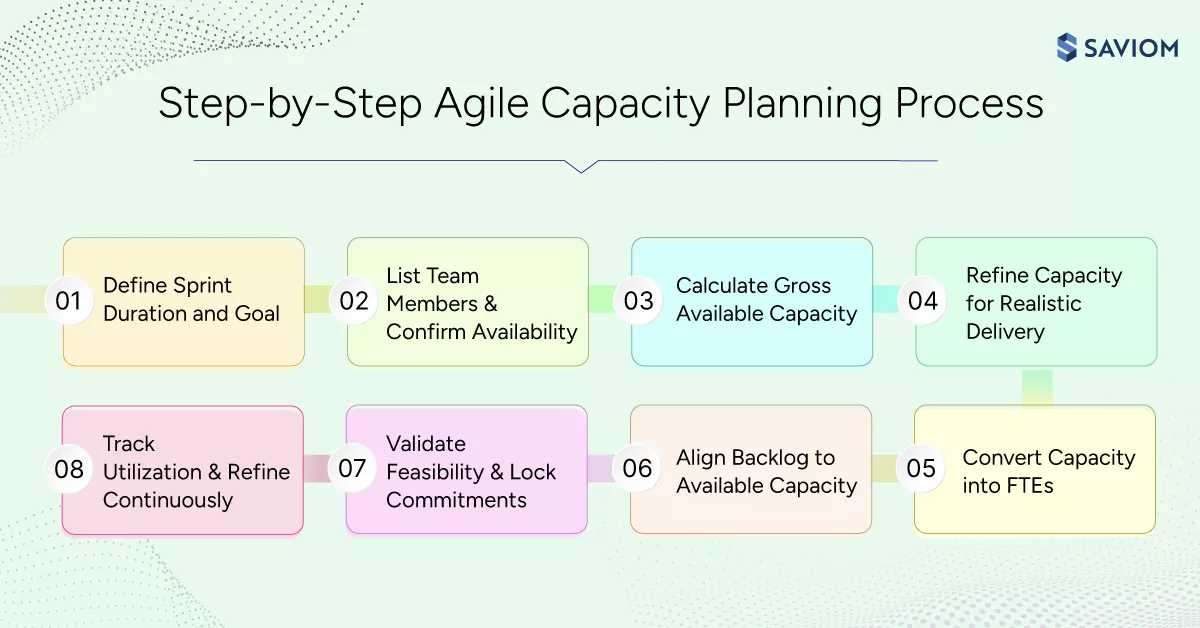
Define Sprint Duration and Goal
The first step is to finalize the sprint length and set clear start and end dates to establish a fixed planning window. While setting the timeline, exclude weekends, holidays, and other non-working days to arrive at a realistic capacity window.
Sprint durations typically range from 1 to 4 weeks, depending on team maturity and project complexity. For example, if an IT development team operates on a 2-week sprint cycle, this results in 10 working days available for planning and execution.
List Team Members & Confirm Availability
Next, identify all team members participating in the sprint and confirm their actual availability. This step is about determining who is in and who is partially in for the sprint.
Factor in:
- Planned time-offs or vacations
- Training sessions or certifications
- Partial resource allocations across other projects or initiatives
Calculate Gross Available Capacity (Time-Based)
Once availability and buffers are clear, the next step is to calculate the gross available capacity based purely on working time. This establishes the maximum theoretical capacity before considering utilization, meetings, or overhead. Let’s understand this with the following agile capacity planning example:
Assume:
- Team size: 5 developers
- Sprint duration: 10 working days
- Working hours: 8 hours per day
Individual capacity:
8 hours/day × 10 days = 80 hours per developer
Total team capacity:
80 hours × 5 developers = 400 hours
At this stage, 400 hours represents the raw available capacity for the sprint.
This number defines the outer boundary for planning, not the actual executable capacity.
Read more on capacity management and its importance.
Refine Capacity for Realistic Delivery
Not all working hours are spent on development or sprint execution. Time is consumed by:
- Daily stand-ups, sprint planning, and retrospectives
- Documentation and administrative work
- Knowledge sharing, mentoring, and reviews
- Cross-functional coordination and support
To account for this, apply an average utilization rate.
Assume utilization = 75%
Productive Capacity = 400 × 75% = 300 hours
This means only 300 hours are realistically available for sprint work.
Learn how to measure resource utilization effectively in our step-by-step guide.
Convert Capacity into FTEs for Standardization
For consistency across teams, programs, and portfolios, capacity is often normalized into FTEs or story points. Let’s understand full-time equivalent (FTE) calculation with an example:
FTE = Total Team Hours / Standard Full-Time Capacity
= 400 / 80 = 5.0 FTE
This step is especially useful in:
- Portfolio-level planning
- Cross-team capacity balancing
- Strategic workforce forecasting
This standardization supports agile capacity management by giving leaders a clear basis to rebalance work across teams and initiatives.
Align Backlog Items to Confirmed Capacity
With realistic, productive capacity now defined, align backlog items accordingly. Prioritize work based on:
- Business value
- Effort and complexity
- Dependencies and sequencing
- Skill availability
Eliminate speculative or stretch commitments that increase risk without a clear payoff. The goal is to load the sprint with work that can actually be delivered, not what looks good on paper.
Validate Feasibility and Lock Sprint Commitment
Review the proposed sprint scope with the full team during sprint capacity planning. Validate feasibility by checking:
- Workload distribution across team members
- Skill coverage for specialized tasks
- Dependency impact and external constraints
If constraints surface, proactively adjust the scope before execution begins. Once aligned, lock the sprint commitment so everyone moves forward with clarity and confidence.
Monitor Capacity Utilization and Refine Continuously
Finally, compare planned capacity with actual utilization at the end of each sprint. Analyze:
- Where capacity was underused or overused
- Recurring bottlenecks or overload patterns
- Skill gaps impacting delivery
Capture these insights into retrospectives or lessons-learned reports. Over time, this continuous feedback loop improves resource forecasting accuracy and strengthens predictability across future sprints.
Read our blog on capacity requirement planning and its types.
In the following section, let’s go through the challenges of agile resource capacity planning.
Agile Capacity Planning Challenges and How to Overcome Them
Even mature agile organizations struggle with capacity planning when real-world complexity increases. Addressing these challenges proactively is essential to ensure successful project delivery:
Failing to Account for Unplanned Work
Challenge: Agile teams routinely face ad-hoc work such as production defects, support requests, stakeholder reviews, and urgent project meetings. When this work is not planned upfront, it silently consumes sprint capacity and delays committed backlog items.
Solution: Reserve explicit capacity buffers based on historical interruption patterns. This allows managers to absorb unplanned work without disrupting sprint goals. Consequently, improving completion rates and ensuring successful delivery.
Inability to Manage Team Dependencies
Challenge: In agile environments, cross-departmental collaboration and distributed teams create dependencies that are often invisible during sprint planning. When these dependencies are unclear, they lead to bottlenecks, delivery delays, and reduced effective capacity.
Solution: Assign clear ownership for cross-team dependencies and handoffs. By defining accountability for each dependency, teams can track progress, resolve blockers more quickly, and avoid delays caused by unclear responsibility assignments.
Lack of Visibility into Actual Team Availability
Challenge: In the absence of real-time visibility into available resources, agile teams often plan sprints based on guesswork rather than data-driven insights. As a result, factors such as leave, shared responsibilities, support work, and partial allocations remain fragmented or undocumented.
Solution: Use a centralized resource management tool to gain real-time visibility into team availability across initiatives. By capturing leave, shared responsibilities, and allocations upfront, managers can plan sprints based on actual availability, prevent overcommitment, and ensure smoother, more predictable execution.
Check out our blog on resource management challenges and solutions.
Poorly Defined Sprint Backlog Tasks
Challenge: When tasks in the backlog lack clarity and have unclear acceptance criteria, it creates estimation errors and ambiguity in project execution. This makes capacity planning unreliable, as effort assumptions do not align with the actual work required.
Solution: Backlog items must be refined with clear scope, validated priorities, and effort estimates. Furthermore, regular backlog grooming sessions ensure work is well-defined before it enters sprint planning, strengthening capacity accuracy.
Resistance to Capacity-Driven Planning
Challenge: Teams accustomed to velocity-only planning may view capacity planning as restrictive or unnecessary. This resistance often stems from misunderstanding its purpose rather than from inefficiencies in the process.
Solution: Managers should use historical sprint data to demonstrate how capacity-driven planning reduces stress and improves predictability. When teams see fewer spillovers and smoother sprints, it ultimately encourages flawless adoption of this process.
Read more on the capacity planning challenges and ways to overcome them.
Let’s move to the next section and discover how organizations can enhance agile capacity planning using SAVIOM.
How SAVIOM Enables Smarter Agile Capacity Planning?
Modern agile environments demand more than static spreadsheets or sprint-level estimates. SAVIOM’s advanced resource management software enables agile teams and managers to plan sprint commitments based on actual capacity, shared visibility, and continuous change. Let’s see how:
- All-in-one resource planner provides 360-degree visibility into ongoing projects, upcoming demand, and team availability, helping agile teams assess sprint feasibility while accounting for competing priorities and shared resources.
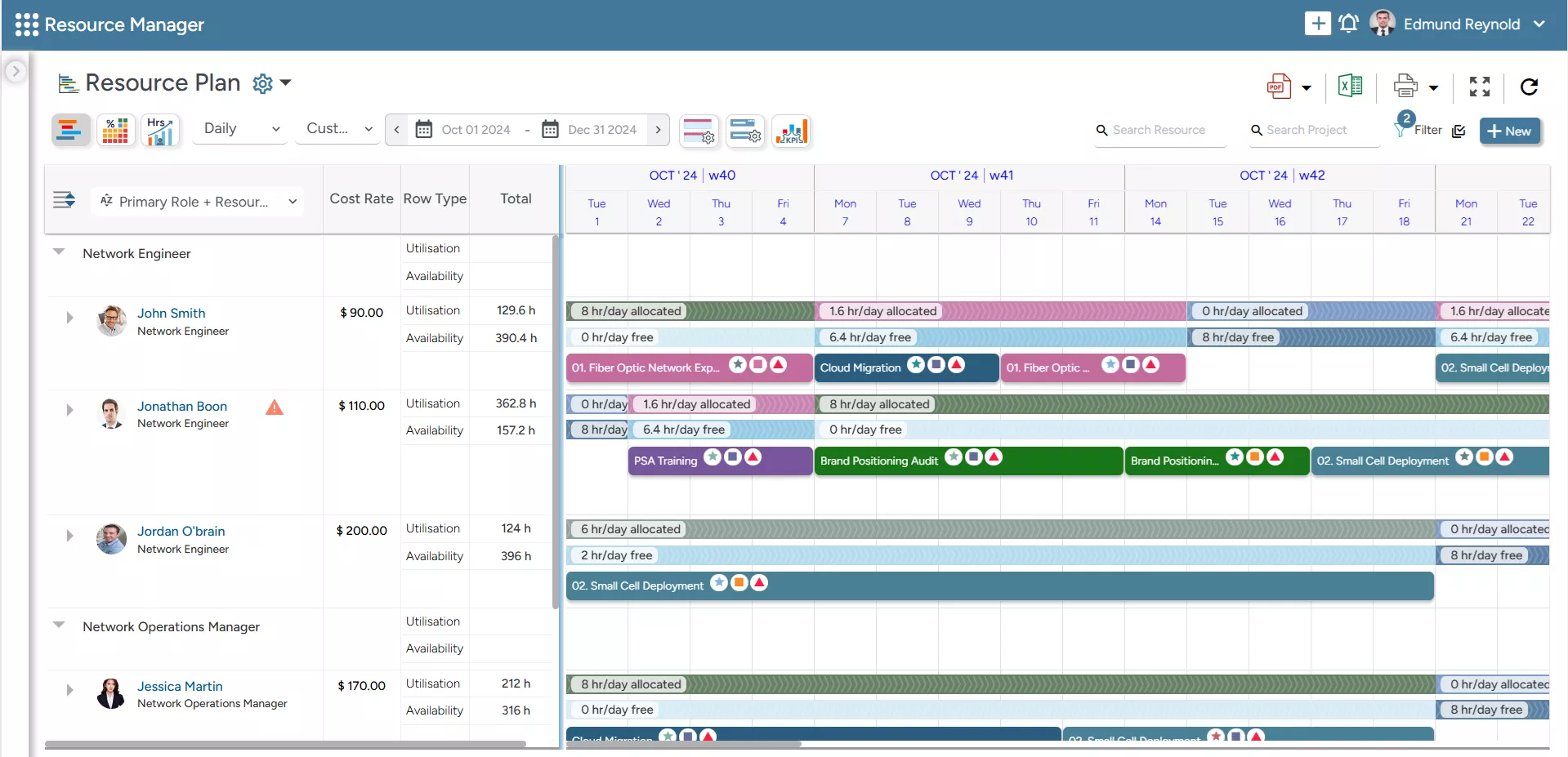 SAVIOM’s All-in-One Resource Planner provides organizations with a holistic view of the resource’s availability, utilization, and capacity, enabling informed decision-making.
- Embedded capacity planner allows teams to forecast demand across sprints, identify skill gaps early, and adjust sprint scope before delivery risks arise.
- KPI forecaster offers insights into resources’ capacity, utilization, availability, and workload, enabling managers to balance delivery goals without overloading any team member.
- A competency matrix enables managers to allocate resources to sprint commitments based on their skills and capabilities. Thus, with a skill matrix, managers can quickly identify and address gaps.
- Embedded resource heatmaps instantly highlight overutilized, underutilized, and constrained resources, enabling faster and more precise sprint planning and reallocation decisions.
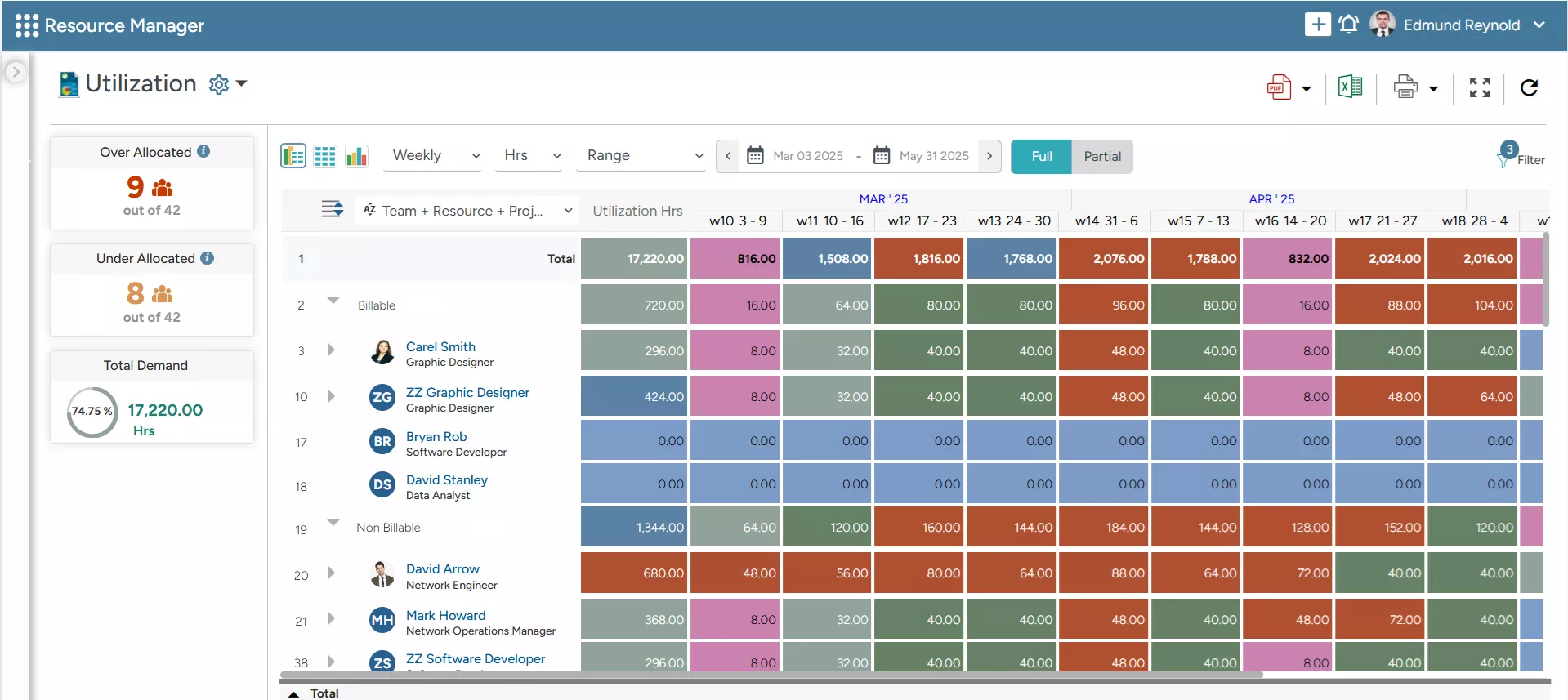 SAVIOM’s Embedded Resource Heatmap helps managers identify over- or underutilized resources and take proactive measures to balance workloads.
- An early warning system flags capacity gaps, skill mismatches, and workload imbalances before they impact delivery. This enables proactive course correction and prevents firefighting.
- Scenario modeling allows managers to simulate what-if scenarios before locking sprint or release commitments, enabling informed decisions instead of reactive compromises.
Read our buyer’s guide to learn how to select the right resource management software.
Conclusion
Agile capacity planning is not planning overhead; it is a maturity lever that enables predictable delivery without sacrificing flexibility. When availability drives commitments, teams reduce spillover work, stabilize utilization, and sustain performance over time.
FAQs (Frequently Asked Questions)
Agile capacity planning is a method to determine realistic sprint workloads based on actual team availability, constraints, and competing demands, thereby improving commitment accuracy and ensuring successful project delivery.
Velocity planning relies on past sprint performance, while agile capacity planning focuses on the team’s actual availability for the upcoming sprint. When used collaboratively, they support more balanced and reliable sprint commitments.
Agile capacity planning helps organizations to:
1. Enable accurate sprint commitments
2. Optimize utilization without overloading teams
3. Support faster response to changing priorities
4. Improve predictability in delivery timelines
5. Stabilize velocity and reduce sprint spillovers
The following are the steps to perform capacity planning for agile teams efficiently:
1. Define sprint duration and goal
2. List team members & confirm availability
3. Calculate gross available capacity
4. Refine capacity for realistic delivery
5. Convert capacity into FTEs for standardization
6. Align backlog items to confirmed capacity
7. Validate feasibility and lock sprint commitment
8. Monitor capacity utilization and refine continuously
Prevalent agile capacity planning challenges include the following:
1. Failing to account for unplanned work
2. Inability to manage team dependencies
3. Lack of visibility into actual team availability
4. Poorly defined sprint backlog tasks
5. Resistance to capacity-driven planning