

Introduction
As organizations grow in scale and complexity, initiatives multiply, creating competing priorities, tighter budgets, and increasing pressure on limited resources. In this environment, the real challenge is not just execution, it’s choosing the right initiatives.
Are the right initiatives being funded?
Are scarce skills concentrated where impact is highest?
Is the portfolio aligned with the long-term strategy—or is it merely reacting to short-term demands?
Project Portfolio Management (PPM) brings structure to these decisions. It provides managers with a framework to evaluate trade-offs, align investments with enterprise strategy, and apply resource management practices that ensure talent is deployed for maximum impact. Instead of managing projects in isolation, PPM ensures every initiative is justified by measurable, strategic value.
In this guide, we will dive deep into the fundamentals of project portfolio management to understand how it helps enterprises translate effort into measurable business value.
Let’s start, shall we?
What is Project Portfolio Management (PPM)?
Project Portfolio Management (PPM) is the enterprise-level discipline of evaluating, prioritizing, and managing multiple projects to ensure they align with an organizational strategy and deliver maximum business value.
Rather than concentrating on how individual projects are executed, PPM focuses on determining which initiatives should be pursued, in what sequence, and with what level of investment. These decisions are based on strategic alignment, expected benefits, risk exposure, financial impact, and available resources.
In simple terms, project portfolio management ensures organizations focus on the right projects at the right time to achieve their objectives.
Now that we have established a definition of project portfolio management, let us explore its tangible business benefits.
Why Project Portfolio Management Matters for Enterprise Value?
According to Fortune Business Insights, “The global PPM market is expected to grow from USD 5.79 billion in 2026 to USD 10.35 billion by 2034 with a CAGR of 7.50%.”
This statistic highlights the exponential growth of project portfolio management, which, in turn, makes it necessary for firms to implement it and gain a competitive advantage. So, here are a few crucial benefits:
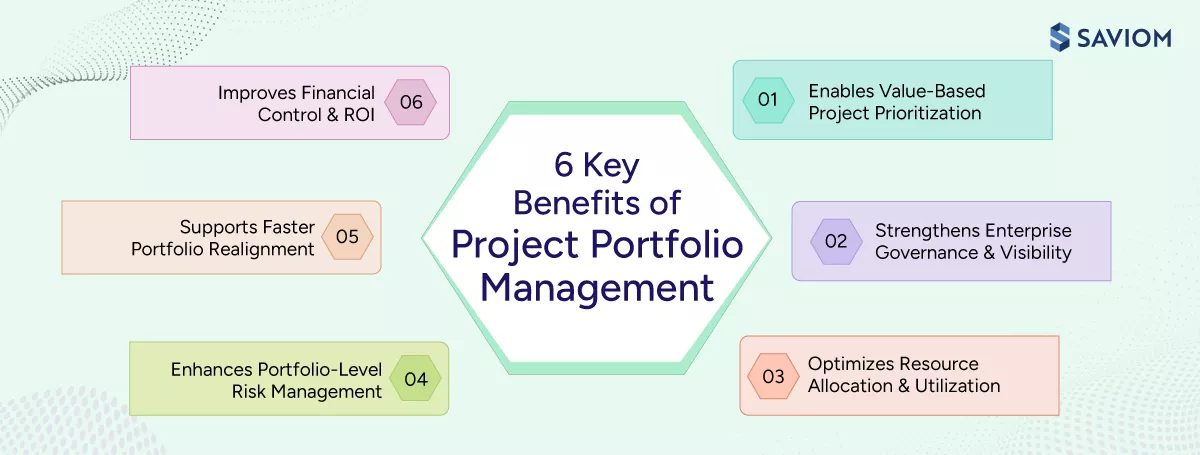
Enables Value-Based Project Prioritization
PPM establishes structured evaluation criteria based on strategic alignment, financial return, risk exposure, and resource feasibility. By introducing scoring models and weighted frameworks, it enables transparent trade-offs when budgets and capacity are limited. This ensures that high-value initiatives are prioritized consistently across business units.
Strengthens Enterprise Governance and Visibility
PPM provides a consolidated view of all initiatives across the enterprise, linking them to strategic objectives, funding, and risk profiles. This improves executive oversight and accountability through defined approval gates and ownership structures. As a result, leadership gains clarity and control over the entire investment landscape.
Optimizes Resource Allocation and Utilization Across Projects
PPM provides a consolidated view of capacity across roles and skills, preventing critical experts from being overbooked while others remain underutilized. By integrating capacity insights into prioritization, PPM ensures that high-value initiatives receive access to niche-skilled talent. Lastly, PPM improves resource utilization by reducing context switching and unplanned reallocations.
Enhances Portfolio-Level Risk Management
PPM delivers a unified view of risk exposure across initiatives, enabling early identification of cross-project dependencies and potential cascading impacts. It highlights risks such as over-reliance on critical skills, constrained resources, key vendors, or single funding sources. As a result, managers can proactively develop mitigation plans and strengthen resilience across the portfolio.
Read our detailed blog on enterprise risk management.
Supports Strategic Rebalancing in Dynamic Environments
In evolving market conditions, PPM enables organizations to reassess priorities and realign investments with emerging strategic objectives continuously. It provides the structure to reallocate funding, resources, and executive attention without destabilizing ongoing operations. By supporting controlled scaling, reprioritization, and phased transformation, PPM ensures agility without sacrificing governance.
Improves Financial Control and ROI
PPM links portfolio spending directly to expected business outcomes, ensuring that investments are justified by strategic and financial value rather than activity alone. It enables dynamic reallocation of budgets from low-performing or low-priority initiatives to higher-value opportunities. By systematically eliminating low-impact work, PPM strengthens capital discipline and improves return on investment.
Learn more about project cost management and the key steps to calculate it.
With a clear understanding of the benefits of project portfolio management, let us now learn about its framework.
The Enterprise Project Portfolio Management Framework
Managing project portfolios at an enterprise scale requires a well-defined framework that integrates strategy, investments, and execution. Given below is the exhaustive PPM framework:
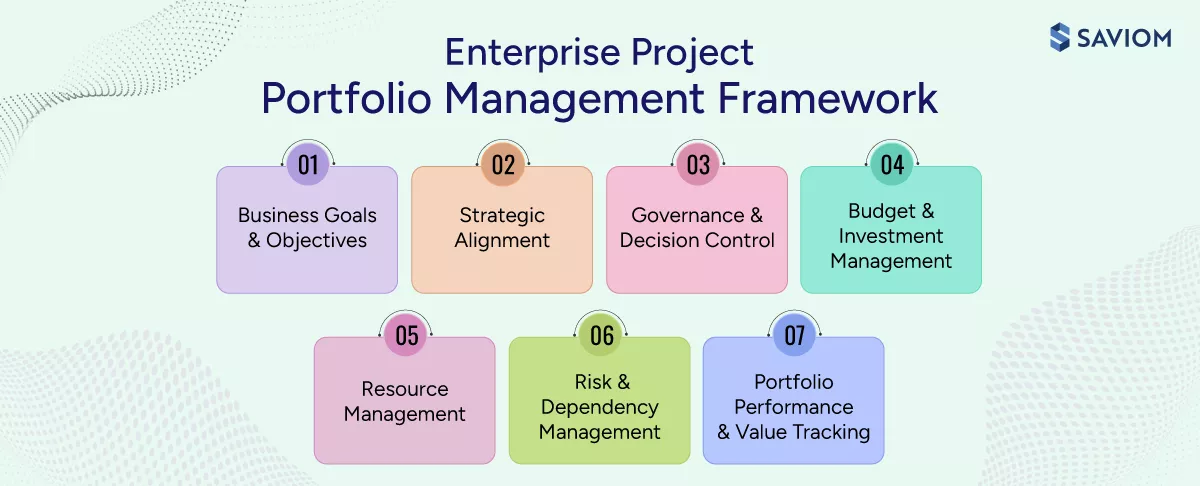
Business Goals and Objectives
This component in project portfolio management establishes the strategic direction that guides all portfolio investment decisions.
Key focus areas include:
- Enterprise strategic priorities (growth, cost optimization, innovation, resilience)
- Measurable strategic and business targets
- Clear articulation of value drivers guiding investment choices
This ensures portfolio funding is driven by strategic intent, not just short-term demand.
Check out our blog on 25 business objectives that firms must measure.
Strategic Alignment
Strategic alignment ensures that every initiative proposed for the portfolio has a clear and measurable connection to business objectives before it is approved.
Here organizations:
- Link each initiative to one or more strategic objectives
- Filter out projects without measurable strategic contribution
- Prevent resources from being consumed by low-impact work
This keeps the portfolio focused on initiatives that directly advance business strategy.
Governance and Decision Control
Governance defines how portfolio decisions are made, reviewed, and enforced across the organization.
Key elements include:
- Clear approval hierarchies and stage-gate checkpoints
- Defined decision rights and escalation paths
- Structured intake and review mechanisms for new initiatives
This creates disciplined, transparent, and auditable portfolio decision-making.
Explore types of project management methodologies and tips to choose the right one.
Budget and Investment Management
At the portfolio level, the focus shifts from fixed project entitlements to strategic allocation and reallocation of capital.
This component focuses on:
- Allocating funding based on strategic importance and value potential
- Reallocating capital as new performance insights emerge
- Monitoring portfolio-level financial exposure and ROI
The result is a more dynamic, value-driven use of enterprise capital.
Resource Management
Effective resource management ensures portfolio plans remain achievable in real-world delivery.
Key focus areas include:
- Enterprise-wide visibility into skills and capacity
- Aligning critical capabilities to high-priority initiatives
- Identifying capacity gaps before they impact delivery
- Balancing workloads to avoid employee burnout and underutilization
This ensures that the portfolio is ambitious but executable.
Read our blog on portfolio resource management.
Risk and Dependency Management
This component extends risk management beyond individual projects to the portfolio level, addressing cross-project dependencies and concentration risks.
With this element, organizations:
- Identify project interdependencies and cascading risks
- Monitor dependency risks related to skills, vendors, or funding
- Use scenario-based analysis to assess portfolio-level impact
This enables proactive, enterprise-wide risk management rather than reactive firefighting.
Portfolio Performance and Value Tracking
Portfolio performance management focuses on measuring outcomes to ensure investments deliver the value they were approved to create.
This focuses on:
- Defining portfolio KPIs aligned with strategic and financial goals
- Tracking benefit realization against approved business cases
- Identifying value leakage and underperforming initiatives early
This creates a continuous feedback loop for optimizing portfolio value.
Learn more about 15 resource management metrics that must be tracked.
Now that the enterprise project portfolio management framework is clear, we can move on to understanding the differences among the three similar concepts.
Project Portfolio Management vs. Project Management vs. PMO
While closely related, project portfolio management, project management, and the PMO serve different purposes and operate at distinct decision-making layers—from enterprise investment decisions to day-to-day delivery control. Let us see them in detail:
| Dimension / Aspect | Project Portfolio Management (PPM) | Project Management (PM) | Project Management Office (PMO) |
|---|---|---|---|
| Primary Purpose | Maximize business value across all initiatives | Deliver a specific project successfully within agreed constraints | Govern, standardize, and support consistent project delivery |
| Core Question Answered | Are we investing in the right work? | How do we plan and deliver this work? | Are projects being executed the right way? |
| Decision Scope | Enterprise-wide investments and priorities | Single project or program | Portfolio, program, or project governance (varies by model) |
| Key Stakeholders | Executives, strategy, finance, and portfolio boards | Project sponsors, customers, and delivery teams | Executives, PMs, governance bodies |
| Success Metrics | Strategic alignment, ROI, value realization, risk balance | Scope, schedule, cost, quality | Delivery maturity, compliance, predictability |
| Risk Management | Aggregated and systemic portfolio risk | Delivery, scope, schedule, and cost risk within a project | Governance, escalation, and risk management standards |
| Typical Outputs | Prioritized portfolio, funding decisions, roadmap | Project plans, schedules, and deliverables | Standards, reports, dashboards, audits |
Learn in detail about PMO roles and responsibilities in firms.
Next, let us dive deep into the project portfolio management lifecycle.
PPM Lifecycle: From Project Intake to Value Realization
An effective project portfolio management lifecycle ensures that the right initiatives are identified, executed, monitored, and optimized to protect project delivery predictability and long-term business ROI. Let’s see how it works:
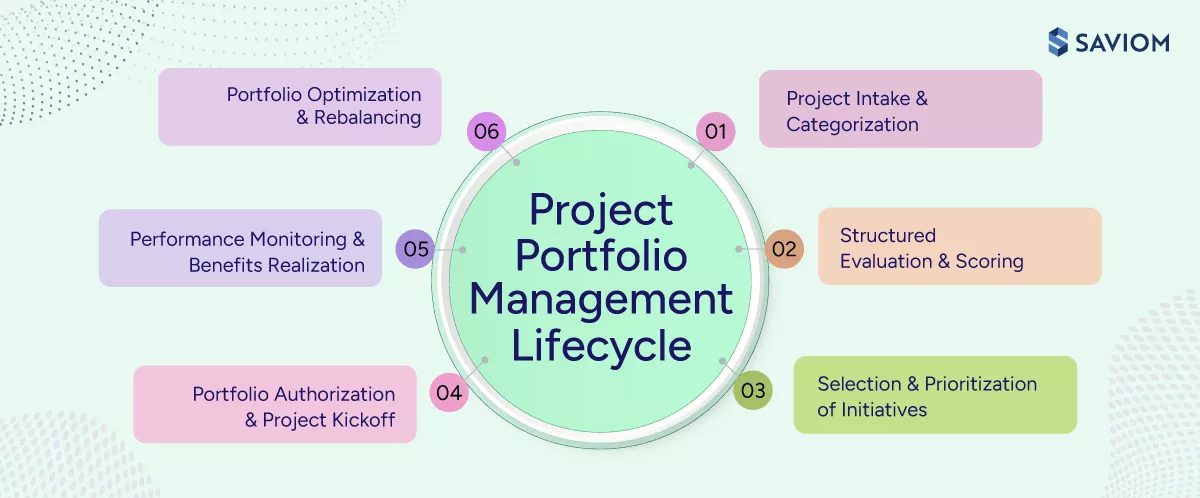
Stage 1: Project Intake and Categorization
Managers must begin by creating a centralized inventory of proposed, planned, and active initiatives governed within the portfolio. This should capture concise and high-level details like objectives, expected value, scope, ownership, and constraints for informed decisions on project intake.
Then, they must group these initiatives based on meaningful categories such as strategic growth, regulatory, innovation, etc. This categorization will reflect different investment objectives and enable clear portfolio trade-offs.
Understand effective ways to write a project proposal.
Stage 2: Structured Evaluation and Scoring
Here, managers should standardize criteria like benefits, costs, risks, dependencies, and delivery complexity to gather key information for each initiative. This creates a consistent evaluation baseline, allowing initiatives to be assessed objectively using the same criteria rather than being reviewed in isolation.
With a structured scoring model, managers score each initiative and create a side-by-side comparison profile. This builds a fact-based foundation for project selection and makes outcomes transparent when capacity and budget are limited.
Stage 3: Selection and Prioritization of Feasible Initiatives
Now, managers can shortlist initiatives that deliver the highest combined strategic and business value, rather than ones that are urgent or highly visible. Therefore, the portfolio reflects deliberate investment choices and prevents low-impact work from displacing initiatives that matter most to enterprise outcomes.
Selected initiatives are then ranked in a clear order to manage sequencing, funding timing, and resource allocation. This focus avoids diluting effort and directs available project resource capacity to the highest-impact work first.
Learn key steps to create a project plan.
Stage 4: Portfolio Authorization and Project Kickoff
At this stage, managers must formally communicate portfolio decisions, clearly stating which initiatives are approved, deferred, or rejected. This ensures that only authorized initiatives move forward in line with defined executive sponsorship and governance expectations.
Then, managers can allocate budgets and project resources to approved initiatives, thereby starting project execution. This step establishes accountability, confirms ownership, and sets clear delivery expectations, supporting streamlined execution.
Stage 5: Performance Monitoring and Benefits Realization
During execution, managers must continuously track progress, costs, risks, and dependencies across all initiatives using portfolio-level dashboards and outcome-focused KPIs. This provides them with an integrated performance view and enables early detection of delays or cost pressures.
At the same time, compare planned benefits with actual outcomes to assess whether investments are delivering the promised value. This benefit realization view helps highlight value leakage, delays, and underperforming initiatives early, enabling course-corrective measures.
Discover 12 critical project reports that help managers track progress effectively.
Stage 6: Portfolio Optimization and Rebalancing
Finally, managers must review the performance trends, risk exposure, project constraints, and strategic fit across all initiatives to ensure the investment mix remains aligned with business priorities. The focus is on improving the quality of the portfolio by directing funding and talent to initiatives with the greatest impact.
For this, managers must rebalance the investment mix. This may involve accelerating high-performing initiatives, slowing or stopping underperforming ones, or shifting resources to emerging priorities. As a result, firms protect delivery capacity and improve project ROI.
Learn how 5th gen resource management helps PMOs forecast, plan, allocate, utilize, and optimize resources to achieve better business outcomes.
Once initiatives are authorized, the focus shifts to ensuring sufficient capacity for execution without overload or delays. Next, let’s examine how resource capacity planning supports this.
Resource Capacity Planning: Aligning Capacity with Portfolio Demand
Aligning strategy with execution ultimately depends on strong resource capacity planning. Let’s understand how this works in detail:
Capture Demand at Portfolio Level
Managers must start by consolidating and capturing demand across all approved and pipeline initiatives into a single portfolio view. Using demand forecasting, they must foresee demand by roles, skills, and time horizons while factoring in project sequencing, dependencies, and priorities. This creates a realistic demand estimate.
For example, a CIO in a global IT services firm consolidates demand from approved and pipeline initiatives like cloud migrations, ERP upgrades, and AI programs. Using role- and skill-based forecasting, they estimate needs for cloud architects, SAP consultants, data engineers, and security analysts across upcoming quarters.
Learn a practical framework for effective resource forecasting in enterprises.
Determine Internal Resource Capacity
Now, managers must establish a realistic view of available resource capacity by factoring in actual working hours, leaves, overhead, and non-project commitments. Simultaneously, they must also use the skills matrix to map available proficiencies, competencies, certifications, etc. This helps determine current resource readiness.
Identify Capacity vs. Demand Gap
Here, managers must compare available capacity and project demand across roles, skills, and time horizons. This helps identify potential resource shortages, emerging skill gaps, and excess workforce in advance, thereby initiating course-corrective measures.
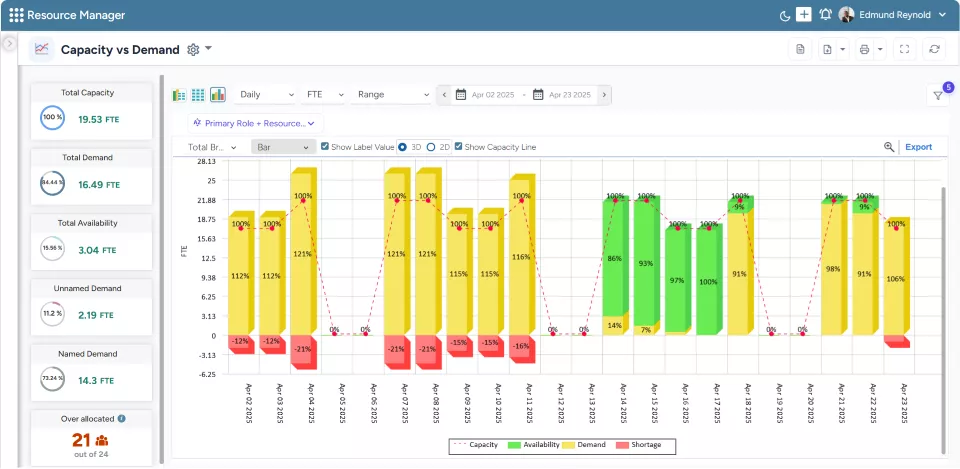 SAVIOM’s Capacity vs. Demand graph compares workforce capacity against forecasted demand to highlight shortages and excess capacity in real time.
Mitigate Resource Shortages/Excesses
Once gaps are identified, managers must implement corrective measures to bridge them. In case of shortages, they can apply upskilling/retraining, out-rotation or backfill strategies, and planned hiring. Conversely, for excesses, they must either bring forward project timelines or sell extra expertise at discounted rates.
For example, in the audit and accounting industry, a shortage of senior auditors during peak season can be addressed by hiring contractors or training junior employees. During slow periods, excess capacity can be redirected to compliance reviews or advisory projects to maintain utilization and revenue stability.
Create Multiple Resource Scenarios
As per a Goodfirms survey, “33.6% of organizations use scenario planning for better decision-making.”
Next, managers must simulate multiple what-if scenarios to evaluate different resource allocation options. By comparing scenario outcomes based on factors such as utilization levels, costs, delivery timelines, etc., managers can select the most cost-efficient and feasible resource plan.
Read our blog on scenario planning.
Track and Optimize Resource Capacity Frequently
Finally, managers must continuously track resource utilization levels, workload distribution, and demand-forecasting accuracy to identify variances. Consequently, adjust capacity plans as priorities, scope, or market conditions evolve to ensure optimal alignment between workforce supply and project demand.
Align strategy, execution, and investment using advanced enterprise project portfolio management software. Book your demo now!
In the next section, we shall understand the difference between project and portfolio budgeting.
Financial Management: Project vs. Portfolio Budgeting
Financial control takes on a different dimension when the focus shifts from managing a single project to optimizing an entire investment portfolio. Rather than simply tracking project-level costs, the emphasis moves to allocating funds across initiatives, balancing risk and return, and ensuring that investments collectively deliver maximum strategic value. Here, we discuss the key differences between portfolio and project budgeting.
| Dimension | Project Budgeting | Portfolio Budgeting |
|---|---|---|
| Primary Focus | Control and track costs within a single approved project | Optimizing capital allocation across multiple initiatives |
| Decision Scope | Managed by the project manager or program sponsor within a defined scope | Owned by executive leadership or a portfolio board across the enterprise |
| Time Horizon | Short to mid-term aligned to specific project duration | Short, mid, and long-term, aligned to strategic investment cycles |
| Objective | Deliver the project within the approved cost baseline | Maximize overall business value and ROI across investments |
| Funding Structure | Fixed budget assigned at approval with limited flexibility | Flexible capital pools are distributed based on priority and performance |
| Funding Structure | Fixed budget assigned at approval with limited flexibility | Flexible capital pools are distributed based on priority and performance |
| Evaluation Criteria | Cost variance, schedule variance, and budget adherence | Strategic alignment, ROI, risk-return balance, and capacity feasibility |
| Risk Perspective | Focuses on risks affecting the cost and delivery of one project | Aggregated risk exposure across initiatives |
| Success Measurement | Measured by on-budget delivery and financial compliance | Measured by portfolio value realization and capital efficiency |
Understand the cost baseline in project management.
Having understood the distinction, let us explore some critical KPIs to assess the effectiveness of the enterprise project portfolio management process.
Key Metrics to Measure Project Portfolio Performance
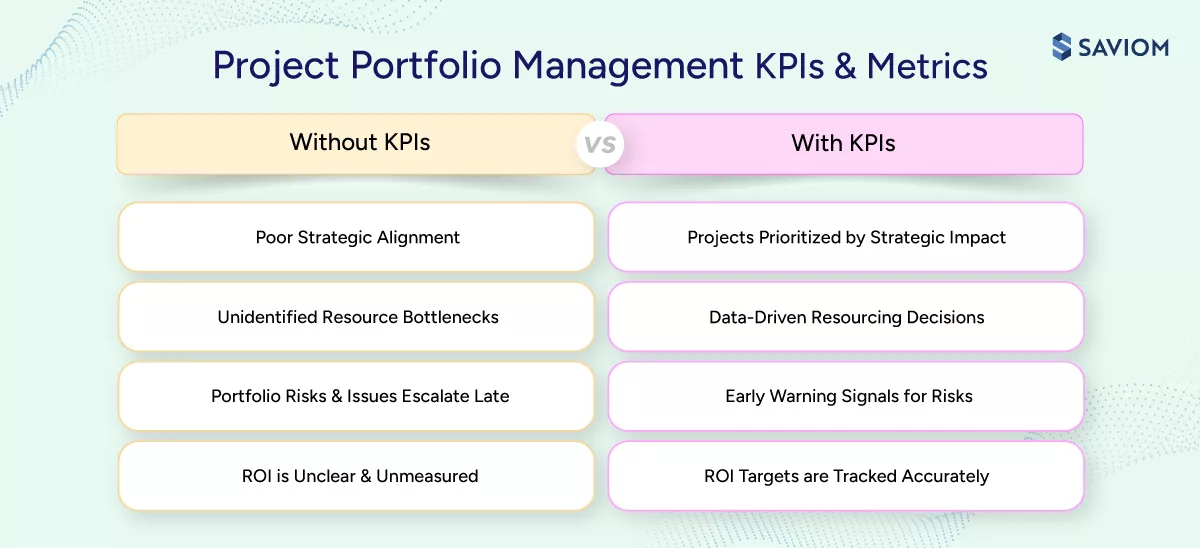
Enterprises must track the right KPIs and metrics to evaluate the effectiveness of their project portfolio management process. These insights help identify what is performing well and where improvements are needed. Let us look into a few critical KPIs:
Strategic Alignment Ratio
The strategic alignment ratio measures the proportion of projects that support the organization’s strategic objectives. It helps ensure that investments are directed toward high-priority initiatives. This enables managers to confirm that both budget and resources are aligned with strategic goals. A high alignment indicates effective resource allocation, improved operational efficiency, and better financial performance.
The formula to calculate the strategic alignment ratio is:
Initiatives) X 100
Portfolio Value Realization
Portfolio value realization compares expected benefits defined in business cases with actual outcomes delivered across initiatives. It captures both financial values, such as revenue growth or cost savings, and strategic value, such as market share or customer experience improvements.
The formula to calculate portfolio value realization is:
100
Check out our blog on project ROI and essential steps to measure it.
Demand Coverage Ratio
The demand coverage ratio measures how much of the approved portfolio demand can realistically be supported by available capacity, serving as an early warning signal for overcommitted portfolios. By tracking demand coverage, leadership can intervene before resource overload turns into widespread project delays and employee burnout.
The formula to calculate the demand coverage ratio is:
Capacity Utilization Rate
The capacity utilization rate measures how effectively available workforce capacity is used across the portfolio, revealing patterns of chronic overutilization, underutilization, or skill bottlenecks. It helps optimize workforce productivity, improve delivery predictability, and enhance the resource health index.
The formula to calculate the capacity utilization rate is:
Capacity Hours) X 100
Learn ways to measure various types of resource utilization.
Delivery Predictability Index
The delivery predictability index measures how consistently the portfolio meets its committed schedules and budgets, exposing systemic planning or execution weaknesses. A consistent predictability is a strong signal of mature portfolio governance and realistic resource planning assumptions.
The formula to calculate the delivery predictability index is:
Planned Date / Total Number of Completed Projects) X 100
Project Cost Variance (PCV)
Project cost variance measures the gap between actual spending and approved budgets, highlighting potential weaknesses in financial control or unrealistic cost estimates. When analyzed across the portfolio, it highlights systemic project cost management issues and helps make informed decisions to mitigate them.
The formula to calculate project cost variance is:
Read our blog on earned value management and the steps to measure it.
In the following section, we shall see some common project portfolio management challenges and their solutions.
Common Project Portfolio Management Challenges (and How to Avoid Them)
Even with a structured project portfolio management system in place, enterprises often face challenges that hinder timely project initiation. Given below are a few challenges, their impact, and solutions.
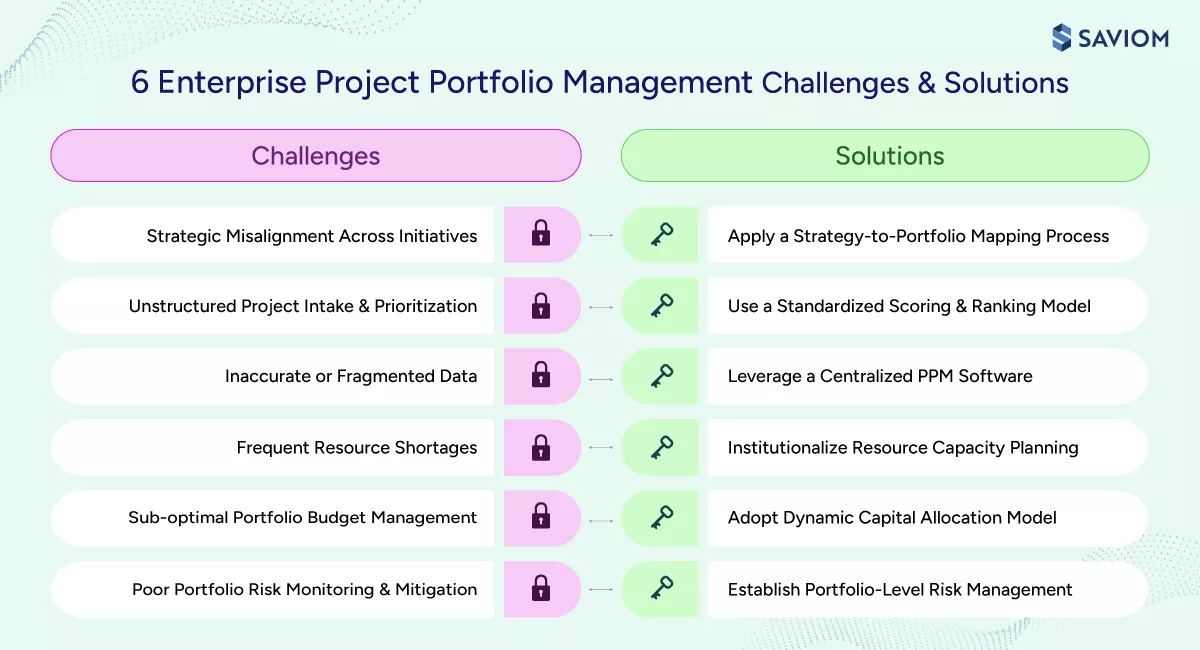
Strategic Misalignment Across Initiatives
According to Harvard Business Review, “82% of executives believe they are aligned with corporate strategy, yet actual measured alignment is only 23%.”
- Reason: Over time, portfolios expand with approved or ongoing initiatives that lack clear, measurable links to enterprise strategy.
- Impact: Organizations end up investing in lower-priority initiatives while high-value programs compete for constrained resources. This misallocation weakens focus, slows execution, and reduces overall business ROI.
- Solution: Establish a formal strategy-to-portfolio alignment process that maps every initiative to strategic themes and measurable business outcomes.
Unstructured Project Intake and Prioritization Process
- Reason: Portfolio initiatives enter through ad-hoc requests, informal approvals, or inconsistent evaluation methods.
- Impact: High-value initiatives are delayed, while lower-impact work consumes budget, capacity, and management attention, leading to poor portfolio performance.
- Solution: Implement a centralized portfolio intake process supported by a standardized scoring and ranking model to guide project approval, sequencing, and funding decisions.
Explore more on ad hoc projects and critical strategies to manage them effectively.
Inaccurate or Fragmented Data
- Reason: Project portfolio decisions are based on inconsistent, outdated, or incomplete information spread across multiple systems or spreadsheets.
- Impact: Increases the likelihood of misallocated budget, overlooked resource risks, and unrealistic delivery commitments. This leads to cost overruns and delays.
- Solution: Establish a single source of truth through a centralized PPM platform to ensure portfolio decisions are consistently based on accurate, timely, and comparable information.
Frequent Resource Shortages
- Reason: Organizations lack real-time visibility into available skills, workload distribution, and future demand. As a result, they overcommit resources based on assumptions rather than verified capacity.
- Impact: Teams become chronically overloaded, critical skills are constantly overutilized, delivery delays, and a subsequent increase in burnout and attrition rates.
- Solution: Introduce portfolio-level capacity planning based on roles, skills, and time-based availability. Continuously balance demand against realistic capacity and test & adjust priorities using scenario planning.
Learn more about capacity management.
Sub-Optimal Portfolio Budget Management
- Reason: Funding is locked into initiatives through rigid, project-level budgeting and is not actively reallocated based on changing priorities or performance.
- Impact: Budget remains tied up in low-performing or lower-priority initiatives while higher-value opportunities are underfunded or delayed. This reduces market responsiveness and weakens project ROI.
- Solution: Shift to a portfolio-based capital allocation model that treats funding as a dynamic investment pool rather than fixed project entitlements. Regularly review performance, risk, and strategic alignment, and reallocate budgets as needed.
Poor Portfolio Risk Monitoring and Mitigation
- Reason: Risk management is limited to individual projects, and there is no consolidated, portfolio-level view, thereby lacking early warning signals to emerging issues.
- Impact: Aggregated risks remain hidden until they materialize as widespread schedule delays, major delivery failures, and cost overruns across the portfolio.
- Solution: Establish a portfolio-level risk management framework that consolidates risks across initiatives, maps interdependencies, and monitors dependencies related to skills, vendors, technology, or funding.
Discover critical resource risks in project management.
Finally, let us understand how AI is shaping the future of project portfolio management.
Role of AI, Analytics & Automation in Project Portfolio Management
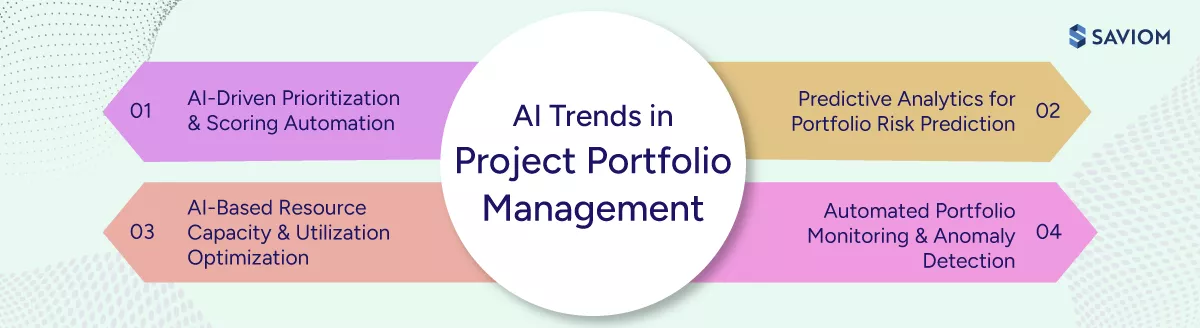
As project portfolios grow in size and complexity, manual analysis becomes increasingly inadequate. AI, advanced analytics, and automation enable organizations to process large volumes of data and uncover insights more effectively. Together, they transform project portfolio management into a continuous, data-driven decision system that supports faster and more informed strategic choices. Let us see a few major AI trends:
AI-Driven Prioritization and Scoring Automation
As per Custom Market Insights, “AI-based portfolio management systems increase project success rates by 40 – 50% through accurate prioritization.”
AI-driven prioritization uses machine learning to automatically score and rank initiatives based on historical performance, strategic fit, and risk profiles. This reduces bias and manual efforts, especially in large or complex portfolios. It also enables real-time portfolio reprioritization as business conditions change.
Predictive Analytics for Portfolio Risk Prediction
Predictive analytics leverages historical project risk data to forecast schedule delays, cost overruns, and delivery risk at the portfolio level. This provides probability-based insights into emerging dependencies, resource bottlenecks, and project risks before they materialize. Subsequently, this supports proactive data-driven decisions.
Check out our blog on risk matrix.
AI-Based Resource Capacity and Utilization Optimization
AI-based resource optimization uses predictive algorithms to match portfolio demand with available skills and time-based capacity in real-time. Continuous analysis of utilization patterns and pipeline demand helps, it helps prevent burnout and minimize bench time while recommending optimal workforce allocations.
Automated Portfolio Monitoring and Anomaly Detection
Automated portfolio monitoring continuously tracks KPIs, budget consumption, utilization, and risk indicators in real-time. It detects performance deviations such as cost overruns, schedule delays, or unexpected resource risks, and flags anomalies early through threshold alerts and pattern-recognition algorithms.
Conclusion
Project portfolio management is the mechanism through which strategy is translated into disciplined investment decisions. By governing portfolios with clear priorities, realistic capacity planning, and strong financial oversight, organizations can ensure that resources are directed toward the initiatives that deliver the greatest strategic value.
This approach improves delivery predictability, strengthens capital efficiency, and reduces the risk of misaligned investments. As a result, PPM evolves beyond operational practice and becomes a critical leadership mandate for driving strategic execution and long-term business success.
Frequently Asked Questions (FAQs)
Project Portfolio Management (PPM) is the practice of selecting, prioritizing, and managing an organization’s projects and programs as a single portfolio to achieve strategic business goals.
Project management focuses on delivering a specific project successfully on time, within budget, and within scope. It is about planning, executing, and controlling the work needed to produce defined outputs and deliverables.
Portfolio management, on the other hand, focuses on deciding which projects to pursue and fund. It looks across all initiatives to prioritize investments, allocate resources, balance risk, and ensure the firms work on projects that deliver the highest strategic value.
Project portfolio management is important for organizations because it:
1. Enables value-based project prioritization
2. Strengthens enterprise governance and visibility
3. Optimizes resource allocation and utilization across projects
4. Enhances portfolio-level risk management
5. Supports strategic rebalancing in dynamic environments
6. Improves financial control and ROI
The critical components of an effective project portfolio management framework are:
1. Business goals and objectives
2. Strategic alignment
3. Governance and decision control
4. Budget and investment management
5. Resource management
6. Risk and dependency management
7. Portfolio performance and value tracking
Project portfolio management provides a centralized view of all projects, allowing leaders to evaluate, select, and prioritize initiatives, allocate resources effectively, and focus on high-value work. This ensures that project investments directly support strategic objectives and deliver maximum business value.
PPM provides portfolio-level visibility into demand and capacity, preventing overcommitment, reducing bench time, and aligning critical skills with high-priority initiatives.
A few common project portfolio management challenges include:
1. Strategic misalignment across initiatives
2. Unstructured project intake and prioritization process
3. Inaccurate or fragmented data
4. Frequent resource shortages
5. Sub-optimal portfolio budget management
6. Poor portfolio risk monitoring and mitigation