

Introduction
Picture this: in one organization, resourcing decisions take days, slowed by limited visibility into availability, skills, and shifting priorities. In another firm, similar decisions are made within hours, powered by real-time resource data and clearer alignment between available talent and project demand.
The difference is not scale, talent, or budget, but how effectively enterprise resource management is structured and executed.
This is where a structured resource management implementation approach comes into play. It enables organizations to plan, allocate, and monitor resources more effectively, enabling faster, more informed decisions and greater operational efficiency.
In this guide, we will explore what is resource management implementation and how it helps organizations gain visibility into resources, improve allocation accuracy, and drive better utilization.
What is Resource Management Implementation?
Resource management implementation is the structured process of planning, allocating, scheduling, and monitoring organizational resources such as people, skills, finances, and equipment to ensure optimal utilization and successful project delivery.
It involves auditing existing resources, defining roles and responsibilities, setting priorities, and accurately forecasting future needs. It also includes assigning the right resources to the right tasks, tracking utilization in real time, and continuously adjusting allocations to align capacity with demand. This ensures balanced workload distribution, prevents shortages or excesses, and improves overall project outcomes.
Having understood what is resource management implementation, let us now move on to explore why it matters for organizations.
Why Resource Management Implementation Matters for Enterprises?
In enterprises, resourcing decisions shape how well organizations respond to changing demands and maintain operational efficiency. A structured resource management implementation approach enables greater consistency and control in how resources are planned and governed across the organization. Here is why it matters:
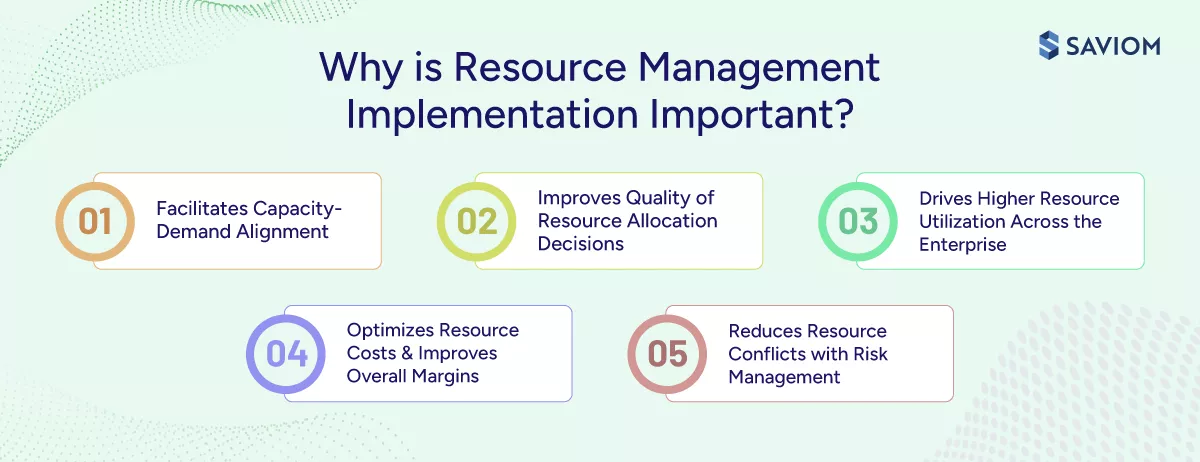
Facilitates Capacity-Demand Alignment
Implementing resource management enables organizations to manage capacity and demand in a structured manner. As a result, managers get a clear view of upcoming requirements across roles and skills. Therefore, they can identify shortages and excesses early and plan resource needs proactively instead of reacting at the last minute.
Improves Speed and Quality of Resource Allocation Decisions
When organizations implement resource management, they gain access to accurate data on resource availability, workload, and competencies. This allows managers to quickly evaluate allocation options and reduce reliance on manual coordination. Consequently, they can make faster, more reliable staffing decisions with better alignment to requirements.
Drives Higher Resource Utilization Across the Enterprise
Resource management implementation enables managers to track utilization across both billable and non-billable work in real time. With this visibility, they can identify underutilized resources and redeploy them to billable or high-priority work. This results in better workforce utilization and improved revenue contribution without increasing headcount.
Optimizes Resource Costs and Improves Overall Margins
A well-implemented resource management framework helps managers align resource deployment with actual demand, reducing unnecessary hiring, preventing overstaffing, and minimizing bench time. This results in greater predictability in workforce-related spending, improved cost efficiency, and stronger profit margins.
Explore strategies to reduce resource costs and boost profitability in our blog.
Reduces Resource Conflicts with Proactive Risk Management
Resource management implementation provides visibility into allocations and establishes clearer control over resource scheduling decisions. As a result, managers can identify resource booking conflicts or overlapping assignments early and take corrective action in time. Organizations can therefore maintain stable resource deployment across teams and avoid disruptions to planned work.
So far, we have covered the definition and why is resource management implementation important for organizations. In the next section, we will understand some of the most common signs that indicate your organization needs better resource management.
Signs Your Organization Needs Better Resource Management
Many organizations continue to operate with fragmented resource management practices without realizing the extent of inefficiencies they create. Over time, these gaps begin to surface as recurring operational issues that affect planning accuracy, workforce stability, and overall performance. The following signs indicate that your organization needs better resource management:
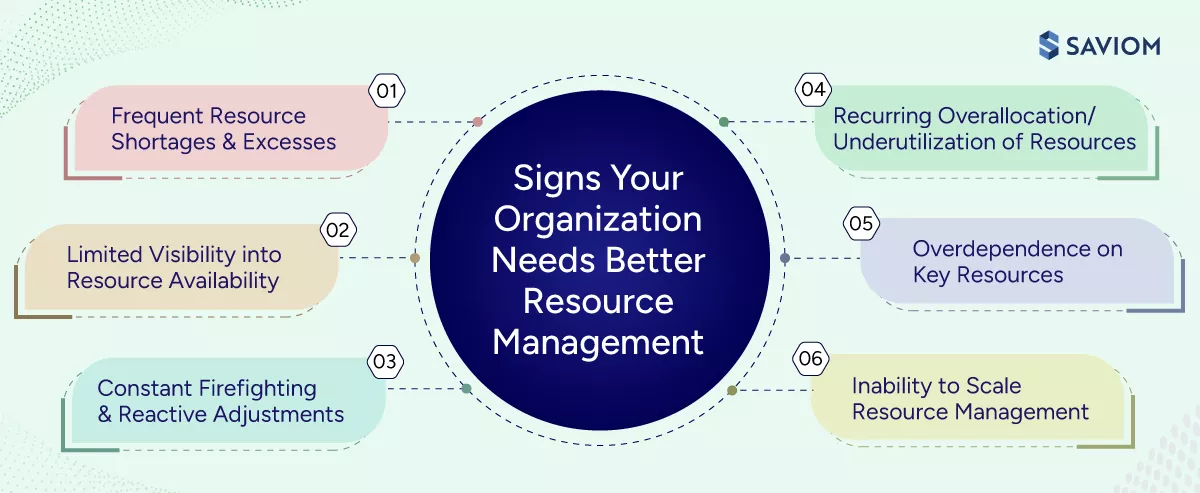
Frequent Resource Shortages and Excesses
When organizations consistently struggle to align capacity with demand, some projects face critical resource shortages while others operate with excess capacity that remains underutilized. This imbalance leads to delayed timelines, increased hiring costs, and inefficient resource utilization across the organization.
Limited Visibility into Resource Availability and Skills
In the absence of a centralized, real-time view of resource availability, competencies, and current allocations, managers rely on fragmented or outdated information. This makes it harder to match the right people to the right work. The result is skill mismatches, inefficient deployment, and lower execution quality across projects.
Constant Firefighting and Reactive Resource Adjustments
A lack of forward-looking resource planning forces organizations into a reactive mode, where allocations are continuously adjusted to address immediate gaps. This constant firefighting disrupts planned workflows, reduces employee productivity, and creates instability in resource schedules, making it difficult to maintain consistency in execution.
Recurring Overallocation and Underutilization of Resources
According to a PMI survey, “Inadequate resource allocation is one of the most frequently cited contributors to project failure.”
Without structured allocation and utilization tracking, organizations often overbook high-demand resources while leaving others underutilized. This creates an uneven distribution of work and limits the organization’s ability to use its workforce effectively. The consequences include employee burnout among overloaded resources, lower morale, and lost productivity from bench capacity.
Overdependence on Key Resources or Critical Roles
When organizations consistently depend on a few high-performing individuals or specialized roles, it creates bottlenecks in resource allocation and scheduling. Their limited availability delays multiple initiatives, while other capable resources remain underutilized due to a lack of visibility into alternative skills or backup capacity.
Inability to Scale Resource Management with Business Growth
As organizations grow, manual and fragmented resource management practices fail to support the increased complexity of demand, workforce size, and project volume. This leads to reduced planning accuracy, operational inefficiencies, and growing difficulty in maintaining delivery consistency as the business expands.
Next, let us learn about the core components of enterprise resource management implementation.
Key Components of Resource Management Implementation
A successful resource management implementation depends on a set of interconnected components that collectively enable effective planning, allocation, and control of resources across the enterprise. The following core components play a specific role in ensuring that resource decisions remain aligned, structured, and responsive to changing demand:
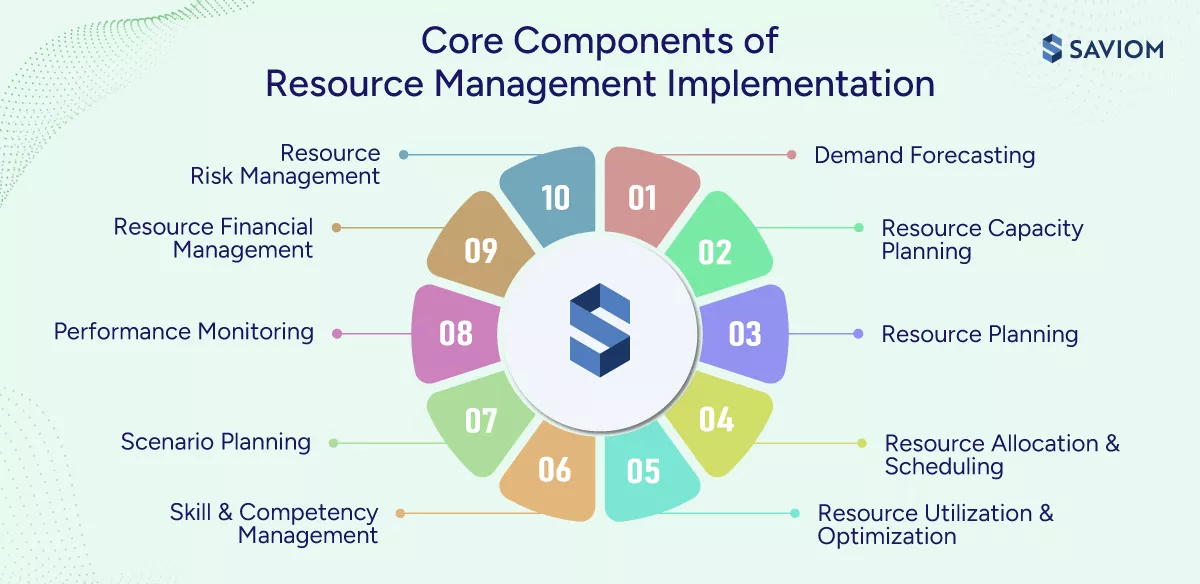
Demand Forecasting
Demand forecasting estimates future resource demand based on historical data, project pipeline, and business priorities. It involves analyzing project requirements, timelines, and effort estimates to determine the quantity and type of resources needed over time. This helps organizations anticipate workload in advance and prepare for upcoming resource requirements with greater accuracy.
Resource Capacity Planning
Resource capacity planning evaluates available resource capacity against forecasted demand to determine whether the organization has sufficient resources to meet project requirements. This helps organizations identify capacity gaps early and take timely actions, such as redeployment, retraining/upskilling, or hiring, to balance capacity with demand and ensure smooth project execution.
Resource Planning
Resource planning is the process of forecasting, allocating, and managing organizational resources to deliver projects on time and within budget. It aligns workforce availability with project pipelines and organizational priorities, ensuring resources are positioned where they are needed most. This enables organizations to maintain continuity in execution and respond effectively to changing demand.
Resource Allocation and Scheduling
According to the McKinsey research, “83% of business executives consider resource allocation as the most critical management lever for driving growth.”
Resource allocation and scheduling involve assigning resources to specific tasks and defining when they will work on them across project timelines. It ensures assignments are based on skills, availability, and priorities while maintaining a clear, conflict-free project schedule. This helps organizations improve execution efficiency and avoid issues such as double booking or last-minute reallocations.
Resource Utilization and Optimization
Resource utilization tracks how effectively resources are engaged across billable and non-billable work. On the other hand, resource optimization focuses on rebalancing workloads to avoid resource underutilization or overutilization. As a result, organizations can improve productivity, minimize burnout and disengagement, and maximize the value they derive from their workforce.
Skill and Competency Management
Skill and competency management focuses on maintaining a centralized view of workforce capabilities, including skills, expertise, and proficiency levels. It enables skill-based allocations to the projects, ensuring that critical work is supported by the right expertise. It also supports informed staffing decisions and helps guide targeted upskilling and workforce development initiatives.
Scenario Planning
Scenario planning simulates different demand and capacity situations in a sandbox environment to understand their impact on resource management plans and business outcomes. It allows organizations to assess alternatives such as shifting project timelines, adjusting allocations, or hiring a contingent workforce. As a result, businesses can respond effectively to changing conditions.
Performance Monitoring
Performance monitoring involves tracking key resource management metrics to evaluate how effectively resources are planned, allocated, and utilized across the organization. It provides visibility into areas such as utilization levels, allocation efficiency, and forecasting accuracy. This enables organizations to identify inefficiencies, improve decision-making, and continuously refine their resource management practices.
Resource Financial Management
Resource financial management deals with tracking and managing resource-related costs across projects. It includes monitoring metrics, such as cost per resource, billable hours, and overall budget alignment, to ensure financial control. This helps organizations manage resource costs effectively, improve profitability, and maintain better financial discipline in resource utilization.
Resource Risk Management
Resource risk management addresses potential risks related to availability, skill gaps, and overallocation of resources that can impact project delivery. It involves identifying these risks early and assessing their potential impact on plans and timelines. This allows organizations to take preventive measures, reduce disruptions, and ensure more stable and predictable execution.
Read our comprehensive eBook to understand how 5th gen resource management can help you improve utilization, optimize resource allocation, and drive better workforce planning outcomes.

Moving on, let us explore the steps for resource management implementation.
How to Implement Resource Management: Step-by-Step Process
Resource management implementation requires a structured, step-by-step approach to ensure consistency across planning, allocation, and utilization practices. Without a clear roadmap, organizations risk fragmented adoption, inconsistent processes, and limited impact from implementation efforts. Outlined below is a practical approach to implementing resource management effectively across the enterprise:
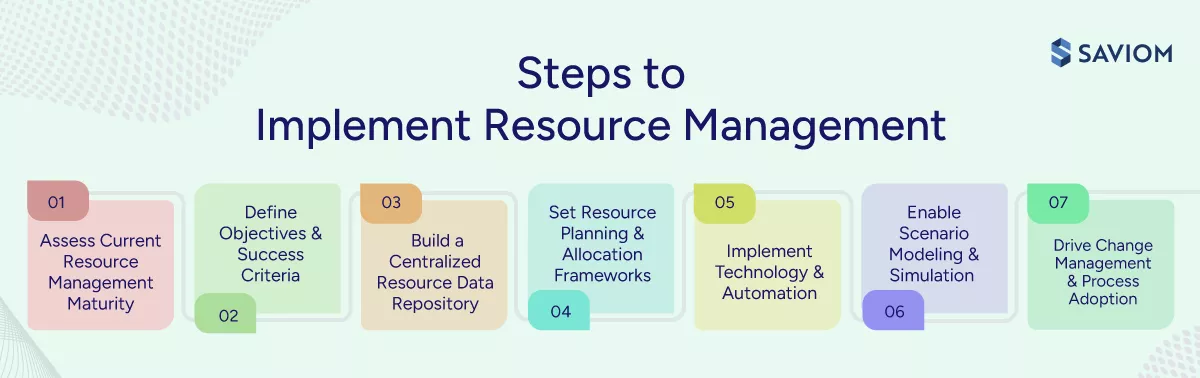
Step 1: Assess Current Resource Management Maturity
Organizations should begin by evaluating their current resource management maturity, including processes, tools, and data visibility. This will allow them to establish a clear understanding of their current state and help to:
- Identify gaps in demand forecasting, capacity planning, and allocation practices.
- Define a clear starting point for the implementation roadmap.
- Prioritize focus areas based on impact and urgency.
- Ensure subsequent steps are aligned with current organizational realities.
Step 2: Define Objectives and Success Criteria
Next, businesses can define clear objectives for enterprise resource management implementation. These objectives may include improving utilization or enhancing resource capacity forecasting accuracy, along with measurable success criteria. This enables firms to:
- Establish measurable benchmarks to track implementation success.
- Align resource management efforts with business and operational priorities.
- Clarify expected outcomes from the implementation.
- Make more informed decisions throughout the implementation process.
Deep dive into our blog to explore 25 crucial business objectives that firms must track for success.
Step 3: Build a Centralized Resource Data Repository
Once business objectives are defined, organizations can consolidate resource data, including skills, roles, availability, and allocations, into a centralized system. This helps ensure all planning and allocation decisions are based on accurate, consistent, and real-time information. As a result, organizations can:
- Improve visibility into resource availability, skills, and allocations.
- Enable accurate demand forecasting and resource capacity requirement planning.
- Reduce allocation errors caused by outdated or inconsistent data.
- Enhance project delivery by assigning the right skills to the right projects.
Step 4: Establish Resource Planning and Allocation Frameworks
At this stage, organizations should establish standardized processes for demand management, capacity planning, resource planning, and allocation. This will help ensure consistency in how resource decisions are made across teams and functions. In addition, organizations can:
- Reduce conflicts such as double booking and scheduling overlaps.
- Improve coordination between demand, capacity, and allocation decisions.
- Increase transparency in how resources are assigned across projects.
- Enable structured and repeatable resource management practices.
Step 5: Implement Technology and Automation
Organizations can then select a resource management software to streamline and automate key processes such as forecasting, allocation, and reporting. Implementing software will help replace manual coordination with system-driven workflows and enable organizations to:
- Gain real-time visibility into resource availability and utilization.
- Improve accuracy and speed of resource-related decisions.
- Scale resource management practices as organizational complexity grows.
- Streamline the end-to-end resource management process.
Step 6: Enable Scenario Modeling and Simulation
According to a GoodFirms’ survey, “57.5% firms leverage scenario planning for effective resource allocation.”
Next, organizations should enable scenario modeling capabilities to evaluate multiple resource plans under varying business conditions. This shifts planning from reactive adjustments to proactive, strategic decision-making and enables organizations to:
- Evaluate multiple resource plans based on factors like resource unavailability, scope changes, and budget cuts.
- Anticipate potential resource risks such as skill shortages, cost overruns, and delayed deliveries.
- Make necessary staffing decisions such as redeployment, upskilling, or hiring.
- Enhance decision-making agility by enabling faster, data-backed what-if analysis.
Step 7: Drive Change Management and Process Adoption
Finally, firms should focus on driving structured change management by aligning project stakeholders, redefining roles, and ensuring that new resource management processes are clearly communicated and consistently followed across the organization. This helps:
- Ensure consistent adoption of new resource management practices.
- Align teams on standardized planning and allocation processes.
- Reduce resistance to change by communicating clearly and securing stakeholder buy-in.
- Embed resource management into day-to-day operations.
Learn more about change management and why it is important for organizations.
Having explored how to implement resource management, we will now learn about the common challenges organizations face.
Common Implementation Challenges and How to Overcome Them
Implementing resource management is not without challenges, especially in complex enterprise environments where multiple teams, systems, and processes are involved. If not addressed early, these challenges can slow down adoption, reduce effectiveness, and limit the overall impact of implementation efforts.
| Challenge | Impact | Solution |
|---|---|---|
| Poor Data Quality and Fragmented Resource Information | Leads to unreliable planning, poor allocation decisions, and a lack of trust in the system | Establish a centralized data repository with standardized formats and regular data validation processes. |
| Misalignment Between Demand, Capacity, and Business Priorities | Results in resource shortages, excess, and frequent conflicts across projects, impacting delivery timelines | Implement integrated demand forecasting and capacity planning processes aligned with business priorities. |
| Lack of Executive Buy-In and Strategic Alignment | Leads to fragmented adoption, inconsistent execution, and weaker connection between resource decisions and business goals | Secure leadership sponsorship by aligning implementation goals with strategic business outcomes and ROI. |
| Resistance to Change and Low User Adoption | Slows down implementation and results in inconsistent usage of processes and tools across teams | Drive structured change management with stakeholder training, communication, and continuous support. |
| Unclear Ownership and Decision-Making Accountability | Causes delays, conflicts, and inefficiencies due to lack of clarity in roles and responsibilities | Define a clear ownership model with role-based responsibilities and decision-making authority. |
| Overreliance on Reactive and Ad Hoc Planning Practices | Leads to constant firefighting, unstable plans, and reduced efficiency in resource utilization | Establish standardized planning frameworks and regular planning cycles to enable proactive decision-making. |
Discover the most common resource management challenges and solutions to overcome them.
After exploring the challenges in resource management implementation, we will now learn the best practices.
Best Practices for Resource Management Implementation
Adopting the right practices is critical to ensuring that resource management strategy implementation delivers consistent, scalable, and long-term results. Without clearly defined best practices, organizations risk fragmented execution, low adoption, and limited value from their implementation efforts. Outlined below are proven best practices for effectively and sustainably implementing resource management.
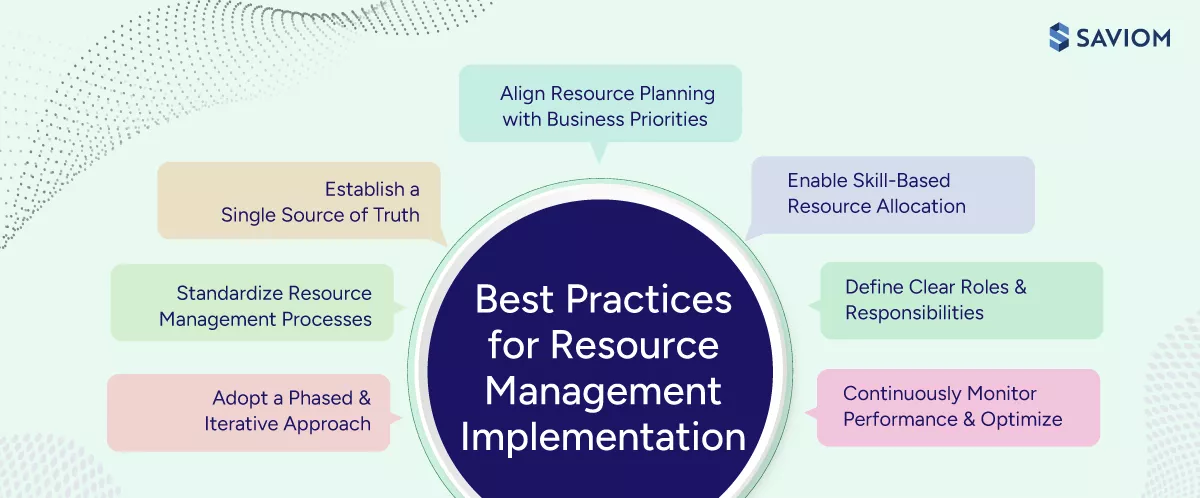
Adopt a Phased and Iterative Implementation Approach
A phased and iterative approach helps organizations implement resource management in manageable stages rather than attempting a large-scale transformation all at once. Managers can begin with high-impact areas and gradually expand coverage, reducing implementation risks and ensuring early value realization. This also allows teams to refine processes, address gaps, and improve adoption over time.
Standardize Resource Management Processes Early
Standardizing key processes early is essential to building consistency across the organization. This includes defining how teams forecast demand, plan capacity, allocate resources, and track utilization. Early standardization reduces process gaps and inconsistencies across business units. Moreover, it improves cross-departmental coordination and supports data-driven decision-making.
Establish a Single Source of Truth
Managers must centralize resource data to ensure all stakeholders use accurate, consistent information. This eliminates dependency on disconnected systems, spreadsheets, and manual tracking, which often leads to errors and misalignment. With a unified data source, managers gain real-time visibility into availability, skills, and current commitment, improving planning accuracy.
Read our blog to understand why organizations should not depend on Excel for resource planning.
Align Resource Planning with Business Priorities and Demand Pipelines
Resource planning should be directly aligned with project demand, sales pipeline, and strategic priorities. This alignment enables teams to allocate resources to high-impact initiatives while avoiding unnecessary capacity build-up. As a result, organizations can improve employee productivity and maintain operational excellence.
Enable Skill-Based Resource Allocation
Managers should adopt a skill-based approach to resource allocation by leveraging a competency matrix alongside availability and timelines. This allows resources to be matched more accurately to project requirements rather than relying solely on resource capacity. Such an approach optimizes resource utilization and ensures that the right expertise is applied to the right work.
Learn what a skill matrix is and how it supports effective resource allocation.
Define Clear Roles, Responsibilities, and Governance Models
Effective implementation requires clear ownership across planning, allocation, and decision-making processes to avoid ambiguity. Defining roles and governance structures ensures accountability and reduces conflicts during execution. This clarity helps accelerate decisions and ensures resource management practices are applied consistently across teams.
Continuously Monitor Performance and Optimize Processes
Resource managers and leadership teams should consistently track key metrics, including utilization, capacity alignment, and delivery performance. Monitoring these indicators helps identify inefficiencies and gaps in current practices. These insights can then be used to refine processes and drive continuous improvement in resource management.
After understanding the best practices, the next step is to explore the KPIs firms must monitor to measure the success of resource management implementation.
KPIs to Measure Resource Management Implementation Success
Measuring the success of resource management implementation requires a clear set of KPIs that reflect how effectively resources are planned, allocated, and utilized across the organization. The following KPIs help organizations assess the effectiveness and impact of enterprise resource management implementation:
Resource Utilization Rate
Resource utilization rate measures the percentage of available capacity that is actively used for productive or billable work. It helps managers assess whether resources are being effectively deployed or if there are issues such as underutilization or overloading. An optimized utilization rate indicates that resource management strategy implementation is improving workforce efficiency and capacity usage.
The formula to calculate the resource utilization rate is:
100
Resource Forecast Accuracy
Resource forecast accuracy evaluates how closely planned resource demand aligns with actual utilization over time. It reflects the reliability of forecasting processes and the organization’s ability to accurately anticipate workload. Higher accuracy indicates that planning decisions are data-driven and that the implementation enables more predictable, stable resource management.
The formula to calculate resource forecast accuracy is:
Actual Demand) X 100
Billable vs. Non-Billable Hours
Billable vs. non-billable hours track the proportion of time spent on revenue-generating work compared to non-billable activities. It provides insight into how effectively resources are contributing to business outcomes. A high ratio suggests that resource management practices are optimizing billable utilization while controlling excessive non-billable effort.
The formula to calculate billable vs. non-billable hours is:
Resource Allocation Effectiveness
Resource allocation effectiveness measures how well resources are matched to project requirements based on skills, availability, and priorities. It helps managers evaluate whether the allocation process is improving assignment accuracy and ensures resource management practices are applied consistently across teams. Strong performance in this area indicates better decision-making and more efficient use of available resources.
The formula to calculate resource allocation effectiveness is:
Allocated Hours) X 100
Skill Gap Index
The skill gap index assesses the difference between the skills required for current and upcoming projects and the competencies available within the workforce. It helps organizations understand whether they have the right capabilities to meet demand. A declining gap over time indicates that resource management implementation is supporting better skill alignment, hiring, and upskilling efforts.
The formula to calculate skill gap index is:
Number of Skills Required] X 100
Now, let us understand resource management implementation with an example.
Resource Management Implementation Example
To understand how resource management implementation works in practice, consider a mid-sized IT services organization managing multiple client engagements.
The organization faced ongoing challenges in allocating resources effectively. Critical resources were frequently overbooked, while others remained underutilized, resulting in inconsistent utilization and reduced workforce efficiency.
With no structured integration between demand forecasting and capacity management, project pipeline requirements often failed to align with available skills. As a result, allocation decisions remained reactive, driven by immediate delivery pressures rather than long-term planning or competency alignment.
So, how can such an organization move from reactive allocation to a more structured and predictable resource management approach?
To address these challenges, the organization implemented a set of structured resource management practices:
- Integrated pipeline data with demand forecasting and capacity planning to improve visibility into future requirements.
- Established a centralized competency framework to support skill-based allocation.
- Introduced real-time utilization tracking to monitor workforce efficiency and identify imbalances early.
- Enabled scenario planning to evaluate allocation decisions and prepare for changing demand conditions.
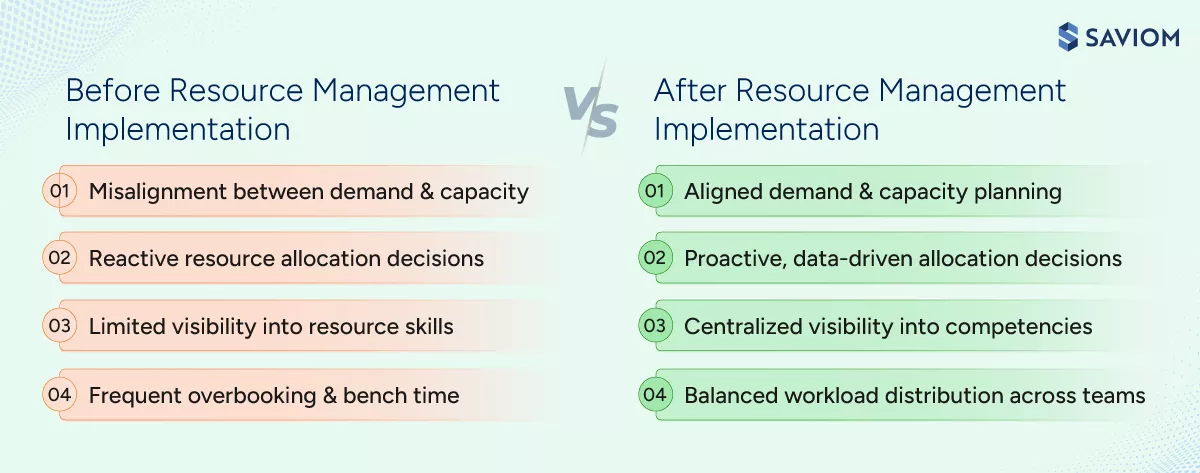
These changes enabled a more balanced and data-driven approach to resource management. As a result, the organization improved billable utilization, reduced employee burnout, enhanced forecasting accuracy, and achieved more efficient allocation across projects. This resulted in greater delivery stability and better alignment with business goals.
Moving on, let us understand how advanced resource management software can help the implementation process.
How SAVIOM Helps Enterprises Implement Resource Management?
Implementing resource management at scale requires more than defined processes. It demands the right capabilities to connect planning, allocation, and utilization in a single, unified environment. Here is how SAVIOM’s integrated resource management solution enables enterprises to implement resource management effectively with greater visibility, control, and accuracy:
- All-in-one resource planner centralizes enterprise-wide resource data into a single source of truth, enabling complete visibility and control for structured resource management implementation.
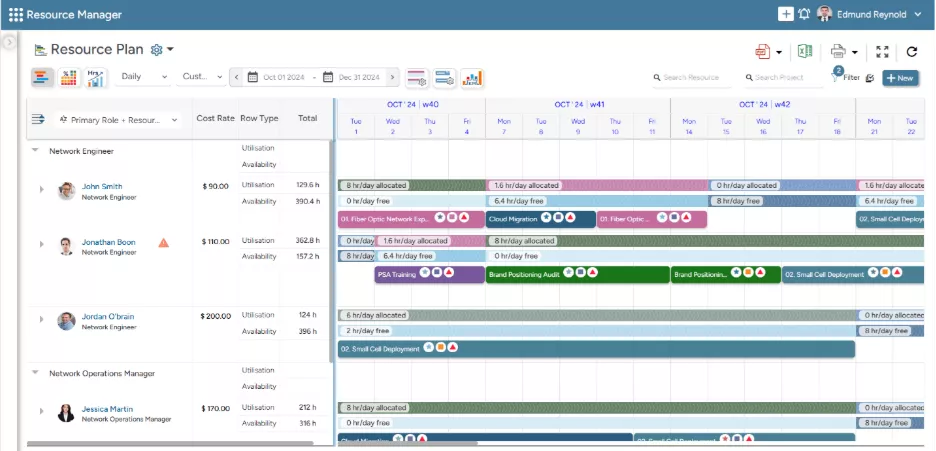 SAVIOM’s all-in-one resource planner providing real-time visibility into resource availability, utilization, and allocation across the enterprise.
- An embedded capacity planner enables accurate demand vs. capacity analysis, helping organizations identify shortages and excesses early to support proactive planning.
- KPI forecaster provides real-time insights into critical resource metrics such as utilization, availability, and capacity, enabling continuous measurement and optimization of implementation outcomes.
- Embedded heat mapping highlights resource overutilization and underutilization through color-coded indicators, allowing managers to rebalance workloads efficiently.
- An early warning system proactively flags issues such as double bookings and overutilization, enabling timely corrective actions and smoother execution.
- Competency matrix consolidates workforce skills, experience, and certifications into a single view, enabling accurate skill-based allocation.
- Real-time BI reports provide comprehensive insights into capacity, availability, bench, and forecast vs. actuals, supporting informed, data-driven decisions.
- Scenario modeling allows simulation of multiple demand and capacity scenarios, enabling organizations to choose the optimal resource strategy.
Explore how SAVIOM’s enterprise solution can streamline your resource management implementation process. Book a demo today.

Conclusion
Resource management implementation enables organizations to move from fragmented, reactive practices to a structured and data-driven approach that improves planning and execution. It brings greater visibility and consistency, allowing teams to make more informed decisions and respond effectively to changing demands.
Moreover, it helps organizations move from reactive decision-making to a more proactive, strategic model, enabling leaders to respond to changing demand with greater confidence. In the long run, effective resource management implementation supports stronger operational performance and sustainable business growth.
Resource Management Implementation FAQs
Resource management implementation refers to the structured process by which organizations plan, allocate, manage, and monitor resources to ensure effective utilization and seamless project delivery.
Some common signs that your organization needs better resource management include:
1. Frequent resource shortages and excesses
2. Limited visibility into resource availability and skills
3. Constant firefighting and reactive resource adjustments
4. Recurring overallocation and underutilization of resources
5. Overdependence on key resources or critical roles
6. Inability to scale resource management with business growth
The implementation timeline varies based on the organization’s size, complexity, and current maturity level. Smaller teams with simpler processes may implement basic capabilities within a few weeks, while enterprise-wide implementations can take several months.
The key steps for resource management implementation are:
Step 1: Assess current resource management maturity
Step 2: Define objectives and success criteria
Step 3: Build a centralized resource data repository
Step 4: Establish resource planning and allocation frameworks
Step 5: Implement technology and automation
Step 6: Enable scenario modeling and simulation
Step 7: Drive change management and process adoption
Common challenges in resource management implementation include:
1. Poor data quality and fragmented resource information
2. Misalignment between demand, capacity, and business priorities
3. Lack of executive buy-in and strategic alignment
4. Resistance to change and low user adoption
5. Unclear ownership and decision-making accountability
6. Overreliance on reactive and ad hoc planning practices
The KPIs to measure the success of resource management implementation include:
1. Resource utilization rate
2. Resource forecast accuracy
3. Billable vs. non-billable hours
4. Resource allocation effectiveness
5. Skill gap index
Driving adoption requires a structured change management approach supported by leadership and clear communication. Organizations must provide targeted training, define roles and responsibilities, and ensure teams understand how to apply new processes in their daily work. Continuous monitoring, feedback loops, and ongoing support then help reinforce consistent usage and ensure long-term adoption across teams.