

Introduction
When resources are limited, every decision matters. Businesses are constantly weighing how to distribute people, time, and budgets across competing priorities. Should resources be assigned based on availability, skills, project urgency, or cost efficiency? These choices directly influence execution, productivity, and business outcomes.
That is where resource allocation strategies become essential. They help leaders align limited capacity with strategic priorities, balance demand with actual resource availability, and make trade-offs with greater control. The right allocation approach supports the organization’s operating model, helps teams work more effectively, improves utilization, and makes delivery more predictable and sustainable.
This blog explores what resource allocation strategies are, their types, how to choose the right one, and what organizations should avoid to improve delivery and planning control.
What are Resource Allocation Strategies?
Resource allocation strategies are the structured approaches organizations use to assign available resources, such as people, tools, equipment, and budget, to the projects that are the most critical to business success. They help leaders decide where resources should be deployed so that the priority initiatives receive adequate support.
Effective allocation strategies ensure that deployment decisions are guided by factors such as project priority, resource capacity, and availability rather than reactive decision-making. By creating a more disciplined approach to resource deployment, they help organizations optimize resource utilization, minimize bottlenecks, and improve overall project execution.
For an in-depth overview of the benefits, process, and best practices, read our resource allocation guide.
Now that we have defined resource allocation strategies, let’s understand how they differ from resource scheduling.
Resource Allocation vs. Resource Scheduling
Resource allocation and resource scheduling are often used interchangeably, but they serve different purposes in project planning. Resource allocation determines where resources should be assigned based on priorities, capacity, and skill needs, while resource scheduling maps that work against timelines and delivery dependencies.
| Comparison Area | Resource Allocation | Resource Scheduling |
|---|---|---|
| Core Purpose | Decides which resources should be assigned to which projects or tasks | Decides when and for how long assigned resources will work on specific tasks or activities |
| Scope | More strategic or planning oriented | More operational and execution oriented |
| Focus | Value selection | Time execution |
| What it Typically Answers | Which projects should get support first, how much capacity can be committed, and where should limited skills be used? | When work starts, how long will it take, and how assignments align with milestones, deadlines, and dependencies? |
| Key Planning Factors | Capacity, business priority, skill alignment, and resource availability | Calendars, workloads, task durations, deadlines, and delivery sequencing |
| Main Business Benefit | Maximizes value from limited capacity by directing resources to the most important initiatives | Improves delivery reliability by organizing when and how resources are used |
Discover how effective resource scheduling improves project outcomes.
With the difference between allocation and scheduling clarified, let’s examine the main resource allocation strategies organizations use.
Types of Resource Allocation Strategies
No single resource allocation strategy works equally well in every business environment. The right choice depends on factors such as business priorities and resource constraints. That is why managers should evaluate different resource-allocation strategies before deciding which one best fits their project delivery model. Let’s look at the most common types:
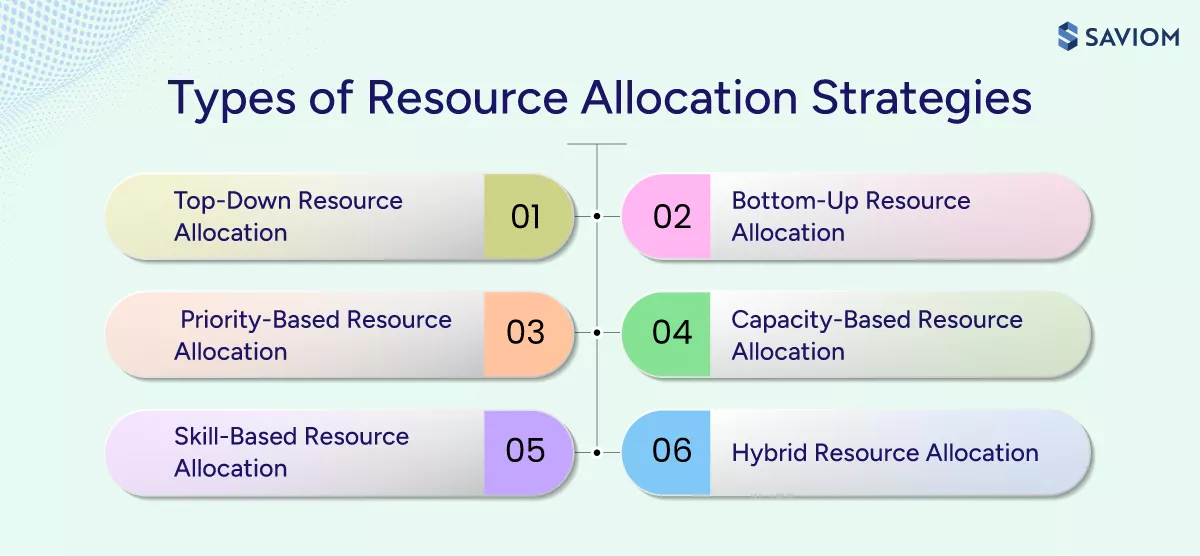
Top-Down Resource Allocation
Top-down resource allocation is driven by senior leadership, with resources assigned according to strategic priorities, approved budgets, customer commitments, or organizational goals. It works well in environments that require strong governance and centralized control. However, it becomes less accurate when decisions are made without clear visibility into actual team capacity, workload distribution, or delivery complexity.
Explore what strategic planning is and how it helps prioritize the right initiatives.
Bottom-Up Resource Allocation
Bottom-up resource allocation starts closer to the work, with project managers or functional leads estimating the effort and capabilities required based on task-level realities. This approach often produces more realistic resource allocation plans and stronger team buy-in. However, organizations can struggle to scale it without clear governance, project prioritization, and decision-making rules.
Priority-Based Resource Allocation
Priority-based resource allocation directs limited resources toward the most important initiatives first, based on business value, urgency, or strategic relevance. It is especially useful when multiple projects compete for the same talent pool, because it helps organizations make trade-offs quickly, consistently, and transparently.
For efficient resource prioritization, read our project resource management guide.
Capacity-Based Resource Allocation
Capacity-based resource allocation focuses on assigning work according to the organization’s actual delivery capacity. It takes into account available bandwidth, utilization thresholds, and existing commitments across teams or roles. This helps managers prevent overcommitment, resource risks, and delivery delays.
Skill-Based Resource Allocation
Skill-based resource allocation focuses on matching project needs with the right competencies, domain knowledge, experience levels, or functional expertise rather than assigning whoever happens to be available. This is especially important in specialized environments, where a poor resource match can slow project delivery, increase rework, and reduce the quality of outcomes.
See how a skill matrix supports better talent allocation.
Hybrid Resource Allocation
Hybrid allocation combines multiple approaches to create a flexible resource planning model, such as using strategic prioritization at the portfolio level and skill- or capacity-based allocation at the execution level. For many organizations, this is the most practical approach because it reflects how real delivery environments operate across shifting priorities, limited resource capacity, and evolving project needs.
Now that we have explored the types of resource allocation strategies, let’s look at the key factors organizations should consider before choosing one.
Key Factors to Consider Before Choosing a Resource Allocation Strategy
Choosing the right resource allocation strategy depends on the conditions it needs to support. Factors, such as business priorities, project complexity, capacity visibility, skill availability, and governance structure, influence which approach will work best. Reviewing these factors helps organizations make a more practical and informed choice. Let’s look at the key ones:
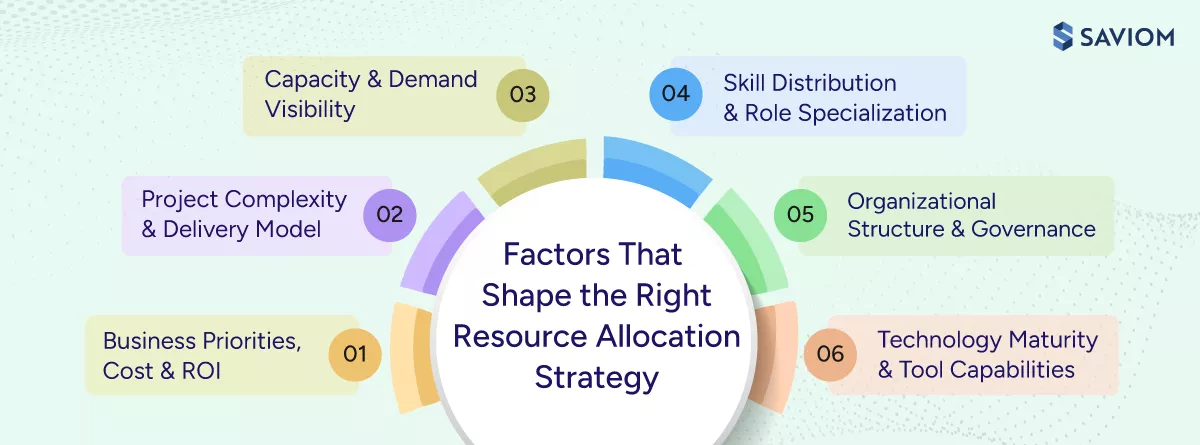
Business Priorities, Cost, and ROI
Resource allocation should always be aligned with business priorities. Whether the goal is to accelerate revenue, improve delivery speed, or support strategic growth, the chosen strategy must direct resources toward the outcomes that matter most. Cost is equally important because the right strategy should help organizations use available capacity in a way that improves both operational performance and financial returns.
Learn how to measure project ROI and improve business returns.
Project Complexity and Delivery Model
The right allocation strategy also depends on the nature of the work being delivered. Projects that are stable and predictable require a different allocation approach than those that are cross-functional, fast-moving, and subject to frequent reprioritization. Hence, organizations managing Agile and Waterfall projects in parallel often need a more flexible allocation model.
Capacity and Demand Visibility
A suitable allocation strategy depends on having a realistic view of both current resource availability and expected demand. Without that visibility, allocation decisions are more likely to be based on assumptions than actual capacity. This increases the risk of overallocation of resources, missed commitments, and ineffective project planning.
See how resource capacity planning helps balance supply and demand.
Skill Distribution and Role Specialization
According to a Mercer report 2025/26, “55% of organizations align skills with roles, and on average, 72% of jobs have defined skill mappings.”
Organizations should choose the strategy based on how skills are distributed across the business. When there is a broad mix of skills, organizations can allocate resources more flexibly. However, if delivery depends on a few specialized roles, organizations need a more deliberate approach. This helps reduce resource risk, avoid delivery bottlenecks, and ensure critical work is assigned to the right talent.
Organizational Structure and Governance
Organizational structure plays a major role in determining which allocation strategy will work best. In centralized models, decisions are usually more consistent, whereas in decentralized or matrix environments, greater coordination across teams and functions is required. As a result, a strategy that works well in one structure may not work well in another without clear governance, ownership, and decision rights.
Understand key resourcing challenges in a matrix organization.
Technology Maturity and Tool Capabilities
The effectiveness of any resource allocation strategy depends on the organization’s technology maturity and the capabilities of its workforce planning tools. More capable tools support real-time visibility, scenario planning, skill tracking, and utilization monitoring. As tool capabilities improve, allocation decisions rely less on manual judgment and more on real-time data, enabling faster and more confident planning.
Having understood the key factors that influence strategy selection, the next step is to determine the right resource allocation strategy.
How to Choose the Right Resource Allocation Strategy?
Choosing the right resource allocation strategy requires a structured evaluation of business objectives, delivery needs, and resource realities. The most effective approach is the one that fits the organization’s strategic priorities, capacity constraints, team structure, and planning environment. Here’s how to make that choice more effectively:
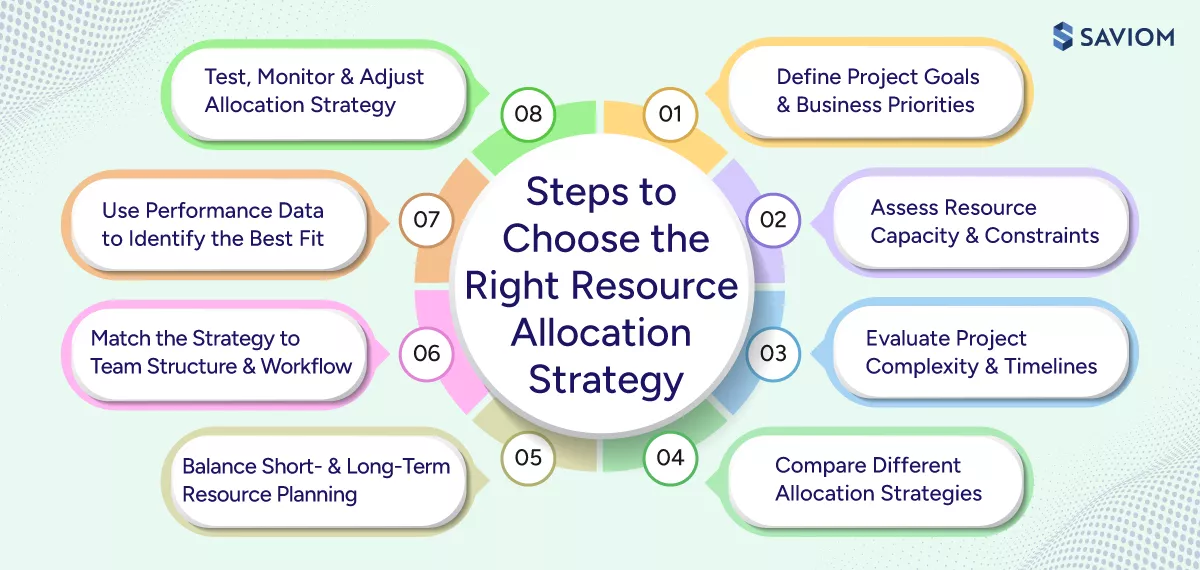
Define Project Goals and Business Priorities
The first step is to clarify what the organization is trying to achieve through resource allocation. Without this, it becomes difficult to judge which strategy is actually the right fit. Some businesses prioritize delivery speed; others focus on maximizing utilization, improving cost control, or building long-term capacity. Once the key drivers are clear, they can be translated into selection criteria.
Discover the significance of business objectives and how to establish them.
Assess Team Capacity and Resource Constraints
In this step, organizations should assess team capacity and resource constraints to determine which strategy is realistic to implement in practice. For example, limited capacity, specialized roles, or frequent resource conflicts may make it difficult to use approaches that depend heavily on frequent manual coordination. This ensures that the selected approach aligns with what the organization can consistently manage.
Evaluate Project Complexity, Workload, and Timelines
This step helps organizations assess how much planning, control, adaptability, and coordination the allocation strategy will need to support. When projects involve tight timelines, heavier workloads, and more cross-functional dependencies, they usually require a more dynamic approach than stable, easier-to-manage work.
Explore how to improve cross-functional collaboration.
Compare Different Resource Allocation Strategies
Next, organizations should compare the resource allocation strategies against their business needs, capacity constraints, and working conditions. This makes it easier to assess how well each resource allocation model aligns with the operating environment. It also helps identify where a strategy is likely to fit, and where resource planning or project execution challenges may arise before implementation.
Balance Short-Term Needs with Long-Term Resource Planning
In this step, organizations should ensure the chosen allocation strategy balances short-term staffing needs with long-term resource planning. This helps meet immediate delivery requirements without leading to skill gaps, resource overutilization, or inefficient allocation patterns later. It also ensures that future resource needs, skill development, and capacity planning are proactively addressed rather than managed reactively.
Learn how to build a future-ready workforce with skill development.
Match the Strategy to Team Structure and Workflow
Next, organizations should match resource allocation strategies with how teams work across projects and functions. This includes work assignments, team collaboration, and the sharing of resources across roles or departments. When the resource allocation strategy aligns with these workflow patterns, it is easier to apply consistently and less likely to introduce unnecessary planning complexity.
Use Forecasting and Performance Data to Narrow Down the Choice
In this step, organizations should use historical patterns, forward-looking estimates, and performance data to narrow down the choice. This helps them assess which resource-allocation strategy is more likely to hold up in real operating conditions. Moreover, data such as utilization trends, delivery performance, and recurring bottlenecks can make the final decision more grounded and less dependent on assumptions.
Learn the fundamentals of resource forecasting
Test, Monitor, and Adjust the Resource Allocation Strategy
Finally, organizations should test the selected strategy in a limited setting before applying it more broadly. This gives teams a chance to see how the approach performs under actual delivery conditions. Furthermore, by monitoring the early results, they can identify implementation gaps, make adjustments, and strengthen the strategy before wider rollout.
Explore this eBook to see how 5th gen resource management supports smarter resource allocation, higher utilization, and stronger delivery outcomes.

With the selection process outlined, the next step is to examine the common mistakes that can weaken resource allocation strategy implementation and how to avoid them.
Common Mistakes to Avoid When Implementing the Allocation Strategy
According to a McKinsey survey, “83% of executives view resource allocation as the most important management lever for driving growth.”
That strategic importance only translates into results when the chosen allocation approach is implemented effectively. Hence, organizations also need to implement it in a way that supports clear decision-making, consistent execution, operational efficiency, and ongoing adjustment. Without that, even a well-suited strategy can fall short. Let’s look at common mistakes to avoid:
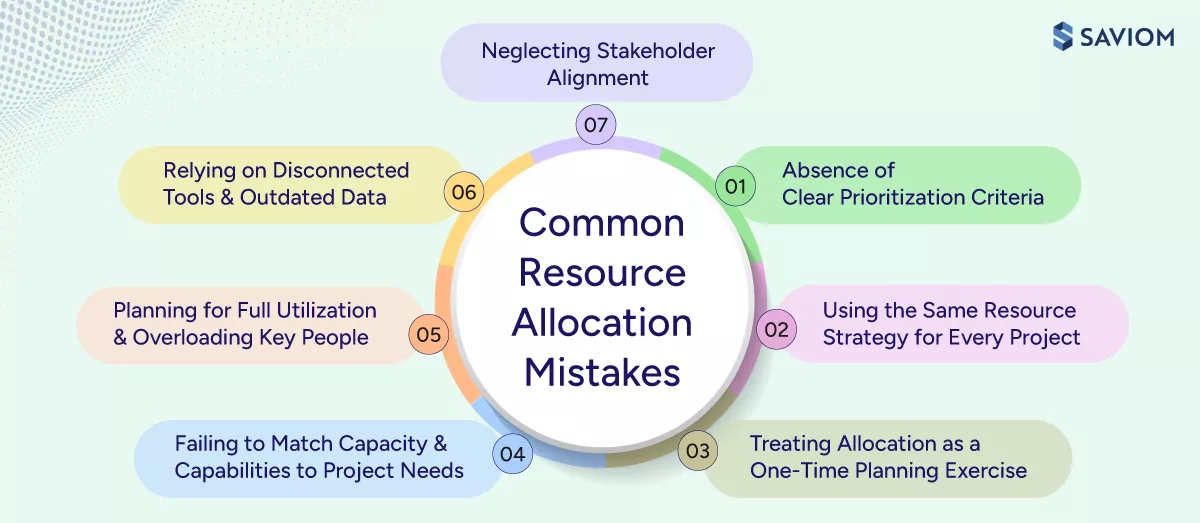
Choosing a Strategy Without Clear Prioritization Criteria
When teams do not understand how projects are prioritized or how resource conflicts will be resolved, allocation decisions quickly become reactive, inconsistent, and harder to defend. As a result, resource managers spend more time negotiating priorities, and stakeholders lose confidence in how limited resources are being assigned.
How organizations can avoid this:
- Define clear project prioritization criteria based on factors such as strategic value, urgency, delivery impact, and resource availability.
- Use those criteria consistently to resolve trade-offs faster and explain allocation decisions with greater confidence.
Applying the Same Resource Allocation Strategy to Every Project
Resource allocation strategies do not work equally well across all projects because delivery needs vary by complexity, timelines, dependencies, and skill requirements. Therefore, when organizations apply the same model everywhere, they weaken the alignment between resource decisions and actual project demands.
How organizations can avoid this:
- Adapt the allocation strategy to the specific project context rather than applying a single model across the full portfolio.
- Define clear guidelines for selecting different allocation approaches based on project type, complexity, and resource requirements.
Treating Allocation as a One-Time Planning Exercise
Organizations often establish an initial resource allocation plan and then treat it as fixed, even as priorities, staffing levels, and timelines change. As a result, the strategy becomes less effective over time, and teams often respond only after those changes begin to affect delivery performance.
How organizations can avoid this:
- Review allocation decisions regularly and update them when demand, capacity, or project scope changes.
- Reassess project priorities, resource availability, and workload distribution as conditions evolve.
Failing to Match Capacity and Capabilities to Project Needs
Resource allocation often falls short when decisions focus only on who is available, without assessing whether the team also has enough bandwidth and the right capabilities to deliver the work. This usually leads to delivery delays, rework, quality issues, or unnecessary pressure on a small number of specialists.
How organizations can avoid this:
- Maintain clear visibility into team skills, certifications, experience levels, and current workload before making allocation decisions.
- Assess both workload capacity and role fit before assigning resources to a project or initiative.
Planning for Full Utilization and Overloading Key People
Resource allocation often becomes unstable when teams are planned at or near full utilization, and high-performing individuals are expected to continuously absorb additional work. This increases the risk of resource overallocation and leaves little room for unplanned work, changes in project demand, or internal coordination, compromising team well-being and execution quality.
How organizations can avoid this:
- Use real-time capacity data and leave room for unplanned work, escalation support, and day-to-day work changes.
- Distribute work more deliberately to balance workloads and prevent the same individuals from being repeatedly overloaded.
To ensure balanced workload distribution, read our resource utilization guide
Relying on Disconnected Tools and Outdated Data
When resource schedules, capacity plans, utilization data, and demand forecasts are spread across disconnected systems or spreadsheets, managers struggle to make allocation decisions with confidence. As a result, resource allocation strategies become harder to trust, slower to update, and more difficult to apply consistently across teams.
How organizations can avoid this:
- Create a single source of truth for resource data, so all teams work with consistent, up-to-date information on capacity, demand, and availability.
- Standardize how resource information is updated, reviewed, and shared among planning teams before allocation decisions are made.
Neglecting Stakeholder Alignment
Resource allocation weakens when project leaders, functional managers, and delivery teams work from different assumptions about priorities, ownership, and decision rights. This often leads to slower approvals, unresolved trade-offs, and misaligned project execution across teams, reducing confidence in the allocation process and disrupting delivery momentum.
How organizations avoid this
- Align project stakeholders on priorities, decision ownership, and resource commitments before applying the strategy across teams or functions.
- Communicate allocation decisions across stakeholders so teams can resolve conflicts faster and make trade-off decisions with shared context.
Learn the best ways to identify and manage project stakeholders.
Use SAVIOM’s resource management software to choose the right allocation strategy, align capacity, and avoid delivery bottlenecks. Book a Demo Today.

Now, let us understand how SAVIOM’s advanced resource management software supports the implementation of resource allocation strategies.
How Does SAVIOM Support Resource Allocation Strategies?
SAVIOM’s advanced resource management software brings together the planning and allocation capabilities organizations need to assign resources across projects. Its integrated platform supports structured decision-making through enterprise-wide resource oversight, capacity planning, skill visibility, and utilization tracking.
The following features show how SAVIOM supports resource allocation strategies:
- The all-in-one resource planner centralizes enterprise-wide resource information, giving managers a unified view of availability, allocation, and workload distribution.
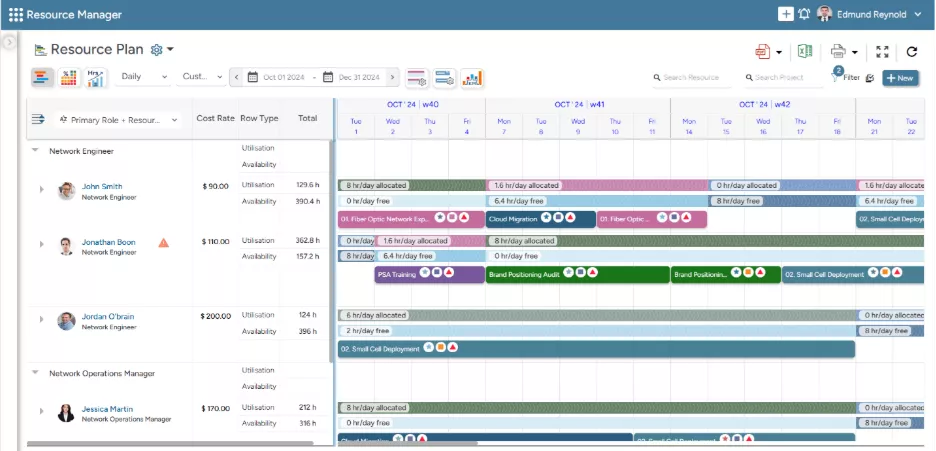 All-in-One Resource Planner provides real-time visibility into resource availability, utilization, and allocation across the enterprise.
- The embedded capacity planner helps organizations compare demand against available capacity, making it easier to allocate resources based on actual delivery capability rather than assumptions.
- The KPI forecaster tracks key metrics such as resource utilization, availability, and capacity, helping organizations monitor allocation performance and spot trends early.
- Embedded heat mapping visualizes over- and underutilized resources, enabling managers to identify workload imbalances and take corrective action.
- The early warning system flags issues such as overutilization and double bookings in advance, enabling teams to address allocation risks before they affect delivery.
- The competency matrix provides clear visibility into workforce skills, certifications, and experience, helping managers allocate skills more accurately across projects.
- Real-time BI reports and dashboards provide ongoing visibility into critical resource data, allowing leaders to review allocation decisions against actual capacity, project demand, and utilization.
- Scenario modeling allows teams to evaluate different allocation approaches before implementation, supporting more structured decision-making in dynamic environments.
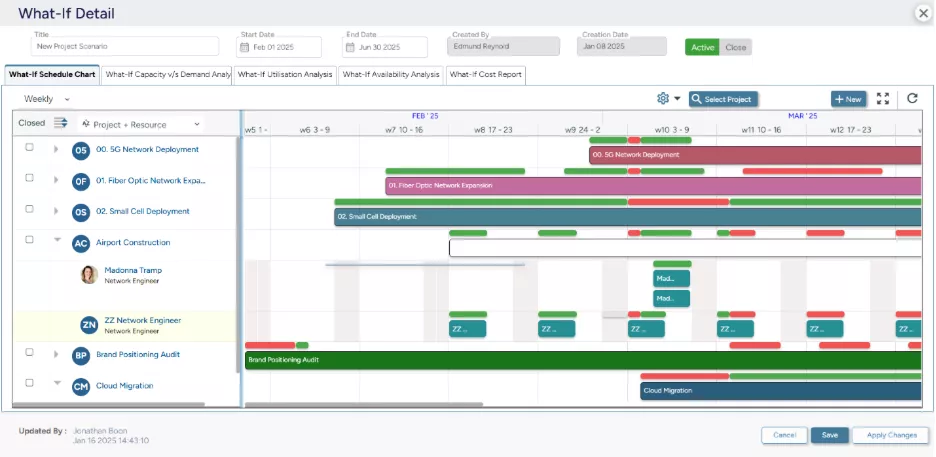 SAVIOM’s Scenario Modeling functionality allows managers to simulate and test multiple workforce scenarios in a sandbox environment.
Read our resource management guide to explore the core concepts.
Conclusion
Resource allocation strategies are most effective when they reflect the realities of the business, not just the demands of individual projects. The right approach helps organizations align capacity with project priorities, deploy critical skills more effectively, and improve delivery outcomes. In practice, better allocation also leads to stronger resource utilization, greater planning control, and more confident decision-making.
However, as business conditions shift, resource allocation must remain dynamic, data-driven, and closely tied to both short-term execution and long-term workforce planning. Hence, organizations that regularly review priorities, capacity, and skill availability are better positioned to reduce bottlenecks, manage change, and sustain operational efficiency.
Resource Allocation Strategies FAQs
Resource allocation strategies are structured approaches organizations use to assign available resources, such as people, tools, equipment, and budget, to the projects that matter most. They help decision-makers allocate resources based on project priority, capacity, and availability, supporting more efficient execution.
Resource allocation determines which resources should support which projects based on priority, capacity, and skills, while resource scheduling determines when that work should occur based on timelines and dependencies. In short, allocation is about who goes where, and scheduling is about when the work gets done.
The common types of resource allocation strategies are:
1. Top-down resource allocation
2. Bottom-up resource allocation
3. Priority-based resource allocation
4. Capacity-based resource allocation
5. Skill-based resource allocation
6. Hybrid resource allocation
Poor resource allocation can lead to missed deadlines, budget overruns, lower productivity, and reduced work quality. When the right people, tools, or budget are not assigned at the right time, businesses may face bottlenecks, duplicated effort, over or underutilized resources. Over time, poor allocation affects project delivery, stakeholder satisfaction, and overall business performance.
The factors to consider when choosing a resource allocation strategy are:
1. Business priorities, cost, and ROI
2. Project complexity and delivery model
3. Capacity and demand visibility
4. Skill distribution and role specialization
5. Organizational structure and governance
6. Technology maturity and tool capabilities
To choose the right resource allocation strategy, organizations should:
1. Define project goals and business priorities
2. Assess team capacity and resource constraints
3. Evaluate project complexity, workload, and timelines
4. Compare different resource allocation strategies
5. Balance short-term needs with long-term resource planning
6. Match the strategy to team structure and workflow
7. Use forecasting and performance data to narrow down the choice
8. Test, monitor, and adjust the resource allocation strategy
The common challenges in implementing resource allocation strategies include:
1. Choosing a strategy without clear prioritization criteria
2. Applying the same resource allocation strategy to every project
3. Treating allocation as a one-time planning exercise
4. Failing to match capacity and capabilities to project needs
5. Planning for full utilization and overloading key people
6. Relying on disconnected tools and outdated data
7. Neglecting stakeholder alignment