

Introduction
Imagine a marketing firm experiencing a surge in client demand. New projects are signed, delivery teams are busy, and business appears to be thriving. Yet beneath that momentum, strategists are unevenly allocated, and critical skills are overbooked. In moments like these, the need to improve resource utilization becomes impossible to ignore, as firms seek better ways to align talent with shifting project demands.
Improving resource utilization is not just about getting more output from the same resources; it is about allocating resources to high-value projects. When available skills and capacity are deployed more strategically, organizations can reduce inefficiencies, strengthen delivery performance, and respond more effectively to changing demand.
In this blog, we will discover strategies to improve resource utilization, enhance efficiency, and drive more sustainable business performance.
What Does Resource Utilization Mean?
Resource utilization refers to how effectively an organization uses its available resources (human and non-human) across billable, strategic, or operational work. It helps measure whether resources are optimally engaged, underutilized, or overutilized in relation to business demand and capacity.
A strong utilization rate indicates better workforce efficiency, stronger cost control, and improved delivery performance. In addition, it is a critical metric for balancing workloads, enhancing productivity, boosting business profitability, and ensuring optimal resource health.
Now that the definition is clear, let us understand the benefits of optimizing resource utilization.
Why Resource Utilization Matters?
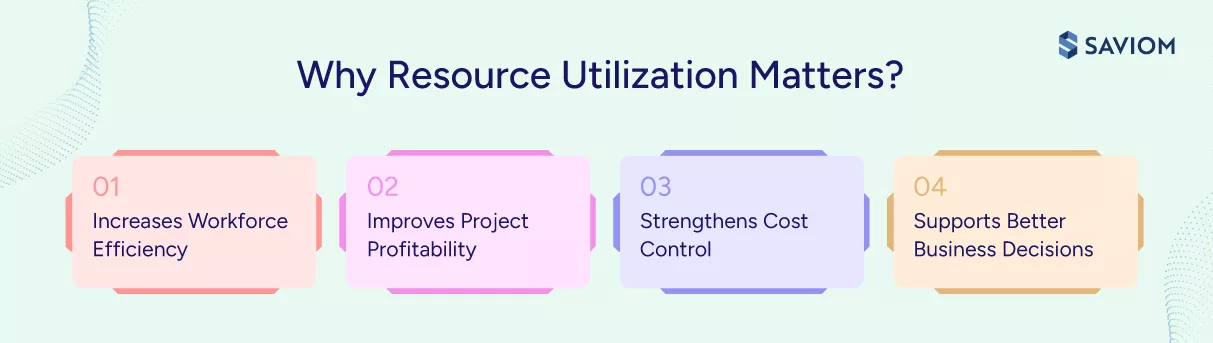
Resource utilization directly influences how efficiently teams, budgets, and tools are deployed across projects. When resources are allocated with clarity, organizations can improve productivity, reduce avoidable costs, and maintain better control over timelines and outcomes. The points below highlight the specific ways effective utilization strengthens performance, planning, and long-term growth.
Increases Workforce Efficiency
Optimal resource utilization increases workforce efficiency by ensuring more time is spent on meaningful work and less time is lost to reallocation churn and avoidable downtime. When resources are assigned based on project priorities, skill fit, and available capacity, organizations can reduce delays, improve productivity, and achieve better outcomes without necessarily increasing headcount.
Improves Project Profitability
Higher resource utilization improves project profitability by increasing the share of resource capacity dedicated to billable, high-value work. When fewer hours are lost to bench time, inefficient deployment, or poorly matched assignments, organizations can generate greater output and revenue from the same workforce base.
Strengthens Cost Control
As per Deloitte’s research, “Modern businesses use real-time data to forecast supply and demand more accurately, activate dynamic scheduling, and simulate disruptions before they become cost problems.”
When resources are planned and utilized efficiently, businesses can reduce dependence on expensive last-minute solutions such as urgent hiring, excessive overtime, or external contractors. In addition, improved utilization helps control costs by reducing bench time, avoiding unnecessary spending, and ensuring project budgets are managed more predictably.
Read our blog on cost reduction strategies to understand how they help boost business profitability.
Supports Better Business Decisions
Utilization data provides managers with a realistic view of resource risks, such as capacity shortages, skill gaps, and excess bench time, across the organization. This visibility supports informed decisions about redeployment, pipeline acceptance, project sequencing, targeted upskilling, and hiring. As a result, organizations can reduce staffing risk and improve readiness for future project needs.
Now that we understand why resource utilization matters, let us look at some common causes of low resource utilization in firms.
Common Causes of Low Resource Utilization
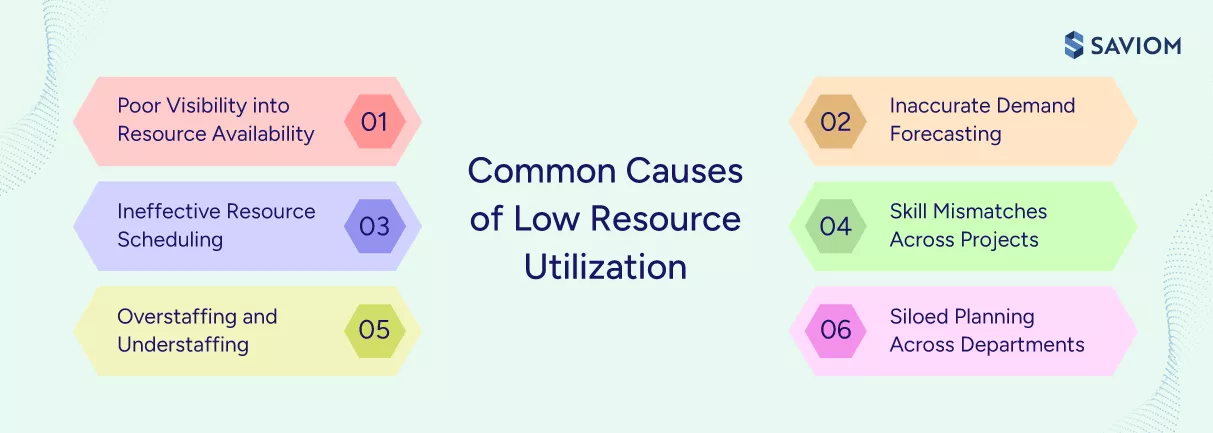
Low resource utilization often stems from gaps in planning, visibility, and decision-making across teams and projects. When workloads are uneven, priorities are unclear, or skills are not matched to the right tasks, valuable capacity can go underused. The following factors explain the most common reasons organizations struggle to utilize resources efficiently.
Poor Visibility into Resource Availability
When resource availability, allocations, leave, bench strength, and project vacancies are not visible in one place, managers end up planning with partial information. This lack of visibility often leads to uneven workload distribution, increased bench size, and last-minute staffing conflicts, reducing overall workforce effectiveness.
Inaccurate Demand Forecasting
As per Deloitte’s research, “Forecasting and dynamic workforce planning are essential for navigating changing skill demand and workforce disruption.”
Inaccurate demand forecasting makes it difficult for organizations to anticipate workload and prepare resources in advance. As a result, workforce planning becomes reactive, often causing underutilization during slower periods and overutilization when demand rises unexpectedly. This makes it harder to maintain a balanced, productive, and cost-efficient workforce.
Ineffective Resource Scheduling
Ineffective resource scheduling results in unplanned breaks between project assignments, double bookings, and handoff delays. Moreover, when scheduling is handled reactively, managers tend to focus only on immediate project needs rather than long-term workforce efficiency. As a result, resources may be deployed in ways that reduce productivity, disrupt work continuity, and lower overall utilization.
Skill Mismatches Across Projects
Resource utilization suffers when employees are assigned to projects without considering their skills, experience, or role suitability. Such mismatches can reduce productivity, increase rework, and affect the quality of project outcomes. At the same time, high-value talent may remain underutilized, while less-suited employees are assigned to critical assignments, resulting in an inefficient deployment of available capacity.
Overstaffing and Understaffing
Overstaffing increases bench time and labor costs without improving output, while understaffing overloads key resources, causing burnout, delayed delivery, and compromised project quality. When the workforce size is not aligned with actual demand, organizations struggle to deploy resources efficiently, making it harder to maintain productivity and control costs.
Siloed Planning Across Departments
When business units plan resources in isolation, they miss opportunities to share available skills across functions or reallocate capacity to higher-priority work. This fragmented approach leaves some teams overloaded while others have unused capacity. As a result, leadership lacks a clear view of resource trade-offs across the organization, making it harder to balance workloads and improve utilization.
Now, let us look at the steps that businesses can take to improve resource utilization.
How to Improve Resource Utilization?
Improving resource utilization starts with building better visibility into capacity, workload, and business priorities. With the right planning, allocation, and tracking practices, organizations can reduce bench time, balance workloads, and make more effective use of available resources. The following strategies outline practical ways to optimize utilization and support stronger operational performance.
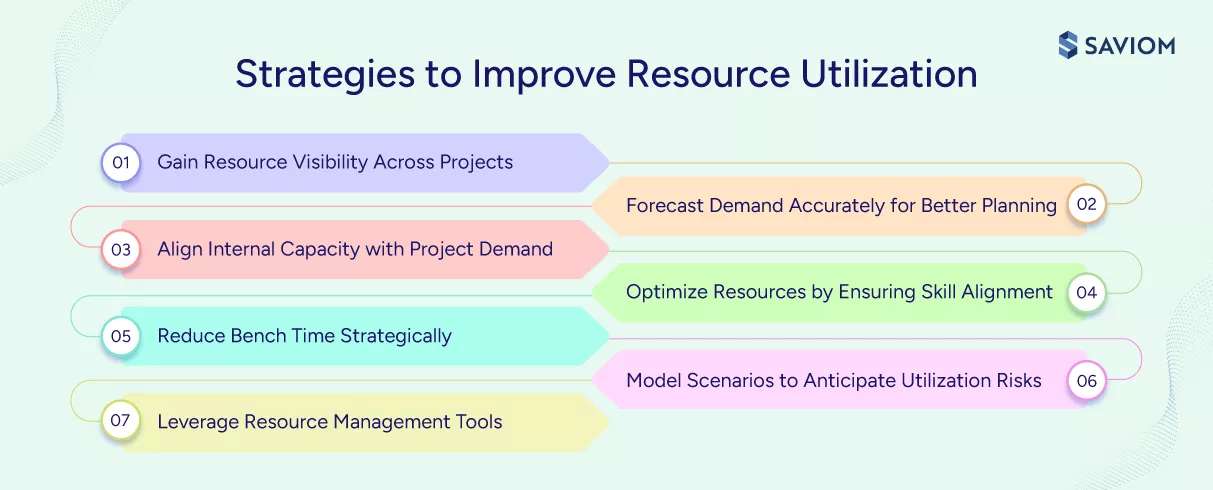
Gain Resource Visibility Across Projects
Improving utilization starts with having a centralized view of resource allocation across all projects and business units. When managers can clearly see who is underutilized, overutilized, or available, they can make faster and more informed allocation decisions. This visibility also supports cross-project reallocation, helping organizations respond more effectively to shifting priorities, workload changes, and delivery pressures.
Forecast Demand Accurately for Better Planning
Next, managers should forecast future project demand and prepare capacity in advance. By understanding expected workload, skill requirements, and upcoming pipeline changes, businesses can avoid last-minute resourcing decisions. This improves planning readiness, supports smoother project execution, and helps maintain a more balanced utilization level over time.
Align Internal Capacity with Project Demand
Next, managers should align workforce capacity with current and expected project demand. Effective resource capacity planning helps organizations avoid both resource shortages that delay delivery and excess bench capacity that impacts profitability. Moreover, when businesses continuously compare supply against demand, they can make strategic redeployment, upskilling, and hiring decisions.
Optimize Resources by Ensuring Skill Alignment
In this step, managers can assign resources based on both availability and skill fit. By using skill inventories alongside project requirements, businesses can place talent where it creates the greatest operational value. Strong skill alignment ensures that the right expertise is allocated to the right work, improving productivity, reducing rework, and enhancing overall delivery quality.
Reduce Bench Time Strategically
Next, managers can proactively mobilize available resources to billable projects, internal initiatives, presales support, or skill development programs to prevent resource underutilization and minimize bench time. This approach helps avoid revenue loss, improve workforce engagement, and ensure resources remain deployment-ready for future demand.
Model Scenarios to Anticipate Utilization Risks
Businesses should use scenario modeling to evaluate how pipeline changes, project delays, or resource constraints may affect utilization. This approach allows decision-makers to test different workforce strategies before issues disrupt delivery. Moreover, by anticipating risks early, businesses can adjust plans with more confidence and protect both productivity and project performance.
Leverage Resource Management Tools
Lastly, businesses should use dedicated resource management tools to track utilization through centralized data, BI dashboards, and reports. These tools provide real-time visibility into resource availability, workloads, and utilization levels, making it easier to optimize allocation across the organization. As a result, businesses can make data-driven decisions that support stronger workforce performance over time.
After the steps, it is time to learn about some of the best practices that can help organizations optimize utilization.
Best Practices to Optimize Resource Utilization
Optimizing resource utilization requires a consistent approach that aligns people, time, and budgets with the right priorities. When organizations follow structured practices, they can improve efficiency, reduce waste, and keep teams operating at their full potential. The best practices below highlight practical ways to prevent resource overutilization or underuse and drive better project and business outcomes.
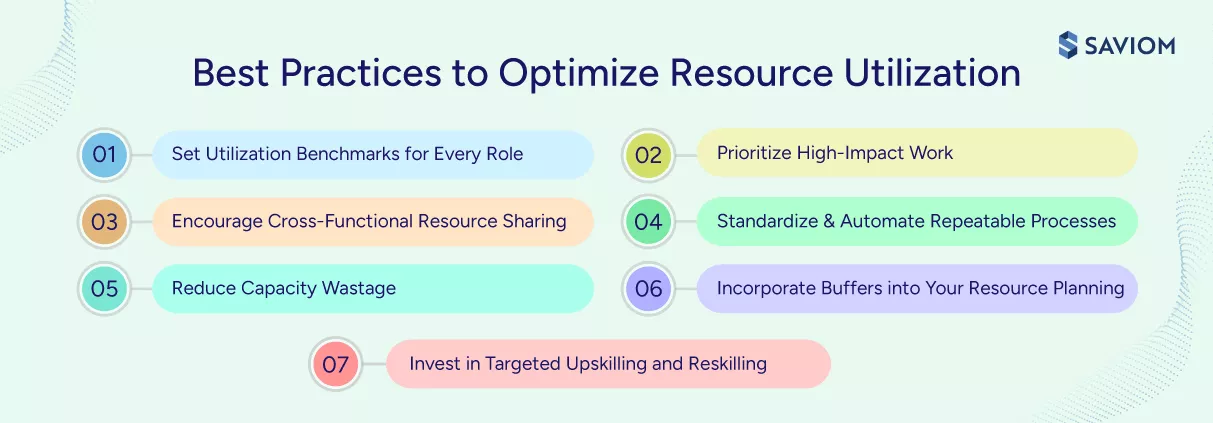
Set Utilization Benchmarks and Targets for Every Role
Resource utilization targets should be defined according to the nature of each role, as not all functions contribute equally to billable work. For example, delivery teams, support functions, and leadership roles should have different utilization targets based on their responsibilities. Defining role-specific benchmarks makes utilization measurement more realistic and helps managers evaluate performance fairly.
Prioritize High-Impact Work
Organizations should rank initiatives based on business impact, urgency, and strategic relevance so that resources are focused on the most important outcomes. This also means shifting capacity away from low-value tasks that do not significantly support delivery or growth. With clear prioritization frameworks in place, managers can make better trade-offs when resources are limited, thereby improving resource utilization.
Encourage Cross-Functional Resource Sharing
Organizations should promote resource sharing across teams by creating visibility into available skills beyond individual departments. In addition, they should establish a clear governance structure so managers can temporarily reallocate talent without disrupting core responsibilities. This approach improves flexibility, helps close capability gaps faster, and enables businesses to make better use of available talent.
Standardize and Automate Repeatable Processes
Businesses should standardize workflows, templates, and handoff processes for recurring tasks to reduce variability and improve execution speed. They can identify activities that consume significant time but require limited judgment, then automate them where possible, including reporting, approvals, scheduling, and data entry. This approach frees up capacity for higher-value work while improving operational efficiency.
Reduce Capacity Wastage
Managers should actively track where time and capacity are being lost, not just where resources are assigned. They can eliminate redundant processes, overlapping systems, and unnecessary reporting layers that consume effort without contributing meaningful value. Additionally, firms should strengthen handoffs, communication, and requirement clarity to reduce avoidable rework and ensure teams use their time more productively.
Incorporate Buffers into Your Resource Planning
Managers should build realistic buffers into resource management plans instead of operating at full capacity. Planning at 100% leaves little room to absorb urgent work, delays, or shifting priorities. On the other hand, contingency capacity helps teams respond to changes more effectively. As a result, resource plans become more resilient, disruptions are reduced, and utilization remains more stable.
Invest in Targeted Upskilling and Reskilling
Businesses must invest in targeted retraining/upskilling to expand workforce flexibility and improve alignment with evolving project needs. Broader capabilities allow businesses to redeploy talent more easily across functions and reduce dependency on external hiring. Consequently, this enhances resource utilization by increasing the pool of deployable talent and reducing skill-based allocation gaps.
Explore this eBook to learn how a 5th gen resource management helps businesses improve resource utilization and boost delivery performance across projects.

Now, let us delve into the key metrics that help organizations track the improvement of resource utilization.
Metrics to Track Resource Utilization Improvement
Tracking the right metrics helps organizations measure whether resource utilization efforts are delivering real operational improvements. Clear performance indicators make it easier to identify inefficiencies, monitor progress, and make better decisions around capacity and allocation. The metrics below highlight the most important areas to assess when improving resource utilization over time.
Resource Utilization Rate
Resource utilization rate measures how effectively a company uses employees, equipment, and tools against the total available capacity. It helps teams spot underutilization or overuse early, balance workloads, prevent employee burnout, improve productivity, and project profitability.
Formula:
Billable Utilization Rate
Billable utilization rate measures the share of an employee’s available hours spent on billable, client-facing work. A low billable utilization rate shows that resources spend more time on low-impact, non-billable work, while a high rate indicates they are allocated more effectively to revenue-generating tasks.
Formula:
Strategic Utilization Rate
Strategic utilization rate measures how much time resources spend on long-term, high-impact initiatives. It helps managers see whether teams align their efforts with strategic goals and focus on work that drives growth and competitive advantage.
Formula:
Productive Utilization Rate
Productive utilization measures the share of time spent on valuable work across billable, strategic, and critical operational activity. It gives a more complete picture than billable utilization alone and is especially useful when organizations run a mix of client delivery and internal transformation programs.
Formula:
Resource Capacity Utilization Rate
The capacity utilization rate measures how effectively an organization uses its total available workforce capacity over a given period. It helps identify whether resources are underutilized, fully utilized, or overutilized across teams and projects. This visibility enables managers to optimize allocation, balance workloads more effectively, and make informed decisions that improve operational efficiency.
Formula:
Forecast vs. Actual Utilization
Forecast vs. actual utilization measures the difference between planned resource utilization and the utilization achieved over a given period. By comparing forecasted and actual utilizations, managers can identify gaps, improve demand planning, and make more reliable decisions around staffing, allocation, and future project readiness.
Formula:
Bench Time Percentage
Bench time percentage measures the share of employee time spent unassigned or significantly underutilized over a given period. It is a critical metric for identifying redeployment delays, weak pipeline conversion, or staffing levels that are not aligned with actual demand. By tracking bench time closely, organizations can take faster action to improve deployment and strengthen overall resource utilization.
Schedule Adherence
Schedule adherence measures how closely actual resource assignments and project timelines follow the original plan. Low adherence often indicates unstable scheduling or frequent priority shifts that disrupt execution. In contrast, strong schedule adherence reflects better planning discipline and a more stable operating rhythm, all of which support consistent delivery and more effective resource utilization.
Resource Forecast Accuracy
According to Deloitte’s research, “Stronger forecasting as a core enabler of dynamic workforce planning.”
Resource demand forecast accuracy measures how closely predicted resource needs align with actual demand over a given period. This metric helps businesses evaluate the effectiveness of their planning assumptions, refine future forecasts, and make better decisions on hiring, allocation, and utilization.
Formula:
Workload Distribution
Workload distribution assesses how evenly work is allocated across available resources. It helps organizations identify imbalances such as overburdened resources, underused capacity, or concentration of critical work within a small group. By monitoring workload distribution, managers can balance assignments more effectively, reduce burnout risk, and improve overall resource utilization and delivery performance.
Use SAVIOM’s resource planner to improve resource utilization in real-time, minimize burnout, and futureproof your workforce. Book a Demo Today.

Now, let us understand how SAVIOM’s advanced resource management software can help businesses improve resource utilization.
How Does SAVIOM Help Improve Resource Utilization?
SAVIOM’s next-gen resource management software helps organizations improve resource utilization by providing end-to-end visibility into capacity, demand, and workforce deployment. Its data-driven approach enables businesses to identify inefficiencies, optimize allocation, reduce bench time, and increase billable utilization.
The following features show how SAVIOM’s capabilities help organizations strengthen resource utilization and drive sustained operational value.
- All-in-One Resource Planner: Brings all resource data into a single view, improving visibility across teams and helping managers make faster, skill-based allocation decisions that increase overall resource utilization.
- Embedded Capacity Planner: Enables forward-looking capacity planning by identifying future resource gaps early, helping organizations balance workloads proactively and improve utilization without relying on reactive staffing decisions.
- KPI Forecaster: Tracks critical resource management metrics such as availability, utilization, burnout, and skill gaps in real time, allowing businesses to take timely action to improve workforce efficiency.
- Embedded Utilization Heatmaps: Uses visual indicators to highlight overutilized and underutilized resources, making it easier to adjust allocations quickly, improve productivity, and reduce unnecessary bench time.
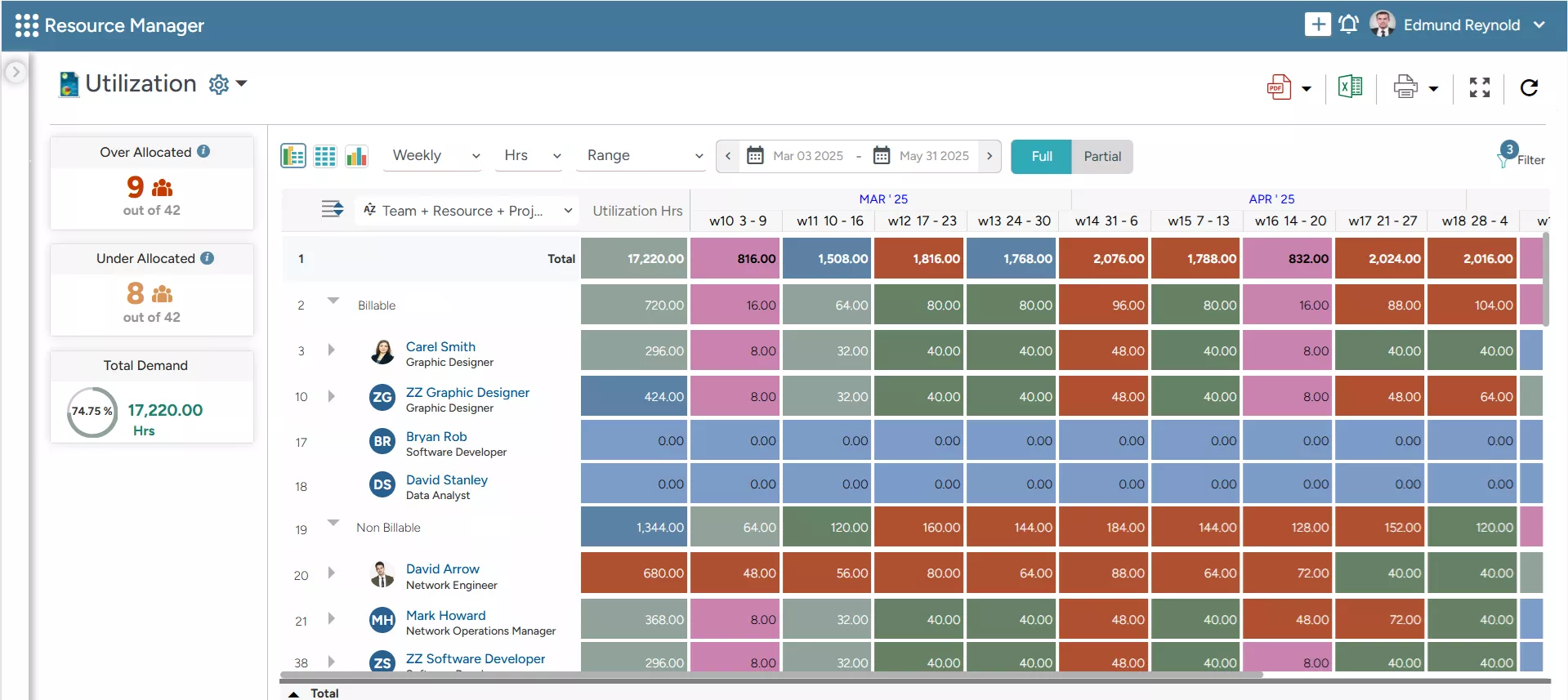 SAVIOM’s Color-Coded Heatmap highlights the real-time resource utilization levels, helping managers identify imbalances and optimize productive utilization.
- Real-Time BI Reports and Dashboards: Provides continuous insight into key metrics such as utilization, project vacancies, people on the bench, and forecast accuracy, helping organizations track and improve resource performance
- What-If Analysis: Supports scenario planning by allowing teams to test multiple resource strategies, helping them identify the most effective utilization approach and make better decisions in uncertain conditions.
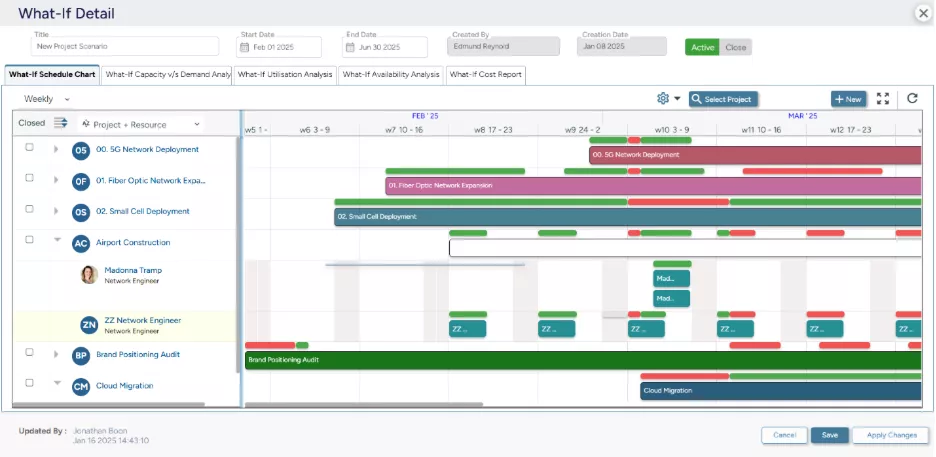 SAVIOM’s Scenario Modeling functionality allows managers to simulate and test multiple workforce scenarios in a sandbox environment.
Improve Resource Utilization FAQs
Resource utilization refers to how effectively an organization uses its available workforce across billable, strategic, or operational work. It helps measure whether resources are optimally engaged, underutilized, or overutilized in relation to business demand and capacity.
The main benefits of optimal resource utilization are:
1. Increases workforce efficiency
2. Improves project profitability
3. Strengthens cost control
4. Supports better business decisions
The common causes of low resource utilization are:
1. Poor visibility into resource availability
2. Inaccurate demand forecasting
3. Ineffective resource scheduling
4. Skill mismatches across projects
5. Overstaffing and understaffing
6. Siloed planning across departments
To improve resource utilization, businesses can:
1. Gain resource visibility across projects
2. Forecast demand accurately for better planning
3. Align internal capacity with project demand
4. Optimize resources by ensuring skill alignment
5. Reduce bench time strategically
6. Model scenarios to anticipate utilization risks
7. Leverage resource management tools
The following are the best practices that help organizations sustain utilization optimization:
1. Set utilization targets by role
2. Prioritize high-impact work
3. Encourage cross-functional resource sharing
4. Standardize and automate repeatable processes
5. Reduce capacity wastage
6. Incorporate buffers in your resource planning
7. Invest in upskilling and reskilling
Below are the metrics that businesses should track to improve resource utilization:
1. Resource utilization rate
2. Billable utilization rate
3. Strategic utilization rate
4. Productive utilization rate
5. Resource capacity utilization rate
6. Forecast vs. Actual utilization
7. Bench time percentage
8. Schedule adherence
9. Resource forecast accuracy
10. Workload distribution
Resource utilization ensures that employees are neither overbooked nor underbooked, enabling optimal productivity and cost efficiency. It helps organizations maximize billable work, reduce wastage, and maintain balanced workloads. This directly supports profitability and sustainable business growth.