

Introduction
For years, the Project Management Office (PMO) was seen as the administrative backbone, tracking project status, enforcing processes, and maintaining documentation. Its effectiveness was largely measured by project reporting accuracy and compliance with governance frameworks. But in today’s highly competitive business environment, that definition no longer holds.
Modern organizations expect far more from their PMOs. Instead of functioning purely as a control mechanism, the PMO is increasingly becoming a strategic orchestration hub that improves project prioritization, optimizes resource utilization and strengthens risk management. By providing greater structure and oversight across initiatives, it enables organizations to translate their investments into measurable business outcomes.
This guide explores the core functions of a Project Management Office, its structural types, maturity evolution, and the emerging trends shaping modern PMO practices.
What is a Project Management Office (PMO)?
A Project Management Office (PMO) is a centralized governance function that standardizes project management practices, establishes oversight across initiatives, and ensures optimal use of organizational resources. It integrates projects into a structured portfolio framework, ensuring visibility and consistency and preventing fragmented efforts.
In modern enterprises, the Project Management Office functions as a strategic enabler, guiding project selection around corporate priorities, providing portfolio-level insights, and enabling proactive risk management. Beyond overseeing execution, it fosters disciplined, outcome-driven performance and ensures that project investments contribute to sustainable business value.
Historical Evolution of PMOs
The Project Management Office has undergone a significant transformation over the past two decades.
Traditional PMOs primarily focused on:
- Standardizing methodologies and documentation
- Enforcing compliance with project management processes
- Consolidating status reports for leadership visibility
- Tracking timelines and budgets
Their mandate centered around process consistency and reporting discipline. As organizations scaled and project portfolios became more complex, this limited PMO governance proved insufficient.
Modern Project Management Offices, in contrast, have expanded their role to:
- Drive portfolio prioritization aligned with strategic objectives
- Balance resource capacity and demand, and address potential constraints
- Support structured decision-making at executive levels
- Enable cross-functional coordination across large portfolios
Digital transformation, integrated enterprise systems, and increasing interdependencies across business units have accelerated this shift. Today’s PMO is expected not just to monitor performance but also to actively shape enterprise direction.
Strategic vs. Operational PMO
While many organizations refer to the Project Management Office as a single entity, its mandate typically spans two distinct dimensions: strategic and operational. Let’s understand the difference between the two:
| Dimension | Strategic PMO | Operational PMO |
|---|---|---|
| Primary Objective | Align portfolios with enterprise strategy | Ensure consistent project execution |
| Focus Level | Portfolio / enterprise-wide | Project / program-level |
| Key Question It Answers | Are we doing the right projects? | Are we delivering projects correctly? |
| Role in Decision-Making | Guides investment prioritization and capital allocation | Supports execution tracking and control |
| Resource Perspective | Balances demand with long-term capacity planning | Coordinates day-to-day resource allocation |
| Performance Metrics | Benefits realization, ROI, strategic alignment, portfolio health | Schedule variance, cost variance, and milestone completion |
| Executive Interaction | Works closely with CXOs and leadership | Works closely with project managers and delivery teams |
| Value Contribution | Drives competitive advantage and enterprise growth | Improves delivery consistency and operational control |
Now that we understand what a PMO is and the difference between strategic and operational PMOs, the next step is to explore the benefits of a Project Management Office.
Why Enterprises Need a PMO
A Project Management Office directly impacts profitability by improving governance, reducing execution risk, and optimizing resource utilization across the portfolio. Here are the benefits it offers:
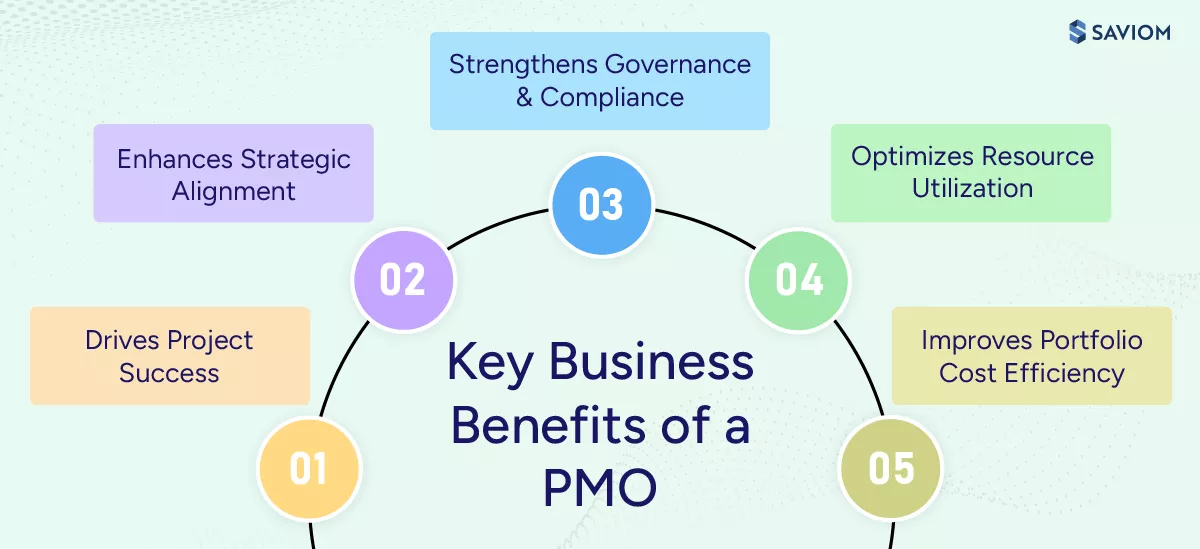
Drives Project Success
A Project Management Office introduces structure and visibility into how initiatives are selected and planned across the enterprise. It standardizes project management methodologies and governance frameworks, ensuring every project follows a consistent lifecycle, reporting standards, and risk controls. This reduces execution variability, improves delivery reliability, and enhances overall success.
Enhances Strategic Alignment
A well-established PMO evaluates initiatives based on how strongly they support enterprise objectives such as revenue growth, innovation, or market expansion. This disciplined prioritization ensures that every investment contributes to long-term goals. Moreover, by aligning resource capacity with strategic priorities, the PMO directs critical skills toward high-impact initiatives, thereby maximizing overall business value.
Strengthens Governance and Compliance
PMO managers strengthen governance by standardizing reporting structures, approval workflows, and audit mechanisms across all projects. This ensures that project progress, financial performance, and risks are consistently tracked and documented. Moreover, standardized governance frameworks enforce compliance with regulatory and internal policies, reducing exposure to operational, legal, and reputational risks.
Optimizes Resource Utilization
The Project Management Office provides centralized visibility into resource availability and skill sets across the organization. This enables managers to assign the right talent to the right initiatives, reducing errors and improving workforce productivity. Moreover, by continuously monitoring utilization trends, the PMO prevents overutilization and bench time while mobilizing resources to initiatives where they deliver the greatest value.
Discover what resource utilization is and how it impacts workforce productivity.
Improves Portfolio Cost Efficiency
PMOs assign resources to high-value projects based on skills and availability, preventing inefficient deployment and unnecessary overtime expenses. Moreover, centralized financial tracking helps PMOs to anticipate and address cost overruns early. In addition, scenario planning allows PMOs to weigh scope, cost, and capacity trade-offs and develop cost-efficient resource plans. Together, these practices improve project cost efficiency.
With a clear understanding of the value and benefits a PMO delivers, the next step is to examine the core functions.
Core Functions of a Modern Enterprise PMO
A modern enterprise Project Management Office integrates governance, strategy, resource management, and analytics to keep execution predictable, cost-efficient, and aligned with business priorities. It also provides the visibility and decision support needed to guide investments and optimize outcomes across the project portfolio. Let’s take a detailed look at its core functions:
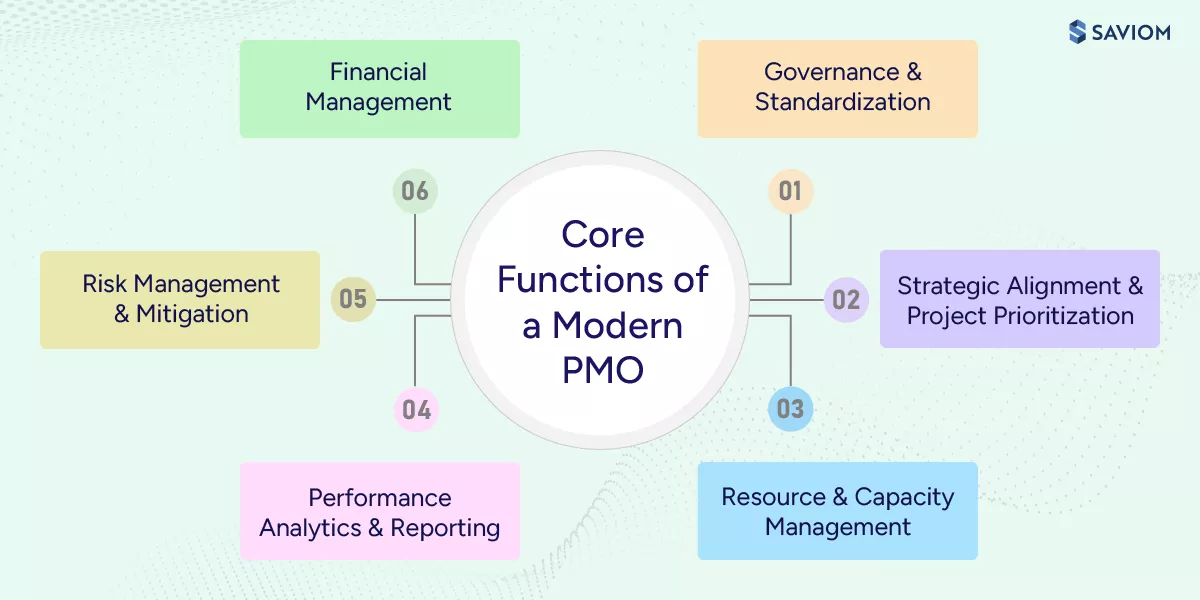
Governance and Standardization
Governance is a core function of the Project Management Office, which involves establishing decision-making authority, approval workflows, escalation paths, and oversight checkpoints. On the other hand, standardization focuses on creating consistent methodologies, templates, reporting formats, and lifecycle processes across all projects.
Strategic Alignment and Project Prioritization
The Project Management Office ensures that initiatives undertaken align with business objectives and long-term strategy. In addition, it implements a structured project prioritization process that evaluates and scores new initiatives based on business value, risk exposure, financial return, and resource capacity. This ensures high-value projects are prioritized.
Resource and Capacity Management
The PMO plays a crucial role in forecasting resource demand and ensuring that people, tools, and equipment are available when needed. It ensures balanced resource utilization while identifying potential skills gaps and capacity constraints. Moreover, the PMO leverages scenario planning and AI-driven signals to enable proactive adjustments.
Check out our blog on resource management.
Financial Management
A modern PMO ensures financial discipline through structured budgeting, forecasting, and cost-control mechanisms. It develops strategically aligned budgets and monitors expenses to detect cost overruns early. The PMO also evaluates project ROI to direct resources and budget towards initiatives that deliver measurable business impact.
Risk Management and Mitigation
The Project Management Office establishes an enterprise risk management framework to identify, consolidate, and categorize risks across the portfolio. It utilizes a risk matrix to visually assess and classify risks as critical, high, moderate, or low. This structured approach enables timely intervention and helps teams implement effective mitigation strategies.
Performance Analytics and Reporting
Modern PMOs leverage real-time dashboards to gain portfolio-level visibility into KPIs such as schedule variance, cost performance, utilization rates, and ROI. PMO managers are responsible for consolidating data into tailored reports for leadership. This enables timely corrective actions and drives continuous improvement.
Explore 12 essential project reports every manager should review for better project oversight.
In the following section, we will talk in detail about the types of Project Management Offices and their key characteristics.
Types of PMOs and How to Choose the Right Model
The PMOs operate across varying levels of governance and decision-making authority. The following section details the primary types of Project Management Offices and their defining characteristics.
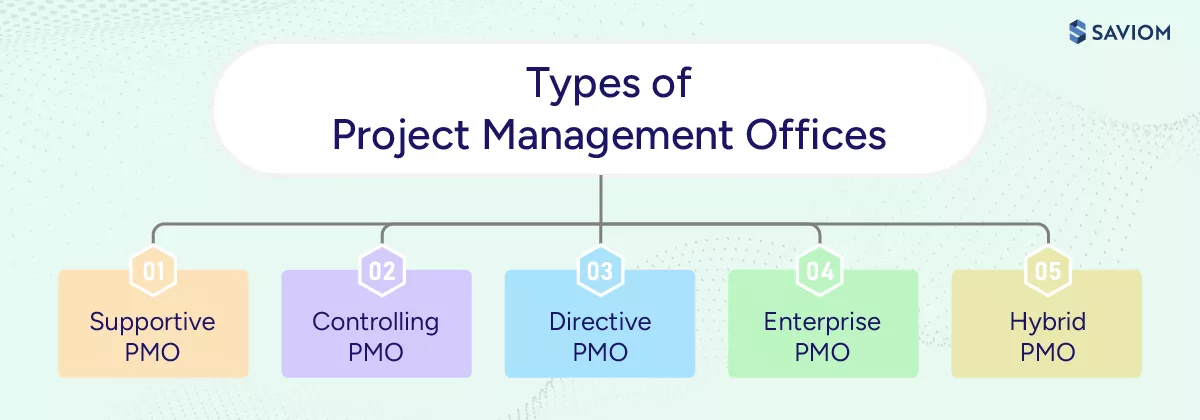
Supportive PMO
A supportive Project Management Office acts as a consultant, offering tools, templates, and training materials to project teams. These PMOs may also maintain project documentation and archives, ensuring the team has easy access to them. Their primary role is advisory, providing consultation and best practices to project teams.
Key Characteristics:
- Low Control Level: Offers recommendations and support but does not enforce governance or compliance.
- Resource Hub: Provides access to project management templates, tools, and standardized documentation.
- Advisory Role: Offers mentoring, coaching, and expert consulting to project managers and teams.
- Knowledge Management: Maintains a central repository of lessons learned, case studies, and historical project data to encourage continuous improvement.
Suitable for:
Ideal for organizations with a decentralized project environment, where success relies on individual project manager expertise rather than strict adherence to standardized processes.
Controlling PMO
A controlling PMO operates with moderate governance authority, ensuring teams follow established methodologies and organizational standards. It enforces consistency through defined frameworks, standardized tools, and structured reporting. Moreover, it also monitors compliance through reviews, audits, and formal governance controls.
Key Characteristics:
- Moderate Level of Control: Balances flexibility with the enforcement of project management standards.
- Standardization: Promotes consistent use of approved tools, templates, and methodologies across teams and portfolios.
- Compliance Monitoring: Tracks adherence to organizational policies, documentation requirements, and reporting standards.
- Methodology Enforcement: Mandates the adoption of specific frameworks, such as Waterfall, Agile, or Hybrid, based on project needs.
- Audit and Review: Conducts regular project audits and governance reviews to ensure alignment with organizational objectives and quality benchmarks.
Suitable for:
The controlling PMO suits mid- to large-sized enterprises managing multiple concurrent projects that require consistent reporting, structured controls, and strong governance oversight.
Read in detail about portfolio resource management and its benefits.
Directive PMO
A directive PMO operates as a central decision-making authority with full control over project execution. It directly manages resources, schedules, and delivery. Moreover, it defines all aspects of project planning, including roadmaps, task prioritization, and methodologies; assigns project managers; and serves as the single point of accountability.
Key Characteristics:
- High Level of Control: Direct oversight of project planning, execution, and performance monitoring to ensure disciplined delivery.
- Centralized Management: Project managers report to the PMO, strengthening coordination and decision-making.
- Clear Accountability: The PMO is responsible for project outcomes and value delivery.
- Consistency: Enforces uniform standards, tools, and methodologies across projects.
- Strategic Resource Allocation: Allocates resources in line with enterprise priorities to optimize utilization and alignment.
Suitable for:
Organizations managing large-scale, complex, or strategic initiatives that require strong governance, centralized decision-making, and alignment with long-term business objectives.
Enterprise PMO (EPMO)
An Enterprise Project Management Office (EPMO) operates at the executive level and oversees project portfolios across the entire organization. Unlike traditional PMOs that focus on departmental or functional areas, the EPMO ensures that projects and resource utilization align with strategic business goals.
Key Characteristics:
- Strategic Alignment: Ensures all projects support the organization’s long-term objectives and strategic priorities.
- Resource Optimization: Allocates resources efficiently across competing priorities to maximize billable utilization.
- Portfolio Management: Manages the entire portfolio of client-focused projects and strategic initiatives.
- Executive Reporting: Reports directly to C-suite executives, often the COO or CEO.
- Cross-Functional Oversight: Coordinates projects across multiple departments and business units.
- Standardization: Establishes consistent project management standards, methodologies, and governance across the enterprise.
Suitable for:
Large enterprises with multiple departments, business units, or global operations manage a high volume of complex, interdependent projects. It enables stronger strategic alignment and improves resource utilization.
Hybrid PMO
The Hybrid Project Management Office blends elements of both traditional (waterfall) and agile project management methodologies. It is designed to support organizations that manage a diverse range of projects requiring different approaches, offering flexibility while maintaining governance.
Key Characteristics:
- Flexible Methodologies: Supports both Agile and Waterfall projects, or a mix depending on project needs.
- Tailored Governance: Applies governance frameworks that suit the nature of each project.
- Cross-Functional Collaboration: Bridges gaps between agile teams and traditional departments.
- Adaptive Processes: Continuously evolves based on feedback and organizational maturity.
- Balanced Control and Agility: Maintains effective oversight while preserving flexibility, innovation, and delivery speed.
Suitable for:
This model is well-suited for organizations that run both agile and traditional projects simultaneously. It works effectively when different departments or teams prefer distinct methodologies based on the nature of their work. Additionally, it is ideal for enterprises seeking to scale agile practices while maintaining strong governance, compliance controls, and structured reporting standards across the portfolio.
Explore how agile project management helps manage resources effectively.
Learn how 5th gen resource management helps PMOs forecast, plan, allocate, utilize, and optimize resources to achieve better business outcomes.
Now that you understand the types of PMOs, the next section elucidates how organizations can set up a Project Management Office.
Setting Up and Scaling an Enterprise PMO (Step-by-Step)
Building an Enterprise PMO requires a structured approach that aligns governance, strategy, and execution to drive measurable business impact. Here is a step-by-step approach on how to build and scale an enterprise Project Management Office:
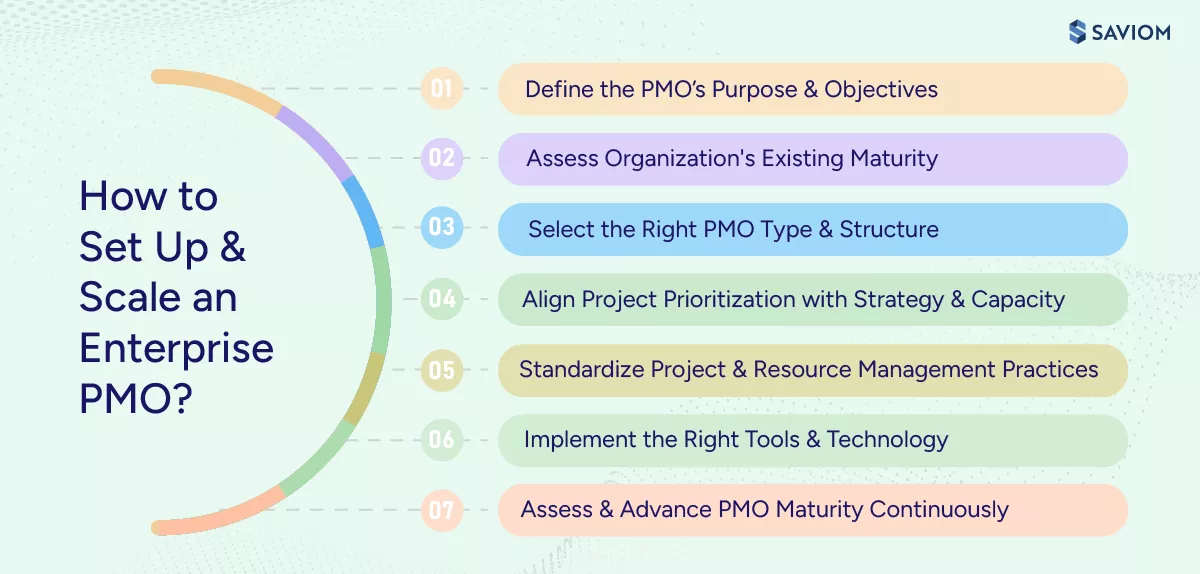
Define the PMO’s Purpose and Objectives
The first step is to answer a key question: why does this PMO exist? To define this clearly, executive sponsors work with stakeholders to establish and formalize decision-making authority. They also define KPIs, such as cost optimization, delivery predictability, and ROI improvement, to objectively assess impact. This clarity ensures the PMO’s mandate is tightly aligned with executive vision and enterprise growth goals.
A PMO without defined outcomes becomes administrative; a purpose-driven PMO becomes strategic.
Assess Organization’s Existing Maturity
Next, leaders evaluate the enterprise’s current maturity in governance consistency, standardization, resource forecasting, and real-time visibility into workforce data. This step helps determine how structured and predictable existing execution practices are. Moreover, leaders should identify gaps in prioritization, execution control, and performance tracking, and use these insights to design a scalable PMO roadmap.
Maturity assessment prevents overengineering and ensures right-sized PMO design.
Select the Right PMO Type and Structure
Executives must choose the appropriate PMO model, Supportive, Controlling, Directive, Enterprise, or Hybrid, based on business complexity and strategic goals. They should clearly define reporting lines, authority levels, and decision rights to ensure governance clarity. Moreover, executives should design the structure with flexibility so it can evolve from operational oversight to enterprise orchestration as maturity increases.
Governance structure shapes authority, and authority shapes outcomes.
Read this blog to learn about the nitty-gritty of next-gen PMO resource management.
Align Project Prioritization with Strategy & Capacity
In this step, leaders implement structured project intake and evaluation frameworks to assess initiatives based on strategic impact, expected ROI, risk exposure, and capacity readiness. This ensures project selection aligns with organizational priorities and business objectives. Moreover, by approving projects based on resource capacity, firms prevent overcommitment and ensure prioritized initiatives are realistically executable.
Strategic filtering of initiatives ensures controlled execution and balanced workloads.
Standardize Project & Resource Management Practices
This step focuses on establishing uniform project lifecycle governance, reporting standards, and structured resource allocation processes across teams. Leaders must introduce skill-based demand forecasting, utilization tracking, and embedded risk monitoring within execution workflows. Together, these measures ensure resource readiness, balance workloads, and strengthen delivery reliability.
Standardization reduces variability, improves predictability, and strengthens accountability.
Implement the Right Tools and Technology
Executives must deploy centralized portfolio and resource management tools that provide real-time visibility into capacity, utilization, and cost. These platforms should offer forecast-versus-actual comparisons to track budget and effort variances. Additionally, scenario modeling capabilities enable managers to evaluate trade-offs between scope, cost, and resource constraints before committing to new initiatives.
Technology transforms the PMO from reactive coordination to proactive orchestration.
Learn how to select the best resource management software for your business.
Assess and Advance PMO Maturity Continuously
Leaders must continuously assess PMO maturity by evaluating governance authority, prioritization effectiveness, forecasting accuracy, resource management discipline, and reporting quality. Periodic governance and process reviews help identify gaps and areas for refinement. Using these insights, organizations progressively elevate the PMO from a compliance-focused function to a strategic advisory capability.
PMO maturity is not a milestone; it is a continuous evolution aligned with organizational growth.
Next, let us examine the key Project Management Office roles and responsibilities in detail to understand how each function contributes to governance, execution discipline, and strategic portfolio performance.
Key Project Management Office Roles and Responsibilities
A high-performing PMO operates through clearly defined leadership, operational, and support roles. Each role contributes differently, but together they ensure governance consistency, execution discipline, and strategic alignment across the portfolio.
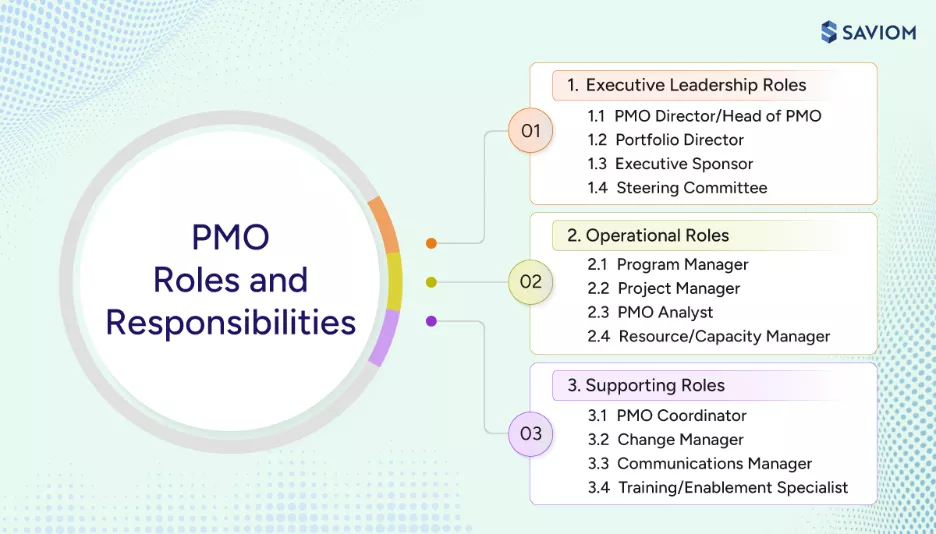
Executive Leadership Roles
Executive leadership roles establish strategic direction, governance authority, and portfolio oversight within the PMO. The following roles fall under this category:
- PMO Director/Head: Defines PMO strategy, oversees portfolio performance, and ensures alignment with enterprise objectives.
- Steering Committee: Reviews major initiatives, prioritizes investments, and approves key portfolio decisions.
- Executive Sponsor: Champions PMO initiatives, secures executive alignment, and removes organizational roadblocks.
Operational Roles
Operational roles are responsible for translating governance frameworks into measurable delivery outcomes. The following roles fall under this category:
- PMO Analysts: Track KPIs, consolidate performance data, and generate portfolio-level reports.
- Project Managers: Lead project execution across scope, schedule, cost, and risk dimensions.
- Resource Managers: Ensure effective resource allocation, monitor utilization, and prevent shortages or overutilization.
Supporting Roles
Supporting roles strengthen coordination, communication, and capability building across the Project Management Office ecosystem. The following roles fall under this category:
- PMO Coordinators: Manage documentation, workflow tracking, and administrative governance support.
- Change/Communications Managers: Drive stakeholder engagement and manage transition communication strategies.
- Training/Enablement Specialists: Develop project management capabilities through structured training and the adoption of best practices.
With the Project Management Office roles defined, the next step is to understand how the PMO operates across different project delivery models, such as Agile, Waterfall, and Hybrid.
Read in detail about PMO roles and responsibilities.
PMO in Agile, Waterfall, and Hybrid Delivery Models
Modern enterprises operate across multiple delivery frameworks depending on project complexity and business objectives. Let us see how the PMO adapts its governance model to maintain alignment, visibility, and control across each environment:
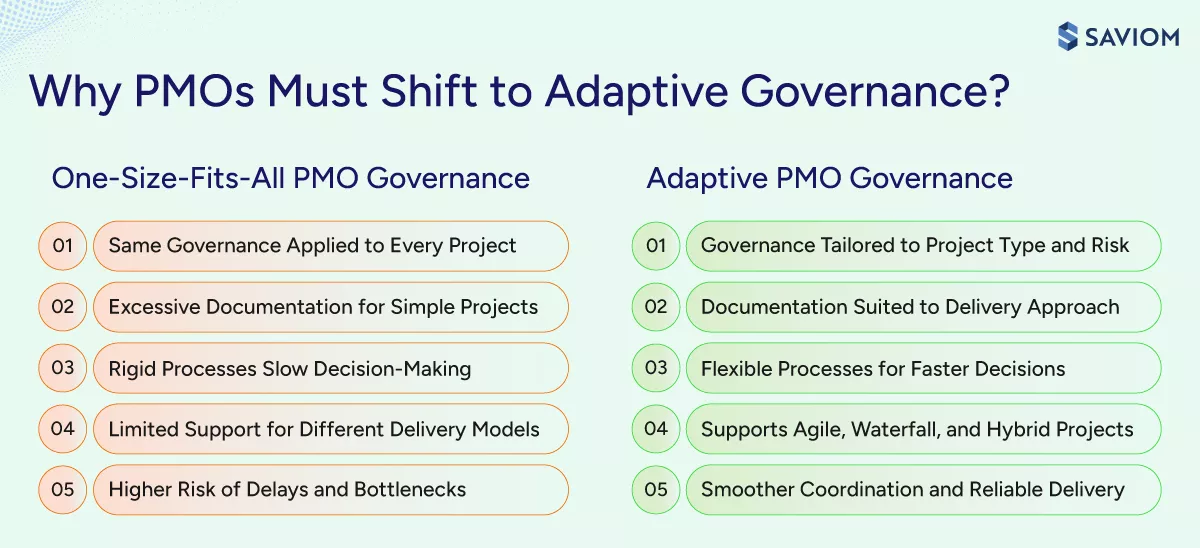
PMO in Agile Environments
In Agile environments, the PMO supports Scrum and Kanban teams through lightweight governance and portfolio-level oversight without disrupting team autonomy. It monitors delivery health using metrics, such as velocity, burn-down rates, and cycle time, to maintain transparency. These insights help align epics and backlogs with enterprise strategy and portfolio priorities, enabling teams to remain agile while leadership retains visibility.
For example, an IT services company developing a customer analytics platform has multiple Scrum teams working on parallel feature releases. The IT Project Management Office consolidates sprint velocity and burn-down data across teams to assess release readiness and capacity constraints. When feature dependencies arise, it coordinates backlog priorities at the portfolio level to maintain alignment while enabling rapid iteration.
Read our blog on agile capacity planning and its benefits.
PMO in Waterfall Environments
In Waterfall environments, the Project Management Office enforces defined phases, milestones, and documentation to ensure disciplined execution. It establishes approval gates and formal change control to safeguard scope, cost, and requirements throughout the project lifecycle. This governance reinforces compliance and risk management, keeping projects aligned with approved budgets, timelines, and scope baselines.
For example, a pharmaceutical manufacturing company implementing a regulatory compliance system follows strict phase-gate approvals. The PMO enforces documentation standards, validation checkpoints, and formal sign-offs before progressing to the next phase. It also monitors budget baselines and risk registers to maintain audit readiness and compliance.
PMO in Hybrid Environments
In Hybrid environments, the PMO combines structured governance with Agile flexibility to accommodate diverse project requirements. It applies formal oversight where predictability is critical, while allowing iterative execution where adaptability is required. This balanced approach enables cross-functional delivery while maintaining portfolio-level alignment and control.
For example, in an AEC firm delivering a large infrastructure project, construction follows milestone-based planning while design teams work iteratively on evolving models. The PMO aligns design updates with fixed construction schedules to avoid rework and delays. It provides tailored reports to site managers and executives, ensuring adaptive execution without compromising overall program control.
Moving on, let us understand the most common PMO challenges and solutions to overcome them.
Common PMO Challenges and How to Overcome Them
Despite clear mandates, the Project Management Office struggles to translate oversight into measurable impact. The following challenges highlight where gaps typically emerge and what can be done to close them.
| Challenges | Impacts | Solutions |
|---|---|---|
| Lack of Executive Buy-In | Without strong executive sponsorship, the PMO struggles to enforce governance standards and implement enterprise-wide frameworks, limiting its ability to deliver strategic value. | • Demonstrate clear ROI from PMO initiatives and align PMO objectives with corporate strategy. • Maintain regular executive communication supported by outcome-driven reporting. |
| Resistance to Process Standardization | When business units bypass standardized frameworks, methodologies are adopted inconsistently, weakening governance effectiveness. | • Simplify governance frameworks and position them as value-enabling rather than restrictive. • Provide targeted training and secure leadership endorsement to drive consistent adoption. |
| Resource Constraints & Capacity Imbalance | When project demand exceeds workforce capacity, critical skills become overutilized while others remain underutilized, leading to burnout and declining productivity. | • Use capacity planning to evaluate workforce availability against project demand. • Regularly monitor resource utilization to maintain balanced workloads. |
| Poor Project Prioritization | Without structured evaluation, projects are approved based on visibility rather than strategic value, allowing short-term pressures to override long-term business priorities. | • Introduce standardized prioritization criteria linked to strategy, value, and resource feasibility. • Conduct regular portfolio reviews to reassess priorities and maintain alignment. |
| Data Fragmentation | Disconnected tools and spreadsheets create inconsistent reporting, limiting executive visibility and delaying timely decision-making. | • Centralize portfolio data within an integrated project and resource management system. • Standardize reporting formats to create a single source of truth for leadership insights. |
Read in detail about PMO resource management challenges.
Next, let us take a look at the KPIs for the Project Management Office.
Measuring PMO Success and Business Value
To determine whether a PMO delivers real business impact, organizations must systematically measure its performance. Evaluating key indicators helps assess their maturity, effectiveness, and overall contribution to business outcomes. The following areas outline how PMO success and value can be measured.
Key Metrics and KPIs
The following key metrics provide a structured way to evaluate PMO performance across delivery, strategic alignment, and resource effectiveness.
Project Success Rate
Project success rate measures the percentage of projects delivered in line with defined criteria such as project scope, schedule, budget, and quality standards. It provides a clear indicator of overall delivery effectiveness. Tracking this KPI helps the PMO identify systemic execution gaps, improve governance consistency, and strengthen leadership confidence in project outcomes.
Projects) X 100
Schedule Variance
Schedule variance assesses whether a project is progressing ahead of or behind its approved timeline. It reflects the accuracy of planning and execution discipline. Monitoring this metric enables early identification of delays, supports timely corrective action, and improves overall delivery predictability across the portfolio.
Budget Variance
Budget variance measures the difference between planned project costs and actual spending. It indicates how effectively financial controls are maintained during execution. Tracking this KPI strengthens budget governance, reduces the risk of cost overruns, and enhances financial accountability at both project and portfolio levels.
Explore the types, importance, and calculation steps of project cost management.
Return on Investment (ROI)
Return on investment evaluates the financial value generated by a project relative to its total cost. It determines whether initiatives are delivering measurable business returns. Monitoring ROI supports informed investment decisions, helps prioritize high-value projects, and reinforces the PMO’s role in driving strategic business impact.
Strategic Alignment KPI
Strategic alignment measures the extent to which projects directly support the organization’s long-term objectives. It ensures that portfolio investments contribute to defined business priorities. Tracking this KPI prevents resource misallocation, sharpens portfolio focus, and strengthens enterprise-wide goal achievement.
Number of Projects) X 100
Resource Utilization
The resource utilization rate is a key metric that measures the percentage of a resource’s available time spent on productive, value-generating work. It helps organizations assess how effectively resources are used compared to their total capacity, enabling better workload balancing and preventing over- or under-allocation.
Explore a step-by-step approach to effectively tracking resource utilization.
PMO Maturity Assessment
PMO Maturity Assessment helps evaluate the strength of governance, standardized processes, enabling tools, and leadership alignment. It benchmarks current capabilities against industry standards to identify structural gaps. These insights support a continuous improvement roadmap that strengthens delivery discipline and strategic contribution over time.
Communicating Value to Stakeholders
The PMO communicates its value to stakeholders by translating performance metrics into clear business outcomes. It uses dashboards and executive summaries to present KPIs in a decision-ready format. By directly linking delivery results, project ROI, and resource performance to strategic priorities, the PMO helps stakeholders evaluate its measurable contribution to enterprise success.
Learn in detail about project stakeholders and ways to manage them.
Empower your PMO to align strategy and execution across every initiative with enterprise project management software. Book a free demo today!
Once PMO performance and value are measured, the next step is to assess its maturity and define a roadmap for continuous improvement and organizational transformation.
PMO Maturity Model and Transformation Roadmap
Organizations must continuously evolve their PMO capabilities to keep pace with growing portfolio complexity and strategic priorities. This section outlines the PMO maturity model, its levels, methods for assessing current capability, and a roadmap to advance toward a more strategic PMO.
What is the PMO Maturity Model?
The PMO Maturity Model is a structured framework that helps organizations evaluate where their Project Management Office currently stands in terms of governance, processes, project, and resource management capabilities. It provides a clear roadmap to improve PMO effectiveness and value delivery by identifying capability gaps and defining improvement milestones.
The Five Levels of PMO Maturity
PMO maturity progresses through structured stages that reflect increasing governance strength, process consistency, and strategic influence. Each level represents a gradual shift from reactive coordination to data-driven portfolio leadership.
Level 1 – Initial
At this early stage, the PMO is informal and lacks structure. Project management practices are inconsistent, and there is little coordination between departments. As a result, projects often face delays, cost overruns, and resource inefficiencies.
Level 2 – Evolving
At the evolving stage, the PMO gains recognition and introduces basic project and resource management processes supported by initial templates or tools. However, project prioritization may still be inconsistent or influenced by internal factors. Adoption varies across teams, leading to uneven process implementation.
Level 3 – Established
At this stage, the PMO becomes a recognized department with defined responsibilities and standardized project management methodologies. Projects are prioritized based on business value, improving portfolio visibility. Resource planning, risk management, and performance monitoring become regular practices for consistent delivery.
Level 4 – Integrated
At the integrated stage, the Project Management Office is embedded across the enterprise and operates as a center of excellence. It enforces governance, uses data-driven decisions, and aligns portfolios with business objectives. Advanced analytics and dashboards enable proactive risk and capacity management.
Level 5 – Strategic
At the highest maturity level, the PMO becomes a strategic partner that ensures projects directly support business growth and transformation. It works closely with C-suite leaders, using portfolio data and predictive insights to guide decisions. The PMO drives innovation, governance, and continuous improvement across the organization.
How to Assess the Current PMO Maturity Level?
Assessing PMO maturity requires a structured review of governance practices, operational capabilities, and strategic alignment. Here is how organizations can evaluate their current PMO effectiveness and identify areas for improvement.
- Define the assessment purpose: Clearly state why the Project Management Office maturity assessment is being conducted, such as to improve project performance, resource utilization, or strategic alignment.
- Select a suitable maturity model: Choose a framework like OPM3 or P3M3 that aligns with the organization’s structure, processes, and goals.
- Collect relevant data: Gather quantitative and qualitative information from project performance reports, resource management metrics, stakeholder feedback, risk records, and project documentation.
- Evaluate current maturity level: Analyze the collected data against the selected model to determine the PMO’s maturity stage and identify strengths and gaps.
Roadmap to Advance PMO Maturity Level
Advancing PMO maturity requires a deliberate shift from reactive coordination to structured governance and strategic portfolio leadership. The following steps outline a practical roadmap for strengthening PMO capability over time.
- Standardize processes and governance: Establish consistent project management methodologies, templates, reporting standards, and approval workflows across the organization.
- Align projects with business strategy: Ensure project selection and prioritization support organizational goals and deliver measurable business value.
- Improve tools and automation: Replace manual tracking with centralized project management tools, dashboards, and analytics platforms to enhance visibility and decision-making.
- Strengthen resource and capacity management: Implement structured resource planning, skills tracking, and workforce optimization to balance workload and prevent shortages.
- Develop PM capabilities: Invest in training, mentoring, and professional development programs to improve project management skills across teams.
- Adopt continuous improvement practices: Regularly review performance metrics, assess maturity levels, and refine processes to progress toward a strategic Project Management Office steadily.
Read our blog on resource management maturity and learn how to accelerate it.
Once the PMO reaches higher maturity levels, it must also evolve to respond to emerging trends that are redefining how projects are governed and delivered across modern enterprises.
Key Trends Reshaping Modern PMOs
Modern PMOs are evolving rapidly as organizations demand stronger strategic alignment and faster decision-making. They are no longer limited to governance and reporting. Instead, they play a more proactive role in guiding priorities and enabling enterprise agility. Here are the key PMO trends:
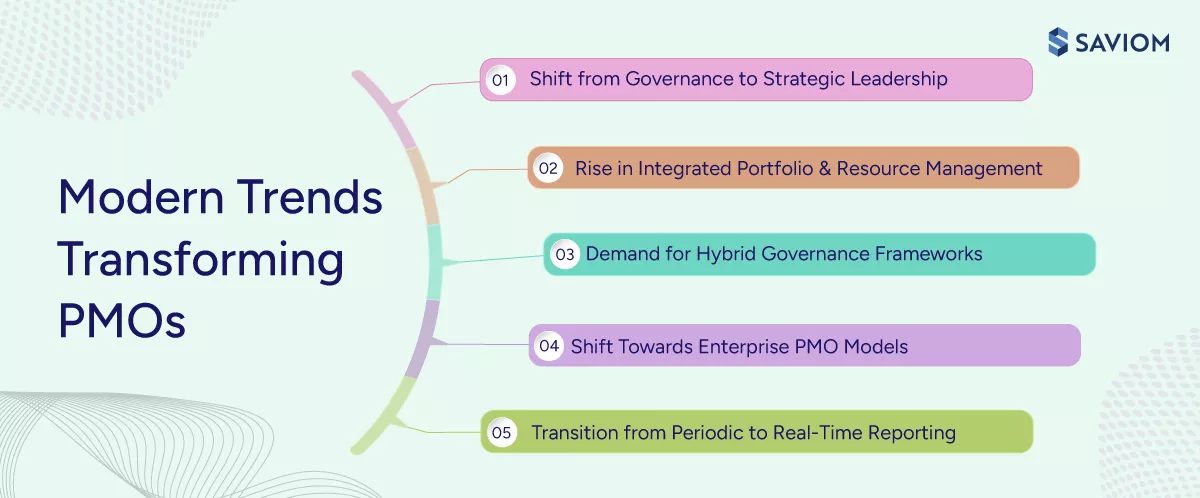
Shift from Governance Oversight to Strategic Leadership
PMOs are increasingly moving beyond compliance monitoring and administrative oversight toward a more strategic leadership role. They now participate in investment prioritization, capital allocation, and portfolio-level decision-making. This positions the PMO as a key contributor to enterprise strategy and long-term value realization.
Rise in Integrated Portfolio and Resource Management
Organizations are increasingly integrating project portfolio management with resource management to improve planning and execution. By linking portfolio decisions with real-time resource insights, PMOs can prioritize initiatives based on both strategic value and resource readiness, improving workload balance and delivery predictability.
Demand for Hybrid Governance Frameworks
As organizations manage diverse project types, rigid governance models are becoming less effective. PMOs now support environments where Agile, Waterfall, and Hybrid delivery methods coexist. Flexible governance frameworks enable the PMO to tailor oversight to project complexity, risk exposure, and delivery methodology.
Growth of Enterprise-Level PMO Models
Many organizations are consolidating fragmented departmental PMOs into centralized or federated enterprise structures. This shift improves standardization, governance consistency, and portfolio visibility across business units. As a result, the PMO is evolving from a support function into an enterprise-level capability that influences strategic execution.
Transition from Periodic Reporting to Real-Time Portfolio Insights
Traditional reporting cycles based on monthly or quarterly updates are gradually being replaced by real-time portfolio visibility. Leaders increasingly expect continuous access to project performance, cost trends, risks, and resource capacity. Modern PMOs leverage integrated tools and dashboards to provide instant insights that support faster decision-making.
Learn how resource management software enables data-driven decision-making.
Conclusion
As organizations manage complex portfolios, the Project Management Office (PMO) brings essential structure and alignment to initiatives. Modern PMOs go beyond oversight by strengthening governance, improving resource coordination, and enabling informed strategic decisions. This ensures the right initiatives receive the right resources, reducing execution risks and improving delivery predictability.
With portfolio-level insights, performance metrics, and standardized practices, the PMO empowers leadership to make better investment and prioritization decisions. Over time, this strengthens organizational agility and execution discipline. When built with clear capabilities and a maturity roadmap, the PMO becomes a key driver of consistent execution and sustained performance.
Frequently Asked Questions
A Project Management Office (PMO) is a centralized function that standardizes project management practices, strengthens governance, and ensures optimal use of organizational resources. It provides visibility into all projects, helps prioritize the most important initiatives, and ensures projects are executed consistently while supporting business goals.
A PMO is responsible for establishing project governance, standardizing methodologies, monitoring project performance, managing resource allocation, and providing portfolio-level visibility. It also supports strategic decision-making by offering insights into project progress, risks, and outcomes.
A well-structured PMO offers the following benefits to the organization:
1. Drives project success
2. Enhances strategic alignment
3. Strengthens governance and compliance
4. Optimizes resource utilization
5. Improves portfolio cost efficiency
The three main types of PMOs are Supportive, Controlling, and Directive. A supportive PMO offers guidance and templates, a controlling PMO enforces standards and governance, and a directive PMO directly manages projects. PMOs can also operate at the departmental or enterprise level, depending on the organization’s scope.
PMO effectiveness is measured using key performance indicators (KPIs) such as project success rate, on-time delivery, budget adherence, and return on investment (ROI). Organizations also conduct maturity assessments, track portfolio performance through dashboards, and gather stakeholder feedback to evaluate the PMO’s strategic value.
The PMO Maturity Model is a framework for assessing how well developed a Project Management Office is in governance, processes, and resource and project management practices. It helps organizations identify capability gaps and provides a roadmap to improve PMO effectiveness.
PMOs often face challenges such as a lack of executive buy-in, resistance to standardized processes, resource constraints, and poor project prioritization. They can overcome them by demonstrating ROI to gain leadership support, simplifying governance frameworks, implementing capacity planning, and prioritizing projects based on strategic value.