


Introduction
Many organizations still rely on spreadsheets or basic home-grown tools to plan and allocate resources. While these approaches may work in the early stages, they quickly become inadequate as organizations scale and projects grow more complex. It can lead to challenges such as double bookings, uneven workloads, rising costs, and delayed timelines.
This is where a structured approach to resource allocation becomes essential. It provides clear visibility into resource availability, skills, and cost, ensuring the right people are assigned to the right work at the right time.
In this guide you will learn how effective resource allocation works and how it helps improve utilization, reduce delivery risk, and strengthen overall business performance.
What is Resource Allocation?
Resource planning is the structured process of forecasting, allocating, and managing organizational resources, such as people, equipment, time, and budget, to ensure projects are delivered on time, within budget, and at optimal efficiency.
This process involves assigning the right resources to the right projects based on factors such as skills, availability, and cost. It requires managers to constantly monitor workloads to maintain balanced resource utilization, ensuring no one is overloaded or underutilized. Therefore, effective allocation helps ensure that every project phase is adequately staffed to support on-time delivery.
Read this eBook to learn how resource allocation doesn’t work in isolation.

Now that the resource allocation definition is clear, the next step is to understand the tangible business impact it delivers at an enterprise level.
Key Benefits of Resource Allocation for Enterprise Performance
Effective resource allocation has a measurable impact on delivery predictability, workforce sustainability, and financial performance. Below are the core benefits organizations see as allocation practices mature.
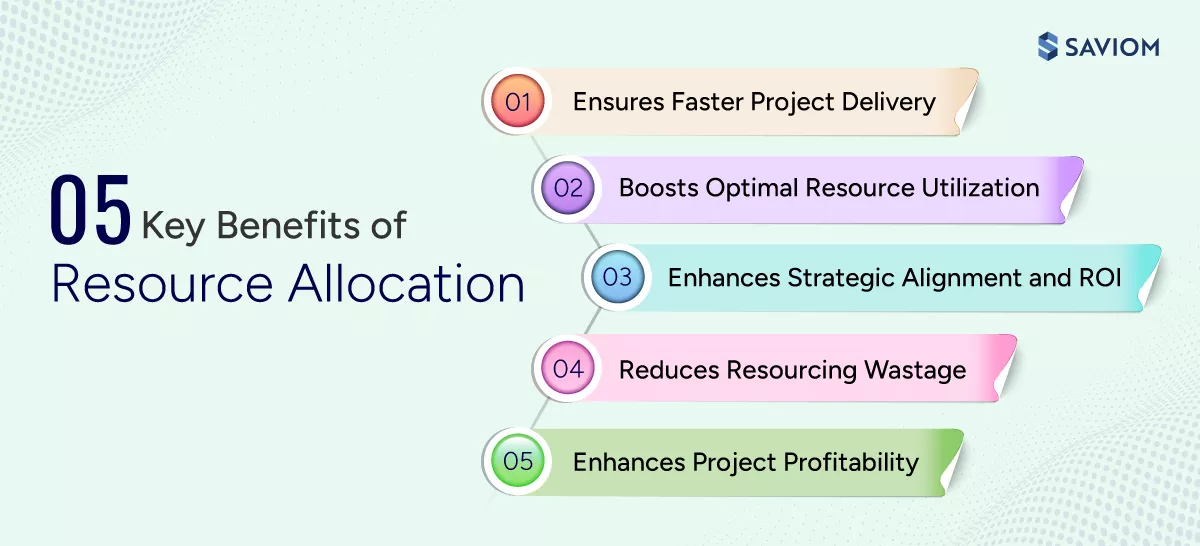
Ensures Faster Project Delivery
When resources are allocated with clear visibility into skill matrix, availability, and priorities, work progresses with far fewer disruptions. It helps identify potential conflicts, overloads, and skill gaps before execution begins, allowing teams to resolve issues early rather than firefighting mid-delivery. Consequently, this ensures projects move forward without repeated delays or rework.
Boosts Optimal Resource Utilization
Effective resource allocation ensures enterprise capacity is applied where it creates the most value. For instance, high-value and priority initiatives receive the right skills at the right time, while low-impact work no longer absorbs scarce or critical resources. This balance prevents both resource underutilization and burnout, improving resource utilization health across projects.
Explore how you can boost optimal resource utilization.
Enhances Strategic Alignment and ROI
Strategic resource allocation directly links execution to business priorities. Instead of spreading talent thin across competing initiatives, capacity is focused on work that delivers the highest impact. This sharper focus improves execution discipline and enables organizations to generate greater returns from the same workforce investment.
Reduces Resourcing Wastage
Structured resource allocation minimizes bench time, redundant staffing, and repeated reallocations caused by poor visibility. With more apparent demand and capacity alignment, organizations reduce reliance on last-minute hiring, contractors, and emergency reshuffling. This leads to lower operational costs and greater continuity across delivery teams.
Enhances Project Profitability
Projects staffed with the right skills at the right cost face fewer delays, less rework, and fewer unplanned staffing changes. With better allocation decisions, firms can keep delivery effort aligned with budgets and timelines throughout execution. This consistency helps protect margins and maintain profitability across the project lifecycle.
Now that we’ve explored the importance of resource allocation, let’s clarify how it differs from related planning disciplines.
Resource Allocation vs. Resource Planning vs. Capacity Planning
Resource planning, capacity planning, and resource allocation are closely related but play different roles across the delivery lifecycle. The table below outlines how each function differs in focus, timing, and business value.
| Dimension | Resource Planning | Capacity Planning | Resource Allocation |
|---|---|---|---|
| Core Objective | Define what resources will be needed to support the upcoming work. | Validate whether the available supply can meet forecasted demand. | Assign available resources to specific work. |
| Primary Focus | Demand forecasting across projects and business initiatives. | Capacity vs. demand comparison and feasibility. | Execution of assignments across project and non-project work. |
| Key Question Answered | What roles, skills, and effort will be required? | Do we have enough capacity to deliver this work? | Who works on what, when, and for how long? |
| When It Happens | Early in the resource planning lifecycle, before commitments are made. | After demand is defined, before detailed assignments. | Ongoing and near–real time as work progresses. |
| Key Inputs | Project pipeline, business goals, and delivery roadmaps. | Headcount, availability, calendars, and constraints. | Skills, availability, capacity limits, cost, and priorities. |
| Primary Output | Forecasted resource demand by role and time period. | Identified capacity gaps or surpluses. | Confirmed resource assignments. |
| Decision Type | Strategic and forward-looking. | Tactical and risk-focused. | Operational and execution-oriented. |
| Business Value | Prevents underplanning and unrealistic commitments. | Enables proactive actions like hiring or upskilling. | Ensures efficient utilization and reliable delivery. |
| Risk If Done in Isolation | Overestimated or misaligned demand. | Unaddressed shortages or idle capacity. | Overallocation of resources, burnout, and delivery delays. |
Knowing the concepts is only half the equation. The real value lies in how enterprises apply them through a structured, repeatable resource allocation plan. Let’s understand.
How to Implement an Enterprise Resource Allocation Process?
Effective resource allocation requires more than simply assigning people to work. The following steps outline a structured approach enterprises use to allocate resources consistently.
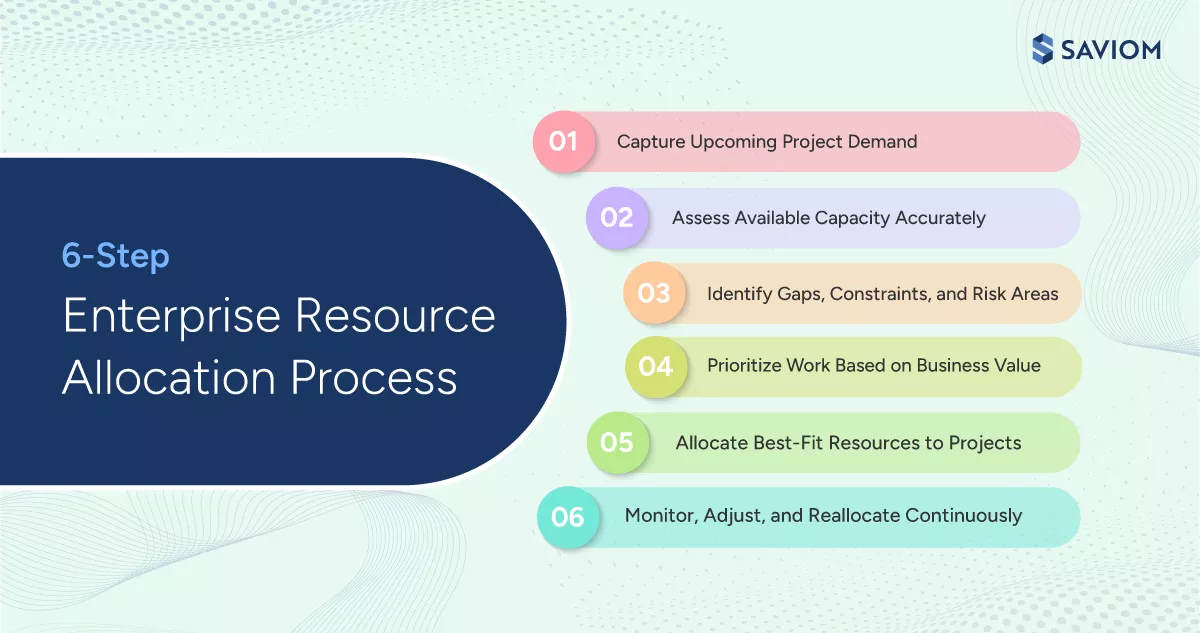
Capture Upcoming Project Demand
The resource allocation process starts by consolidating demand across current and upcoming initiatives. Instead of relying on high-level project estimates, demand is broken down by role, skill, and time period. This level of detail makes demand clearer and far easier to compare across projects.
Assess Available Capacity Accurately
Once demand is visible, the next step is understanding how much capacity is actually available. This includes existing assignments, non-project work, planned leave, and expected attrition. Expressing capacity in hours, full-time equivalents (FTEs), or percentages ensures demand and supply can be compared consistently.
Read our blog on resource capacity planning.
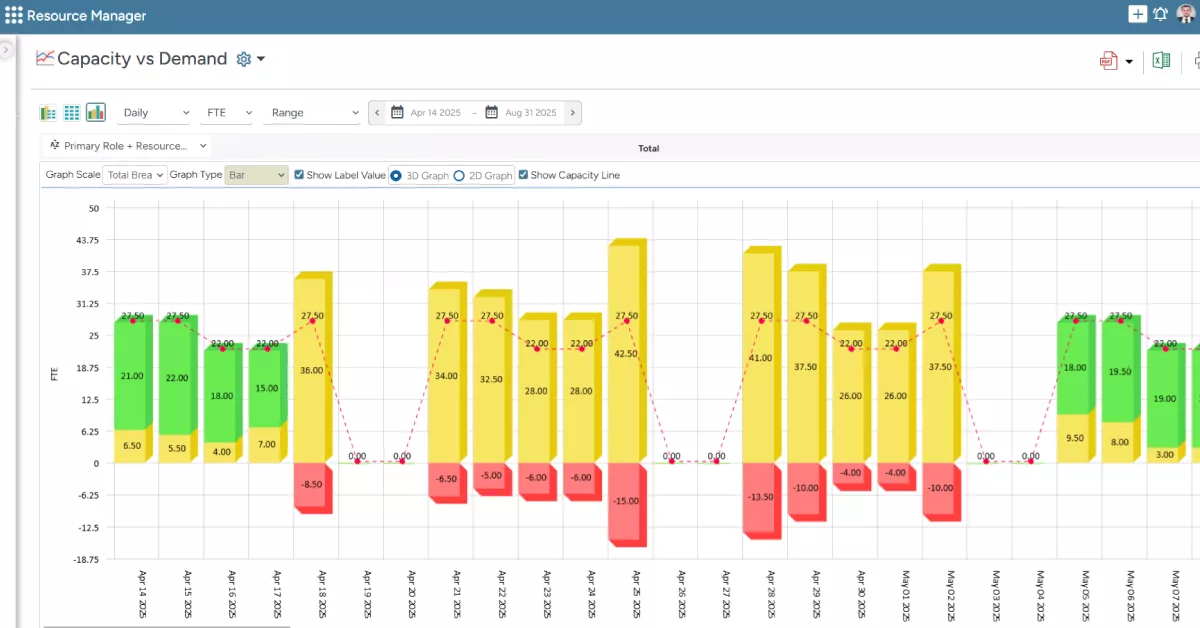
Perform a Capacity vs. Demand Analysis to Identify Gaps
With demand and capacity defined, the resource allocation plan begins to take shape. Comparing resource capacity and demand by role and skill helps surface shortages or excesses early. This gives leaders time to respond by hiring, retraining/upskilling, or making timeline adjustments, before delivery is affected.
Prioritize Work Based on Business Objectives
Allocation decisions should then be guided by business priorities, not request order. Factors such as revenue impact, strategic importance, deadlines, and delivery risk help determine which initiatives receive capacity first. This prevents reactive or politically driven assignments.
Explore the 25 business objectives that every firm must measure for success.
Allocate Best-Fit Resources to Work
With priorities set, resources are assigned based on skill fit, experience, availability, cost, and workload limits. Clearly defining start and end dates and allocation levels upfront reduces ambiguity and limits disruptive reallocations during execution phases.
Monitor, Adjust, and Reallocate Continuously
Finally, allocation is reviewed continuously against actual progress. When deviations occur, teams can rebalance early rather than reacting after delays or overloads appear. Over time, this feedback loop improves resource planning accuracy and overall delivery outcomes.
Use SAVIOM’s dynamic resource allocation feature to deploy the right resources to projects and drive successful project delivery. Book a Demo Today.

Beyond process, effective allocation relies on clear strategies that guide how capacity, priorities, and cost are balanced. The following explains these approaches in detail:
Resource Allocation Strategies and Core Principles
According to a McKinsey research, “83% of executives name resource allocation as the most critical management lever for driving growth.”
The resource allocation strategies below show how enterprises use this capability systematically to maintain delivery outcomes as conditions change.
Capacity-Based Allocation Strategy
This approach begins by understanding how much work teams can realistically handle. By accounting for existing commitments and availability limits, managers ensure work is assigned within practical constraints, preventing resource risks and delivery delays.
Priority-Based Allocation Strategy
Once realistic capacity is established, priorities determine where that capacity should be applied first. This strategy directs scarce resources toward the most valuable and time-sensitive initiatives, ensuring critical work is not delayed and aligned with business goals.
Learn how effective project resource management ensures successful delivery.
Cost-Based Allocation Strategy
After priorities are set, cost considerations help refine allocation decisions further. This strategy evaluates both the cost of resources and how effectively they are utilized, ensuring assignments support financial goals. Further, managers balance skill fit with efficiency to avoid hidden cost overruns.
Agile/Adaptive Allocation Strategy
As projects progress and conditions change, agile allocation keeps plans flexible. Resources are assigned in short, iterative cycles, allowing teams to adjust quickly when demand, scope, or capacity shifts. Ongoing monitoring enables timely reallocation, reducing disruption and maintaining delivery stability in fast-changing environments.
Explore how agile project management helps meet evolving demands and deliver high-quality results.
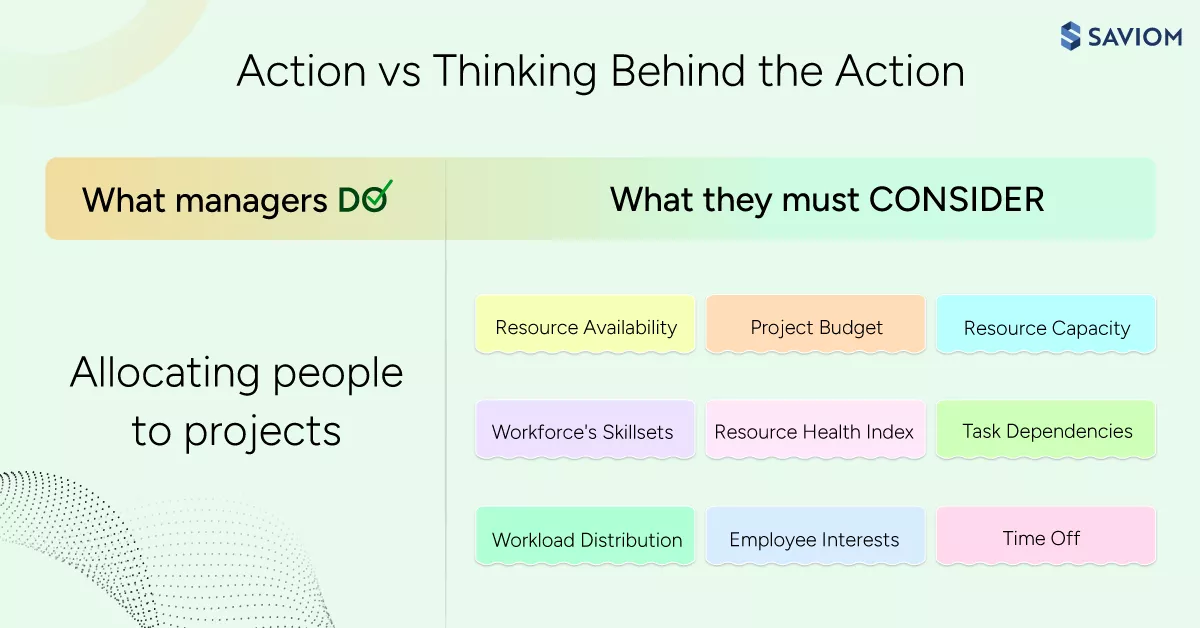
Organizations differ significantly in how resources are allocated and who controls those decisions. Let’s understand the common types and models enterprises use.
Types and Models of Enterprise Resource Allocation
Enterprise teams typically rely on a mix of resource allocation types and governance models to balance delivery speed, flexibility, and utilization without creating conflicts or silos. Take a look:
These structures shape how different methods of resource allocation are applied across teams, projects, and portfolios.
Types of Resource Allocation
Different allocation types define how resources are assigned to work based on delivery structure, skill needs, and operational complexity.
Project-Based Allocation
In project-based allocation, resources are assigned to specific projects for defined periods aligned with timelines and milestones. Assignments are driven by delivery needs rather than long-term ownership, making this approach common in project-centric and client-facing environments with clear delivery commitments.
Skill-Based Allocation
Skill-based allocation assigns work based on a resource’s expertise and proficiency rather than availability alone. This ensures specialized or complex tasks are handled by the most suitable individuals. Reducing skill mismatches limits rework and dependency-related risks.
See what a skill matrix is and why it’s important for business success.
Role-Based Allocation
Role-based allocation focuses on standardized roles instead of individual skill variations. Resources are assigned based on predefined responsibilities, making planning and resource forecasting easier across large teams. It works best in structured environments where roles are clearly defined and interchangeable.
Dedicated Allocation
With dedicated allocation, resources are assigned full-time to a single project or initiative. This improves focus, accountability, and delivery speed by minimizing context switching. However, it can reduce overall flexibility and lead to underutilization if project demand fluctuates.
Shared Allocation
Shared allocation distributes resources across multiple projects or teams simultaneously. It increases flexibility and supports optimizing resource allocation across projects. However, it requires careful coordination to avoid resource scheduling challenges. Without strong visibility, this approach can quickly lead to delivery risk.
Examine how you can improve cross-departmental collaboration.
Resource Allocation Models
While allocation types define how resources are used, allocation models define who controls allocation decisions and how governance is applied across the organization.
| Parameter | Centralized Model | Decentralized Model | Matrix Model | Hybrid Model |
|---|---|---|---|---|
| Decision Ownership | Central PMO or resource management function. | Individual teams or departments. | Shared between functional and project leadership. | Central governance with local execution authority. |
| Visibility Level | Full enterprise-wide visibility. | Limited to individual teams. | Cross-project visibility with functional silos. | High enterprise visibility with contextual detail. |
| Decision Speed | Moderate due to centralized coordination. | Fast due to local autonomy. | Moderate due to shared approvals. | Balanced—faster than centralized, more controlled than decentralized. |
| Governance & Control | Strong, standardized, and policy-driven. | Minimal, and team-led. | Shared governance with defined escalation paths. | Controlled with flexibility built into execution. |
| Conflict Risk | Low, due to centralized arbitration. | High, due to competing local priorities. | Medium, requires active coordination. | Low to medium, managed through oversight. |
| Flexibility | Lower, changes require central approval. | High, teams adapt independently. | Medium, depends on collaboration quality. | High, combines structure with adaptability. |
| Best Suited For | Large enterprises with complex portfolios. | Highly autonomous or product-led teams. | Cross-functional, matrixed organizations. | Growing or scaling enterprises. |
To understand whether allocation decisions are actually working, enterprises must track the right performance indicators. Let’s look at the key KPIs that matter most.
Resource Allocation KPIs to Track Success
Resource allocation KPIs make it easier to identify risks early, correct course before issues escalate, and understand how effectively resources are being used across projects and portfolios. Here are a few key metrics enterprises must track:
Resource Utilization Rate
The resource utilization rate is a critical metric that measures how effectively resources, such as employees, equipment, and tools, are utilized against their total available capacity to identify and mitigate instances of resource overutilization and underutilization.
The formula to calculate the resource utilization rate is:
Resource Allocation Effectiveness
This metric measures how appropriately an organization assigns its available resources, such as people, equipment, and finances, to tasks and projects to achieve optimal results with minimal waste.
The formula to calculate the resource allocation effectiveness is:
Resource Availability Rate
It is the percentage of time a resource (human or non-human) is available to perform productive work within a specific timeframe. It quantifies the portion of a resource’s total capacity that can be assigned to tasks, taking into account current commitments, scheduled leave, maintenance, and other organizational constraints.
The formula to calculate the resource availability rate is:
Take a closer look at what resource availability is.
Forecast vs. Actual Utilization
This metric measures the variance between projected resource utilization and actual usage to assess planning accuracy. A significant gap highlights capacity forecasting issues, leading to either under- or overutilization of resources and higher resource costs.
The formula to calculate the forecast vs. actual utilization rate is:
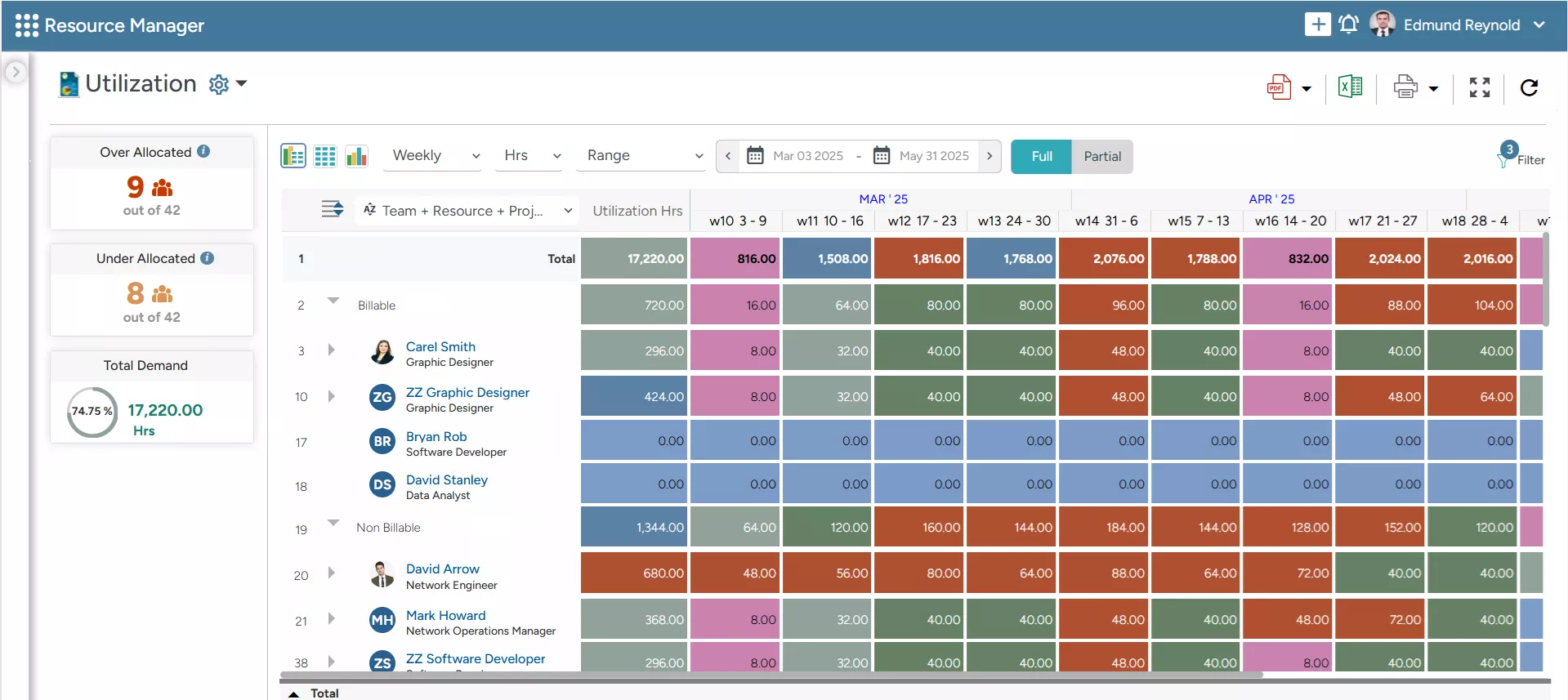
Forecast vs. Actual Time
Forecast vs. actual time compares the estimated hours a resource is expected to spend on assigned work with the actual hours recorded. This metric enables managers to evaluate the accuracy of planned work hours in relation to actual hours worked, identify discrepancies, and take corrective actions to bridge the gap.
The formula to calculate the forecast vs. actual time is:
Understand what resource forecasting is.
Resource Capacity Utilization
This metric measures how much of a resource’s available capacity is actually utilized on assigned tasks over a given period. Low utilization indicates unused capacity, resulting in productivity loss and extended bench time. Higher utilization reflects efficient deployment of project resources.
The formula to calculate the resource capacity utilization rate is:
Resource Extension Rate
Resource extension rate measures the proportion of external resources, such as contractors or consultants, within the total workforce. A high rate indicates heavy reliance on external talent, which can increase costs and reduce long-term stability. A lower rate reflects stronger dependence on internal employees.
The formula to calculate the resource extension rate is:
Allocation becomes more complex when resources are shared across projects and portfolios rather than managed in isolation. Here’s how organizations handle allocation at scale.
How Allocation Works Across Multiple Projects and Portfolios?
When work spans multiple projects and portfolios, allocation decisions must be coordinated, not made in isolation. This ensures shared resources are assigned consistently, conflicts are resolved early, etc.
In practice, organizations do this by:
- Prioritize work at the portfolio level using scoring models and dependency mapping to prevent conflicting allocation decisions.
- Establish clear conflict-resolution rules for situations where multiple initiatives compete for the same skills.
- Maintain a centralized view of shared resources with an up-to-date skills inventory across projects and portfolios.
- Enable role-based access controls so project managers, resource managers, and team leads can view and create an efficient resource request workflow.
- Monitor capacity trends over time to spot upcoming overloads and take corrective action early.
- Use utilization and workload dashboards to surface cross-project allocation conflicts before they impact delivery.
- Standardize escalation and reallocation workflows to keep decisions fair, consistent, and auditable at scale.
Master the art of resource planning across multiple projects.
Even with structured processes in place, organizations often face recurring allocation challenges as complexity increases. Let’s examine the most common issues and how to address them.
Common Resource Allocation Challenges (and Solutions)
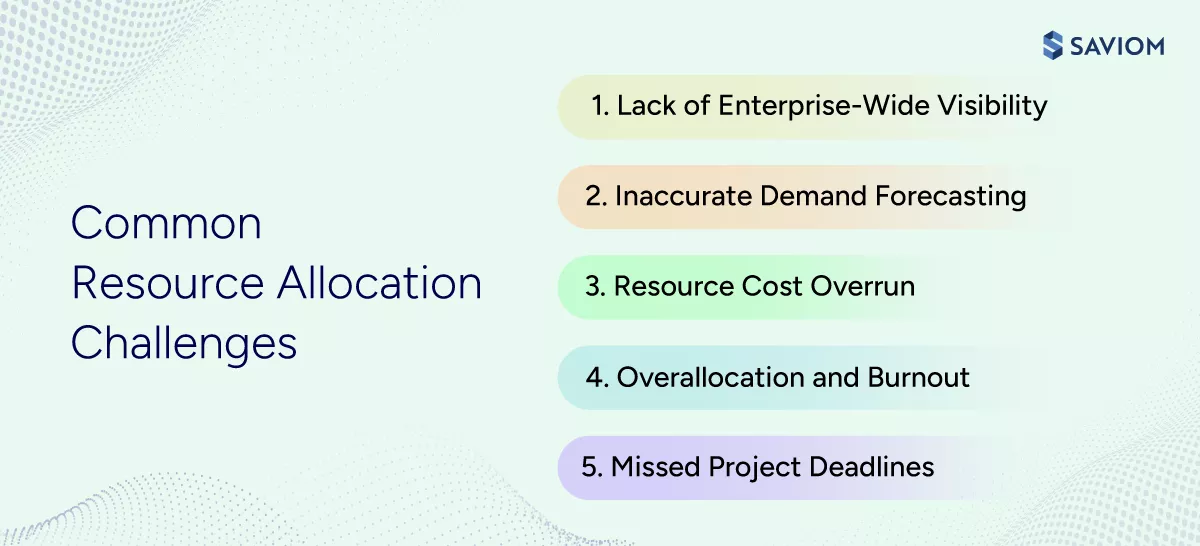
Even with structured processes in place, many organizations struggle with recurring resource allocation challenges. The table below outlines the most common issues, their business impact, and practical ways to address them.
| Challenge | What Goes Wrong | Business Impact | How to Address It |
|---|---|---|---|
| Lack of Enterprise-Wide Visibility | Resource data is spread across disconnected tools and teams, making it hard to see current and future allocations in one place. | Double bookings, conflicting priorities, and reactive allocation decisions that disrupt delivery. | Create a centralized, enterprise-wide view of demand, capacity, and allocations across all projects and portfolios. |
| Inaccurate Demand Forecasting | Resource demand is estimated using high-level scopes or assumptions rather than role- and time-based forecasts. | Under- or over-allocation, frequent plan revisions, and last-minute staffing changes. | Use structured estimation, break demand down by role and timeline, and validate forecasts through regular review cycles. |
| Resource Cost Overrun | Resource allocation decisions fail to account for cost rates, skill fit, or utilization limits. | Rising project costs, margin erosion, and inefficient use of high-cost resources. | Factor cost and skill into allocation decisions and track resource utilization to prevent inefficient staffing. |
| Overallocation and Burnout | Critical resources are repeatedly assigned to multiple initiatives without workload checks. | Burnout, disengagement, reduced quality of work, and increased attrition risk. | Continuously track utilization and workload balance and rebalance allocations before overload becomes sustained. |
| Missed Project Deadlines | Projects compete for the same limited resources without clear prioritization rules. | Schedule slippage, delivery delays, and higher operational risk. | Prioritize work at the portfolio level and allocate resources based on business value, capacity, and dependencies. |
Explore common resource management challenges.
As allocation maturity grows, certain practices consistently help enterprises scale without losing control or visibility. The following resource allocation best practices show what works.
Best Practices for Scalable Resource Allocation in Enterprises
As organizations grow, allocation becomes more complicated to manage without structure. These best practices help enterprises balance demand, capacity, and priorities across projects to ensure successful delivery.
- Establish Enterprise-Wide Demand Visibility: Capture demand across projects and BAU work, broken down by role, skill, and time period to support consistent, informed allocation decisions across enterprises.
- Forward Plan and Forecast Resource Demand: Use historical data and project pipeline insights to anticipate future resource needs and reduce last-minute surprises.
- Streamline Resource Requisition Workflows: Standardize how resource requests are submitted, reviewed, and approved to reduce delays and eliminate ad-hoc decisions.
- Optimize Allocation Using Scenario Planning: Use scenario planning to compare demand vs. capacity options and select the most viable allocation plan.
- Prioritize Allocation to High-Value Initiatives: Assign scarce and critical skills to projects with the highest strategic and business impact. Portfolio-level prioritization prevents dilution of key resources across low-value work.
- Avoid Excessive Multi-Project Allocation: Limit the number of concurrent assignments per resource to reduce context switching. Improved workload management enhances productivity, delivery quality, and workforce sustainability.
- Track Workforce Competency in Real Time: Maintain an up-to-date view of skills, proficiency levels, and experience. This enables accurate, skill-based allocation and reduces capability mismatches.
Explore key best practices for effective resource management
Over time, organizations progress through distinct stages of allocation maturity as scale, demand, and complexity increase. Let’s take a closer look at these stages.
Resource Allocation Maturity Model for Growing Enterprises
As organizations grow, allocation typically evolves through distinct stages. This maturity model outlines how enterprises move from reactive allocation toward data-driven decision-making.
Level 1: Ad-Hoc and Spreadsheet-Driven Allocation
At this stage, resources are assigned using spreadsheets, emails, and informal coordination. Decisions are mostly reactive, with limited visibility into workloads. As a result, conflicts, bottlenecks, and unpredictable delivery are common.
Level 2: Defined Process with Basic Governance
Here, allocation follows documented processes and standard templates, bringing some structure and oversight. While visibility improves, decisions are still largely manual and become increasingly difficult to scale as demand grows.
Level 3: Integrated Capacity Planning and Allocation
At this level, resource data is centralized, allowing teams to factor capacity into allocation decisions. Dedicated tools help align assignments more consistently across projects, reducing last-minute changes and delivery friction.
Discover how capacity planning drives integrated allocation and reduces delivery friction.
Level 4: Data-Driven Optimization and Scenario Planning
Dashboards provide early visibility into utilization risks and cross-project conflicts. Scenario planning enables teams to compare options, supporting resource optimization at the portfolio level rather than reacting project by project.
Learn more about scenario planning for data-driven optimization.
Level 5: AI-Assisted, Predictive Resource Allocation
In the most mature stage, predictive insights improve the accuracy of demand and capacity planning. Resource allocation becomes proactive, guided by recommendations that help reduce risk and improve delivery outcomes.
While the principles of allocation remain consistent, their application varies by industry. The examples below show how this works in practice.
Resource Allocation Examples Across Industries
The following examples illustrate how structured staff deployment helps organizations improve visibility, balance workloads, and reduce delivery risk. Let’s explore:
Professional Services & Consulting
A global consulting firm struggled to allocate consultants across parallel client engagements without creating conflicts or overloading key roles. With better forward visibility into upcoming work, leaders moved from last-minute staffing to planned, role-based assignments.
Impact: Teams rotated consultants earlier, secured contractors in advance, and avoided staffing clashes on high-priority engagements.
Architecture, Engineering & Construction (AEC)
An engineering firm allocated specialists reactively, resulting in idle capacity early and severe overloads later in project lifecycles. By aligning allocations with project phases, leaders assigned resources only when their expertise was required.
Impact: Teams sequenced project initiation more effectively, improved specialist availability, and minimized delays caused by late reallocations.
Explore best practices to create an optimized schedule chart for the AEC industry.
IT & Software Services
An IT services organization found it challenging to allocate developers and architects across projects with changing technology requirements. By gaining early visibility into future skill demand, managers made IT resource allocation decisions before delivery pressure peaked.
Impact: Internal talent was redeployed earlier, skill gaps were addressed in advance, and delivery risks caused by late staffing were reduced.
Audit & Accounting
An audit firm faced recurring allocation challenges during peak seasons, with critical staff spread across multiple engagements. By gaining forward visibility into workloads, leaders planned allocations across offices instead of reacting to shortages.
Impact: Teams distributed work more evenly, planned temporary staffing earlier, and reduced overtime pressure on core teams.
Explore how to optimize resources in auditing and accounting firms effectively.
Healthcare & Pharma
A hospital group struggled to allocate specialist doctors and diagnostic resources evenly across departments. With clearer demand signals, allocations were adjusted to balance workloads and avoid chronic overbooking.
Impact: The organization improved specialist utilization, made scheduling more predictable, and stabilized service delivery without increasing headcount.
Looking ahead, new technologies are reshaping how enterprises plan, assign, and rebalance resources. Let’s explore the key trends driving this shift.
Emerging Trends: AI, Automation, and Data-Driven Allocation
Enterprises are increasingly using AI, automation, and advanced analytics to make allocation faster, more accurate, and less reactive. Dive in:
AI-Assisted Demand Forecasting
Organizations are increasingly using AI-assisted demand forecasting to analyze historical project data, resource usage patterns, and delivery timelines. This reduces reliance on manual estimates and improves early visibility into future demand, enabling more accurate and confident allocation decisions.
Explore how capacity forecasting improves demand visibility and workforce readiness.
Shift Toward Dynamic Capacity Planning
Enterprises are moving away from static capacity plans toward dynamic capacity planning that adjusts allocations as demand, priorities, and timelines change. Real-time capacity visibility allows faster reallocation across projects while helping identify skill shortages or excess capacity before they impact delivery.
Automated Resource Matching
Automation is being used to match project demand with the most suitable resources based on skills, roles, availability, and experience. This streamlines resource allocation workflows, improves consistency across teams, and reduces delays caused by manual decision-making.
Predictive Utilization and Early Warning Signals
According to a 2025 study conducted by Infinite Potential, “82% of employees are at risk of burnout.”
Predictive analytics enable organizations to identify potential over-allocation, underutilization, and workload imbalances in advance. Early warning indicators enable managers to rebalance resources proactively, reducing delivery risks, burnout, and cost inefficiencies.
Conclusion
Resource allocation is no longer an operational afterthought; it is a strategic lever for delivery predictability, workforce sustainability, and profitability. Enterprises that invest in structured processes, data-driven decisions, and scalable tools consistently outperform reactive peers. As projects grow more complex, mature resource allocation capabilities become essential for future readiness.
Frequently Asked Questions
Resource allocation in project management is the process of identifying and assigning the right people, skills, and capacity to work at the right time to meet delivery priorities.
Resource allocation helps organizations:
1. Deliver work on time with fewer disruptions
2. Use limited capacity where it creates the most value
3. Prevent burnout and uneven workloads
4. Keep costs, timelines, and delivery risks under control
Common resource allocation types include:
1. Project-based allocation – assigning resources to specific projects for defined periods
2. Skill-based allocation – assigning work based on expertise and proficiency
3. Role-based allocation – allocating standardized roles across teams
4. Dedicated allocation – assigning resources full-time to a single initiative
5. Shared allocation – distributing resources across multiple projects
A structured resource allocation process typically includes:
1. Capturing demand by role, skill, and time period
2. Assessing the actual available capacity
3. Comparing demand vs. capacity to identify gaps
4. Prioritizing work based on business objectives
5. Assigning best-fit resources
6. Continuously monitoring and rebalancing allocations
1. Capacity planning determines how much resource supply is available
2. Resource allocation assigns the available capacity to specific work based on demand, priority, and constraints
Capacity planning answers “Can we take this on?”
Resource allocation answers “Who works on it, when, and how much?”
Organizations commonly face the following challenges:
1. Lack of enterprise-wide visibility
Disconnected tools make it hard to see workloads and future allocations
2. Inaccurate demand forecasting
High-level estimates lead to under- or over-allocation
3. Resource cost overruns
Allocation decisions ignore cost rates or skill fit
4. Overallocation and burnout
Critical resources are stretched across too many initiatives
5. Missed project deadlines
Competing priorities fight for the same limited capacity
Organizations improve allocation by:
1. Standardizing allocation processes and governance
2. Tracking demand, capacity, and utilization consistently
3. Prioritizing work at the portfolio level
4. Using scenario planning to test allocation options
5. Making allocation decisions data-driven rather than reactive
Key resource allocation KPIs include:
1. Resource utilization rate
2. Resource availability rate
3. Forecast vs. actual utilization
4. Forecast vs. actual time
5. Resource capacity utilization
6. Resource extension rate
These metrics help leaders spot risks early and correct course before issues escalate.
No. Resource allocation is equally important for organizations managing:
1. Operational and business-as-usual work
2. Shared services and centralized teams
3. Portfolios with multiple concurrent initiatives
Any organization with limited capacity and competing priorities needs a structured allocation.
Resource allocation supports strategic planning by ensuring:
1. High-value initiatives receive capacity first
2. Critical skills are not diluted across low-impact work
3. Execution stays aligned with business priorities
This connection between strategy and execution improves delivery predictability and ROI.









Leave a Reply