

Introduction
Organizations often commit to work before confirming whether the required skills and capacity will be available when execution begins. Without a structured resource planning process, it leads to challenges like recurring skill shortages, last-minute firefighting, expensive hiring decisions, etc.
This is where resource planning plays a critical role. It enables organizations to anticipate project demand, plan resource capacity, and make informed staffing decisions to create an optimized workforce. Ultimately, this helps improve workforce efficiency, enhance delivery predictability, and boost overall profitability.
In this guide, we will cover what is resource planning is and how it supports long-term business growth.
What is Resource Planning?
Resource planning is the structured process of forecasting, allocating, and managing organizational resources, such as people, equipment, time, and budget, to ensure projects are delivered on time and within budget.
This process involves forecasting the specific resource demand of current and upcoming projects. It requires managers to map out resource availability against project timelines to create a realistic execution strategy. By aligning these factors, organizations can maintain a balanced workload and avoid the costly disruptions caused by unexpected resource shortages.
Now that the resource planning definition is clear, let’s understand why it is important.
What are the Key Benefits of Resource Planning?
Effective resource planning delivers measurable business outcomes, such as lower resource costs, higher team utilization, and predictable delivery. Over time, these benefits of strategic resource planning strengthen operational efficiency and improve overall financial performance.
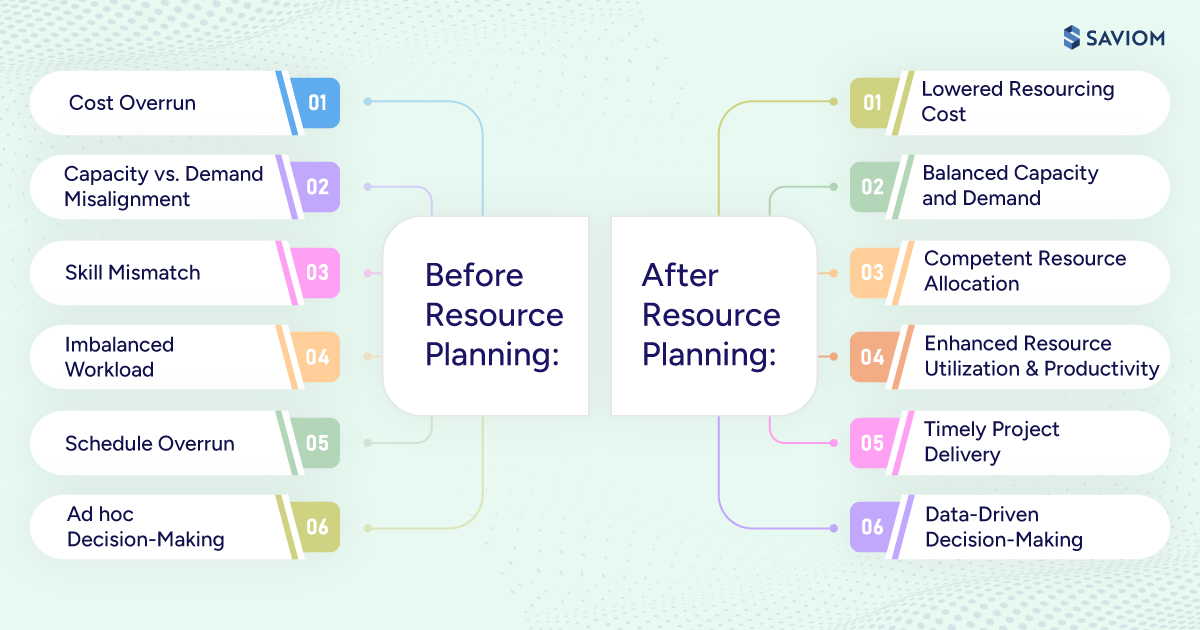
Lowers Resourcing Costs
Proactive resource planning gives leaders early visibility into future demand. This enables planned hiring, reskilling, or redeployment instead of reactive staffing. When resource capacity and demand are aligned early, emergency hiring is reduced. As a result, organizations control resourcing costs without hurting delivery quality.
Ensures Better Capacity vs. Demand Alignment
According to a McKinsey report, “90% of leaders consider capacity planning a pressing to-do that needs addressing now or soon.”
Early identification of capacity shortages and surpluses allows organizations to secure the right resources on time before delivery is impacted. With fewer last-minute resourcing decisions, teams operate within realistic commitments. This leads to higher morale, lower burnout, and more consistent delivery across projects.
Read our blog on resource capacity planning.
Facilitates Competent Resource Allocation
Resource planning enables managers to make allocation decisions based on skills, experience, availability, etc., not convenience or proximity. This ensures that complex work is handled by qualified resources, reducing rework and quality issues. As a result, work progresses with fewer disruptions and more predictable outcomes.
Improves Resource Utilization & Productivity
Effective resource planning maximizes productive and billable time by aligning demand with workforce supply in advance. It distributes work more evenly across teams, reducing both idle time and chronic overutilization. This leads to more consistent team performance, better output quality, and higher employee retention over time.
Learn more about resource utilization.
Boosts Timely Project Delivery
Resource planning in project management helps reduce schedule overruns and dependency-driven delays by validating resource availability during planning. It ensures that the required skills and capacity are in place before work begins. This minimizes rework caused by rushed or mismatched assignments, improving delivery confidence.
Use SAVIOM’s resource planner to identify, allocate, and optimize resources in real-time and ahead of the curve to futureproof your workforce. Book a Demo Today.
Supports Data-Driven Decision-Making
With access to real-time and historical resource data, leaders can make informed decisions about hiring, upskilling, redeployment, and outsourcing. Scenario modeling replaces intuition with evidence-based trade-offs and ensures managers choose the best-fit, cost-effective resource management plan that can facilitate successful project delivery.
Now that we’ve covered the benefits, let’s walk through the resource planning process.
How to do Effective Resource Planning: A Step-by-Step Framework
An efficient framework transforms resource planning in project management from an ad hoc activity into a systematic, proactive process. Each resource planning step builds on the previous one to reduce uncertainty and delivery risk. Let’s take a look:
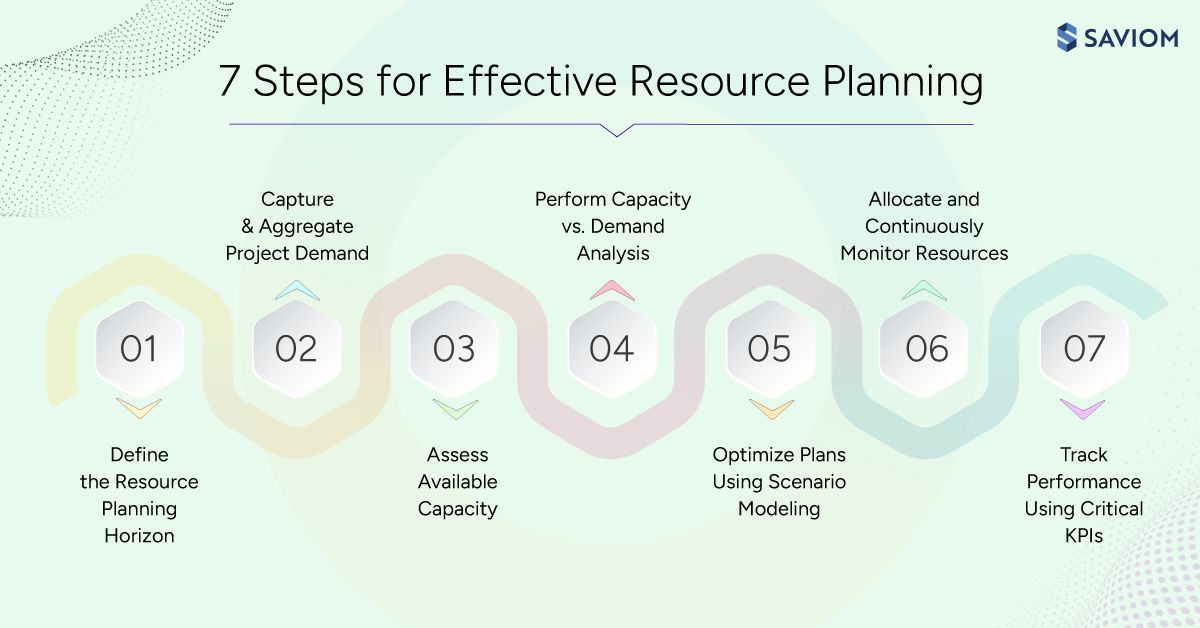
Define the Resource Planning Horizon
Define short-, mid-, and long-term resource planning windows to align day-to-day execution with a long-term workforce strategy. Short-term horizons focus on active work, while longer horizons support hiring, reskilling, and investment decisions. Moreover, aligning the operational planning horizon with portfolio cadence keeps plans practical and actionable.
Capture and Aggregate Project Demand
Consolidate demand from approved initiatives and pipeline projects into one unified view. Normalizing effort estimates across teams is critical for accuracy. When leaders follow consistent assumptions and units of measurement, they can compare priorities objectively and perform capacity requirement planning with greater confidence.
Assess Available Capacity
Assess capacity by role, skill, location, and actual availability, not just by headcount. This means accounting for leave, non-delivery work, and internal commitments before confirming who is truly available. By working with real capacity instead of theoretical availability, organizations ensure accurate business resource planning avoid overcommitment and reduce delivery bottlenecks.
Read our blog on resource availability.
Perform Capacity vs. Demand Analysis
Compare aggregated demand against available capacity to identify shortages or excesses. This enables managers to take timely resourcing actions, such as hiring, reskilling, or redeploying resources, to ensure adequate capacity across teams and portfolios and to avoid resource underutilization.
Optimize Through Scenario Planning
As per a GoodFirms’ survey, “34.2% of organizations leverage scenario planning for better forecasting.”
Model scenarios, such as hiring, reskilling, outsourcing, or reprioritization to close capacity gaps. Each scenario should be evaluated against cost, risk, and delivery timelines. This comparison helps decision‑makers select options that balance delivery reliability with cost and business impact, instead of reacting under pressure, improving the accuracy of resource planning across multiple projects.
Learn more about scenario planning.
Allocate and Continuously Monitor Resources
Assign best-fit resources based on skills, availability, location, and project requirements. Continuously monitor the allocations to ensure they remain aligned with the project requirements as scope and priorities change. Regular reviews allow managers to rebalance workloads and adhere to delivery timelines throughout the project lifecycle.
Track Performance Using Critical KPIs
Monitor utilization, availability, forecast accuracy, and other critical metrics to assess planning effectiveness. These KPIs highlight early warning signs of resource overutilization, schedule overrun, budget risk, etc. Benchmarking results against predefined targets enables faster corrective action and keeps resource planning aligned with business priorities.
Read our blog to learn about performance management.
After the resource planning process, let’s learn about the various components.
Key Components Required for Effective Resource Planning
Here are the resource planning components that support data-driven resource planning:
Competency Matrix
A competency matrix provides a centralized view of skills, proficiency levels, certifications, and experience across the workforce. It enables managers to match demand to capabilities rather than relying solely on individual names or availability.
Learn more about the skill matrix.
Demand Forecasting
Demand forecasting structures how future work is captured, validated, and updated across the organization. It includes both approved initiatives and pipeline opportunities to reflect realistic future demand.
Capacity Planning
Resource capacity planning aligns forecasted demand with available supply to identify shortages, surpluses, and skill gaps early. These insights guide targeted hiring, reskilling, redeployment, and optimization efforts, ensuring proactive capacity planning.
Resource Allocation Governance
Allocation governance defines how resources are requested, approved, and assigned across the enterprise. A centralized process eliminates ad hoc staffing and ensures that scarce skills are allocated to the highest‑value work, boosting resource planning efficiency.
Read our blog to understand what resource allocation is.
Utilization Forecasting
Utilization forecasting predicts how resources will be utilized over time, enabling planners to optimize workloads. Improving forecast accuracy allows firms to increase employee productivity while protecting long‑term business performance.
Scenario Planning
Scenario planning evaluates the impact of potential changes, such as project delays, accelerations, or budget shifts, before resources are committed. This helps leaders choose plans that minimize resource risk while protecting critical initiatives.
Resource Performance Monitoring
Performance monitoring tracks utilization, availability, time tracking, and task completion metrics in real time. It enables managers to implement corrective actions proactively and reinforces accountability at both team and leadership levels.
Risk Management
Risk management configures alerts for workload thresholds, skill gaps, or capacity constraints. Early signals allow leaders to intervene before risks escalate into resource management challenges, such as burnout or missed deadlines.
Deep dive into enterprise risk management to understand the concept better.
Now, let’s understand the difference between resource planning, capacity planning, and resource scheduling.
Resource Planning vs. Capacity Planning vs. Resource Scheduling
These concepts are often used interchangeably, even though they serve very different purposes. Understanding the differences is critical to help teams plan, staff, and execute work more effectively. Read on:
| Parameter | Resource Planning | Capacity Planning | Resource Scheduling |
|---|---|---|---|
| Primary Purpose | Ensures the right resources are available to meet current and future project and business demand | Determines whether available capacity can meet forecasted demand | Helps assign the right resources to tasks within specific timelines |
| Key Question Answered | Do we have the right people with the right skills when needed? | Can our current capacity handle the projected workload? | Who is doing what, and when? |
| Focus Area | Skill alignment, demand forecasting, and allocation strategy | Supply vs. demand balance and workload feasibility | Task sequencing, deadlines, and dependencies |
| Business Impact | Improves delivery predictability, utilization, and cost control | Prevents overcommitment, burnout, and missed deadlines | Improves day-to-day execution efficiency |
| Relationship to Others | Sets the strategic foundation for capacity and scheduling | Validates the feasibility of resource plans | Executes the approved resource and capacity plans |

Now, let’s understand some resource management techniques to optimize workforce capacity planning and utilization.
Workforce Capacity Planning and Utilization Optimization
To maintain delivery performance as demand fluctuates, firms must plan workforce capacity and manage utilization in tandem. This means aligning skills with demand and optimizing resource utilization to improve efficiency without overextending teams.
Skill-Based Capacity Planning
Skill-based capacity planning aligns capacity with demand based on skills rather than generic headcount. This approach enables:
- Faster staffing
- Higher quality outcomes
- Reduces reliance on specialized or scarce roles
By planning at the skill level, organizations improve resource allocation accuracy and avoid delays caused by misaligned assignments.
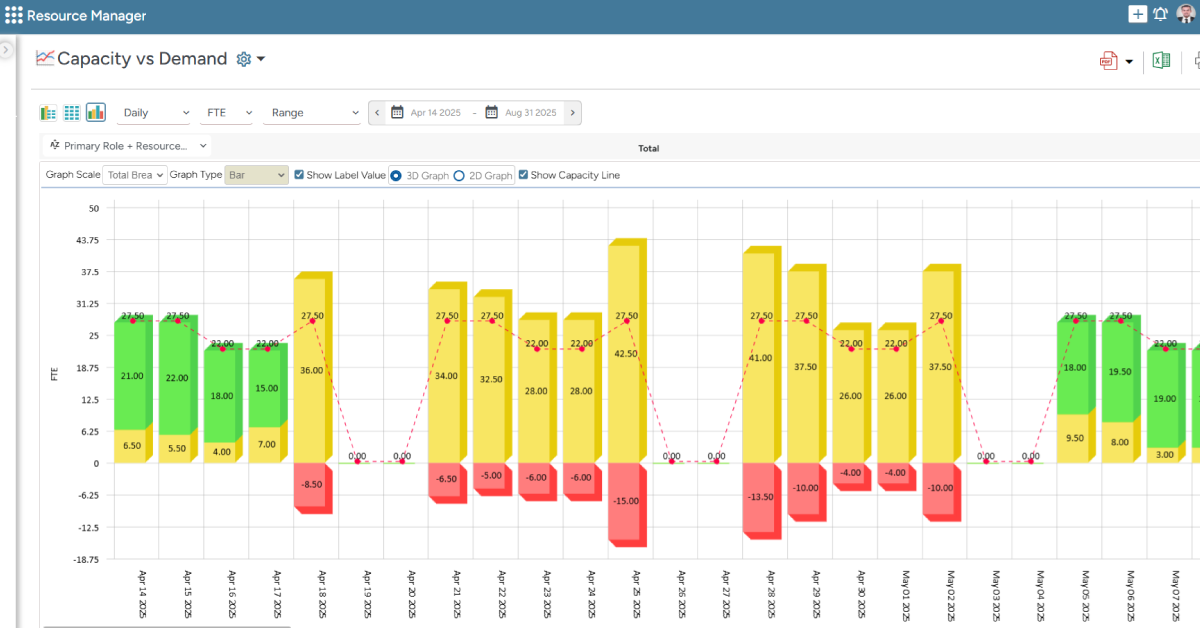 SAVIOM’s Capacity vs. Demand Graph enables managers to spot resource shortages and excesses, and take timely action to balance supply and demand.
Understanding Utilization Metrics
As per a study by Infinite Potential, “82% of employees are at risk of burnout.”
Utilization means different things depending on context, so it must be interpreted carefully. Available utilization reflects theoretical capacity; productive utilization reflects actual work performed, and billable utilization reflects revenue-generating effort. If not managed properly, high utilization over time increases the risk of burnout and attrition.
Understand in detail how to track resource utilization.
Balancing Resource Efficiency and Workload
Balancing workload prevents chronic overutilization that leads to reduced employee engagement and turnover. Workload balancing ensures work is distributed evenly while respecting role complexity and cognitive effort. Moreover, aligning utilization targets with role type protects long‑term productivity and workforce stability.
In the next section, we will take a look at scenario-based resource planning for a project.
Scenario-Based Resource Planning for Shortages, Surpluses, and Uncertainty
Scenario modeling evaluates how different demand and supply situations, such as sudden demand spikes, project delays, or attrition, affect cost, timelines, utilization, and delivery risk. This visibility allows leaders to anticipate consequences before committing resources.
By comparing response options like hiring, redeployment, retraining/upskilling, or outsourcing, organizations identify the most viable resource planning path under each scenario. Decisions remain aligned with strategic priorities rather than driven by urgency.
In addition, scenario‑based resource planning transforms uncertainty into a structured decision space, enabling resilient execution even in volatile environments.
Now, let’s see how AI and predictive analytics have become a game-changer for resource planning for a project.
How AI and Predictive Analytics Are Transforming Resource Planning
AI and predictive analytics matter in team resource planning because manual analysis cannot keep pace with the volume, velocity, and variability of enterprise demand. Let’s take a deeper look:
Predictive Demand and Capacity Forecasting
Predictive forecasting uses historical delivery patterns, pipeline trends, and seasonality to anticipate future demand and capacity needs. Unlike static forecasts, these models continuously learn as new data becomes available. In addition, early risk signals highlight emerging shortages or overloads beforehand, allowing for timely corrections.
Read our blog on capacity forecasting.
AI‑Driven Scenario Recommendations
AI automates the comparison of multiple planning scenarios across cost, risk, utilization, and timelines. Instead of manually evaluating options, leaders receive suggestions based on predefined resource constraints and objectives. This automation shortens resource planning decision cycles and allows managers to respond quickly to changing business needs.
AI‑Powered Utilization and Skill Optimization
AI identifies skill mismatches, chronic underutilization, and burnout risk by analyzing allocation patterns and workload trends. These insights surface issues that are often invisible in traditional reports. Moreover, real‑time recommendations suggest optimal role changes, project reassignments, or skill development actions to keep resource planning relevant and maximize workforce value.
AI‑Enabled Decision‑Making and Governance
AI translates complex resource data into clear, actionable insights for executives. Consistent logic reduces bias and ensures decisions align with enterprise priorities rather than illogical optimizations. This governance layer improves resource planning discipline, transparency, and accountability across project portfolios.
Next, let’s take a look at the various agile resource planning bottlenecks and how they can be handled.
Common Resource Planning Challenges and How to Mitigate Them
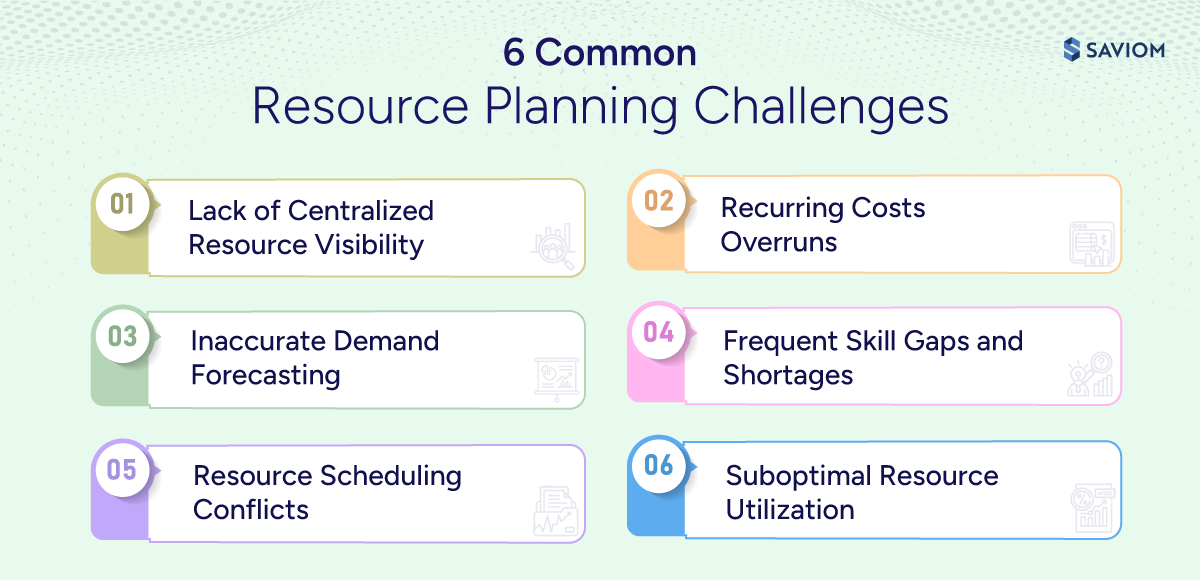
Many organizations face recurring resource planning constraints that disrupt delivery and drive up costs. Below are the most common challenges and how to address them.
| Challenge | What Goes Wrong | How to Fix It |
|---|---|---|
| Lack of Centralized Resource Visibility | Resource data is spread across tools, making accurate availability and commitments hard to see | Centralize demand, capacity, and resource allocation data in one system of record |
| Recurring Cost Overruns | Poor estimates, scope creep, and last-minute staffing drive unnecessary costs | Identify budget risk early and plan hiring, reskilling, or redeployment in advance |
| Inaccurate Demand Forecasting | Static forecasts fail to reflect changing priorities and pipelines | Use rolling forecasts and scenario modeling to keep plans up to date |
| Frequent Skill Gaps and Shortages | Required skills are not available when work begins | Plan demand and capacity at the skill level and invest in targeted upskilling |
| Resource Scheduling Conflicts | Overbooking occurs due to limited visibility into schedules | Align allocations with real-time availability using integrated resource scheduling |
| Suboptimal Resource Utilization | Some teams are overloaded while others remain underused | Forecast utilization and rebalance workloads across teams |
After challenges, let’s move towards best practices for effective resource planning.
Resource Planning Best Practices for Project Success
Given below are proven best practices that can help managers in effective resource planning:
Create a Single Source of Truth
Centralizing all resource‑related data into one integrated platform eliminates fragmentation and conflicting views. Leaders gain enterprise‑wide visibility into resource availability, utilization, skills, and assignments. Additionally, a single source of truth enables consistent decision‑making and reduces team resource planning friction across the business.
Proactively Forecast and Bridge Demand Gaps
Aggregating demand across approved initiatives and the pipeline reveals future capacity constraints early. This foresight supports informed project prioritization and sequencing decisions. Moreover, bridging gaps proactively prevents last‑minute tradeoffs that compromise cost, quality, or delivery timelines.
Standardize Resource Request and Allocation Processes
Establish clear workflows for requesting and assigning resources to reduce ad-hoc staffing and last-minute firefighting. This gives resource managers sufficient lead time to plan effectively. Standardized resource planning processes also improve fairness, predictability, and alignment with business priorities.
Foresee and Optimize Utilization in Advance
Predicting billable, non‑billable, and strategic utilization uncovers inefficiencies before they impact performance. With this insight, leaders can rebalance workloads toward high‑value initiatives. This proactive optimization improves profit margins while protecting workforce wellbeing.
Read our blog on resource optimization.
Maintain a Skills and Capability Inventory
An up‑to‑date inventory of skills, certifications, experience, and cost metrics enables accurate skill‑based resource planning. It helps map future project requirements against existing capabilities. This visibility also supports targeted upskilling and reduces dependency on external talent.
Embed Scenario Modeling into Resource Planning
Scenario modeling evaluates alternative plans under changing conditions. It allows leaders to compare various options before committing resources. This proactive approach reduces exposure to shortages, delays, and cost overruns while preserving strategic flexibility.
Track Resource Metrics to Enable Smarter Decisions
Continuously tracking utilization, forecast accuracy, and variance transforms resource planning from a static exercise into a living management system. Real-time visibility highlights emerging risks early, enabling timely course correction before delivery or cost performance is impacted.
Learn more about resource management KPIs.
Now that we have explored the critical resource planning strategies, let’s take a look at some resource planning examples to understand the concept better.
Resource Planning Examples: Real-World Business Scenarios
To better understand how business resource planning works in practice, let’s look at real-world examples across different industries and demand conditions.
Information Technology (IT) Industry
A software services organization used effective resource planning to align developers, testers, and architects to projects based on technology stack, experience level, location, and cost rates. Resource plans were continuously adjusted as project scope and timelines evolved.
Impact: This approach improved delivery predictability, reduced dependency on emergency hiring, balanced workloads across teams, and ensured critical skills were available before project milestones.
Understand how efficient workforce planning benefits IT firms.
Professional Services Organization
A global consulting firm implemented enterprise resource planning to assign consultants to upcoming engagements based on skills, seniority, availability, and client requirements. Instead of staffing reactively, delivery leaders aligned named consultants to projects 8–12 weeks in advance.
Impact: Teams reduced last-minute reassignments, improved consultant utilization, protected high-value client relationships, and maintained delivery quality during peak demand periods.
Audit, Accounting & Legal Industry
An audit and accounting firm applied resource planning for a large-scale statutory audit for a publicly listed enterprise to assign auditors and tax professionals to engagements based on experience, regulatory requirements, and workload intensity. Leaders planned staff rotations and engagement schedules well ahead of peak season.
Impact: This enabled fair workload distribution, reduced burnout during peak periods, improved engagement turnaround times, and minimized last-minute staffing escalations.
Architecture, Engineering & Construction (AEC) Industry
An engineering firm adopted resource planning to allocate architects, engineers, and site supervisors across the project phases of the office complex building. Instead of assigning resources uniformly, they planned role-specific allocations that shifted as projects moved from design to execution.
Impact: Projects progressed with fewer delays, specialist skills were deployed when most needed, subcontracting costs were controlled, and idle time between phases was significantly reduced.
Learn more about engineering resource planning.
Healthcare & Pharmacy Organizations
In the project of a new oncology wing launch at a hospital, the organization applied resource planning to allocate oncologists, radiologists, nurses, and technicians across the setup and go-live phases. The plan accounted for certifications, shift coverage, equipment availability, and patient load forecasts.
Impact: The facility launched without staffing bottlenecks, specialist coverage remained balanced, patient wait times were controlled, and clinical staff’s burnout was minimized.
Now, let’s move towards the KPIs and metrics.
KPIs and Metrics to Measure Resource Planning Effectiveness
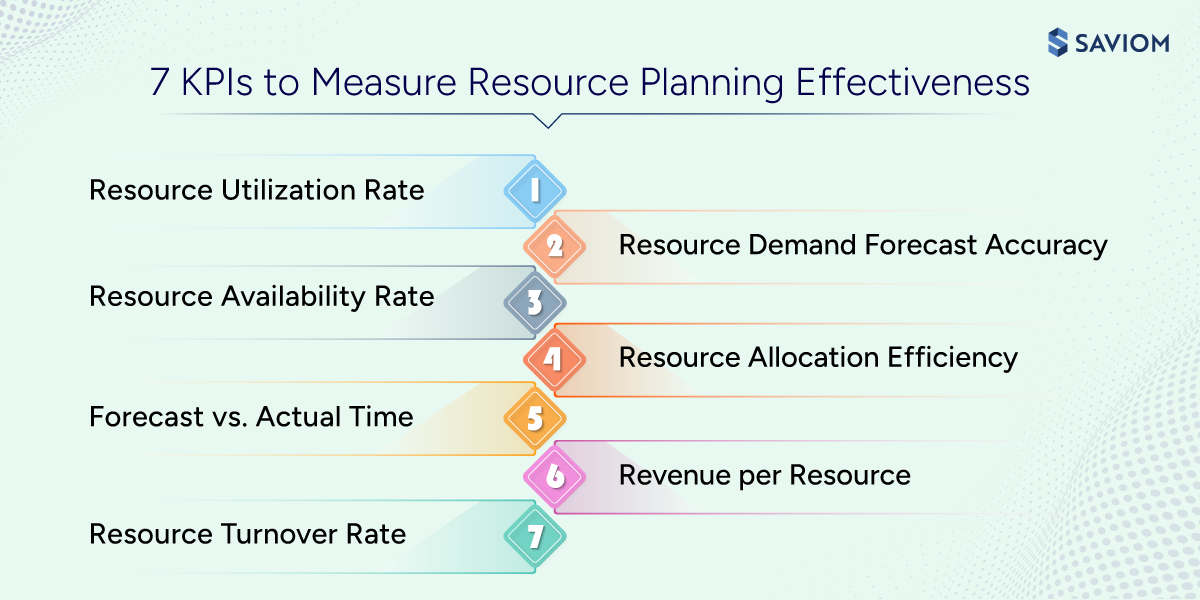
Metrics matter because what is not measured cannot be optimized. These KPIs provide visibility into resource planning accuracy, workforce health, and business impact.
Resource Utilization Rate
The resource utilization rate is a critical metric that measures how effectively resources are utilized against their total available capacity. It helps firms identify instances of under- and overutilization and take corrective action to prevent burnout and employee turnover.
Resource Demand Forecast Accuracy
Resource demand forecast accuracy refers to the degree to which a firm’s predicted resource demand aligns with the actual resources required. High accuracy reduces last‑minute hiring chaos and empowers businesses to make data-driven decisions about hiring, allocation, and utilization.
Resource Availability Rate
Resource availability rate is the percentage of time a resource (human or non-human) is available to perform productive work within a specific timeframe. It quantifies the portion of a resource’s total capacity and supports smoother scheduling to ensure timely project delivery.
Resource Allocation Effectiveness
Resource allocation effectiveness measures how appropriately an organization assigns its available resources to tasks and projects to achieve optimal results with minimal waste. It reduces skill mismatches and ensures the right resources are allocated to the most suitable activities at the right time and at the optimal cost.
Hours) X 100
Forecast vs. Actual Time
Forecast vs. actual time measures the difference between planned work hours and the hours actually spent on assignments. It helps managers assess how accurate their estimates are, spot variances early, and adjust plans or workloads to bridge the gaps beforehand.
Revenue per Resource
Revenue per resource measures how much revenue each resource generates over a given period. It highlights how efficiently the workforce is being utilized to support business objectives, indicating high or low profitability, and helps organizations in making necessary improvements.
Resource Turnover Rate
Resource turnover rate measures how often employees or resources leave the organization and need to be replaced within a given period. Expressed as a percentage, it indicates workforce stability and the effectiveness of the organization’s resource management and retention efforts.
Average Number of Resources During Period) X 100
Use SAVIOM’s resource planner to identify, allocate, and optimize resources in real-time and ahead of the curve to futureproof your workforce. Book a Demo Today.
Now, let’s understand how to select the best resource planning software.
Evaluating and Selecting Next-Generation Resource Planning Software
According to a PMI survey, “26% of companies with a dedicated resource planning platform can estimate and allocate resources to deliver projects on time.”
Software selection matters because the wrong tools reinforce reactive behavior instead of enabling strategic resource planning. Here are certain things to keep in mind while choosing the best resource planning software:
Core Capabilities to Look For
Modern resource planning platforms must go beyond basic allocation and reporting. The core capabilities mentioned below enable organizations to anticipate demand and make informed decisions before risks materialize:
- Resource forecasting
- Scenario modeling
- Skill‑based planning
- Utilization tracking
- Portfolio‑level visibility
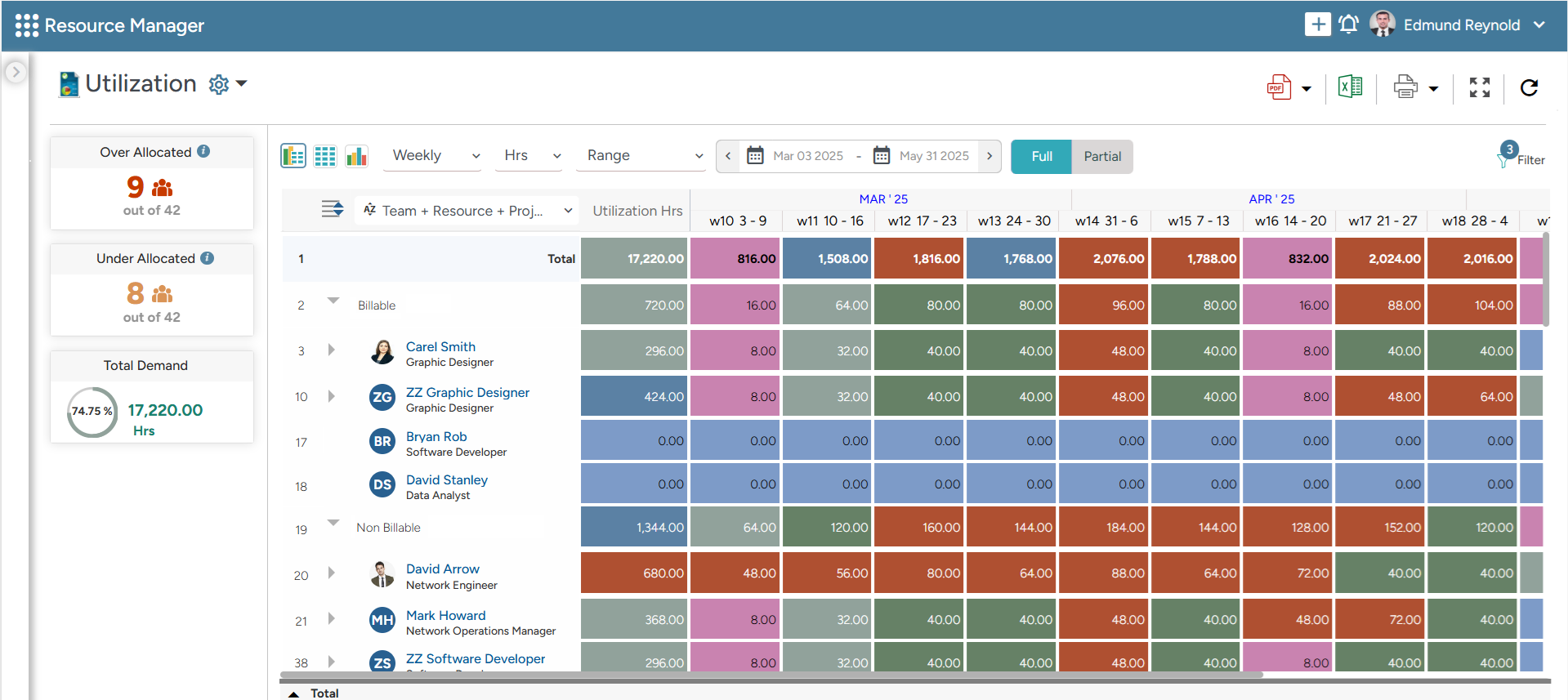 SAVIOM’s Color-Coded Heatmap highlights the real-time resource utilization levels, helping managers identify imbalances and optimize productive utilization.
Enterprise Readiness Criteria
Enterprise readiness ensures the solution can support long-term growth and operational complexity. The criteria that a robust resource planning software must adhere to include:
- Scalability: Supports growing teams, expanding portfolios, and increasing data volumes without performance loss.
- Integrations: Connects seamlessly with ERP, HR, finance, and project systems to avoid data silos.
- Security: Protects sensitive workforce and financial data through role-based access and compliance controls.
- Support for Global Teams: Handles multiple time zones, locations, and regional workforce models.
- Governance and Adoption: Enforces standardized processes while remaining easy for teams to adopt and use consistently.
Common Software Selection Mistakes
Many organizations fall short not because of a lack of tools, but because of misaligned expectations and incomplete evaluation. Avoiding common pitfalls is critical to realizing the full value project management resource planning investments.
- Choosing scheduling tools instead of true planning platforms
- Ignoring change management and governance, which undermines adoption and value realization
Selecting software with a clear focus on planning, not just execution, sets the foundation for consistent, data-driven resource decisions.
Understand the reasons why you should not use excel for resource planning.
Conclusion
Resource planning is a strategic capability that connects workforce strategy to delivery execution. Organizations that master forecasting, scenario modeling, and utilization optimization achieve higher predictability, lower costs, and stronger employee sustainability. As uncertainty increases, proactive resource planning in project becomes a competitive advantage, not an operational overhead.
Frequently Asked Questions
Resource planning in project is the structured process of forecasting, allocating, and managing an organization’s resources, such as people, equipment, time, and budget, to ensure projects are delivered on time, within budget, and at optimal efficiency.
Proactive resource planning is crucial because it:
1. Lowers resourcing cost
2. Ensures better capacity vs. demand alignment
3. Facilitates competent resource allocation
4. Improves resource utilization & productivity
5. Boosts timely project delivery
6. Supports data-driven decision-making
The steps for effective team resource planning are:
1. Establish the planning horizon
2. Capture and aggregate project demand
3. Assess available capacity
4. Perform capacity vs. demand analysis
5. Optimize through scenario planning
6. Allocate and continuously monitor resources
7. Track performance using critical KPIs
The main components of resource planning include:
1. Competency matrix
2. Demand forecasting
3. Capacity planning
4. Resource allocation governance
5. Utilization forecasting
6. Scenario planning
7. Resource performance monitoring
8. Risk management
The most common challenges of agile resource planning are:
1. Lack of centralized resource visibility
2. Recurring cost overruns
3. Inaccurate demand forecasting
4. Frequent skill gaps and shortages
5. Resource scheduling conflicts
6. Suboptimal resource utilization